


Welcome to the Nov. 2 edition of Robe & Gavel, Ballotpedia’s newsletter about the Supreme Court of the United States (SCOTUS) and other judicial happenings around the U.S.
Have you had a Jonathan apple today? We highly recommend them, sweet and tart and wholly satisfying. Let’s take a bite and gavel in, shall we?
Follow Ballotpedia on X and Bluesky or subscribe to the Daily Brew for the latest news and analysis.
We #SCOTUS and you can, too!
Grants
The U.S. Supreme Court has accepted six new cases to its merits docket since our Oct. 12 issue. The case FCC v. Brown was granted and decided without argument. To date, the court has agreed to hear 34 cases during October Term 2026. One case was dismissed, and 12 cases have not been scheduled for arguments.
Click the links below to learn more about these cases:
- Blanche v. Ozurumba asks the Court to clarify the legal threshold for providing material support to a terrorist organization under U.S. immigration law as it relates to an individual’s asylum and removal eligibility. The case was appealed from the U.S. Court of Appeals for the Fourth Circuit, which found that Izuchukwu Ozurumba did not provide material support to the group Unknown Gunmen, and vacated the Board of Immigration Appeals’ removal order.
- Berry v. United States concerns a circuit split—a tension or difference between U.S. courts of appeal rulings on the same legal issue—on certificates of appealability for post-conviction relief. In habeas corpus proceedings, a petitioner must obtain a legal document known as a certificate of appealability (COA) from a judge in order to appeal a writ’s denial. A writ is a court’s written order. The Eleventh Circuit denied Corey Duran Berry’s motion for a COA.
- U.S. Doge Service v. U.S. District Court for the District of Columbia involves a Freedom of Information Act (FOIA) request from watchdog group Citizens for Responsibility and Ethics in Washington (CREW), seeking communications and financial disclosures from the U.S. Department of Government Efficiency (DOGE). DOGE challenges whether it must comply with FOIA requests and if the D.C. Circuit’s order conflicts with the Supreme Court’s separation-of-powers principles established in Cheney v. United States District Court for the District of Columbia (2004).
- Department of Justice v. McNutt, appealed from the Fifth Circuit, concerns the U.S. government's ban on home distilleries and taxation on distilled spirits.
- Association for Education Fairness v. Montgomery County Board of Education asks the Court to decide the legal threshold of discriminatory effect from a school’s facially race-neutral admissions policy in order for a court to consider evidence of discriminatory intent. Facially means on its face, or unconstitutional as written. The case is one of four SCOTUS has accepted from the Fourth Circuit this term.
Arguments
The Supreme Court will hear four hours of arguments this week. Click the links below to learn more about these cases:
Nov. 2
- Maxwell v. Dinis raises a circuit split on whether a federal prisoner can seek habeas relief to transfer their detention and challenge good-time credit denials. Those in federal detention can earn time credits to shorten their sentence through good behavior, known as good time and good time credits.
- The question presented: “Whether a claim regarding application of time credits under the First Step Act of 2018, 132 STAT. 5195–5208 (codified in relevant part at 18 U. S. C. §§3631–3635), seeking accelerated transfer to a halfway house or home confinement, can be brought in a habeas petition under 28 U. S. C. §2241.”
- Younge v. Fulton Judicial Circuit District Attorney’s Office, Georgia concerns when a defendant may raise an affirmative defense as a case is ongoing. In an affirmative defense, the defendant introduces evidence that may negate liability.
- The question presented: “Where a defendant has filed an answer without pleading an affirmative defense, may the defendant nonetheless assert that affirmative defense as the basis for a summary judgment motion, without amending or seeking to amend its answer to plead that affirmative defense, and may a defendant do so even if an amendment adding that affirmative defense would be barred by Rule 16(b)(4) [governing Pretrial Conferences; Scheduling; Management]?”
Nov. 3
- St. Mary Catholic Parish v. Roy involves the Court’s decision in Employment Division v. Smith (1990) that clarified a conflict between generally-applied, facially-neutral laws and free exercise of religion. St. Mary Catholic Parish alleges that Colorado’s universal preschool program discriminates against their religion because the state will not exempt the church’s preschool from rules requiring admission to everyone, including LGBTQIA parents and children.
- The questions presented:
- “Whether proving a lack of general applicability under Employment Division v. Smith (1990) requires showing unfettered discretion or categorical exemptions for identical secular conduct.
- Whether Carson v. Makin (2022) displaces the rule of Employment Division v. Smith (1990) only when the government explicitly excludes religious people and institutions."
- The questions presented:
Nov. 4
- Guerrero v. Johnson concerns U.S. Supreme Court precedent in Atkins v. Virginia (2002) regarding Eighth Amendment prohibitions on executing people with intellectual disabilities, when Atkins claims can be filed after a conviction, and a circuit split among federal courts with differing doctrines on when a claim becomes futile.
- The questions presented: “Whether a claim relies on ‘a new rule of constitutional law, made retroactive to cases on collateral review by the Supreme Court, that was previously unavailable’ when the habeas petitioner could have asserted a claim based on the rule in a prior federal habeas petition.”
In its October 2025 term, SCOTUS heard arguments in 59 cases. Click here to read more about last term.
Opinions
SCOTUS has ruled on one case since our Oct. 12 edition, FCC v. Brown, which was decided without argument on Oct. 14.
The Court granted the Federal Communications Commission’s (FCC) application for stay to halt the Fourth Circuit’s mandamus order while SCOTUS considered the case. The Court describes a writ of mandamus as a court order to “be used only to correct a clear ‘usurpation of power’ by a lower court …, or to compel an agency to ‘perform a ministerial or non-discretionary act’ over which the agency has “no discretion whatever.”
The case concerned the FCC’s lowest unit charge (LUC) requirements—favorable broadcast rates for campaign ads in the weeks leading up to elections. The FCC published a notice that “political candidates, joint fundraising committees with noncandidate members, and political parties engaged in coordinated political activity were entitled to the LUC.” Four Democratic Party congressional candidates—Sherrod Brown, Jon Ossoff, Roy Cooper, Kristen McDonald Rivet—asked the FCC to review and set aside the notice and appealed to the Fourth Circuit to review, claiming that only political candidates are entitled to the LUC. The Fourth Circuit ruled the notice illegal. The FCC filed with SCOTUS to stay the order, which the Court did. The Fourth Circuit then issued its mandamus order compelling the FCC to resolve the candidates’ review application.
In a per curiam ruling, the Court held that the Fourth Circuit’s mandamus order was “inappropriate … and the FCC will suffer irreparable harm absent a stay. ... the Fourth Circuit’s order directing the Commission to abort its deliberative process and issue a final decision on the candidates’ application for review in two days is stayed.”
Justices Sonia Sotomayor and Ketanji Brown Jackson indicated they would deny the FCC’s applications. No dissenting opinion was written.
Federal court action
Nominations
President Donald Trump (R) announced two new nominations since the Oct. 12 edition:
- Eric Hamilton, to the U.S. Court for the District of Nebraska
- Joseph Falvey, to the U.S. District Court for the Northern District of Indiana
Committee action
The Senate Judiciary Committee has not reported any new nominees out of committee since our Oct. 12 edition.
Confirmations
As of Nov. 2, the Senate has confirmed 56 of Trump's judicial nominees—45 district court judges, 10 appeals court judges, and one Court of International Trade judge—since January 2025.
Vacancies
The federal judiciary currently has 28 vacancies, all of which are for lifetime Article III judgeships. As of publication, there were 16 pending nominations.
According to the Administrative Office of U.S. Courts, there are 15 upcoming vacancies in the federal judiciary, where judges have announced their intention to leave active judicial status.
For more information on judicial vacancies during Trump’s term, click here.
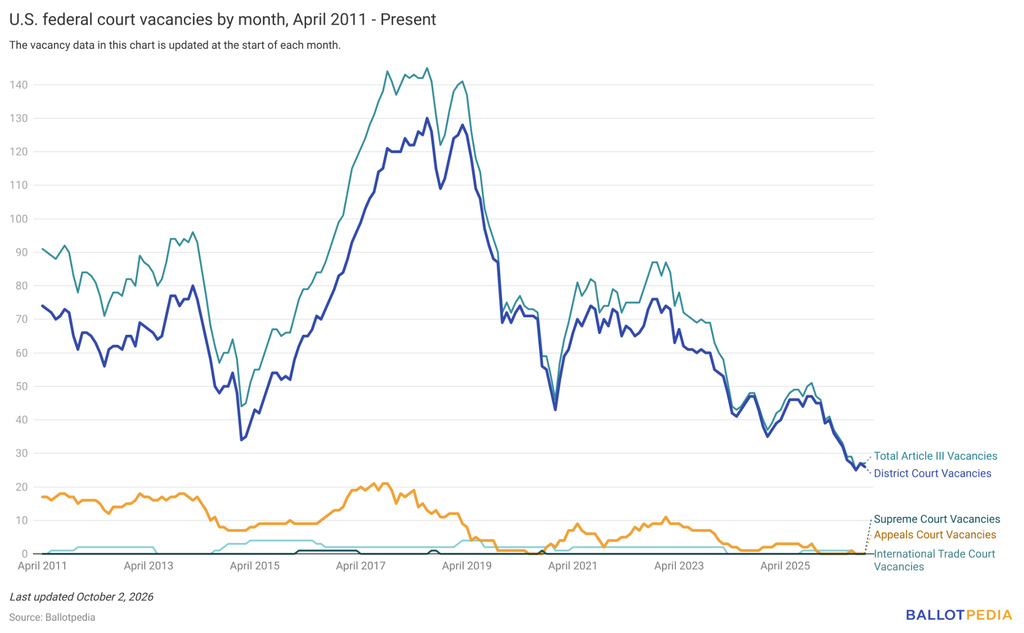
Do you love judicial nomination, confirmation, and vacancy information? We figured you might. Our monthly Federal Vacancy Count monitors all the faces and places moving in, moving out, and moving on in the federal judiciary. Click here for our most current count.
Need a daily fix of judicial nomination, confirmation, and vacancy information? Click here for continuing updates on the status of all federal judicial nominees.
Or, keep an eye on our list for updates on federal judicial nominations.
Spotlight: Lone dissents
Hello readers! Kate popping in here with a note: in a recent edition of Robe & Gavel, I neglected to highlight that Justice Kagan’s lone dissent in Havana Docks Corporation v. Royal Caribbean Cruises, Ltd. (2026) was her first since joining the Court. As a remedy for this oversight, please enjoy some data. As a reminder, we consider lone dissents as cases decided by an 8-1 vote in which one justice dissents in full, not joined by any other justice.
Here’s a brief rundown of each U.S. Supreme Court justice’s first 8-1 lone dissent:
- Chief Justice John Roberts, Uzuegbunam v. Preczewski (2021)
- Justice Clarence Thomas, Dawson v. Delaware (1992)
- Justice Samuel Alito, United States v. Stevens (2010)
- Justice Sonia Sotomayor, Perry v. New Hampshire (2012)
- Justice Elena Kagan, Havana Docks Corporation v. Royal Caribbean Cruises, Ltd. (2026)
- Justice Neil Gorsuch, Sveen v. Melin (2018)
- Justice Brett Kavanaugh, Laboratory Corporation of America Holdings v. Davis (2025)
- Justice Amy Coney Barrett has not written a lone dissent since joining the Court.
- Justice Ketanji Brown Jackson, Glacier Northwest, Inc. v. International Brotherhood of Teamsters (2023)
Of the nine current SCOTUS justices, five have written more than one lone dissent.
Looking ahead
We’ll be back on Nov. 16 with a new edition of Robe & Gavel. Until then, gaveling out!
Contributions
Kate Carsella and Myj Saintyl compiled and edited this newsletter, with contributions from Ellie Mikus and Sam Post.