


Welcome to the Wednesday, Nov. 4, 2026, Brew.
By: Lara Bonatesta
Here’s what’s in store for you as you start your day:
- Democrats win U.S. House and Senate majorities
- Democrats gain at least three trifectas, majority of governorships
- Democrats gained control of five state legislative chambers; Republicans lost one supermajority
- Top ballot measure results
- Noteworthy local elections
Good morning! We hope you got some sleep last night. If you stayed up following the results, you likely have a good sense of what happened. If you hit a normal bedtime, this may be one of your first updates and we hope to give you a general summary of results from across the country. Visit Ballotpedia.org all day today for updated results as states continue to process ballots. All results and updates below are as of 1:30am EST.
Democrats win U.S. House and Senate majorities
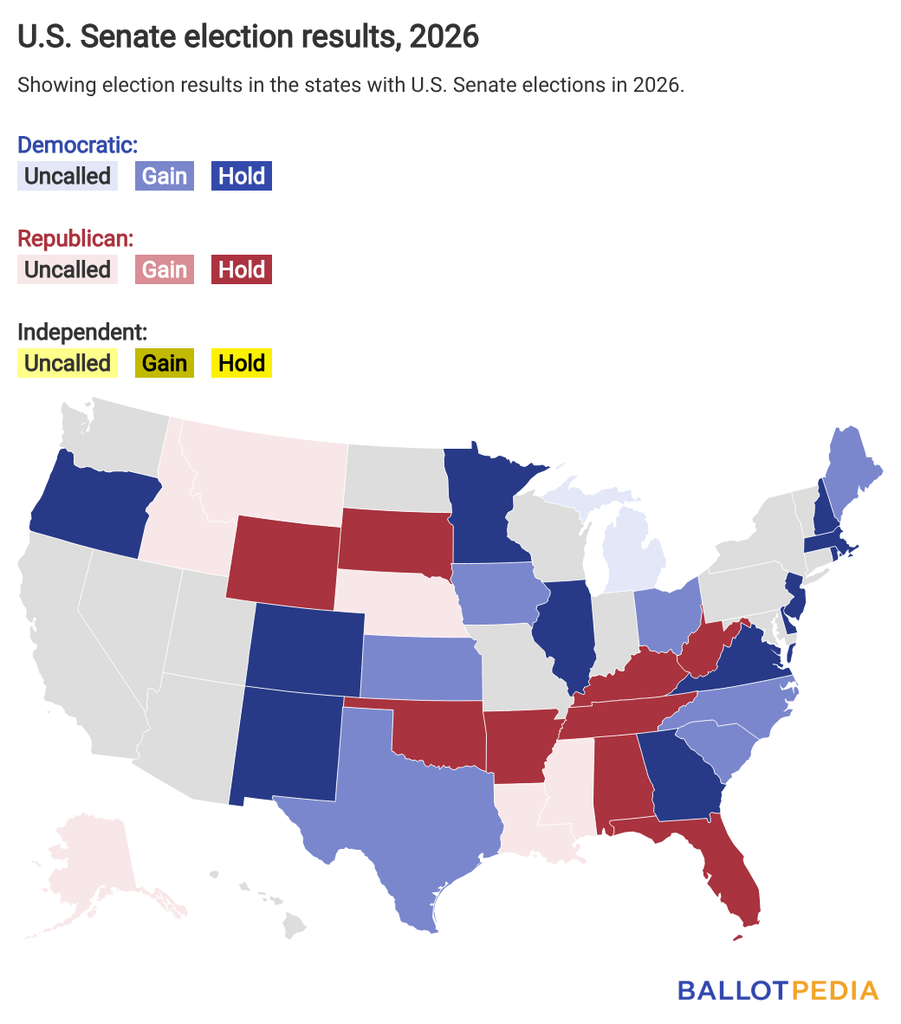
Democrats won majorities in both the U.S. House and Senate — picking up at least 18 House seats and seven Senate seats. With results still being reported, Democrats will have at least a 231-141 majority in the House and a 54-44 majority in the Senate.
U.S. Senate: Democrats won Senate races in seven states that President Donald Trump (R) won in 2024. Four Republican Senators lost re-election.
Republicans' loss of seven Senate seats puts the 2026 elections in the top 20% of election years in terms of seat swings against a president's party — a threshold we've previously defined as a wave election.
This is also the first time since 1954 that the party that won the Senate the previous even year lost it in the next cycle.
Democrats gained Senate seats in the following states:
- Iowa: Josh Turek (D) defeated Ashley Hinson (R). The last time Iowa elected a Democratic U.S. Senator was in 2008.
- Kansas: Adam Hamilton (D) defeated incumbent Roger Marshall (R). This is the first time Kansas has elected a Democratic U.S. Senator since 1932.
- Maine: Troy Jackson (D) defeated incumbent Susan Collins (R). Collins is the first Senator to lose a general election for a sixth term in the U.S. Senate since 2000.
- North Carolina: Roy Cooper (D) defeated Michael Whatley (R). This is the first time a Democrat has won a U.S. Senate seat in North Carolina since 2008, and the first time they’ve won an open seat since 1974.
- Ohio: former U.S. Sen. Sherrod Brown (D) defeated incumbent Jon Husted (R) in the special election to serve the remaining two years of the term Vice President J.D. Vance was elected to in 2022.
- South Carolina: Annie Andrews (D) defeated incumbent Darline Graham (R). The last time South Carolina elected a Democratic U.S. Senator was 1998.
- Texas: James Talarico (D) defeated Ken Paxton (R). Talarico is the first Democrat to win an election statewide in Texas since 1994. The last time the state elected a Democratic Senator was 1988.
U.S. House: Fourteen Republicans and no Democrats lost their re-election bids for the U.S. House. Since 2014, 85 U.S. House incumbents have lost re-election in general elections. That’s an average of 14 incumbents per election cycle. The highest number of incumbent losses during that period was in 2018 when 30 Republicans lost re-election.
In the House, nine states conducted mid-decade redistricting between the 2024 and 2026 elections (six voluntarily, three because of litigation). Before 2025, only two states had conducted voluntary mid-decade redistricting since 1970. Based on the 2024 presidential results, the changes would have resulted in a net change of nine new districts more favorable to Republicans. If current leads hold, Democrats will have gained a net of 15 seats across these states.
Candidates that the Democratic Socialists of America (DSA) endorsed won seven of the 10 U.S. House races they ran in. Three races featuring DSA-endorsed candidates are still uncalled. There were previously two DSA-endorsed members in Congress, if all endorsed candidates win there will be a total of 10 in Congress.
Democrats gain at least three trifectas, majority of governorships
Trifectas: Democrats gained state government trifectas in at least three states: Minnesota, Pennsylvania, and Wisconsin. Republicans lost trifectas in four states: Georgia, Iowa, Ohio, and Texas.
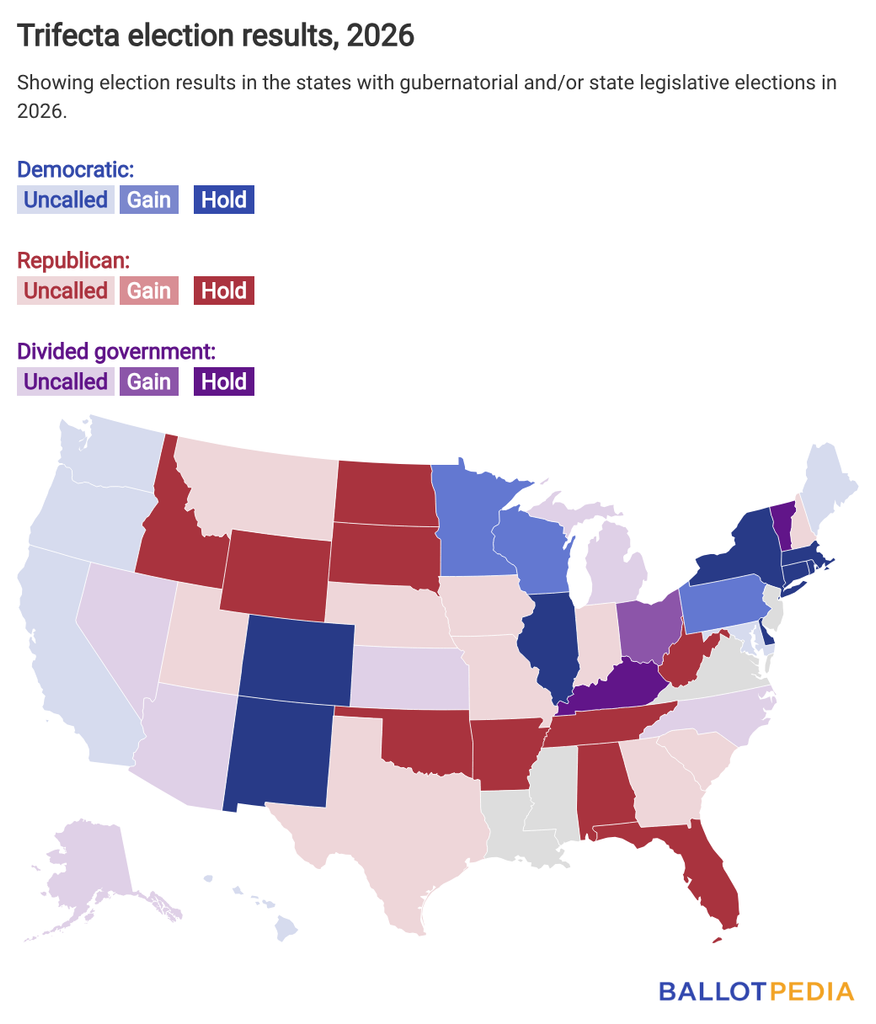
As a result, there will be at least eleven Democratic trifectas, twelve Republican trifectas, and three divided governments. Twenty-four states' final trifecta status remains uncalled. Heading into the 2026 elections, there were 23 Republican trifectas, 16 Democratic trifectas, and 11 divided governments.
A gain of three Democratic trifectas would match the party's gains in 2008 and 2012. Dating back to 1992, Democrats' largest gain was seven in 2006. In the same time period, Republicans' four losses would tie 2018 for the most Republican trifecta losses.
Governors: Democrats gained four governorships, giving them a majority of state governorships for the first time since 2010. With some races still uncalled, Democrats will hold at least 27 governorships and Republicans will hold 20.
One incumbent – Texas Gov. Greg Abbott – lost a bid for re-election. Abbott is the second governor to lose a bid for re-election this year, joining Rhode Island Gov. Daniel McKee (D), who lost in the Democratic primary.
Democrats gained governorships in:
- Georgia: Keisha Lance Bottoms (D) defeated Rick Jackson (R). Bottoms is the first Black woman to be elected governor in the U.S and the first Democrat to be elected governor of Georgia since 1998.
- Iowa: Rob Sand (D) defeated Zach Lahn (R). This is the first time Iowa elected a Democratic governor since 2006.
- Ohio: Amy Acton (D) defeated Vivek Ramaswamy (R). This is the first time Ohio elected a Democratic governor since 2006.
- Texas: Gina Hinojosa (D) defeated Abbott. The last Democrat to win a gubernatorial election in Texas was Ann Richards in 1990.
Democrats gained control of five state legislative chambers; Republicans lost one supermajority
Democrats gained control of five state legislative chambers — the North Carolina House of Representatives, the Wisconsin Senate, the Wisconsin State Assembly, the Pennsylvania Senate, and the Minnesota House of Representatives. Republicans have so far not gained control of any state legislative chambers. As a result, Democrats will have majorities in at least 27 chambers that held elections this year and Republicans will have majorities in at least 26. Control of 35 chambers was still uncalled.
Republicans lost their supermajority in the Florida Senate. Democrats have so far not lost any of their supermajorities. Neither Democrats nor Republicans have gained supermajorities.
We were also tracking 63 candidates that DSA endorsed for state legislatures. Forty of the 63 DSA-endorsed candidates for state legislatures won their races in six states. Seven DSA-endorsed candidates lost their races, and 16 are running races that have to be called.
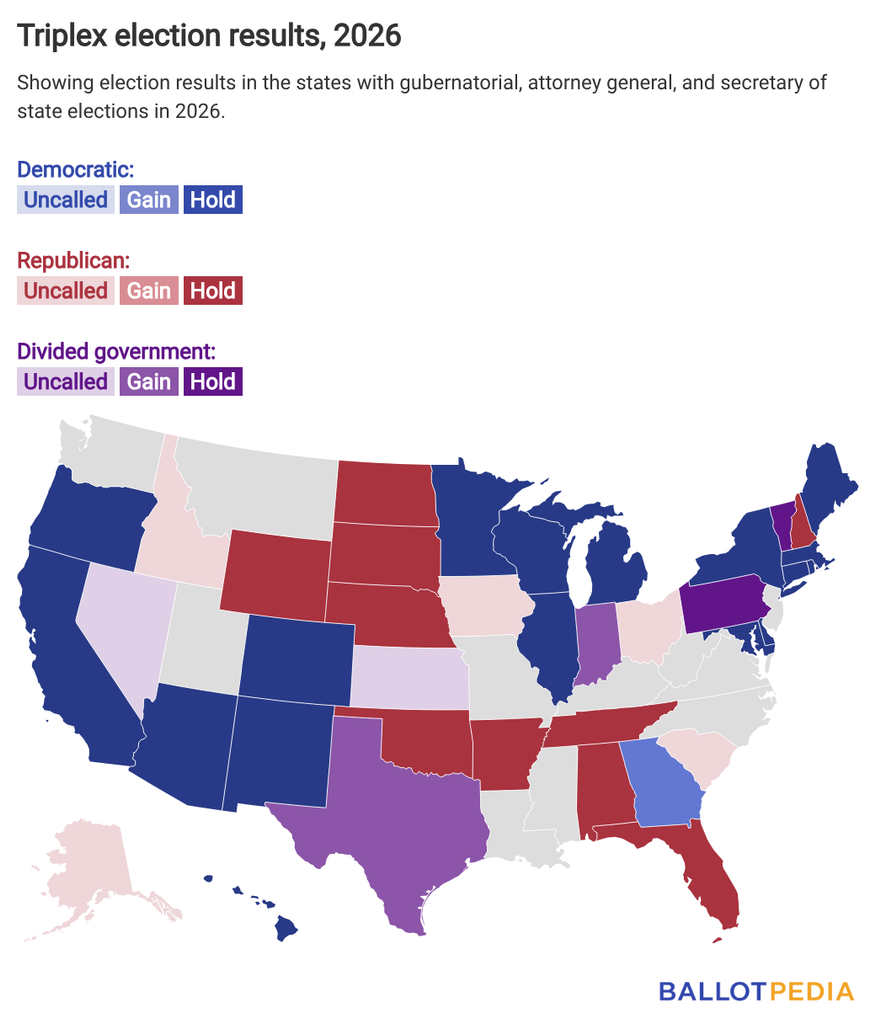
Triplexes: Republicans lost triplexes in three states: Georgia, Indiana, and Texas. Democrats gained a triplex in Georgia. Republicans also did not gain any triplexes. Here are some of the triplex-related races we were watching.
Attorneys General:
- Wisconsin: Incumbent Josh Kaul (D) defeated Eric Toney (R) in the general election. The two previously ran against each other in 2022, when Kaul defeated Toney 50.6% to 49.3%.
- Iowa: The race between incumbent Brenna Bird (R) and Nate Willems has yet to be called. In 2022, Brenna became the first Republican to hold the office since 1978
- Arizona: Incumbent Kris Mayes (D) defeated Warren Petersen (R).
- Nevada: The race between Nicole Cannizzaro (D) and Adriana Guzmán Fralick (R) has yet to be called.
Secretaries of State:
- Indiana: Beau Bayh (D) defeated Max Engling (R), Greg Ballard (I), and Lauri Shillings (L) in the general election. Incumbent Diego Morales (R) lost to Engling at the June 20 Republican convention. Republicans have controlled the secretary's office since 1994.
- Michigan: Garlin Gilchrist II (D) defeated Anthony Forlini (R) and three other candidates. Incumbent Jocelyn Benson (D) ran for governor.
Top ballot measures
Noteworthy topics across statewide ballot measures this year included abortion, citizenship requirements for voting, criminal sentencing, penalties, and bail, housing, income and wealth taxes, initiative and referendum process, property taxes, sex-based sports eligibility and medical procedures for transgender minors, state constitutional rights, and voter ID. Here's a look at some early results.
Abortion: Voters in Virginia approved an amendment establishing a constitutional right to reproductive freedom, including abortion before the third trimester and afterward under specified exceptions. Voters in Missouri defeated Amendment 3, which would have repealed the constitutional right to reproductive freedom and prohibited abortion and certain medical procedures for transgender minors, with exceptions. Two measures – an amendment in Nevada and a statute in Idaho – that would have established rights to abortion were still uncalled.
Citizenship-voting requirements: Voters in Arkansas, Kansas, South Dakota, and West Virginia approved measures adding citizenship requirements to vote in state and local elections to their state constitutions. Voters in Arizona defeated a measure that would have required government-issued identification for in-person and mail voting, added citizenship and foreign-contribution restrictions, and provided an option for ballot tabulation at voting locations. One measure in Alaska was still uncalled.
Voter ID: Voters in North Carolina and Ohio approved amendments expanding voter ID requirements in their states. The amendment in North Carolina extends the constitutional photo ID requirement from in-person voting to all voting methods, including mail ballots. The amendment in Ohio adds constitutional requirements for photo ID when voting in person and photo ID or an authorized signature-and-identifier alternative when voting by mail.
Voters in Arizona, California, and Colorado defeated amendments that would have established or expanded voter ID requirements in their states. The amendment in Arizona would have required government-issued ID for in-person and mail voting, added citizenship and foreign-contribution restrictions, and provided an option for ballot tabulation at voting locations. The one in California would have required government-issued ID for in-person voting, an identifying number for mail ballots, and efforts to verify voters’ citizenship using government data. The measure in Colorado would have required voters returning mail ballots for federal or statewide elections to provide an identification number alongside their signature.
One voter ID measure in Nevada was still uncalled. It would require photo ID for in-person voting and an identifying number for mail voting.
Noteworthy local elections
Louisville Mayor Craig Greenberg won re-election. Greenberg, a Democrat, defeated Shameka Parrish-Wright and three other candidates. Parrish-Wright was endorsed by the Louisville branch of the Democratic Socialists of America. The Los Angeles mayoral election between incumbent Karen Bass and councilmember Nithya Raman remained uncalled. Both candidates are Democrats. Raman was endorsed by the Los Angeles branch of the Democratic Socialists of America.
No mayors voluntarily retired in 2026. Seven incumbent mayors were defeated in 2025, four in 2024, three in 2023, and one in 2022.
Yukon, Oklahoma, mayor Brian Pillmore became the fourth official in the U.S. to be removed from office in a data center-related recall election. The first of these happened in September in Independence, Missouri. This was one of three data center-related recalls on the ballot nationally on Nov. 3. The others – in Mason, Michigan, and San Angelo, Texas – were uncalled as of this writing. So far in 2026, there have been 46 recall efforts related to data centers against 83 officials in 10 states.