


Welcome to the Thursday, Nov. 5, 2026, Brew.
By: Briana Ryan
Here’s what’s in store for you as you start your day:
- Democrats’ Senate gains qualify as a wave election, while House gains so far fall short
- 21 states set to have Democratic trifectas, 19 set to have Republican trifectas, and 10 set to have divided state governments
- Developing stories from statewide ballot measures to local election results
Democrats’ Senate gains qualify as a wave election, while House gains so far fall short
Democrats have gained control of at least 30 districts in the U.S. House of Representatives, giving them at least a 233-138 majority in the chamber. Sixty-four other races — 12 in Democratic-held districts and 52 in Republican-held districts — remain uncalled and could change those totals. DDHQ projects that Democrats' majority could increase to 249, while NBC projects that it could increase to 255.
Seven of the 30 districts that have changed partisan control were open. In the other 23, Democratic candidates defeated Republican incumbents. If the total of defeated incumbents holds at 23, it will be the second-highest number of incumbents who have lost re-election in a general election since at least 2014.
Democrats have also gained control of at least seven seats in the U.S. Senate, giving them at least a 54-44 majority in the chamber. The races in Alaska and Mississippi remain uncalled and could change those totals.
In Alaska as of Nov. 4 at 12:26 p.m. EST first choice votes show Mary Peltola (D) receiving 48.2% of the vote, incumbent Sen. Dan S. Sullivan (R) receiving 47.9%, Gerald L. Heikes (R) receiving 2.3%, and Daniel J. Sullivan Jr. receiving 1.7%. Alaska uses ranked-choice voting (RCV) in which voters rank candidates by preference on their ballots. If a candidate wins a majority of first-preference votes, they are the winner. If no candidate wins a majority of first-preference votes, the candidate with the fewest first-preference votes is eliminated. Ballots that ranked a failed candidate as their first, or highest choice, depending on the round, are then reevaluated and counted as first-preference ballots for the next-highest-ranked candidate in that round. A new tally is conducted to determine whether any candidate has won a majority of ballots. The process is repeated until a candidate wins an outright majority.
In Mississippi as of Nov. 4 at 4:24 p.m EST Scott Colom (D) is leading incumbent Sen. Cindy Hyde-Smith by 65 votes. Mississippi is the only state that does not have laws allowing for recounts in at least some circumstances, which other states allow if the margin of victory is very close, if there are problems in the vote-counting process, or due to the possibility of administrative errors. Races from Nov. 3 where the margins are close enough to either automatically trigger or allow for a requested recount include North Carolina’s 5th Congressional District, Florida’s 27th Congressional District, and Minnesota’s 1st Congressional District.
Republicans’ net loss of at least seven U.S. Senate seats put this year’s elections in the top 20% of election years in terms of seat swings against a president’s party — a threshold we’ve previously defined as a wave election. The U.S. House has not yet reached that mark. Republicans’ net loss of 26 seats is short of the 48 seats needed to qualify as a wave, though uncalled races could still change that total.
Mid-decade redistricting results
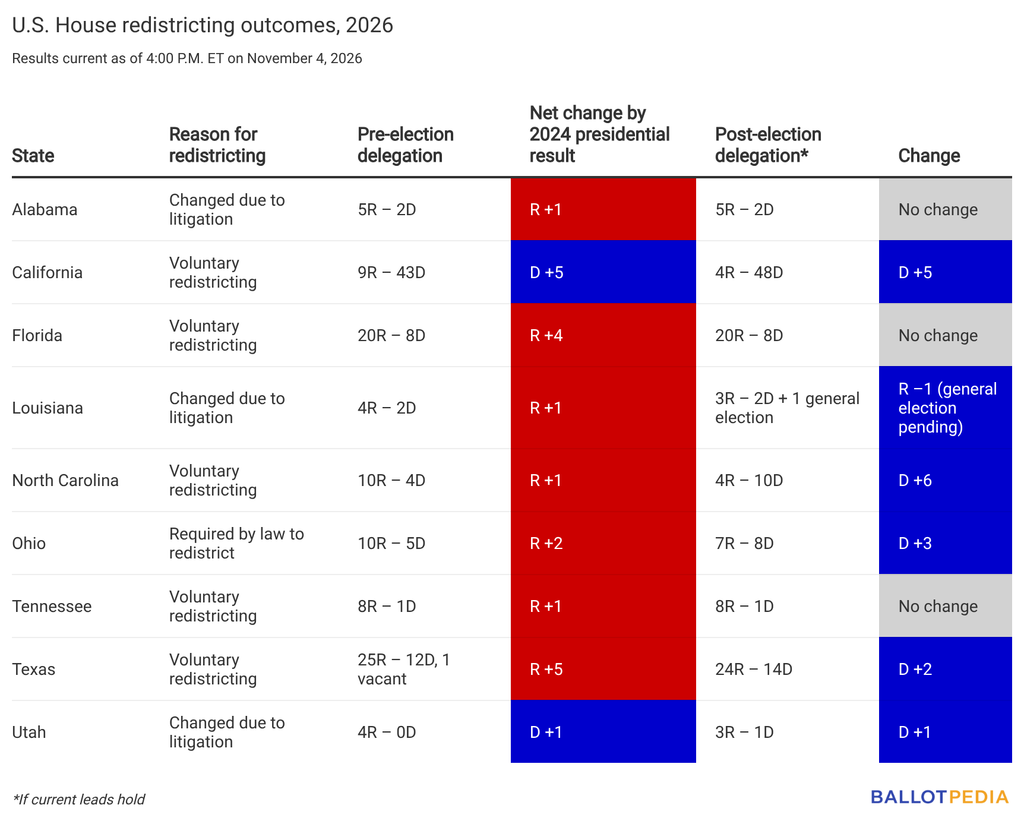
New congressional maps in nine states created a net of nine new districts that, based on 2024 presidential election results, President Donald Trump (R) would have won those districts in the 2024 presidential election. If current leads in those states hold, though, Democrats would gain 17 seats across those states.
The table below shows how the U.S. House delegations could have changed based on the 2024 presidential results, and what the delegations would look like based on the candidates leading in the races in each state.
21 states set to have Democratic trifectas, 19 set to have Republican trifectas, and 10 set to have divided state governments
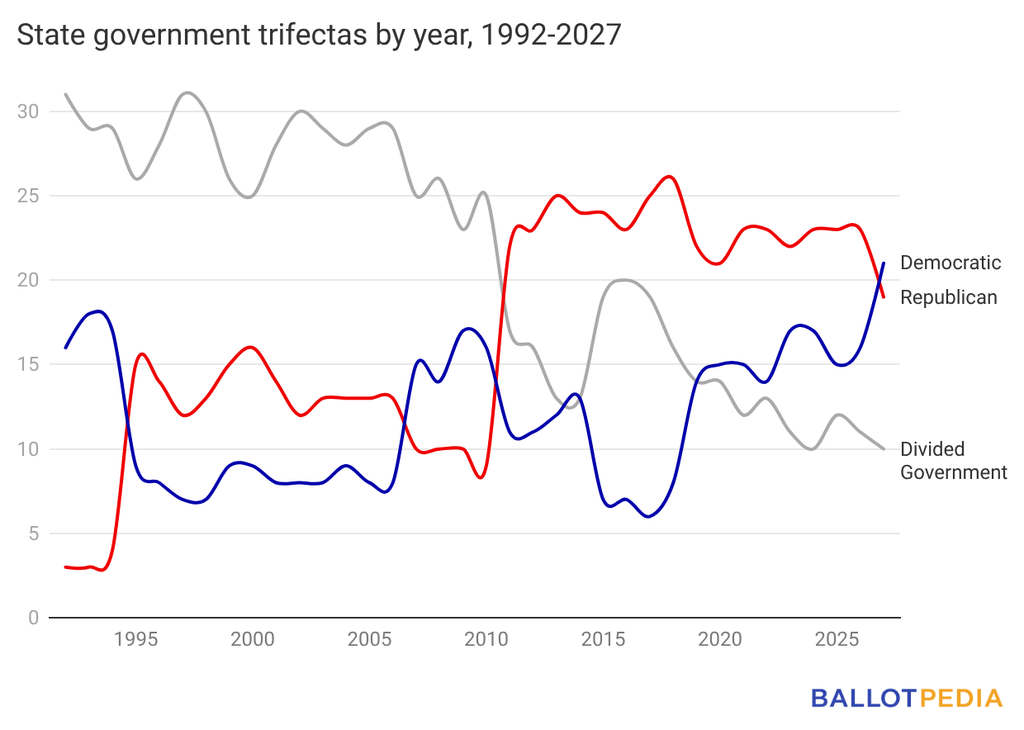
Democrats will hold 21 trifectas, the most the party has held since 1992. Republicans will hold 19, the party’s fewest since before the 2010 elections. The 2010 elections were also the last to result in there being more states with Democratic trifectas than Republican trifectas. There will be 10 divided governments, tying 2024 for the fewest since 1992.
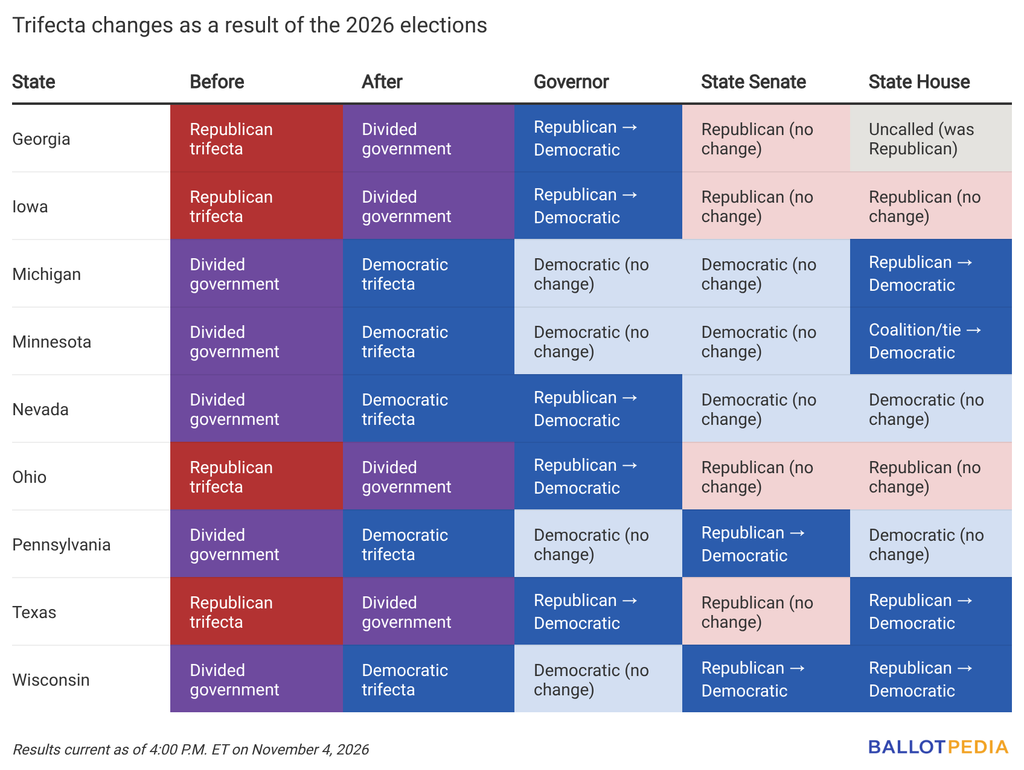
Five states — Michigan, Minnesota, Nevada, Pennsylvania, and Wisconsin — went from being divided state governments to Democratic trifectas. Four states — Georgia, Iowa, Ohio, and Texas — went from being Republican trifectas to divided state governments.
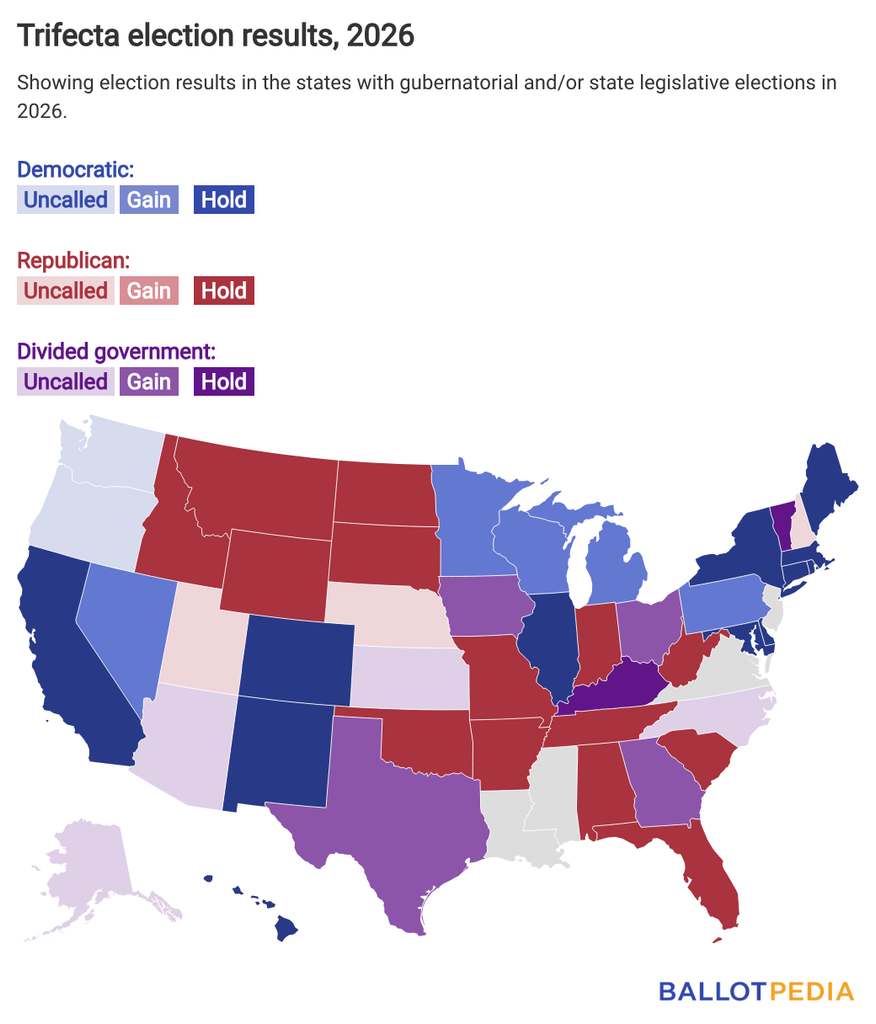
Democrats’ five gains are the most for either party since 2018, when Democrats gained six. Republicans’ four losses tie 2018 for the most the party has lost in an election since at least 2010. Since 2010, the only other elections in which one party gained five or more trifectas were 2018, when Democrats gained six, and 2010, when Republicans gained 12.
Those trifecta changes were driven by Democrats gaining five new governorships. The races were open for governorships in Georgia, Iowa, and Ohio. Democratic candidates defeated incumbents in Nevada and Texas. Democrats also gained new state legislative majorities in chambers in Michigan, Minnesota, Pennsylvania, Texas, and Wisconsin.
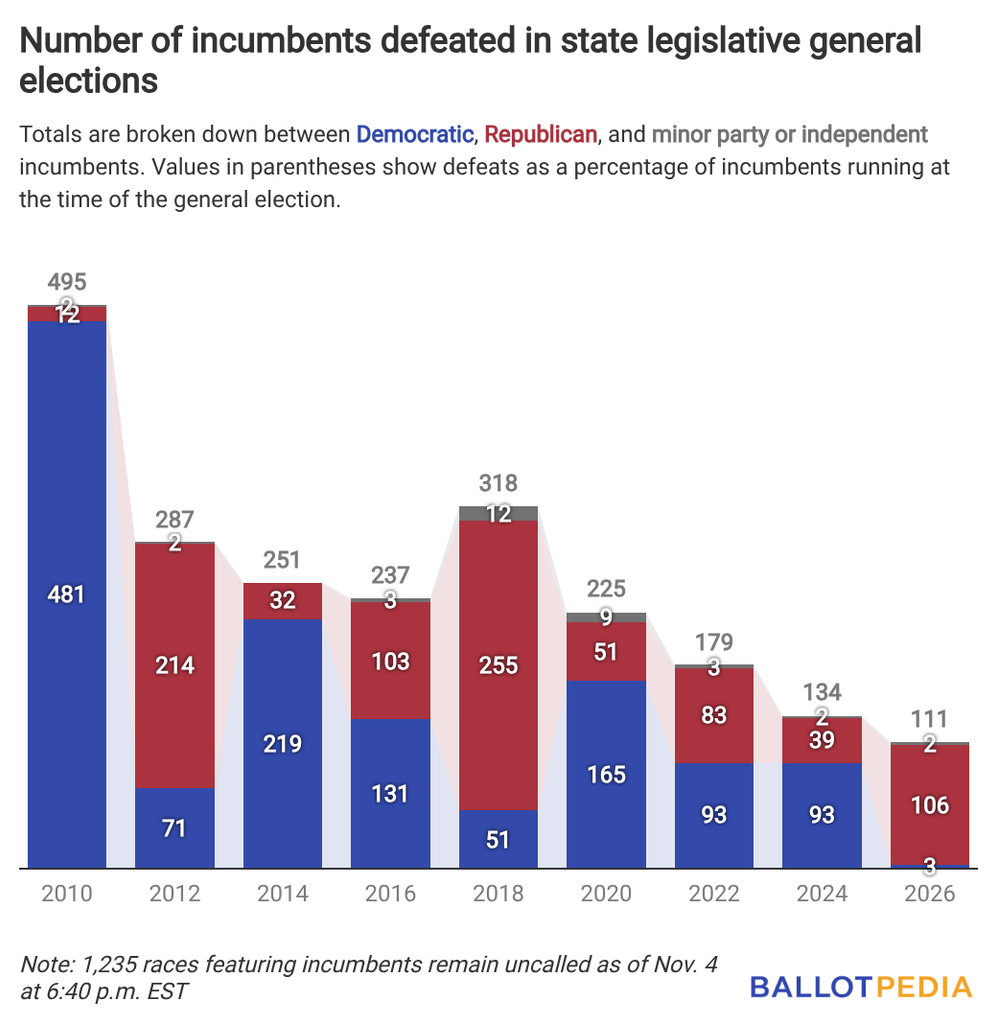
Of the state legislative races that had been called as of 2 p.m. EST on Nov. 4, 106 Republican, three Democratic, and two minor party state legislators lost their re-election bids, bringing the total to 111. Across the last eight election cycles, nationwide defeats averaged 265.8 per cycle, with a simple mean rate of 5.6% across the eight cycles. The high was 495 defeats (10.2%) in 2010, and the low was 134 (2.9%) in 2024.
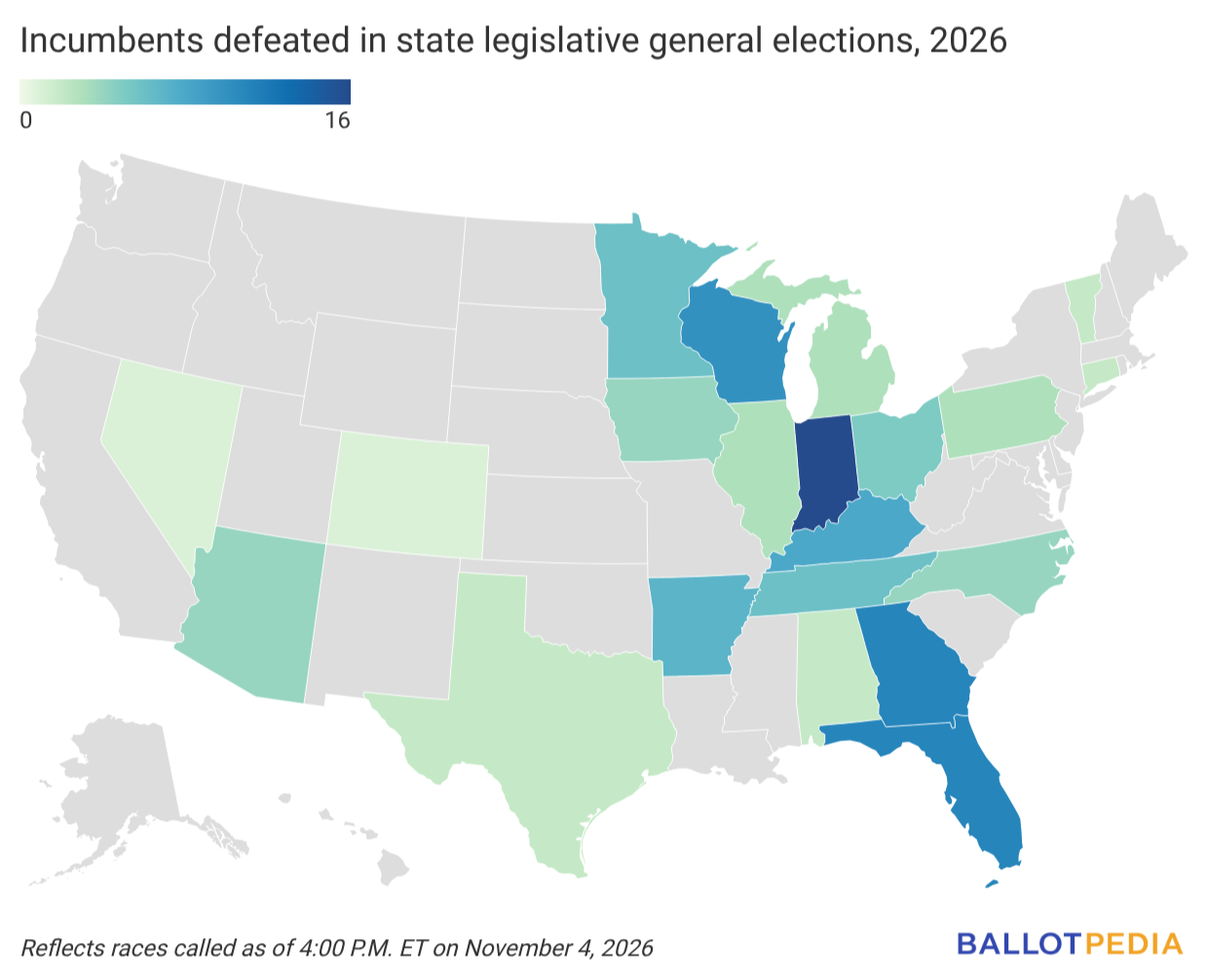
At least one incumbent lost in each of 21 states. Indiana, where 16 Republican legislators lost re-election, saw the most incumbents lose. The next highest states were Florida where 11 Republicans lost re-election. In Georgia 10 Republicans and one Democrat lost re-election. In Wisconsin, eight Republicans, one Democrat, and one independent.
There were a few notable defeats among these legislators. In Indiana, House Speaker Todd Huston (R), who has served since 2012, lost re-election 52% to 48% after running unopposed in 2024. In North Carolina, Senate Majority Leader Michael Lee (R) lost 53% to 47%. Additionally, while not called yet, Utah Senate Majority Leader Kirk Cullimore (R) trailed his opponent by more than 4,000 votes.
In addition to party leaders, some long-serving legislators lost their re-election bids, including lawmakers who had served since the 1990s. The longest-serving of these lawmakers was Rep. Robert Behning (R) of Indiana, who has served in the Indiana House of Representatives since 1992, won re-election in 2024, 60% to 40%, and lost this year, 54% to 46%. Sen. John Kissel (R) of Connecticut, who has served in the Connecticut Senate since 1993, lost re-election. On the Democratic side, Rep. Sharon Tomiko Santos (D), who has served in the Washington House of Representatives since 1999, trails a progressive challenger.
Developing stories from statewide ballot measures to local election results
Some other results we are keeping a close eye on are statewide ballot measures, state supreme courts, DSA endorsements, and local elections.
Statewide ballot measures
Voters decided four statewide ballot measures on abortion policy this year. They approved measures establishing a right to abortion in Nevada and Virginia, and defeated one such measure in Idaho. Missouri voters also defeated a measure that would have repealed the state constitutional right to abortion that voters approved in 2024, prohibited abortion with exceptions, and prohibited certain surgical procedures and treatments for transgender minors.
Voters decided seven statewide measures this year to require identification for both in-person and mail-in voting or expand identification requirements to include mail-in voting — the most in a single year. They approved the measures in Oklahoma, Nevada, North Carolina, and Ohio. Nevada and Ohio voters approved their measures, which the states’ Republican Parties supported, while electing Democratic governors. North Carolina approved its measure, endorsed by the state’s Republican Party, while electing a Democratic U.S. Senator. Voters defeated the other three in Arizona, California, and Colorado. The Republican parties in each state, except Oklahoma, supported the measures.
Voters decided on six statewide measures on citizenship requirements for voting. Each measure was designed to provide that only U.S. citizens may vote in state and local elections. Voters approved the measures in Alaska, Arkansas, Kansas, South Dakota, and West Virginia. Arizona voters defeated the other measure.
Voters decided on four measures to establish sex-based requirements for school sports. Voters approved the measures in Arizona and Nebraska. The results of the measures in Colorado and Washington have yet to be called.
Voters decided on two measures that would prohibit certain medical or surgical procedures for transgender minors. Voters defeated the measure in Missouri, while the measure in Colorado has yet to be called.
Voters in four states voted on five ballot measures related to criminal sentencing, penalties, and bail. Voters approved the measures in Indiana, Louisiana, Tennessee, and Colorado. Another measure in Colorado has yet to be called.
Voters in seven states decided on seven ballot measures related to the initiative and referendum process. Voters defeated measures that would add requirements to the process in Idaho, North Dakota, South Dakota, and Utah. Another such measure in California has yet to be called. Voters in Missouri and Montana approved measures to expand or preserve the initiative and referendum process.
A few other notable statewide measure results included:
- Colorado voters defeated Amendment 82 — the first ballot measure in the nation to propose a constitutional right to buy and sell natural gas. Voters defeated it 54% to 46%.
- New Mexico voters approved Constitutional Amendment 1, which eliminates the governor’s ability to veto bills through inaction and requires substantive explanations for all vetoes. Voters approved it 75% to 25%.
- Nebraska voters defeated Constitutional Amendment 1, which would have changed the term limit for state legislators from two consecutive four-year terms (eight years) to three consecutive four-year terms (12 years). Voters defeated it 81% to 19%.
State supreme court election results
No state supreme court changed partisan control, but Democrats did gain seats on three courts last resort. Across the country, six incumbent state supreme court justices, all Republicans, lost re-election. That’s the second-most incumbent defeats since 2018 when six lost re-election. The most incumbent losses occurred in 2024 when eight lost re-election.
Democrats defeated all four Republican incumbents running for re-election on the Texas Supreme Court, decreasing Republicans' majority on the court from 9-0 to 5-4. The last time there was a 5-4 Republican majority on the court was 1995. Democrats also won two open seats and defeated a Republican incumbent running for re-election on the Texas Court of Criminal Appeals, bringing that court's majority from 9-0 to 6-3. Texas is one of two states with two courts of last resort.
Ohio's Republican supreme court majority decreased from 6-1 to 5-2. One Democratic incumbent won re-election and another defeated a Republican justice running for re-election to the court.
In Montana, the only state where control was in play, Amy Eddy defeated Dan Wilson, 61% to 39%. According to Bolts this result preserves the court's 4-3 liberal majority. In Michigan and North Carolina, Democratic incumbents won re-election, preserving Michigan's 6-1 Democratic majority and North Carolina's 5-2 Republican majority. Only one seat is up for election in Michigan 2028, so 2030 is the next possible time that the court’s majority could change. The next possible time that the court’s majority in North Carolina could change is 2028 when three seats are up for election.
Democratic Socialists of America endorsements
Eight candidates that the national or a local chapter of the Democratic Socialists of America (DSA) endorsed won their respective general elections for the U.S. House. One DSA-endorsed candidate lost and another ran in a race that has not been called. There were previously two DSA-endorsed members of Congress. If the DSA-endorsed candidate wins the race that has not been called it will increase to nine.
Fifty-two of the 63 DSA-endorsed candidates won state legislative seats. Two of those candidates — Ashley Herrmann (D) of Florida House District 69 and Mark Pinsley (D) of Pennsylvania Senate District 16 — won previously Republican-held seats. Nine DSA-endorsed state legislative candidates lost and two others are running in races that have not been called.
Local elections
DSA-endorsed candidates were on the ballot for mayor in two of the 100 most populous U.S. cities: Los Angeles, California, and Louisville, Kentucky. The Democratic incumbent mayors of both cities were also on the ballot. As of 6:15 a.m. EST on Nov. 4, DSA-endorsed Nithya Raman leads incumbent Los Angeles Mayor Karen Bass 51% to 49%. According to WLKY, incumbent Louisville Mayor Craig Greenberg defeated the DSA-endorsed candidate Shameka Parrish-Wright 57.6% to 42.4%.
Chicago voters elected all 21 members of the Board of Education. Candidates that the Chicago Teachers Union supported won seven seats on the board, with another three leading in races that have not been called. Eleven candidates not supported by the Chicago Teachers Union won or were leading in races for 11 seats on the board. The union originally sought to win a majority of seats on the board. According to the Chicago Tribune, most candidates who the Chicago Teachers Union had not supported had “support from several pro-school-choice groups that have opposed CTU, including the Illinois Network of Charter Schools, Common Ground Collective, and the Urban Center.”