


Welcome to the Friday, Nov. 6, 2026, Brew.
By: Lara Bonatesta
Here’s what’s in store for you as you start your day:
- Voters favored limiting data center development in 40 of 41 local ballot measures on Nov. 3.
- Democrats will control a majority of state legislative chambers for the first time since 2010
- Twenty-six states complete unofficial results reporting by Nov. 4
- On Nov. 4, voters in 40 states decided local ballot measures on ranked-choice voting, surveillance cameras, foie gras and more
A note from Ballotpedia founder and CEO Leslie Graves
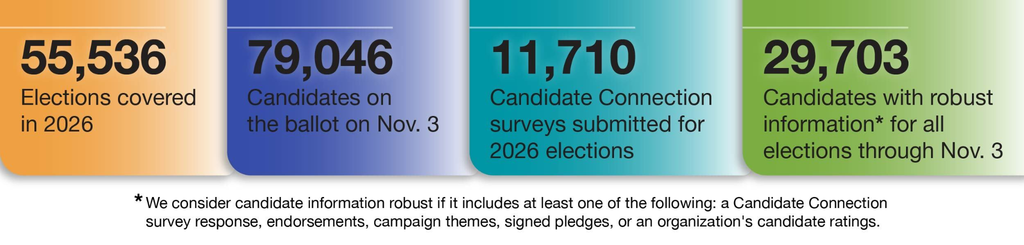
This has been an incredible week for us at Ballotpedia. This was the biggest election we’ve covered in our history. We provided our readers with news and analysis on races up and down the ballot, and all across the country. There’s a tremendous sense of accomplishment that comes from all of this hard work. Here’s our election report card by the numbers — all of it made possible with your support and encouragement:
Voters favored limiting data center development in 40 of 41 local ballot measures on Nov. 3.
Voters favored limiting data center development in 40 of the 41 local ballot measure contests on Nov. 3. The one exception occurred in Harwood, North Dakota, where voters defeated a proposed review requirement for certain developments, including data centers.
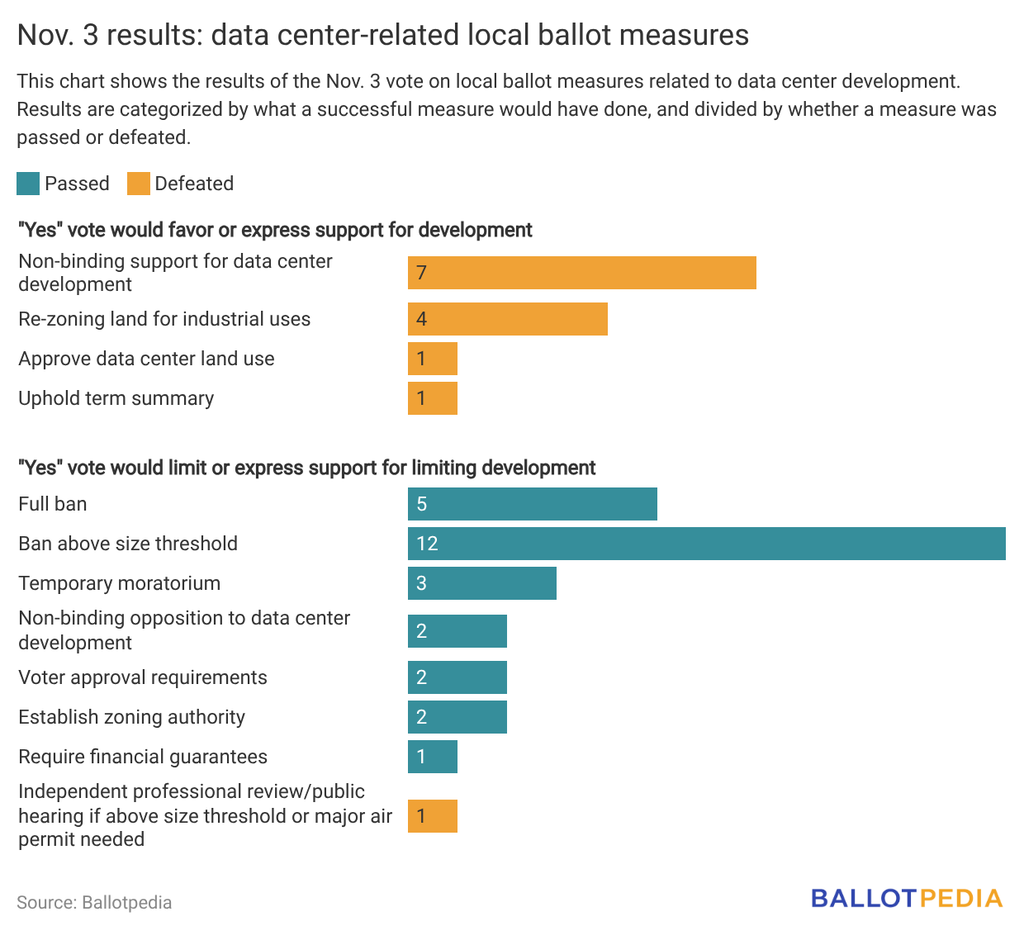
Voters approved 27 measures that limited data center development or expressed opposition to it. These included:
- Five full data center bans: one in California, one in Florida, and three in Ohio.
- Twelve partial bans: three in Kansas, one in Maine, and eight in Ohio. This includes bans with only narrow exceptions to bans on large data centers only.
- Three six-month moratoriums on data center development, all in Maine.
- Two applications of zoning regulations: two Adams County, Ohio, measures established zoning regulations for unincorporated areas, meaning that the areas affected would have to be zoned for a use consistent with data center development for construction to take place there.
- Two non-binding measures expressing opposition to data center development in Illinois.
- Two voter approval requirements: Grove City, Ohio, Issue 28 required approval for developments (including data center projects) using more than 50 acres, 20 megawatts of electricity, or 500,000 gallons of water a day. It also established enforceable community-impact standards for developments. A Janesville, Wisconsin measure required voter approval for development of a GM/JATCO proposed data center site if its cost exceeds $450 million.
- One measure related to financial guarantees: Perry, Ohio, Issue 16 requires hyperscale data center developers seeking certain tax incentives to provide financial guarantees to the community.
Voters defeated 13 measures that would have favored data centers or expressed support for development. These included:
- Seven non-binding support measures: five in Illinois, one in New Jersey, and one in Ohio.
- Four rezoning measures, all in Wilmington, Ohio, that would have rezoned specific areas of land from residential to industrial uses, allowing data center construction at those sites.
- One measure that would have added data centers as an approved use for a particular area of land in Boulder City, Nevada.
- One measure upholding a term summary. The Ashville, Ohio, Data Center EdgeConneX Development Term Summary Referendum would have upheld Resolution 06-2026, a term summary guiding village negotiations with the data center company EdgeConneX.
Voters decided on six local ballot measures related to data center development before Nov. 3. In all six cases, voters favored limits on data center development. In December, voters will decide on two local ballot measures related to data centers in Clarksville, Arkansas, and one in Mandan, North Dakota.
See Ballotpedia’s full results and analysis for measure summaries and outcomes.
Democrats will control a majority of state legislative chambers for the first time since before the 2010 elections
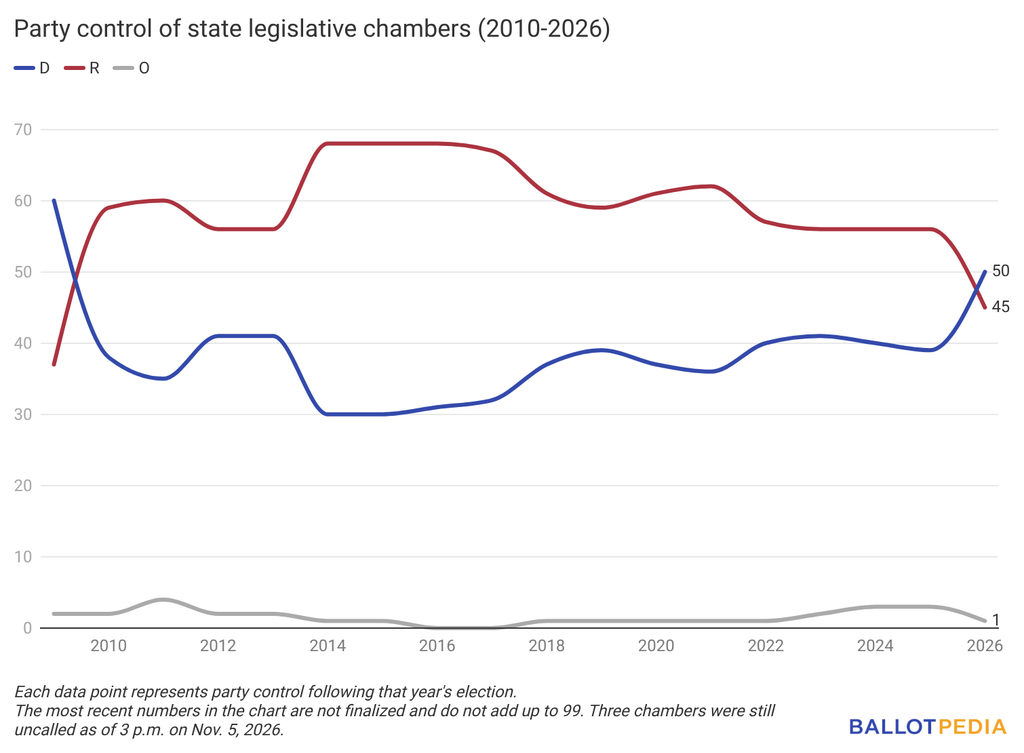
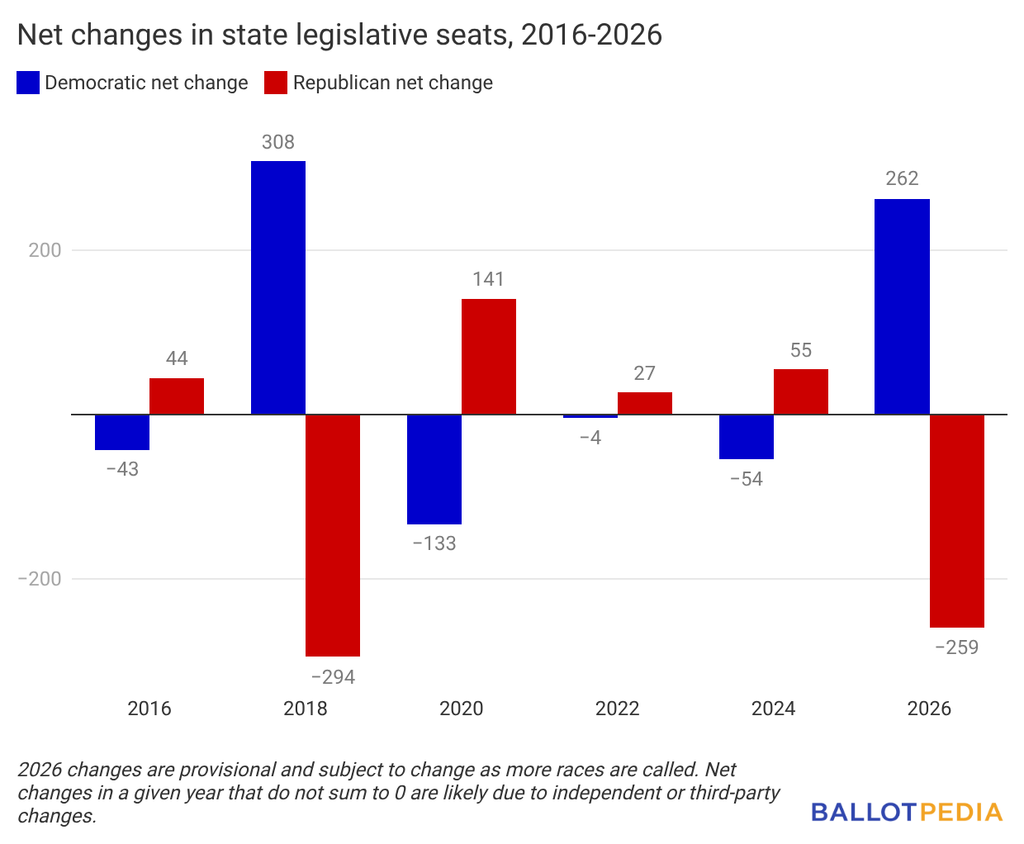
Democrats are projected to control a majority of state legislative chambers for the first time since before the 2010 elections. As of 3 p.m. on Nov. 5, they had gained a net 262 seats nationwide with some races still uncalled.
Democrats won majorities in at least 11 chambers, 10 of which previously had Republican majorities and one — the Minnesota House — that was split. As a result, Democrats will control at least 50 state legislative chambers and Republicans will control at least 45. One chamber – the Alaska Senate – is projected to have a power-sharing coalition. The last time Democrats controlled at least 50 chambers was was before the 2010 elections, when they controlled 60. Control remains uncalled in the North Carolina Senate, the Georgia House, and the Alaska House. There are 99 chambers in the country.
The chambers that changed from Republican to Democratic majorities are the Arizona House and Senate, Michigan House, New Hampshire House and Senate, North Carolina House, Pennsylvania Senate, Texas House, and Wisconsin Assembly and Senate.
Democrats have so far gained a net of 262 state legislative seats across the country - this is the second-most either party has gained going back to 2016. The year with the largest net change in that period was 2018 when Democrats gained 308 seats and Republicans lost 294.
Democrats increased their membership in 54 chambers in 33 states. As of 3 p.m. Republicans had not increased their membership in any chambers.
So far, Democrats gained the most seats in North Carolina — 23. Indiana follows with a 19-seat Democratic gain, then Missouri with 18. Twelve other states have also had double-digit Democratic gains. Fifteen states have had single-digit Democratic gains.
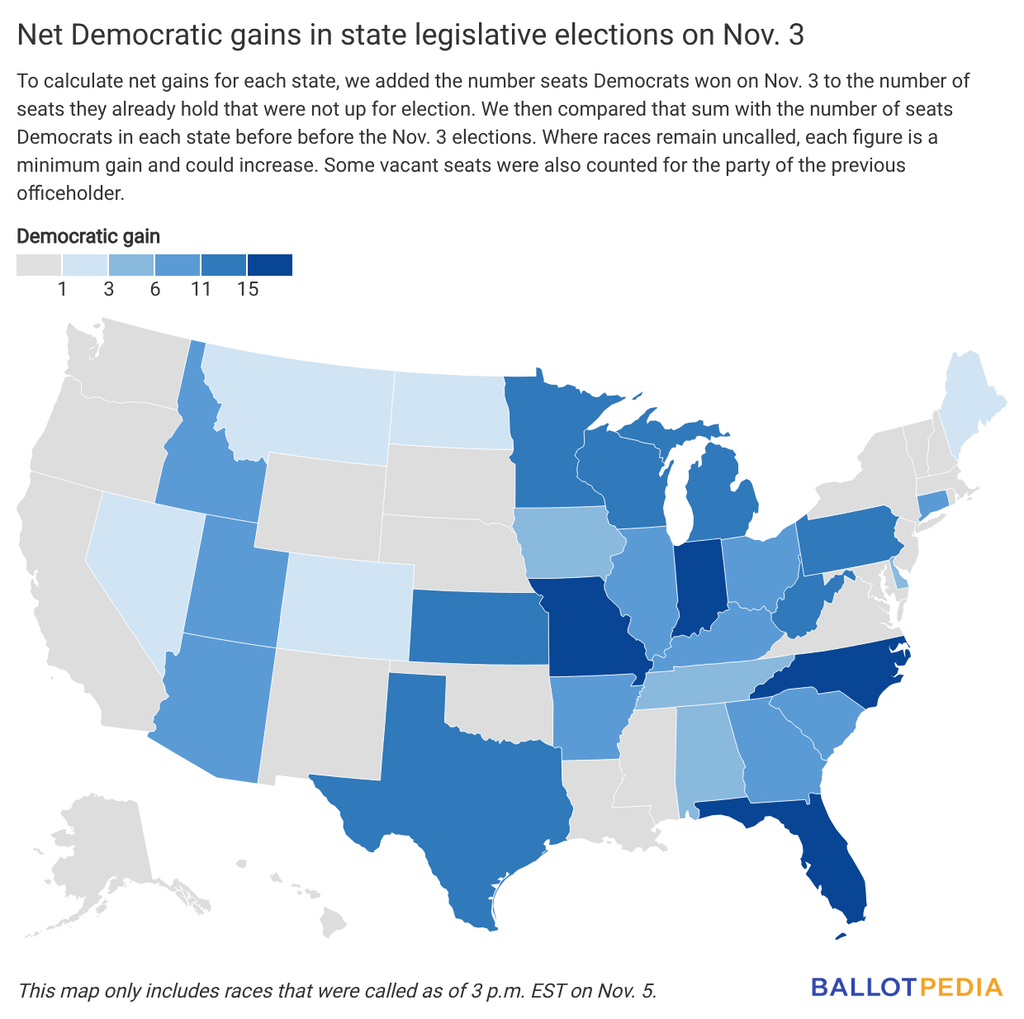
Democrats gained supermajorities in the Colorado House, Nevada Assembly, New York Senate, and Vermont Senate. Republicans lost supermajorities in the Florida House and Senate, Iowa House, Kansas House, Missouri House and Senate, New Hampshire Senate, North Carolina Senate, Ohio House, South Carolina House, and the New Hampshire House.
Heading into the elections, Kansas was one of two states that had a veto-proof state legislative majority of one party and an opposing party governor. The other state, Kentucky, maintained this status.
Click here to learn more about the state legislative election results from Nov. 3.
Twenty-six states complete unofficial results reporting by Nov. 4
Twenty-six states completed their unofficial reporting of the Nov. 3 election results by 5 p.m. EST on Nov. 4.
Unofficial results include all Election Day, early voting, and regular absentee/mail-in ballots, but do not necessarily include provisional ballots, cured ballots, or ballots from overseas or military voters. Local and state governments finalize official election results during the canvassing and certification process.
The following map shows which states finished their unofficial reporting as of Nov. 4 by their pre-election trifecta status
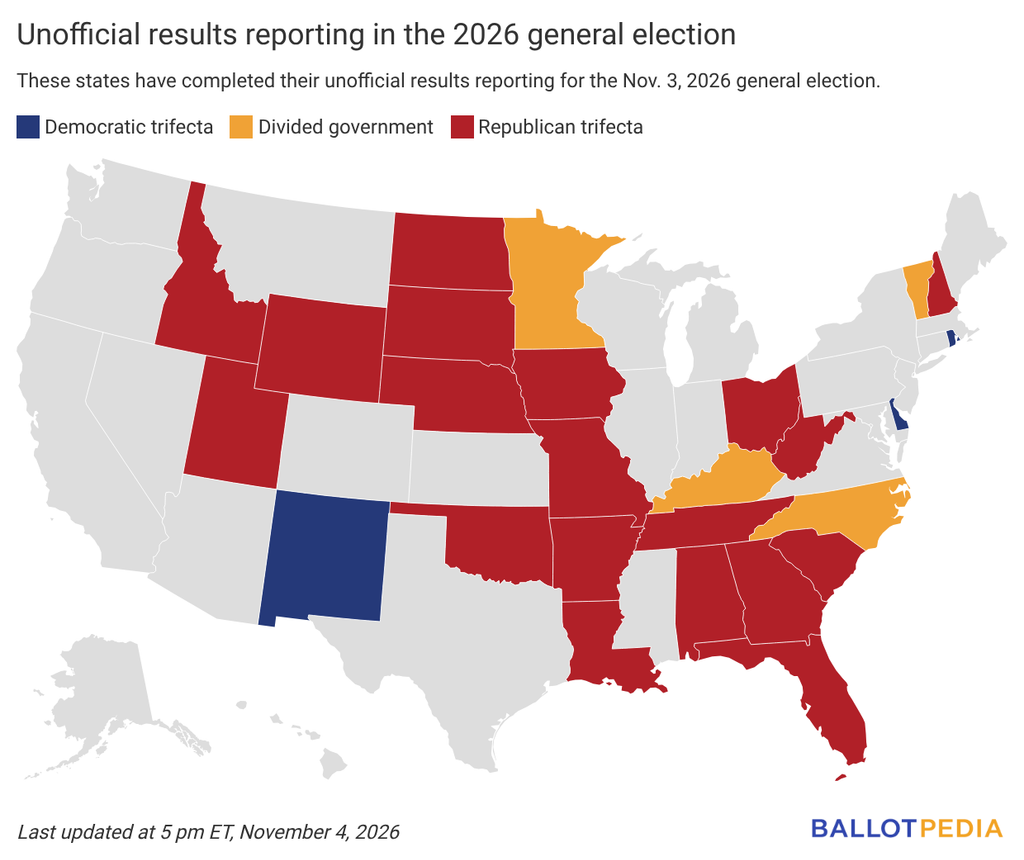
Pre-election, three of these states had Democratic trifectas, 19 had Republican trifectas, and four had divided governments.
Twenty-four states had yet to finish reporting their unofficial results. The states closest to completion as of Nov. 4 were Maryland, Pennsylvania, and Texas, each with 99% of their unofficial results reported.
States count ballots and report election results at different speeds. In some states, unofficial election results are reported on Election Day or soon after. In other states, it may take election officials weeks to deliver the results.
This variance results from differences in election administration methods, policies, and priorities across states, reflecting the decentralized nature of election administration in the United States.
Policies that can affect the speed of results reporting include the percentage of voters participating in absentee/mail-in and early voting, absentee/mail-in ballot processing and counting rules and timelines, policies related to tabulation and reporting, and vote counting resources.
Ballotpedia will publish a full report with analysis on results reporting in the 2026 primary and general elections after all states report their 2026 general election results.
Click here for more information on unofficial results reporting in the 2026 election.
On Nov. 4, voters in 40 states decided local ballot measures on ranked-choice voting, surveillance cameras, foie gras, and more
We covered 931 local ballot measures on Nov. 3 in 40 states. This year, our coverage scope for local ballot measures includes those that appear on the ballot for voters within the 100 most populous cities, within state capitals, and throughout California and Virginia. We are also covering local ballot measures related to electoral systems, like ranked-choice voting, and data centers outside of the largest cities.
Noteworthy topics across the country included ranked-choice voting and other election systems, Flock cameras, immigration, law enforcement, and more. Here are some noteworthy measures by city and topic.
Ranked-choice voting
Voters in Irvine, California; Longmont, Colorado; and Honolulu, Hawaii, decided measures to adopt ranked-choice voting for local offices. Longmont’s measure was approved and Honolulu’s was defeated, while Irvine’s remained too close to call. Three states use RCV statewide. Alaska and Maine use RCV in some federal and statewide elections, while Hawaii uses it for certain statewide elections. Thirteen states where RCV is not used in any statewide elections have localities that either use or are scheduled to begin using RCV in municipal elections.
- Longmont, Colorado, Question 3C: Approved, 56.1% to 43.9%. The amendment provides for ranked-choice voting for mayor and city council elections where possible, starting in November 2029.
- Honolulu, Hawaii, Question 5: Defeated, 55.8% to 44.2%. The amendment would have adopted ranked-choice voting for mayor, city council, and prosecuting attorney elections.
- Irvine, California, Measure D: Too close to call, with 51.4% to 48.6%. The measure would establish ranked-choice voting for mayor and city council elections.
Flock cameras
Voters in York, Maine, and League City, Texas, weighed in on the use of automated license plate reader cameras. York voters approved removing the cameras and requiring voter approval for future surveillance technology, while League City voters opposed continued police use of the cameras in a nonbinding advisory vote.
York, Maine, Article 5: Approved, 72.5% to 27.5%. The initiative removes the town’s automated license plate reader cameras and requires voter approval for future installations of surveillance technology.
League City, Texas, Flock camera advisory question: Defeated, 54% to 46%. The question asked whether police should continue using automated license plate reader cameras at fixed locations on public roadways. The vote was advisory and did not itself require the city to remove the cameras.
Foie gras bans
Voters in Denver and Washington, D.C., approved initiatives prohibiting the force-feeding of birds to enlarge their livers and restricting products made from force-fed birds, including foie gras.
Denver, Colorado, foie gras initiative: Approved, 66.6% to 33.5%. The initiative prohibits force-feeding birds and the commercial sale, distribution, importation, transportation, and receipt of products derived from force-fed birds.
Washington, D.C., Initiative 86: Approved, 73.2% to 26.8%. The initiative prohibits the force-feeding of birds to enlarge their livers and banning the commercial sale, distribution, and importation of foie gras and other fattened bird liver products. It includes an exception force-feeding directed by a licensed veterinarian solely for therapeutic purposes.
Currently, California is the only state that bans force-feeding birds and selling products resulting from force-feeding. Heading into the 2026 elections, cities with foie gras bans inclued New York City, Pittsburgh, Brookline, Massachusetts, and Portland, Oregon. None of these prohibitions came through ballot measures.
Government structure
Voters in Oakland, Baltimore, Cuyahoga County, Ohio, and Hillsborough County, Florida, approved measures changing the powers of local officials and how some officials are elected. These are a selection of the government-structure measures on Nov. 3 ballots.
Oakland, California, Measure EE: Approved, 73.8% to 26.2%. It makes the mayor the city’s chief executive and grants veto authority subject to council override, among other changes to council oversight and elected officials’ roles. Heading into the elections, Oakland was one of seven hybrid governments among the 100 largest cities. Forty-seven cities had strong-mayor systems and 46 had council-manager systems. As a result of this measure, there will be 48 strong-mayor systems, 46 had council-manager systems, and six hybrid systems.
Baltimore, Maryland, Question F: Approved, 64.8% to 35.2%. It changes the ordinance veto process and grants the mayor responsibility for preparing and presenting the proposed annual budget, among other changes.
Cuyahoga County, Ohio, Issue 12: Approved, 75.3% to 24.7%. It requires county council confirmation of the county executive’s removal of members of specified boards, agencies, commissions, and authorities.
Hillsborough County, Florida, Referendum 1: Approved, 58.1% to 41.9%. Beginning in 2028, the school superintendent will be elected in a partisan election rather than appointed by the school board.
Hillsborough County, Florida, Referendum 2: Approved, 51.7% to 48.3%. It increases the county commission from seven to nine members, requires commissioners to be elected from single-member districts, and provides for 11 members when the county reaches 2.5 million residents.
Immigration
Voters in Honolulu and Chicago approved measures addressing local responses to federal immigration enforcement.
Honolulu, Hawaii, Question 6: Approved, 66.9% to 33.1%. It requires requiring the police department to "adopt policies to ensure the constitutional rights of all persons, regardless of immigration or citizenship status" and limits assistance with federal immigration enforcement to circumstances required by statute or court order, after the requesting agency’s identity and authority are confirmed according to procedures established by the Chief of Police.
Chicago, Illinois, ICE operations compensation measure: Approved, 84.9% to 15.1%. It asks whether the city should pursue lawful means to recover federal compensation for costs and economic harm associated with ICE operations. The measure is advisory and its approval does not itself secure federal compensation.
Foreign policy
Voters in Bloomington and Oak Park, Illinois, approved advisory questions concerning federal weapons transfers and state investment restrictions. Providence, Rhode Island, voters approved an initiative to divest municipal funds from certain foreign countries and entities.
Bloomington, Illinois, federal weapons transfers advisory measure: Approved, 88.4% to 11.6%. The nonbinding measure advises the federal government to ban weapons transfers to countries that are dictatorships, apartheid states, or major human rights violators.
Oak Park, Illinois, state investment advisory question: Approved, 65.4% to 34.6%. The nonbinding question advises Illinois to repeal laws prohibiting state investment in businesses that boycott Israel.
Providence, Rhode Island, divestment initiative: Approved, 74.5% to 25.5%. The initiative directs the city to divest municipal funds from foreign countries and entities conducting certain human rights violations, including genocide, war crimes, occupation, or apartheid.
Other election systems
Voters in Columbus, Ohio; Burbank and Waterford, California; and St. Louis, Missouri, decided measures addressing how local officials are elected. Columbus voters approved two measures involving district-only voting, while Burbank voters rejected a specific by-district council election proposal.
Columbus, Ohio, Issue 8: Approved, 82% to 18%. The amendment changes council district elections so voters elect only their own district representative, rather than voting on every district seat citywide.
Columbus, Ohio, Issue 9: Approved, 57.2% to 42.8%. Like Issue 8, Issue 9 also establishes district-only voting for district seats and adds four at-large seats, expanding the council from nine to 13 members in stages.
St. Louis, Missouri, City Proposition 1: Approved, 56.2% to 43.8%. It extends the city’s nonpartisan top-two runoff system to special elections.
Burbank, California, Measure CD: Defeated, 77.6% to 22.4%. The measure would have changed City Council elections from at-large to by-district elections.
Burbank, California, Measure CC: Not yet called. The yes vote currently leads 52.9% to 47.1%. The charter amendment would remove the requirement for at-large City Council elections. It would let the electoral system be set by council ordinance or by voter initiative.
Waterford, California, Measure O: Defeated, 59.6% to 40.4%. The measure would have required the election of the City Council from four districts, with the mayor still elected at large.
Regional transit project funding
Voters approved regional transportation funding measures in special districts across multiple counties in California’s Bay Area and Colorado’s Front Range. Both establish sales taxes, but the California measure funds existing regional transit systems, while the Colorado measure funds the Colorado Connector passenger rail project.
Public Transit Revenue Measure District, California, Proposition RTM: Approved, 62% to 38%. The initiative establishes a 14-year additional sales tax of 1% in San Francisco and 0.5% in Alameda, Contra Costa, San Mateo, and Santa Clara counties. It funds regional transportation systems including Bay Area Rapid Transit (BART), Muni, Caltrain, and AC Transit. The Public Transit Revenue Measure District covers Bay Area counties.
Front Range Passenger Rail District, Colorado, Proposition 7A: Approved, 55.22% to 44.78%. The measure establishes a 0.333% sales and use tax and authorizes debt to construct, operate, and maintain Colorado Connector passenger rail service.
Law enforcement and policing
Voters approved measures concerning marijuana enforcement and no-knock warrants in Houston and a civilian police advisory commission in Buffalo.
Houston, Texas, Proposition A: Approved, 71.5% to 28.5%. It makes enforcement of Class A and Class B misdemeanor marijuana possession the police department’s lowest enforcement priority and prohibits officers from requesting or executing no-knock warrants.
Buffalo, New York, Proposal 10: Approved, 76.6% to 23.5%. It creates a civilian commission to advise city departments on policing policies.
New York City
New York City voters approved all five charter amendments on the ballot. Each amendment proposed by the city’s mayor-appointed Commission on Government Efficiency and addressed public space, city contracting, street projects and property, building permits, and the city’s rainy day fund. Support ranged from 61.8% to 72.8%.
- Question 1: Public space: Approved, 63.4% to 36.6%. Removes mandatory hearings for certain private uses of public space and City Council review of sidewalk cafes. Public hearings remain an option.
- Question 2: City contracting: Approved, 61.8% to 38.2%. Authorizes the Procurement Policy Board to simplify contractor paperwork and requires quarterly board meetings.
- Question 3: Street projects and city property: Approved, 65.7% to 34.3%. Shortens timelines for street construction projects, the disposition of unused city property, and the leasing of offices for the city workforce.
- Question 4: Building permits: Approved, 67.7% to 32.3%. Authorizes a centralized construction-permitting hub, moves waterfront permitting to the Department of Buildings, and allows additional department officials to issue approvals.
- Question 5: Rainy day fund: Approved, 72.5% to 27.5%. Sets reserve targets and requires the mayor to develop a method for calculating rainy day fund contributions; deposits remain subject to budget approval.
Click here to learn more about the local ballot measures we covered in 2026.
Correction: In the Nov. 5 edition of the Daily Brew, we incorrectly stated that the 2010 elections were the last to result in there being more states with Democratic trifectas than Republican trifectas. This was incorrect, as the 2010 elections resulted in more Republican trifectas. Before the 2026 elections, the last time Democrats had more trifectas was before the 2010 elections.