



Before Feb. 15, 2027, state governors must take action to finalize their states' participation in the Federal Scholarship Tax Credit (FSTC), and the results of the Nov. 3 election raise new questions about what states will do.
To participate in the program, a state must submit an advance election form (Form 15714) to the Internal Revenue Service (IRS) by Jan. 1, 2027, and must submit a list of eligible scholarship granting organizations (SGOs) by Feb. 15.
Outgoing governors may choose to submit Form 15714 or finalize FSTC enrollment by submitting an SGO list before they're sworn out, or leave this choice to their successor. Incoming governors that take office after Jan. 1 — all but five — cannot opt in if their predecessor doesn't submit Form 15714 by Jan. 1, but, they may have the option to not finalize participation before the February deadline if the outgoing governor has not submitted an SGO list.
Democrats — who gained control of the governorship in five states that have opted into the FSTC — have been less likely than Republican counterparts to say they'll participate in the FSTC. While some Democratic governors have decided not to participate, others remain on the fence. Recently, five Democratic governors wrote the Treasury Department asking for clarity on certain program specifics, indicating that Democratic governors are still weighing participation as the IRS works to finalize regulations.
A look at election results
Before Election Day, 30 states, including 23 with a Republican trifecta, had opted into the FSTC program by submitting IRS Form 15714. Gubernatorial elections took place in 19 of those 30 states, and participation in the program was a campaign issue in several states, including Michigan and Arizona. As a result of the election, control of the governorship in five states opted in to the FSTC — Georgia, Iowa, Nevada, Ohio, and Texas — flipped from Republicans to Democrats.
Because the Internal Revenue Service (IRS) issued regulations less than 90 days before the program start date of Jan. 1, the IRS gave states until Feb. 15, 2027, to submit a list of eligible scholarship granting organization (SGOs) and complete their election to participate. Taxpayers in states that do not participate can still donate and claim the tax credit, but SGOs will not be authorized to disburse or award scholarship funds in that state.
Of the 20 states that had not opted into the program before Nov. 3, 17 had gubernatorial elections. Partisan control did not change in any of those states as a result of the election: Democrats maintained control in 16 states, and Gov. Phil Scott (R) won re-election in Vermont.
One outgoing governor has taken action on the FSTC since the election. On Nov. 4, New Mexico Gov. Michelle Lujan Grisham (D), who was term-limited and did not run for re-election, announced that she would opt the state into the program and that her administration would certify SGOs for participation. Lujan Grisham will be succeeded by Debra Haaland (D), who will assume office on Jan. 1, 2027. No other states or governors had moved to participate in the program after the election, as of Nov. 10.
Thirty (30) states have officially opted in to participate, though it's unclear – and unlikely – that any have submitted SGO lists to the IRS. New York Gov. Kathy Hochul (D) – who was up for and won re-election – announced on Oct. 9 that the state would participate, but New York has not submitted Form 15714. New Mexico has similarly not yet to submitted the form.
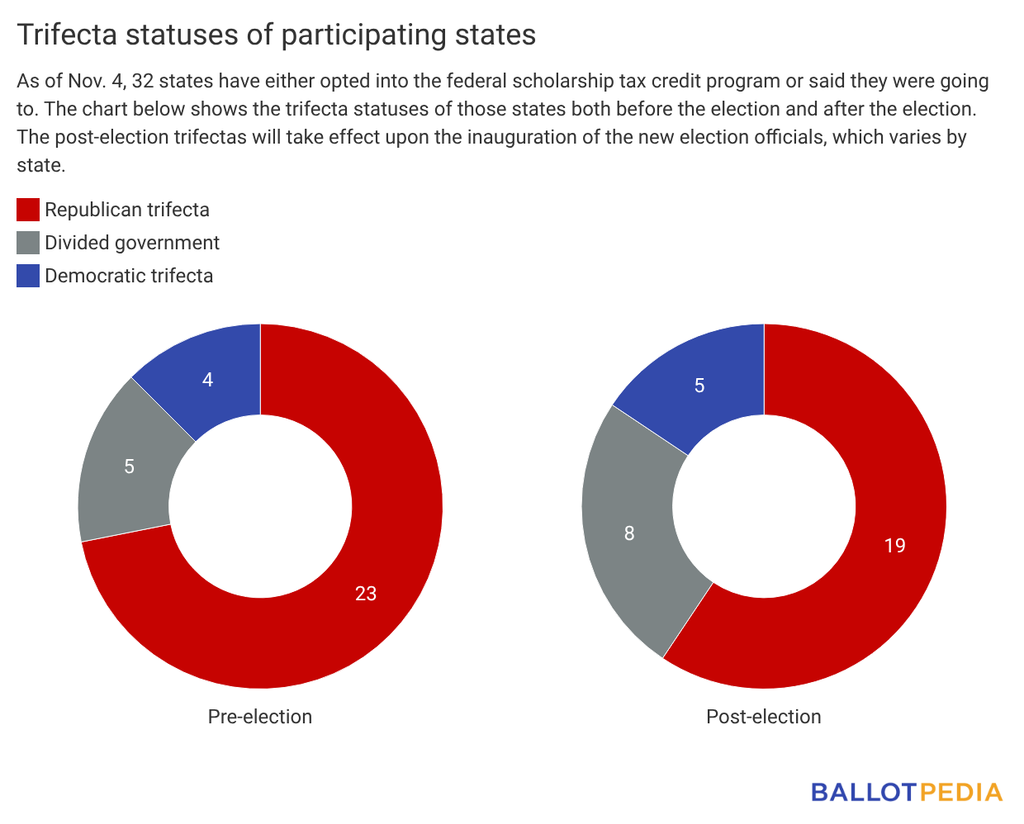
Participation along partisan lines
All 23 states with Republican trifectas, three states with Democratic trifectas, and five states with divided governments opted into the program (or said they would) in 2026. Virginia, which now has a Democratic trifecta, opted in under a Republican governor.
Several Democratic governors indicated they would wait on the Treasury Department to issue regulations before deciding if their states would participate. However, no Democratic states opted in after the IRS issued regulations in October, and one Democratic governor – Oregon Gov. Tina Kotek, who won re-election on Nov. 3 – said the state would not participate.
The Oct. 22 letter from democratic governors indicated that some Democrats are still weighing whether to participate.
In the letter, five Democratic governors – Maura Healey, Gavin Newsom, Ned Lamont, Gretchen Whitmer, and Mikie Sherrill – wrote to the IRS, seeking clarification on aspects of the program grouped into five categories: state oversight and authority; waste, fraud, and abuse; public school students and qualified expenses; ability to use funding to close opportunity gaps; and, associated costs. Their specific questions included:
- What is the state's role in overseeing multistate SGOs?
- To what extent may states establish anti-fraud or financial integrity requirements for SGOs?
- Will the federal government reimburse participating states for the oversight responsibilities the regulations impose?
Read the letter to see the full list of questions.
Perspectives on participation
Democrats for Education Reform, a political action committee, said Democrats should opt in as soon as possible.
Senior fellow at DFER and former U.S. Secretary of Education Arne Duncan said, "Treasury’s rules confirm what we’ve anticipated for a while now: public school students will benefit. No program is perfect, but the only way to shape this one and make sure it works for the kids who need it most is to opt in. Republicans have sold fear. We have to sell excellence and show parents we’re fighting for their child. Democratic governors should be leaping at the chance to close the gap and own education again."
Marguerite Roza, Research Professor at Georgetown University and Director of the Edunomics Lab, a research center focused on exploring and modeling education finance policy and practice, said she didn't think the IRS would respond expeditiously to the governors' inquiry.
She said, "For those governors that have hesitations but opt in anyway, a smart move would be to establish clear criteria under which their state will stay in the following year. One of those criteria might be that school districts and the students they serve see a clear benefit from the program."
Miguel Cardona, another former U.S. Secretary of Education and head of an education consulting firm, and Robert Kim, executive director of Education Law Center, said the regulations will not make the program workable for public school students.
They said, "We urge all governors and state leaders to steer clear of this dangerous federal scheme, which is nothing more than a Trojan horse that will gut public schools under the guise of a gift. ... Much has been written about how public schools and students can supposedly benefit from the program. But the measly sum that may reach public school students is certainly not worth pushing private education voucher programs into states that don’t currently have them."
Zooming out
The FSTC is a dollar-for-dollar nonrefundable tax credit, meaning individuals can lower their federal tax liability by $1 for every $1 donated to accredited SGOs up to certain limits. SGOs distribute the donated scholarship funds to eligible families for a variety of private or public educational expenses, including private school tuition, tutoring services, textbooks, and more. To qualify for scholarships, students had to live in households earning no more than 300% of the area's median gross income and be eligible to enroll in K-12 schools. The program will begin on Jan. 1, 2027.
States that elect to participate must submit a list of SGOs that taxpayers can donate to in order to receive the federal tax credit. Students in states that do not opt in cannot receive scholarships funded under the program, but donors in those states can still receive a federal tax credit by donating to SGOs in participating states.
The IRS is finalizing proposed rules for the program — with a public hearing on Dec. 15 — and expects to issue further guidance defining eligible expenses. In addition to changes in state government, election results may effect the program's future in Congress where legislation in the Senate to repeal the program has 36 co-sponsors, and a House version has 116, all Democrats.