


Welcome to the Wednesday, Nov. 11, 2026, Brew.
By: Briana Ryan
Here’s what’s in store for you as you start your day:
- 79 candidates that the Democratic Socialists of America endorsed won elections on Nov. 3
- Democrats gain 12th state legislative chamber this year
- An early look at legal challenges to recently approved ballot measures
79 candidates that the Democratic Socialists of America endorsed won elections on Nov. 3
The national Democratic Socialists of America (DSA) and its local chapters endorsed 164 candidates in 32 states and the District of Columbia running on Nov. 3: one for the U.S. Senate, 10 for the U.S. House of Representatives, 64 for state legislatures, and 89 for local offices. They also took positions on 72 state and local ballot measures.
As of Nov. 10, 79 of those candidates had won and 24 had lost. Results for the remaining 61 have yet to be called.
The DSA website describes itself as "the largest socialist organization in the United States because we're a member-driven mass organization. We believe that working people should run both the economy and civil society, and we show our commitment to this principle by being an organization of, by, and for the working class."
The DSA and its local chapters are some of what we at Ballotpedia refer to as a Recognized Endorsement Contributor (REC) — a person or organization that publicly expresses their support for candidates or campaigns. These endorsements provide voters with valuable information and, ultimately, contribute to an information environment that fosters a more civically engaged and informed electorate.
Congressional elections
Eight DSA-endorsed candidates won U.S. House elections on Nov. 3: two incumbents and six new members. Once new members take office, that raises the number of DSA-endorsed members of the U.S. Congress from two to eight.
All six new DSA-endorsed members won in congressional districts that Democrats represented before the election. Three new DSA-endorsed members defeated Democratic incumbents in primaries, and one defeated a Democratic incumbent on Nov. 3. Two new DSA-endorsed members won in open congressional districts. As of Nov. 10, incumbent Rep. Doris Matsui (D-Calif.) leads DSA-endorsed Mai Vang (D) 56% to 44% in California’s 7th Congressional District, which has not been called.
No DSA-endorsed candidate won a Republican-held congressional district. In Louisiana’s 1st Congressional District, incumbent Rep. Steve Scalise (R-La.) defeated DSA-endorsed Lauren Jewett (D). DSA-endorsed Gregory Levy (I) also lost the U.S. Senate special election in Ohio.
State legislative elections
Of the 64 DSA-endorsed state legislative candidates, 51 won and 11 lost. Two races have not been called.
Sixteen DSA-endorsed candidates ran against incumbents, 15 of them against Republicans. Five defeated Republican incumbents to win. Ten lost, and one race has not been called.
Another 26 DSA-endorsed candidates won open seats previously held by Democrats where no incumbents were on the Nov. 3 ballot: 11 had defeated Democratic incumbents in primaries, and 15 won open seats. None won an open seat previously held by Republicans. Isaiah Harris (D) was the only DSA-endorsed candidate to run for such a seat in Kansas House District 3.
The one DSA-endorsed candidate who ran against a Democratic incumbent on Nov. 3 was Brittany Kubicek (I), who lost to State Rep. Anthony DeSimone (D) in Rhode Island House District 5. In Illinois House District 70, DSA-endorsed Veronica Garcia-Martinez (D) leads Rep. Jeff Keicher (R) in a race that has not yet been called.
Thirteen DSA-endorsed candidates won in New York, more than any other state. Eleven ran for and won in the New York Assembly, the most of any single chamber in the country. Two ran for and won in the New York Senate. DSA-candidates also won in 19 other states.
Twenty of the 21 DSA-endorsed state legislative incumbents won re-election. The race State Rep. Lesly Munoz (D) is running in for Oregon House District 22 has not been called.
The 11 DSA-endorsed candidates who lost ran in Alabama, Florida, Illinois, Indiana, Kansas, New Mexico, Rhode Island, Texas and Vermont.
Local elections
DSA-endorsed candidates won two of the three mayoral races in large cities where the group had endorsed:
- Los Angeles: Nithya Raman defeated incumbent Mayor Karen Bass. Although the race was officially nonpartisan, both candidates are Democrats.
- Washington, D.C.: DSA-endorsed Janeese Lewis George (D) won the open mayor's office.
- Louisville: Incumbent Mayor Craig Greenberg defeated DSA-endorsed Shameka Parrish-Wright in the city's first nonpartisan mayoral election.
Ballot measures
DSA's position prevailed on 44 of the 72 measures that voters decided on Nov. 3. Five have not been called.
Statewide: DSA's side won 17, lost 11, and two were uncalled. Voters approved California Proposition 3, which renews a state income tax increase for education, and all three Virginia constitutional amendments the group supported. Voters rejected California Proposition 40, a one-time wealth tax DSA supported, and Washington Initiative 645, which would have repealed the state's tax on household income over $1 million and which DSA opposed.
Local: DSA's position won 27 and lost 12, and three were uncalled.
Click here to read more about the candidates and ballot measures that DSA endorsed this year.
Democrats gain 12th state legislative chamber this year
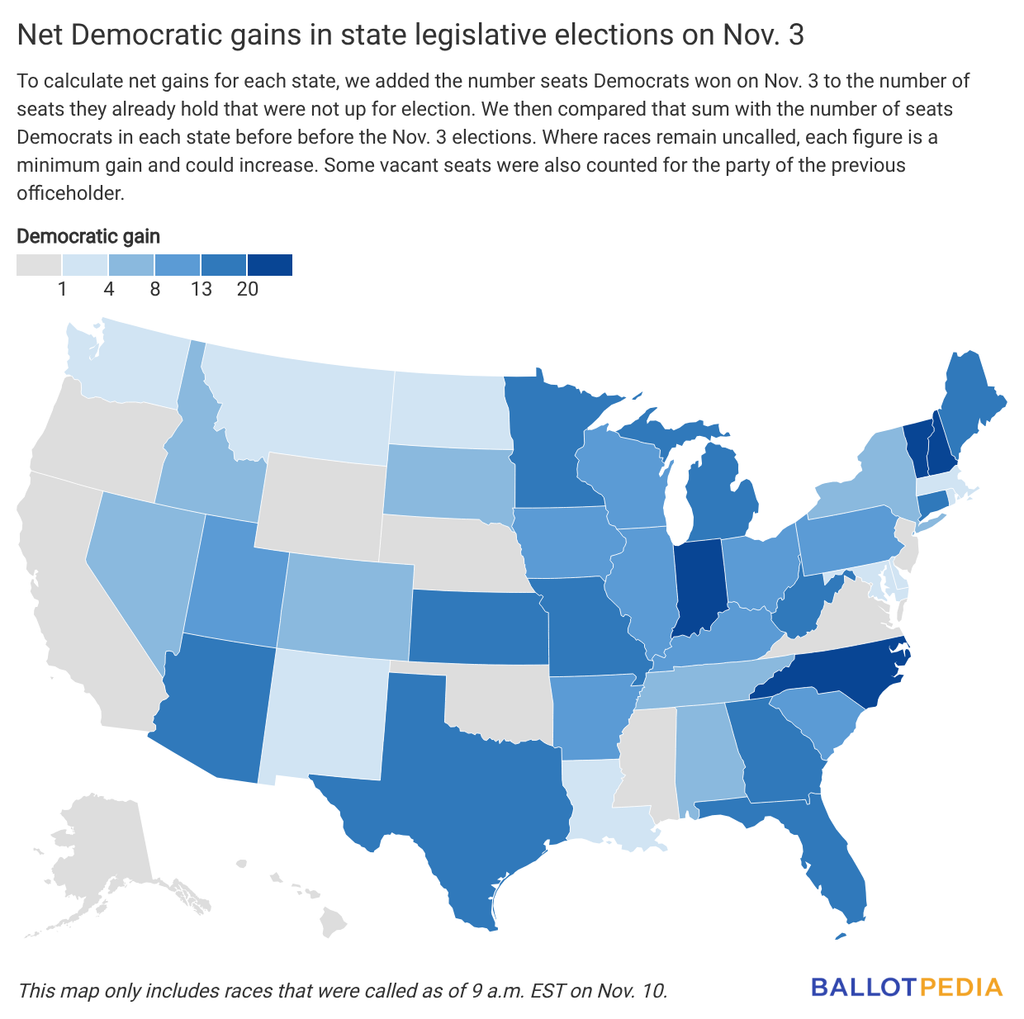
Democrats gained control of 12 state legislative chambers in the Nov. 3 elections, including the Georgia House of Representatives, which was called after our last update in the Nov. 6 Daily Brew. According to State Navigate, the 12-chamber gain is the party’s largest in a single year since 1982.
Republicans controlled 11 of the 12 chambers before the election. In the other chamber, the Minnesota House of Representatives, both parties controlled an equal number of seats. As of Nov. 10, two chambers remain uncalled: the Republican-controlled North Carolina Senate and the Alaska House of Representatives, which a multipartisan, power-sharing coalition also controls.
Those 11 chambers included five that Republicans had controlled for more than 20 years. Republicans had controlled the Georgia House since 2004, the Arizona Senate and Texas House of Representatives since 2002, and the Pennsylvania Senate since 1994. The longest streak ended in the Arizona House of Representatives, which Republicans won in 1966.
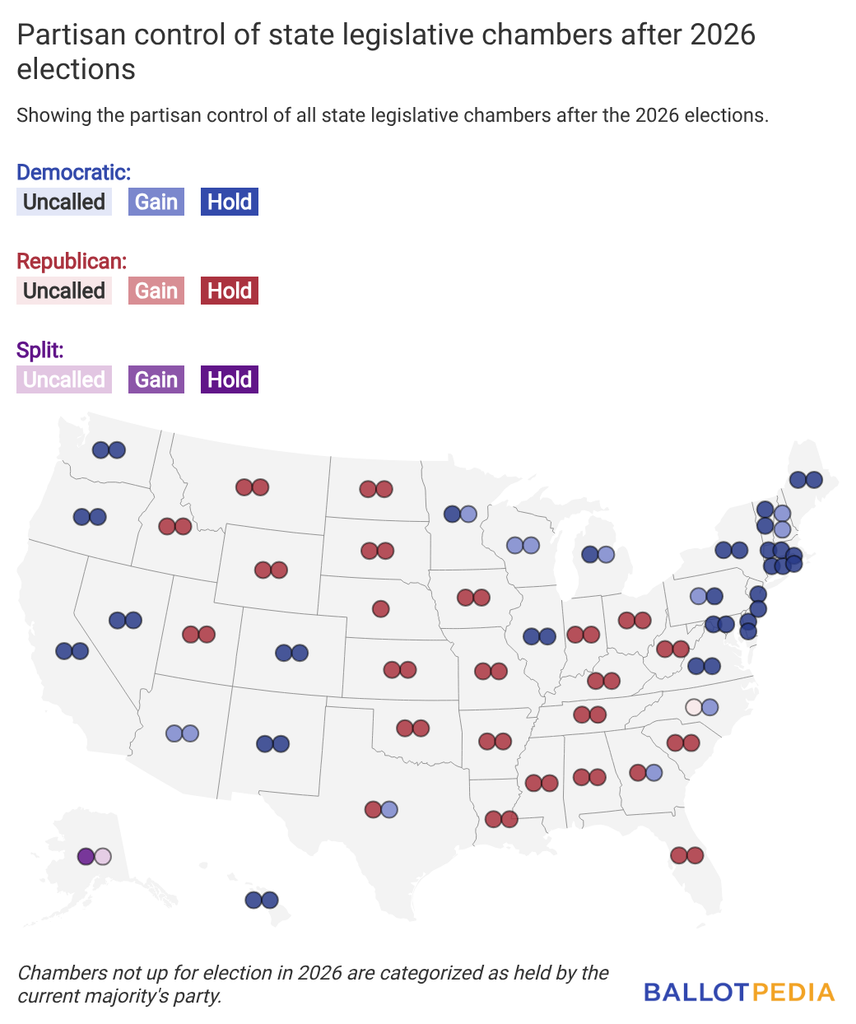
Democrats now control 51 of the country’s 99 chambers, and Republicans control 45, giving Democrats control over a majority of chambers for the first time since before the 2010 elections. Before this year’s election, Republicans controlled 57 chambers, and Democrats controlled 39.
Projections show a multipartisan, power-sharing coalition retaining control of the Alaska Senate.
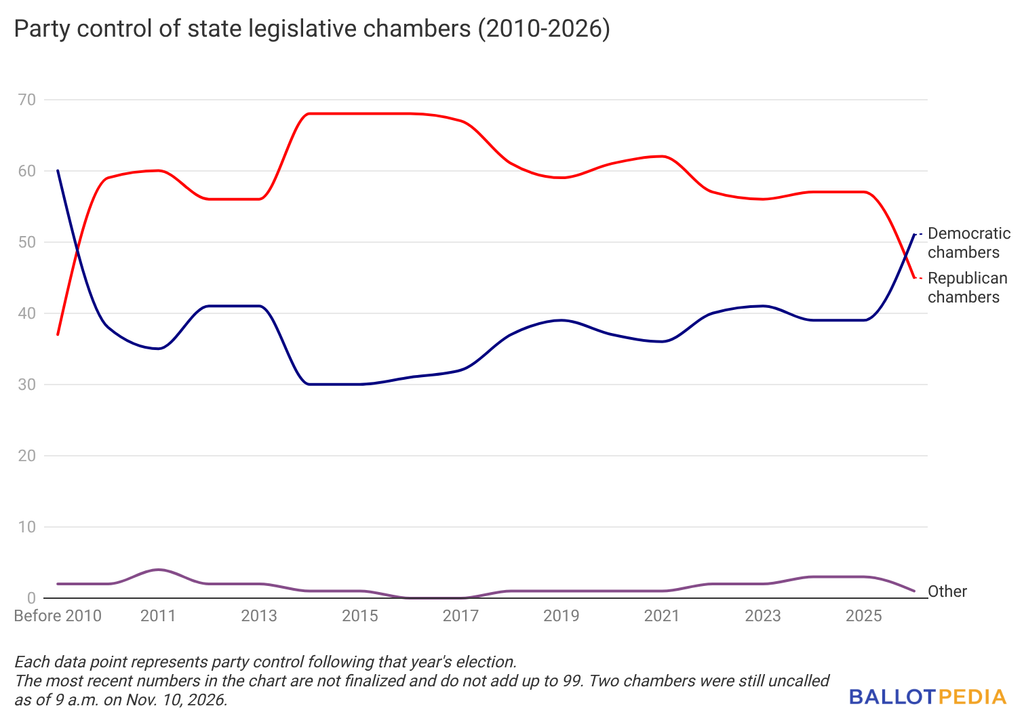
As of Nov. 10, Democrats have gained 364 total seats — the largest gain for either party since 2016. The second-largest gain was in 2018 when Democrats gained 308 seats. Republicans have lost 359. With 450 seats still uncalled, the final totals are not yet known. We define a wave election by the number of seats the president’s party loses. This year, that threshold is 494 Republican seats.
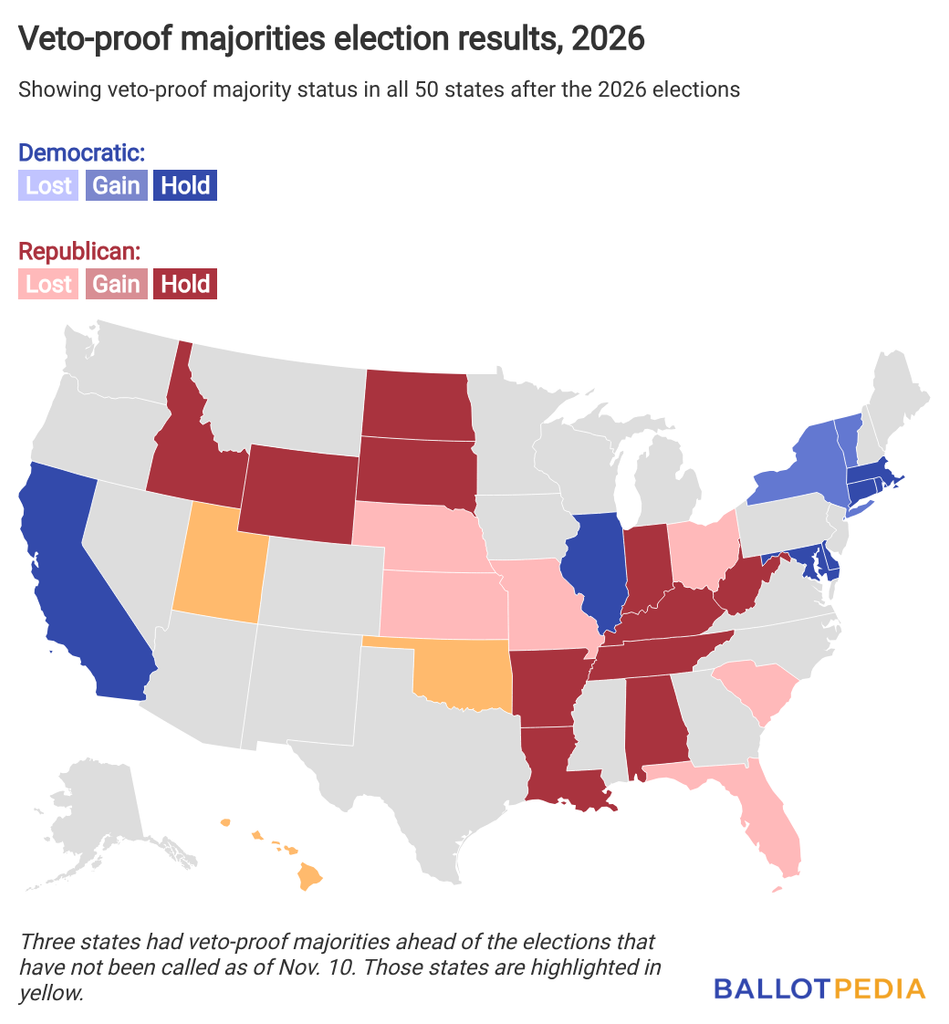
In our last update, we noted that Republicans have lost veto-proof majorities in Florida, Kansas, Missouri, Nebraska, Ohio, and South Carolina. A veto-proof majority means one party has enough seats to override a gubernatorial veto without any votes from the minority party. Neither party has lost one anywhere since our last update.
Ohio is the only one of those six states in which Republicans will control both chambers and Democrats will control the governorship — ending the state’s Republican trifecta that began in 2011. Republicans no longer have the three-fifths of seats needed to override a gubernatorial veto without Democratic votes. Georgia, Iowa, and Texas also elected Democratic governors in states with a Republican majority in at least one chamber.
Before the election, Republicans had veto-proof majorities in 19 states, and Democrats in eight. Democrats have gained veto-proof majorities in New York and Vermont so far. Neither party has gained one anywhere else since our last update.
Whether a party will have a veto-proof majority remains uncertain in eight states. Three of them had veto-proof majorities before the election: Hawaii had a Democratic veto-proof majority, and Oklahoma and Utah had Republican veto-proof majorities.
Click here to check out our full coverage of this year’s state legislative elections.
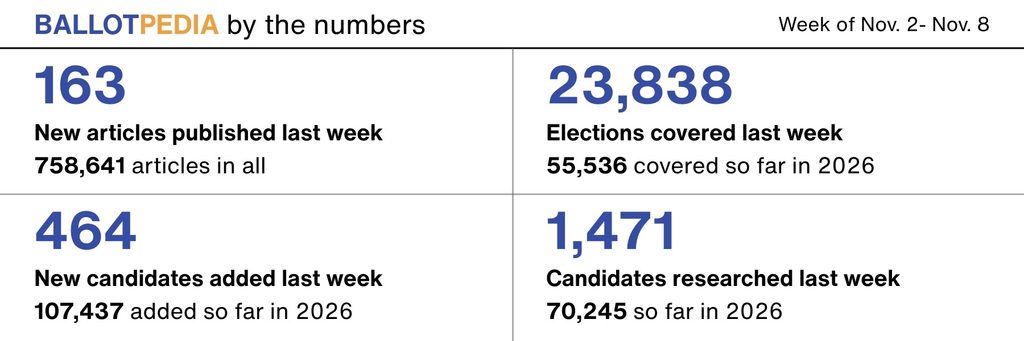
Ballotpedia by the numbers
An early look at legal challenges to recently approved ballot measures
At least three statewide ballot measures that voters approved on Nov. 3 already face court challenges. Two of those challenges came after the election. Within two days of the vote, plaintiffs filed lawsuits to block measures in Montana and Michigan. Plaintiffs filed the third, in Virginia, more than six months before voters decided the measure.
The difference in timing reflects two kinds of challenges. Plaintiffs can file a lawsuit before an election. If the plaintiffs win, a judge can void the measure even after voters approve it. Plaintiffs can also file a lawsuit after the election, before or after the measure takes effect on a date that the state or the measure itself sets. Either kind of case can take months or years to resolve.
Between 1995 and 2025, courts overturned 57 measures that voters approved. That’s approximately 2% of the more than 2,400 measures voters approved in that time. Those rulings came approximately six years after the vote, on average.
Rulings can come fast when a challenge is already underway before the vote. In May 2026, the Virginia Supreme Court voided a redistricting measure 17 days after voters approved it 52% to 48%. Opponents filed that challenge in October 2025.
Here’s where each of this year’s challenges stand.
Montana voters approved I-194 65% to 35%. The measure prohibits artificial persons, as defined in the initiative, from contributing to candidates, ballot measure campaigns, or political parties.
On Nov. 4, the Montana Republican Party and other plaintiffs filed a lawsuit in the U.S. District Court for the District of Montana, alleging that the measure violates the First Amendment of the U.S. Constitution. According to the Center for American Progress’ Tom Moore “[states] have reserved the authority to pull [corporations] back in, refashion their powers and then send them back out.” The Center for American Progress supported the measure.
Michigan voters approved Proposal 2 82% to 18%. The measure prohibits certain regulated electric and gas utilities, government contractors that hold more than $250,000 in government contracts annually, and certain affiliated individuals and organizations from making specified campaign contributions. It also extends campaign finance requirements to additional public communications about candidates and ballot questions, including some that do not expressly advocate for or against them.
On Nov. 5, CMS Energy Corporation and other plaintiffs filed a lawsuit in the U.S. District Court for the Western District of Michigan, alleging that the measure’s contribution restrictions on utilities and their affiliates are discriminatory and unconstitutional. According to Bridge Michigan’s Kelly House, “Supporters of the measure, including voter advocacy, environmental and racial justice groups, argued it offers a needed check on corporate lobbyists’ influence in Lansing.”
Virginia voters approved Question 1 62% to 38%. The measure establishes a state constitutional right to reproductive freedom, defined as "the ability to make and carry out decisions relating to one's own prenatal care, childbirth, postpartum care, contraception, abortion care, miscarriage management, and fertility care."
On April 30, the Association of American Physicians and Surgeons and other plaintiffs filed a complaint with the Tazewell County Circuit Court alleging that the ballot question for the measure is misleading. The Tazewell Circuit Court scheduled oral arguments in the case for Nov. 13. At the time of the lawsuit’s filing, State Sen. Jennifer Boysko (D) said, “Virginians have made it clear time and again that we support reproductive freedom and do not want our healthcare controlled by politicians. In November, voters will be able to enshrine one of our most essential freedoms in Virginia’s Constitution.”
Click here for more information about voter-approved ballot measures that courts have overturned.