


Welcome to the Monday, Nov. 16, 2026, Brew.
By: Lara Bonatesta
Here’s what’s in store for you as you start your day:
- Campaigns submit signatures for 2027 Maine sex-based sports eligibility initiative and 2028 Massachusetts abortion referendum
- Democrats gain ground in state financial officer elections, with implications for ESG policy
- There were fewer federal judicial vacancies on Nov. 1 than in any other midterm year since 1982
Campaigns submit signatures for 2027 Maine sex-based sports eligibility initiative and 2028 Massachusetts abortion referendum
With the November 2026 election concluded, where voters decided 145 state ballot measures across 39 states, efforts to place statewide citizen initiatives on the 2027 and 2028 ballots are underway in Maine and Massachusetts.
Maine Birth Certificate Sex Requirement for Public School Sports Initiative
Supporters of an initiative to require that public school sports teams designated for girls or boys be limited to students of the corresponding sex as recorded on their birth certificates submitted a second round of signatures in an attempt to place the measure on the 2027 ballot. In 2026, voters decided at least four measures concerning sex-based requirements for school sports — approving all of them.
The proposed sports restrictions have an exception allowing girls to join a boys’ team when no girls’ team is available in that sport. The measure also addresses private spaces and civil lawsuits.
Sponsors of the initiative originally filed a petition to place the measure on the ballot for the 2026 election. Protect Girls’ Sports in Maine submitted more than 82,000 signatures to the secretary of state’s office on Feb. 2. In March 2026, Secretary of State Shenna Bellows (D) announced that the group had submitted a sufficient number of signatures and certified the measure for the 2026 ballot.
Opponents of the initiative filed a complaint with state courts saying the state incorrectly validated some signatures and that it should be removed from the ballot. In July 2026, the Maine Supreme Judicial Court ruled that the initiative petition was 532 valid signatures short of qualifying for the ballot and was removed.
In September 2026, Protect Girls’ Sports in Maine announced they would renew efforts to gather additional signatures and aimed to place the measure on the 2027 ballot. On Nov. 2, they submitted an additional 4,836 signatures to the secretary of state’s office. As of Nov. 9, the secretary of state’s office has not announced when it will finish reviewing the new signatures.
Voters in Arizona, Colorado, Nebraska, and Washington approved measures establishing sex-based requirements for school sports in 2026. States first enacted laws similar to these measures in 2020 and 2021, but voters had never decided the issue at the ballot box until 2026.
Massachusetts Abortion Regulations Veto Referendum
As of the submission deadline, Nov. 6, a group called the Compassionate Care Coalition had submitted 113,477 signatures in support of a veto referendum that would repeal House Bill 5595 (H. 5595), the Massachusetts law that permits abortions after 24 weeks gestation "based upon the professional judgment of the physician."
Signature verification began on Nov. 6 and was projected to take one to two weeks. As of Nov. 9, the division had not announced how many signatures were valid.
On Nov. 6, Massachusetts Gov. Maura Healey (D) signed an emergency statement to block the suspension of H. 5595.
The Massachusetts veto referendum process allows voters to put a bill that the General Court passes on the ballot to uphold or repeal. If voters gather signatures equal to 1.5% (37,287) of the total votes cast for governor in the most recent gubernatorial election, the bill will be placed on the ballot. If they gather a number of signatures equal to 2% (49,716) of the total votes cast for governor, the bill will be placed on the ballot and will be suspended until after voters decide on the veto referendum.
The state constitution permits governors to issue an emergency statement that, “the immediate preservation of the public peace, health, safety or convenience requires that such law should take effect forthwith and that it is an emergency law.”
Because of Healey’s statement, the abortion law took effect on Nov. 8, 2026, and will not be suspended before the November 2028 election.
Before H. 5595 took effect, Massachusetts law permitted abortions before 24 weeks' gestation and after 24 weeks' gestation when necessary to preserve the life of the mother, to protect the mother’s physical or mental health, due to a lethal fetal anomaly, or due to a fetal diagnosis that indicates the fetus/baby is unable to sustain life outside the uterus without extraordinary medical interventions.
Voters decided four statewide ballot measures on abortion this year. They approved measures establishing a right to abortion in Nevada and Virginia, and defeated one in Idaho. Missouri voters defeated a measure that would have repealed the state constitutional right to abortion that voters approved in 2024, prohibited abortion with exceptions, and prohibited certain surgical procedures and treatments for transgender minors. The 2026 measures followed a record year for abortion-related ballot measures in 2024, when voters decided 11 statewide measures — the most in a single year. From 1970 through 2025, voters decided 65 abortion-related measures. Of those, 44 had the support of organizations that described themselves as pro-life, while 21 had the support of organizations that described themselves as pro-choice or pro-reproductive rights.
Click here to learn more about the proposed measures in Maine for 2027 and here to learn more about the proposed measures in Massachusetts for 2028.
Democrats gain ground in state financial officer elections, with implications for ESG policy
On Nov. 3, Democrats won six state financial offices that Republicans previously held and Republicans won one office that a Democrat previously held.
Of the 49 elected state financial offices on the ballot across 30 states, Democrats won 27 and Republicans won 22. Across all 69 directly elected state financial offices nationwide, Republicans will continue to hold a majority, with 39 offices compared to Democrats' 30.
State financial officers (SFOs) include treasurers, auditors, and comptrollers, whose responsibilities generally include overseeing government finances, auditing public agencies, managing payments, and administering pension or trust funds. Some also oversee public investments, giving them influence over state investment policies, including the consideration of environmental, social, and governance (ESG) factors.
In Indiana, incumbent Treasurer Daniel Elliott (R) defeated Coumba Kebe (D) 51.1% to 48.9% in a race that highlighted differing approaches to ESG investing. Elliott has supported restrictions on ESG considerations in public investments, including placing BlackRock on a state watchlist in 2024 over alleged ESG commitments, which BlackRock disputed. The Indiana Public Retirement System's board, on which Elliott serves in his capacity as state treasurer, subsequently voted to replace BlackRock as manager of a roughly $969 million bond portfolio. Elliott emphasized financial returns as the primary consideration in investment decisions, while Kebe advocated greater transparency regarding investment costs and risks and argued that workforce practices can affect long-term financial performance.
In Texas, Sarah Eckhardt (D) defeated the incumbent Comptroller Don Huffines (R) 51.3% to 46.2%, giving Democrats control of the office for the first time since 1999. Under a 2021 law, the Texas comptroller is responsible for maintaining a list of financial companies that the office determines are boycotting fossil fuel-based energy companies. The law requires certain state investment funds to divest from listed companies, and the comptroller's office has added and removed financial companies as recently as 2025, making the change in leadership particularly relevant to ongoing debates over ESG-related investment restrictions.
In Connecticut, incumbent Treasurer, Erick Russell (D) won reelection against Fred Wilms (R) 59.2% to 40.8% in a race where ESG investing was a central issue. Russell defended considering ESG factors when managing the state's approximately $69 billion in public pension assets, arguing that ESG considerations can support long-term investment returns. Wilms opposed using ESG factors in pension investment decisions and proposed creating an investment board to share fiduciary responsibilities with the treasurer.
The election results could influence state policies on pension investments, financial institutions, and ESG considerations. Many Republican financial officers have supported restrictions on ESG investing, while some Democratic officials have defended considering financially material ESG risks in investment decisions.The extent of any policy changes will depend on individual officeholders' priorities, statutory requirements, and the authority shared with pension boards and other state agencies.
Click here to learn more about state financial officer elections in 2026.
There were fewer federal judicial vacancies on Nov. 1 than in any other midterm year since 1982
As a result of Democrats gaining a majority in the U.S. Senate in the Nov. 3 elections, when the 120th Congress is sworn in on Jan. 3, different parties will control the Senate and the presidency for the first time since the final two years of President Barack Obama’s (D) second term from 2015 to 2017.
This means that Democrats will have majority control over the committee process and thereby over which of President Donald Trump’s (R) federal judicial nominees the Senate approves. Meanwhile, Senate Republicans have about a month and a half to fill vacancies until the Democratic Senate majority is sworn in.
As of Nov. 1, 28 (3.2%) of the 870 total Article III federal judgeships were vacant nationally. There were no vacancies among the 20 additional positions on the United States Court of Federal Claims and the United States territorial courts. This is the fewest as of Nov. 1 in any midterm election since 1982, the first midterm year for which data was available.
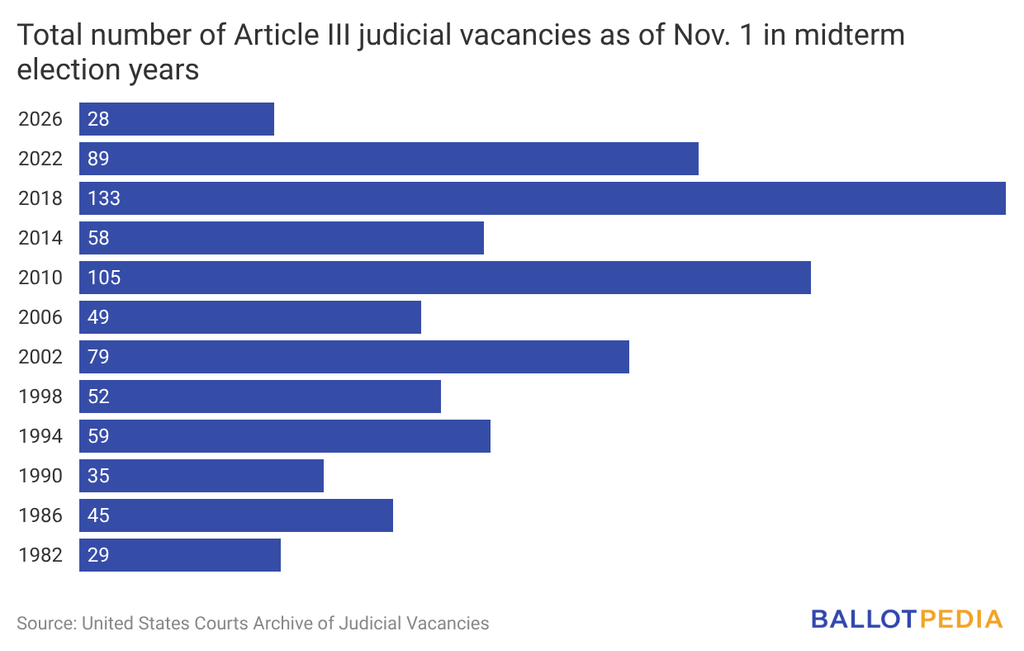
A vacancy occurs when a judge resigns, retires, takes senior status, or dies. Article III judges are appointed for life terms. The president must nominate an individual to fill the vacancy. Nominations are subject to confirmation on the advice and consent of the U.S. Senate.
One judge left active status in October, creating a vacancy and bringing the total number of vacancies as of Nov. 1 to 28. Judge Thomas Varlan assumed senior status on the U.S. District Court for the Eastern District of Tennessee.
The following chart shows the number of federal judicial vacancies each month during the Trump administration from Jan. 21, 2025, to Nov.1.
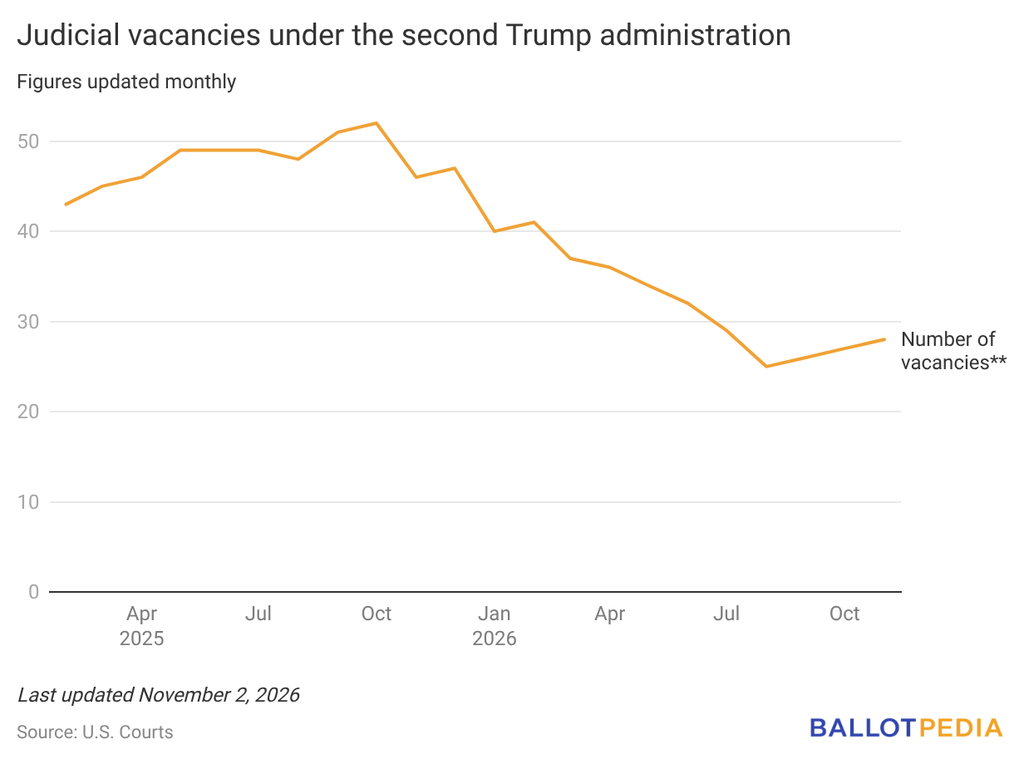
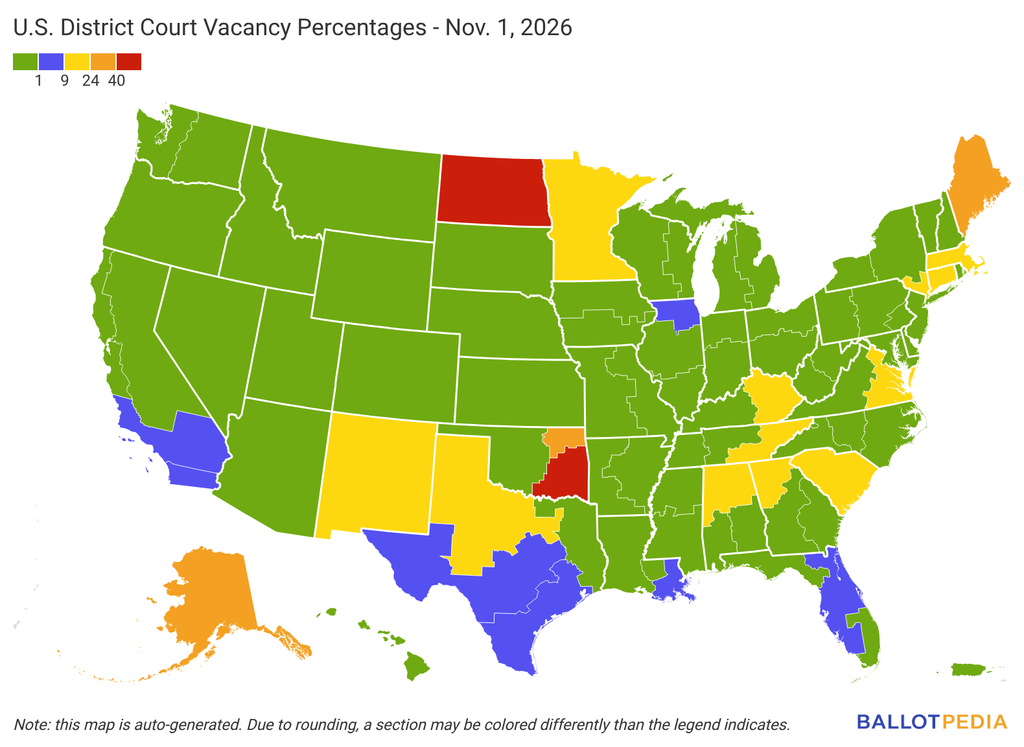
All 28 vacancies are for U.S. District Court positions. This amounts to 4.2% of the 673 total U.S. District Court positions nationwide. There were no new nominations or confirmations from Oct. 2 to Nov. 1. The following map shows the number of vacancies in the U.S. District Courts as of Nov.1.
Since taking office in January 2025 through Nov. 1, 2026, Trump officially nominated 80 individuals to federal courts. The Senate had confirmed 57 of Trump’s judicial nominees since January 2025– most recently confirming Greg Cook, to the U.S. District Court for the Northern District of Alabama on Nov. 12. The 57 confirmed nominees include 46 district court judges, 10 appeals court judges, and one Court of International Trade judge.
Presidents since Ronald Reagan have made an average of 79 judicial appointments through Nov. 1 of their second year in office. Obama had the most appointees confirmed with 107, and President George W. Bush (R) had the fewest confirmations with 53.
- President Bill Clinton (D) made the most appointments through four years with 174. W. Bush made the fewest through four years with 122.
- Obama made the most appointments through two years with 134. W. Bush made the fewest with 54.
- Obama made the most appointments through one year in office with 45. W. Bush made the fewest with 22.
After Nov. 1, Trump made four new nominations:
- Grayson Lambert, to the U.S. District Court for the District of South Carolina
- Elliot Gaiser, to the U.S. District Court for the Northern District of Texas
- James Sullivan, to the U.S. District Court for the Western District of Texas
- James Hiland, to the U.S. Court of Appeals for the Eighth Circuit
When Congress adjourns sine die, all pending nominations are returned to the president.
Click here to learn more about current federal judicial vacancies.