


Welcome to the Thursday, Nov. 19, 2026, Brew.
By: Briana Ryan
Here’s what’s in store for you as you start your day:
- 28 runoffs and 15 Louisiana general elections to happen over the next four weeks
- Water desalination plant dispute shapes the Dec. 12 runoff election for mayor of Corpus Christi
- Mary Peltola clears 50% threshold to win Alaska’s U.S. Senate seat
28 runoffs and 15 Louisiana general elections to happen over the next four weeks
At least 28 runoff elections for 29 offices that were up for election on Nov. 3 will take place between Nov. 20 and Dec. 12. The contests include three state legislative races, 23 local races, and two races for three territorial executive offices.
Louisiana voters will also decide 15 general elections on Dec. 12 in races where no candidate won a majority on Nov. 3.
All of these runoffs are part of our core coverage scope, which includes every federal and state election as well as elections in the 100 most populous cities and their overlapping jurisdictions, state capitals, and the 200 largest school districts.
Georgia, Mississippi, and Louisiana require runoff elections for at least certain congressional and state offices when no candidate receives a majority of the vote in the general election. In most other states, a candidate for state or federal office can win a general election with a plurality of the vote. Some states also require majority winners in general elections for certain local offices, and some cities require runoffs under their own charters.
Georgia
Under Georgia law, primaries, general elections, and special elections for congressional, state, and local offices go to runoffs when no candidate wins a majority of the vote.
On Dec. 1, Georgia voters will decide runoffs for District 151 in the Georgia House of Representatives and for District 2 on the Savannah-Chatham County school board.
In the race for District 151, incumbent state Rep. Mike Cheokas (R) and James Ethan Wolfe (D) advanced to the runoff. This race is one of three Georgia House races that have not yet been called. So far, Democrats have won a 91-86 majority in the chamber, gaining control of the chamber for the first time since 2004. Republicans had a 99-81 majority in the chamber ahead of Nov. 3.
In the nonpartisan special election for the Savannah-Chatham County school board, incumbent Mary Snowden and Valarie Grimes advanced to the runoff. The race is to fill the vacancy left by Dionne Hoskins-Brown on the board when she resigned to run for board president.
Mississippi
Under Mississippi law, gubernatorial and other statewide candidates must win a majority of the vote in regular general elections to avoid a runoff. All other regular general elections are decided by plurality. However, there are different rules for special elections to fill vacancies. In special elections, candidates run in a nonpartisan race, and the top two vote-getters advance to a runoff if no candidate wins a majority of the vote.
Also on Dec. 1, Mississippi voters will decide runoffs for Districts 70 and 77 of the Mississippi House of Representatives, as well as for the district attorney's office in the 7th Circuit Court District.
In the special election for District 70, Marcus Cheatham and James Lott III advanced to the runoff. In the special election for District 77, Melissa Sullivan and Chris Dunn advanced to the runoff. Both state House seats became vacant when their incumbents died in June.
In the special election for the district attorney's office, Darla Palmer and Gwen Agho advanced to the runoff. The race is for the remaining 14 months of the term Jody Owens won in 2023, which ends in January 2028. Owens resigned after pleading guilty to a federal bribery conspiracy charge on June 29. On July 10, Mississippi Gov. Tate Reeves (R) appointed Brad McCullouch as district attorney and called a special election. McCullouch was not eligible to run for the remainder of the term because he lives outside of the district.
New Jersey
New Jersey has no statewide runoff requirement. Under New Jersey law, towns that hold nonpartisan elections can choose to require runoffs, and voters adopt or drop them by referendum. All other New Jersey races are decided by plurality.
Trenton — the state capital — is one of the towns that use runoffs. On Dec. 8, voters there will decide a mayoral runoff. In the general election, Corey Isiah McNair and incumbent Mayor Reed Gusciora advanced to runoff.
Texas
Under Texas law, candidates running in party primaries and special elections require a majority of the vote to avoid a runoff. In general elections, candidates for congressional, state, and county offices need only a plurality to win. However, cities can require a majority to win local office elections in their charters, and school boards can adopt the practice by resolution. Additionally, candidates running for offices with terms longer than two years or for appraisal district boards must use it.
On Dec. 12, voters across seven localities in Texas will decide 20 runoffs:
- Corpus Christi: Mayor, an at-large City Council seat and Council Districts 1 through 5
- Austin: City Council Districts 1, 3, and 5
- El Paso: City Council Districts 1, 6, and 8
- Laredo: Mayor and Place 9 on the Laredo College Board of Trustees
- Midland: The District 5 seat on the Midland ISD Board of Trustees
- Harris County: Places 2 and 3 on the Harris Central Appraisal District board
- Tarrant County: Places 1 and 2 on the Tarrant Appraisal District board
Northern Mariana Islands
Under the law in the Northern Mariana Islands, runoffs are required for only three office types — governor, lieutenant governor, and attorney general — when no candidate wins a majority of the vote. On Nov. 20, voters in the Northern Mariana Islands will decide two runoffs for all three of those offices.
In the race for governor, Ralph Torres (R) and Blas T. Attao (I) advanced to the runoff along with their running mates Benjamin Jones Jr. (R) and Edmund S. Villagomez (I).
In the race for attorney general, Joaquin Guerrero Torres and Michael Evangelista advanced to the runoff.
Louisiana
Louisiana uses the majority-vote system for local, state legislative, and state executive elections. All candidates for an office appear on the same ballot regardless of party, and a candidate who wins a majority on Election Day is elected outright. When no one does, the top two vote-getters advance to a general election.
In 2024, the Louisiana Legislature replaced the majority-vote system with semi-closed party primaries for congressional races, the Louisiana Supreme Court, the Public Service Commission, and the Board of Elementary and Secondary Education, beginning in 2026. On April 29, the U.S. Supreme Court struck down Louisiana’s congressional map. Gov. Jeff Landry (R) suspended the May U.S. House primaries, the Legislature approved a new map, and legislators moved this year’s U.S. House races back to the majority-vote system. Those races will use party primaries in future years.
On Dec. 12, Louisiana voters will decide on 15 general elections. Two of those general elections are for open congressional districts. In the election for Louisiana's 5th Congressional District, Pat Moore (D) and Gabe Firment (R) advanced to the runoff. In the election for Louisiana's 6th Congressional District, Chauna Banks (D) and Blake Miguez (R) advanced to the runoff.
The remaining general elections are for local offices:
- Caddo Parish Public Schools: Districts 2, 5, 6, and 12
- East Baton Rouge Parish School System: Districts 2, 3, and 7
- Jefferson Parish School Board: District 5
- St. Tammany Parish School Board: District 5
- East Baton Rouge Parish Constable: District 3
- East Baton Rouge Parish Justice of the Peace: Districts 4 through 6
Click here for more information on runoff elections, and here for more on the Louisiana majority-vote system.
Water desalination plant dispute shapes the Dec. 12 runoff election for mayor of Corpus Christi
As noted above, there will be a runoff election on Dec. 12 between incumbent Mayor Paulette Guajardo and Gil Hernandez for mayor of Corpus Christi, Texas. Fifteen of the 100 most populous U.S. cities had mayoral elections on Nov. 3, and Corpus Christi is one of two that required a runoff along with Laredo, Texas.
When no candidate wins a majority, the top-two finishers advance from the general election to a runoff. In the seven-candidate general election, Guajardo received 38.8% of the vote and Hernandez received 23.4%.
Ahead of the general election, the Corpus Christi City Council voted 5-3 on Sept. 1 to reject construction plans for a water desalination plant in the Inner Harbor. Texas Gov. Greg Abbott (R) supported the construction project. Governor-elect Gina Hinojosa (D) opposed it. According to The Texas Tribune's Colleen Deguzman, the "debate over the city-owned desalination plant has emerged as a leading campaign issue." Guajardo supports the plant and Hernandez opposes the plant’s location.
The desalination plant was proposed as a source of drinking water in response to water supply issues stemming from drought and rising water demand. Currently, the city’s website says that it could experience a Level 1 Water Emergency in September 2028. According to the city website, “A Level 1 Water Emergency is declared when the water supply is 180 days away from not meeting demand. During a Level 1 Water Emergency, strict conservation measures are put in place for all customers.”
The runoff is also taking place against the backdrop of the City Council voting on Aug. 7 to reprimand and suspend Guajardo for 30 days over allegations of misconduct related to a tax incentive agreement for a downtown hotel construction project. Hernandez voted to suspend Guajardo while serving on the Corpus Christi City Council. Regarding her suspension, Guajardo said, "The process lacked fundamental fairness, with council members serving as witnesses, judges and jurors. The fact that two of them then immediately announced campaigns for Mayor only deepened concerns about the process."
Guajardo has served as mayor since 2021 and served on the City Council from 2016 to 2020. Her professional experience includes owning an Allstate Insurance agency.
Hernandez has served on the City Council since 2019. His professional experience includes serving in the U.S. Navy and working as a sales manager for the Coca-Cola Company.
Mayoral elections in Corpus Christi are officially nonpartisan. In January 2021, Guajardo told Ballotpedia, "I am officially nonpartisan and do not associate with any political party." In 2024, the Nueces County Republican Party endorsed Hernandez in the race for the Corpus Christi City Council.
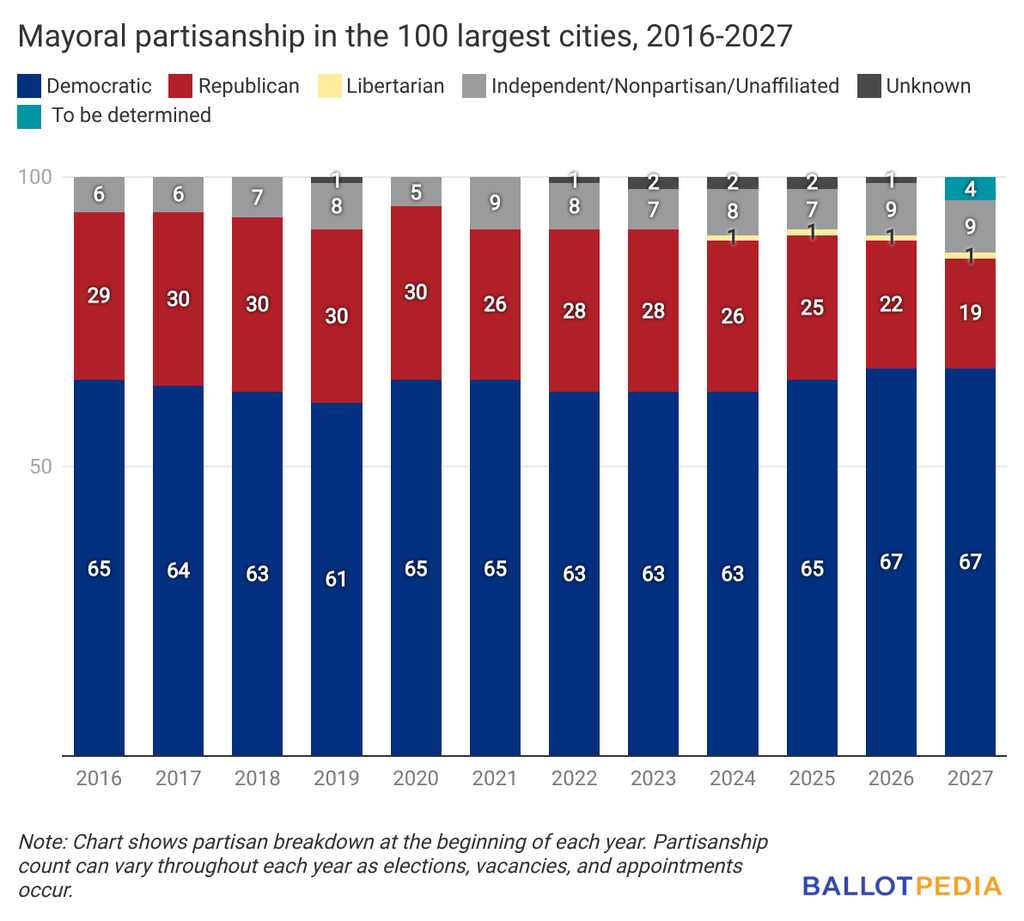
As of 5:00 p.m. EST on Nov. 17, Democrats have won nine and Republicans have won three of the 15 mayoral races held on Nov. 3 in the 100 most populous U.S. cities. The incumbent in one of the three cities with uncalled mayoral races is a Democrat, one is nonpartisan, and the other’s partisan affiliation is unknown.
Based on results so far, Democrats will control 67 mayoral offices, Republicans 19, nonpartisans four, independents four, and Libertarians one, and one mayor will be unaffiliated. Three mayoral elections are still uncalled – including the two that went to runoffs. One additional city’s mayoral partisanship is also still underdetermined. That city is Santa Clarita, California, where members of the Santa Clarita City Council select the mayor each December.
Click here to read more about the runoff election for mayor of Corpus Christi, Texas.
Mary Peltola clears 50% threshold to win Alaska’s U.S. Senate seat
On Nov. 17, Mary Peltola (D) defeated incumbent Sen. Dan S. Sullivan (R) and two other candidates in the general election for the U.S. Senate in Alaska. Because Peltola won a majority of first-choice votes, she won outright, and no ranked-choice tabulation was needed.
As of 10:50 p.m. EST on Nov. 17, Peltola received 50.1%, incumbent Sen. Dan S. Sullivan received 45.8%, Gerald Heikes (R) received 2.1%, and Daniel J. Sullivan Jr. (No Party Affiliation) received 1.7%. Write-in votes for undeclared candidates made up the remaining 0.3%.
This was the last U.S. Senate general election of the year to be called. As a result of this year’s elections, Democrats will have a 54-44 majority in the chamber, with two independents who caucus with Democrats.
Under Alaska's electoral system, voters rank as many or as few of the four candidates that advanced from the primaries. A candidate needs a simple majority of the vote (50% + 1) to be declared the winner of an election. If no candidate wins a simple majority of votes cast, the candidate with the fewest votes is eliminated from the running. Voters who selected that candidate as their first choice have their votes redistributed to their second choices. The tabulation process continues in rounds until a candidate receives a simple majority.
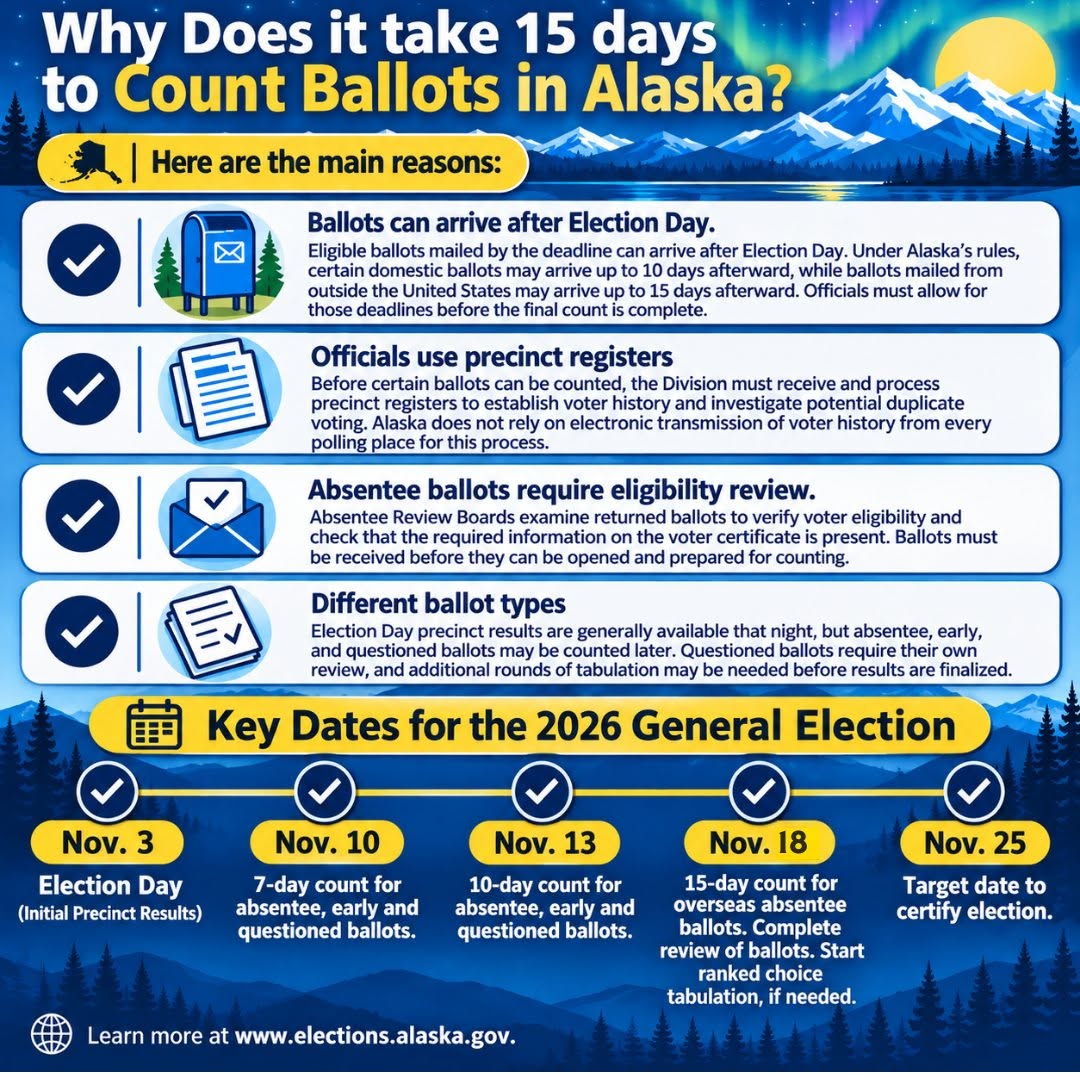
Alaska accepts overseas absentee ballots for up to 15 days after Election Day, which was Nov. 3, so the deadline was Nov. 18. After those ballots are counted, election officials will complete their review. Alaska's target date for certifying the general election results is Nov. 25.
Alaska and Maine are the only two states that use ranked-choice voting (RCV) for regular federal or statewide elections. Hawaii uses RCV only for special federal elections and county council vacancies, not for regular federal or statewide elections. An additional four states have laws specifically authorizing the use of RCV in local elections.
This U.S. Senate general election is the second in Alaska since voters passed a 2020 statewide ballot measure adopting the system, 50.5% to 49.5%. In 2024, voters defeated a statewide measure that would have repealed the system, 50.1% to 49.9%. As we mentioned in the Nov. 18 Daily Brew, voters defeated another statewide measure this year that would have repealed the electoral system, 53.6% to 46.4%.
Click here to read more about this year's general election for the U.S. Senate in Alaska.