



What's the story?
Gov. Josh Stein (D) vetoed House Bill (HB) 87, titled the Educational Choice for Children Act, on Aug. 6. The bill was designed to opt North Carolina into the federal private school choice tax credit program passed as part of the One Big Beautiful Bill Act. The North Carolina General Assembly (NCGA) was the first state legislature to pass a bill opting into the program.
The federal tax credit program allows donors to lower their tax liability by $1 for every $1 donated to accredited scholarship-granting organizations (SGOs) up to $1,700 for any tax year. SGOs are entities that provide scholarships for educational expenses as part of an education tax credit scholarship program. Scholarships under the federal program would be available to families making up to 300% of the median income in the area and could be used to pay private school tuition, hire tutors, and purchase textbooks and other supplies. The program is the first federal private school choice program. It will become effective Jan. 1, 2027, for SGOs in any state that has opted into the program.
HB 87 opts the state into the program and requires the State Education Assistance Authority to establish accreditation criteria for SGOs and publish and maintain a list of the state-certified organizations to fulfill the federal program requirements.
Stein said in the veto message, "Cutting public education funding by billions of dollars while providing billions in tax giveaways to wealthy parents already sending their kids to private schools is the wrong choice." Stein also said that he believes the federal tax credit program could benefit public school students: "Once the federal government issues sound guidance, I intend to opt North Carolina in so we can invest in the public school students most in need of after school programs, tutoring, and other resources."
What's the background?
The North Carolina Senate passed HB 87 30-19 on July 29, with all Republicans supporting the bill and all Democrats opposing it. It passed the state House of Representatives 69-47 on July 30, with one Democrat joining all Republicans to support the bill, and all other Democrats opposing it.
At least one Democrat in the state House joined Republicans to override eight of 14 Stein vetoes in July. A veto override in North Carolina requires a three-fifths supermajority vote in both chambers, which is 72 votes in the House and 30 votes in the Senate. Republicans control 71 seats.
The House had a Republican veto-proof supermajority from April 2023 to January 2025. Republicans gained their veto-proof supermajority in the House when Rep. Tricia Cotham (D) switched parties from Democratic to Republican in 2023, giving Republicans 72 seats out of 120. Republicans gained a veto-proof supermajority in the Senate in the 2022 election, going from 28 to 30 seats out of 50. The legislature overrode all 27 vetoes by former Gov. Roy Cooper (D) in 2024.
In the November 2024 elections, Democrats won a vacant seat in the House that had previously been held by a Republican. This ended the Republican veto-proof supermajority. Republicans retained control of 30 Senate seats in the 2024 elections.
School choice in North Carolina
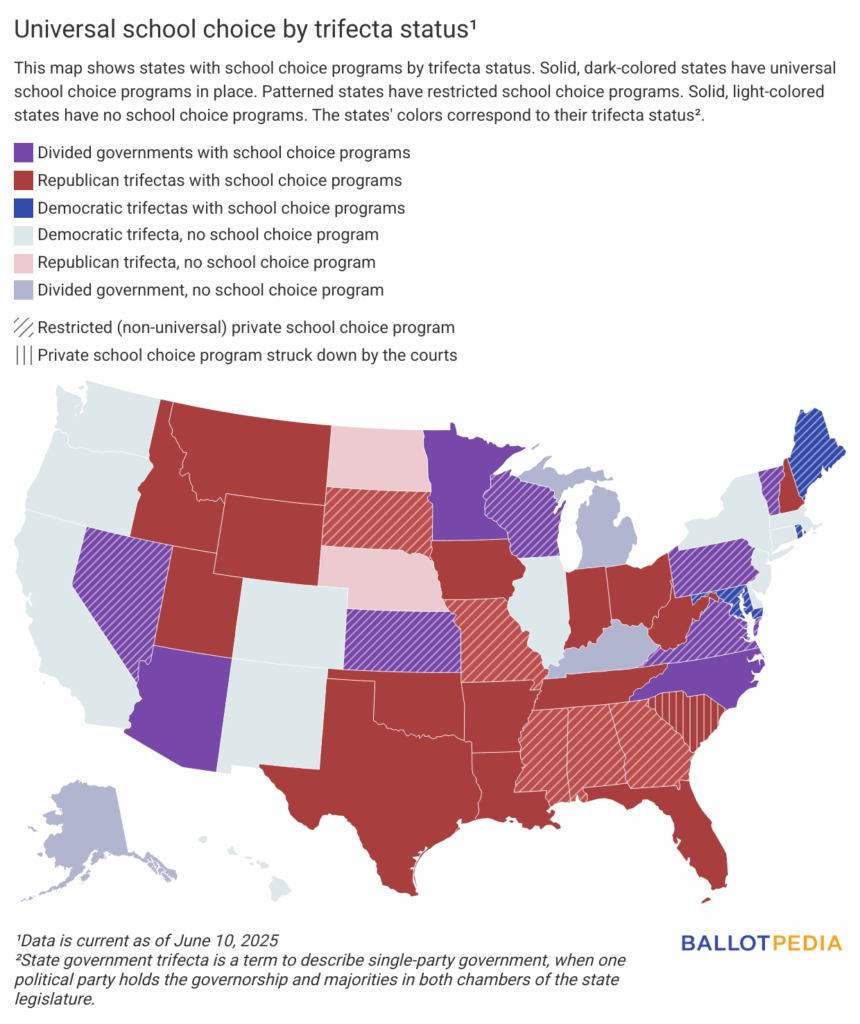
North Carolina operates two private school choice programs, the Education Student Accounts (ESA+) and the Opportunity Scholarship. The ESA+ program provides families with education savings accounts to pay for education and services for children with disabilities. The Opportunity Scholarship is a voucher program for which all students in the state are eligible, providing funds for private educational expenses.
North Carolina is one of 18 states to operate universal private school choice programs.
Additional reading: