



Candidates for state and federal office must meet a variety of filing requirements and deadlines. These requirements are set by state ballot access laws, which determine what candidates must do in order to appear on the ballot. Some ballot access requirements for primaries are set by political parties.
Some states require candidates to submit a certain number of petition signatures for ballot access, while others require filing fees, and some require both. In some states, the number of required signatures is set, while in others, it is a percentage of votes cast for a particular office. Similarly, some states' filing fees are a set dollar amount, while others are a percentage of the salary for the office. The number of required signatures and the filing fee can also vary depending on the office sought and the candidate's party affiliation.
Below is an overview of primary election filing requirements for partisan candidates for U.S. Senate, U.S. House of Representatives, gubernatorial, and state legislative offices up for election in 2026.
U.S. Senate
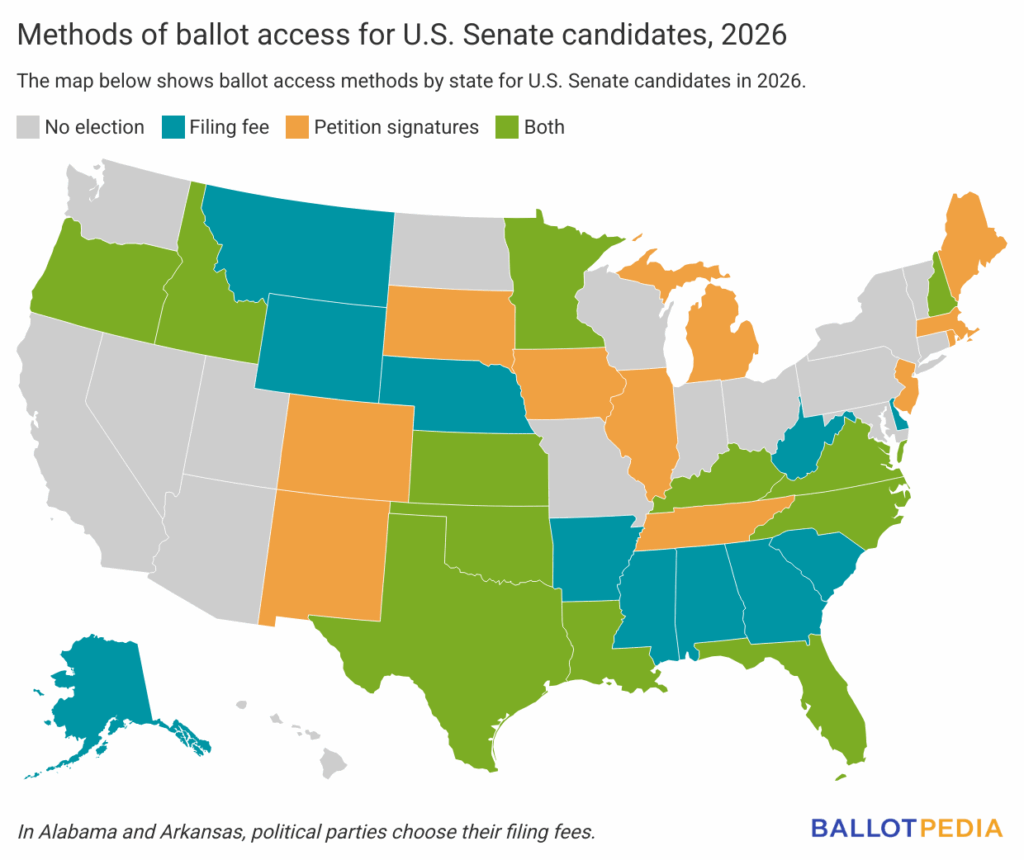
Of the 35 states with U.S. Senate elections in 2026, 23 require or allow candidates to gather signatures for ballot access. Of those with a set number of signatures, Michigan requires the most, at 15,000. Kentucky requires the least, at two signatures.
Twenty-two states require a filing fee for candidates to appear on the ballot. Of those with set filing fees for U.S. Senate, Delaware and Florida have the highest filing fee, at $10,440. Alaska and New Hampshire have the lowest, at $100.
U.S. House of Representatives
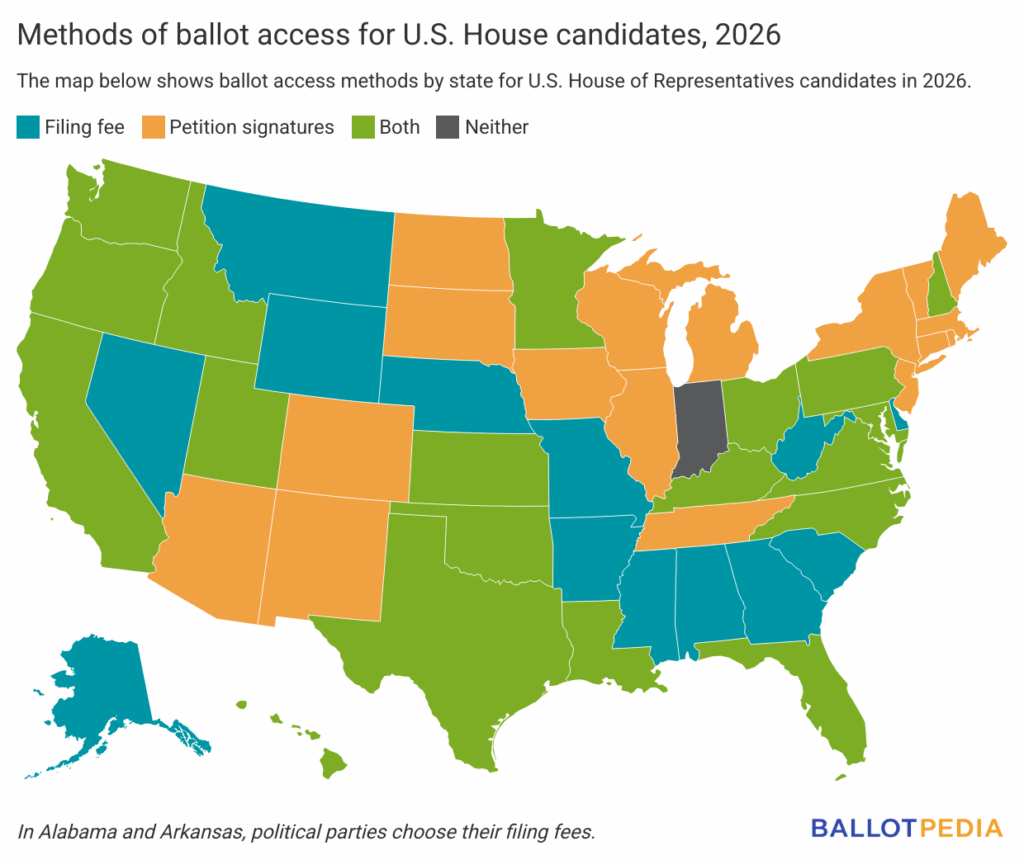
All 435 U.S. House districts are up for election in 2026. Forty states require or allow candidates to gather signatures for ballot access. Of the states with a set number of required petition signatures, Utah requires the most signatures, at 7,000 registered voters who are residents of the congressional district in which the candidate is running. Kentucky requires the least — two signatures.
Forty-two states require or allow candidates to achieve ballot access by paying a filing fee. Of the states with set filing fees for ballot access for the office of U.S. representative, Florida's is the highest, at $10,440. The lowest is in New Hampshire, at $50.
Gubernatorial
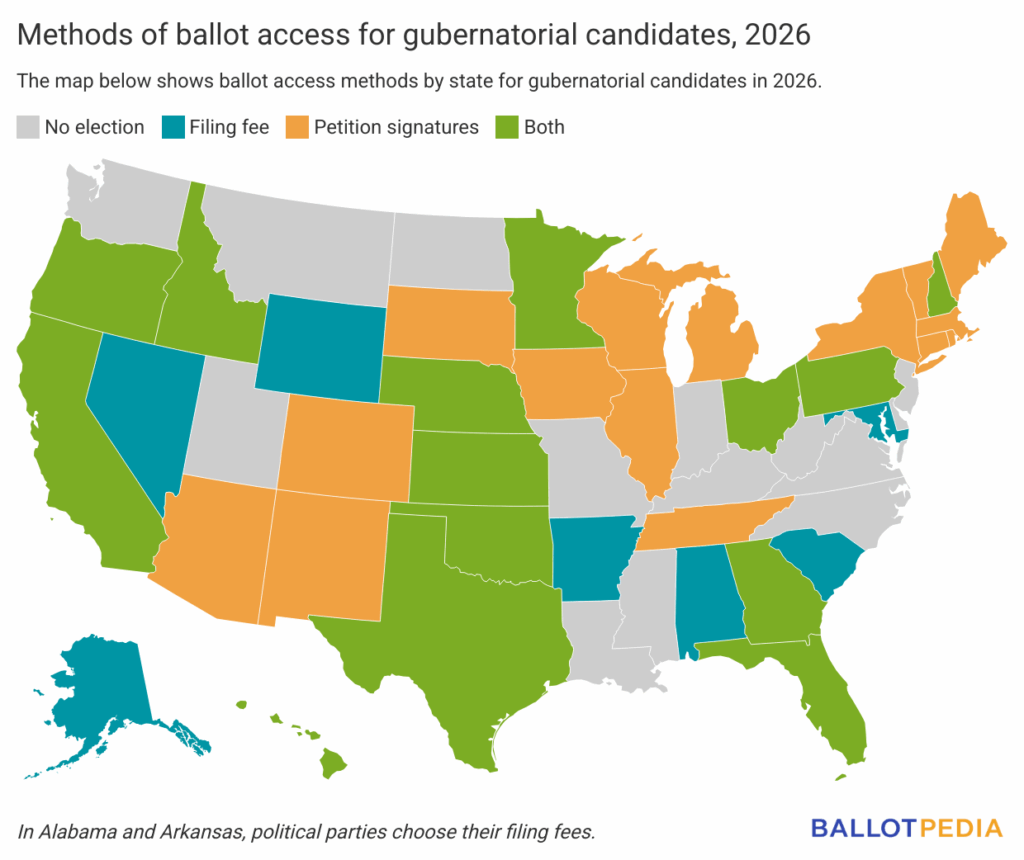
There are 36 gubernatorial seats on the ballot in 2026. Of those, 33 require or allow candidates to gather signatures for ballot access. Of the states with a set number of required petition signatures to run for governor, Michigan and New York require the most, at 15,000. Hawaii requires the least, at 25.
Thirty-two states require or allow candidates to access the ballot via a filing fee. Of the states with set filing fees for ballot access for the office of governor, the highest set filing fee is in Texas, at $3,750. The lowest is in Alaska and New Hampshire, at $100.
State legislatures
Eighty-eight state legislative chambers are holding regular legislative elections across 46 states in 2026.
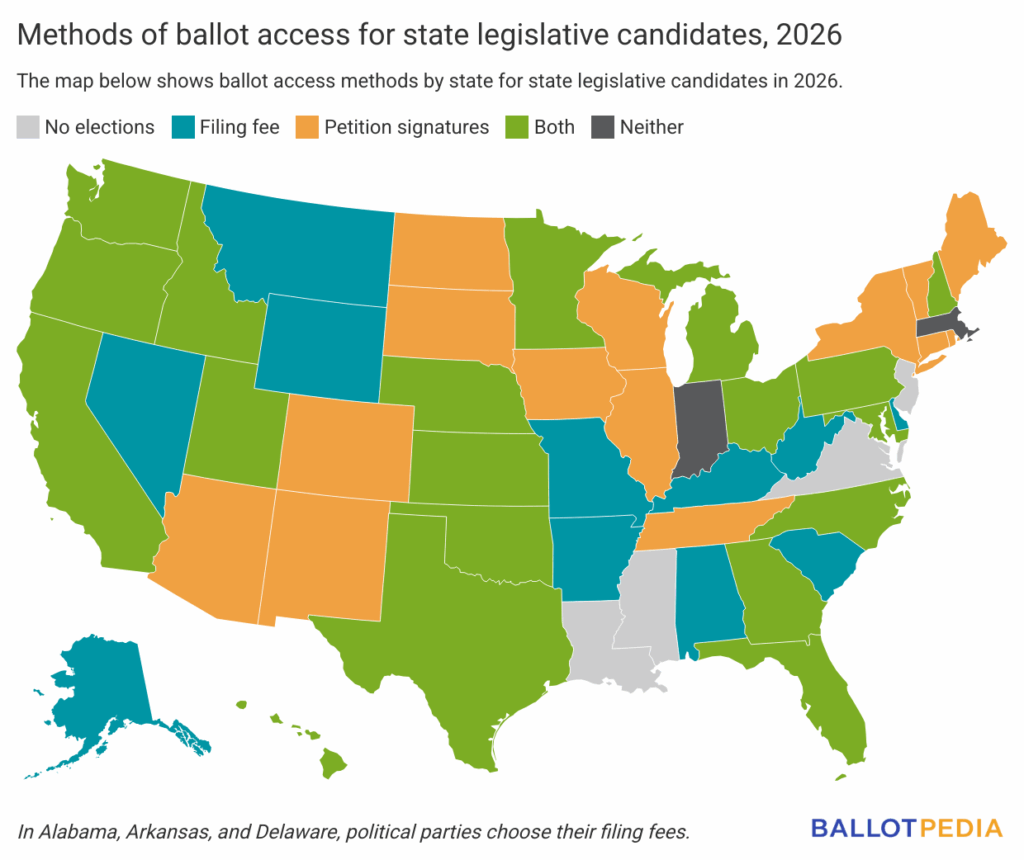
Thirty-four states holding state Senate elections require or allow candidates to gather signatures for ballot access. Of those with a set number of required signatures, Utah requires the most, at 2,000, and New Hampshire requires the least, at 20. Thirty-five states require or allow candidates to gather signatures for ballot access for the lower chambers of their state legislatures. Of those with a set number of required signatures, Utah also requires the most, at 1,000, and New Hampshire requires the least, at five.
Thirty-five states require or allow candidates for state Senate or their lower legislative chamber to access the ballot via a filing fee. The highest set filing fee for state Senate is in Texas and is $1,250. The lowest is in New Hampshire, at $10. For the lower chambers, Texas and New Hampshire are also the highest and lowest, with Texas requiring a $750 fee and New Hampshire requiring a $2 fee.
Click below to read more about ballot access requirements for candidates across all 50 states.