



In 2026, voters in up to seven states could decide on ballot measures establishing citizenship voting requirements in elections. While three states have already certified their measures for the ballot, the other four measures are proposed, either citizen-initiated ballot measures that have been cleared for signature gathering or legislative referrals that require additional votes.
Measures certified for the ballot
Three states have certified ballot measures: Arkansas, Kansas, and South Dakota. All three measures are legislatively-referred constitutional amendments.
In Arkansas, voters will consider a constitutional amendment that would change Article 3, Section 1 to state that only a citizen of the United States meeting the qualifications of an elector may vote in the state, as well as specify that any person who does not meet the qualifications of an elector is not permitted to vote in any state or local election.
In Kansas, voters will decide on a constitutional amendment that would amend Article 5, Section 1 of the state constitution to include citizenship in its list of qualifications to become an elector, specifically stating that every citizen of the United States who has attained the age of eighteen years and who resides in the voting area in which he or she seeks to vote shall be deemed a qualified elector.
In South Dakota, voters will decide on Amendment J, which would provide that an individual who is not a citizen of the United States is disqualified from voting in any election or ballot measure within the state.
Measures gathering signatures or requiring additional votes
There are four potential ballot measures related to citizenship voting requirements across four states: Alaska, California, Michigan, and West Virginia. Of these measures, two are initiated constitutional amendments, one is a legislatively-referred constitutional amendment, and the other is an indirect initiated state statute. If certified for the ballot, they would all be voted on in Nov. 2026.
In Alaska, voters may consider a ballot initiative that would require that only United States citizens may vote in state elections. The initiative was cleared for signature gathering on Oct. 3, 2025, and needs to gather at least 34,098 valid signatures by Jan. 16, 2026.
In California, voters may see an initiative that would require government-issued identification to vote in person; require the last four digits of a unique government-issued identifying number for mail-in ballots; require the secretary of state and county election officials to maintain voter registration lists, including verifying citizenship attestations and reporting what percent of voter rolls have been verified for citizenship. The initiative was cleared for signature gathering on Sep. 19, 2025, and must gather at least 874,641 valid signatures by June 25, 2026.
In Michigan, voters may weigh in on an initiated constitutional amendment that would require citizenship verification for all voters through a statewide program, document submission, or provisional voting; require proof of citizenship by showing birth certificates, passports, or other documents; and require a photo-ID, driver's license, or partial social security number to cast an absentee ballot, among other provisions. The initiative was cleared for signature gathering on May 2, 2025, and has until July 6, 2026, to gather at least 446,198 valid signatures.
In West Virginia, voters could cast ballots for or against a legislatively-referred constitutional amendment that would declare that only United States citizens can vote in all elections held within the state. For the measure to be placed on the ballot, a two-thirds vote in both chambers of the West Virginia State Legislature is required during a single legislative session, which amounts to at least 67 votes in the state's House of Delegates and 23 votes in the state Senate. The amendment was passed in the state Senate on April 2, 2025, with 34 in favor and zero against.
Noncitizen voting in the United States
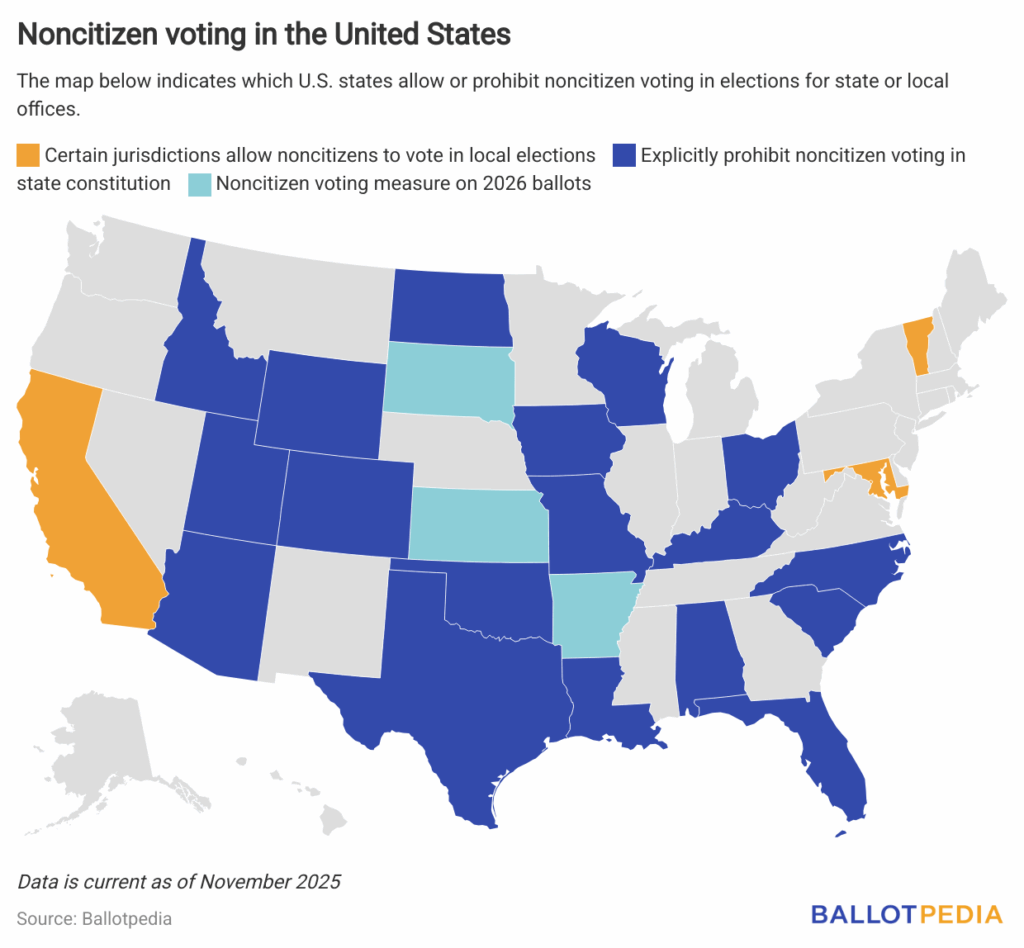
Noncitizens are already prohibited from voting in federal elections, per the Illegal Immigration Reform and Immigrant Responsibility Act, which Congress passed in 1996. However, the law did not address state or local elections. As of 2025, municipalities in three states—California, Maryland, and Vermont—have allowed noncitizens to vote in certain local and school board elections. In 18 states, their constitutions allow citizens, but not noncitizens, the right to vote.
A New York City law that allowed noncitizen voting was overturned in June 2022 by the New York State Supreme Court for Staten Island, ruling that it violated the state's constitution.
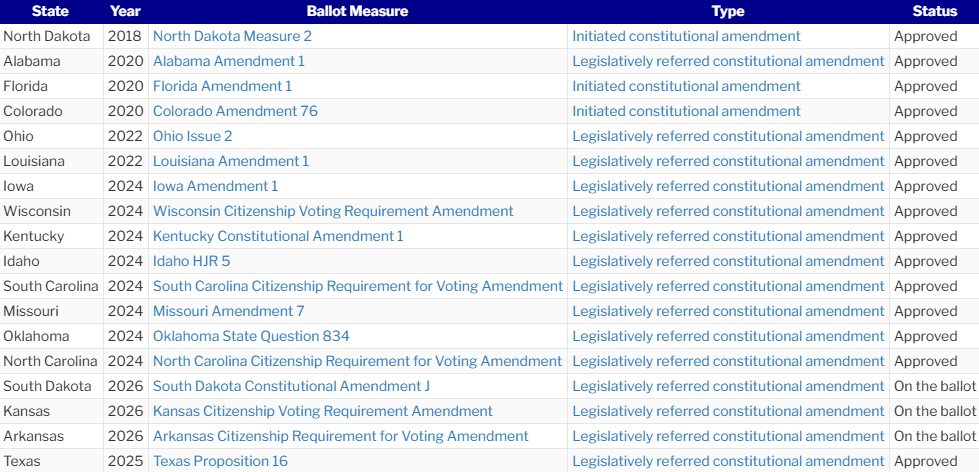
From 2018 to 2025, voters decided on 15 ballot measures that added language about citizenship voting requirements. Voters approved all 15.
Additional reading: