


Welcome to the Wednesday, Dec. 3, 2025, Brew.
By: Lara Bonatesta
Here’s what’s in store for you as you start your day:
- Voters in six states approved 22 constitutional amendments this year, the second most in an odd year since 2011
- Alabama's Jones and Tuberville could become first current or former U.S. senators from opposite parties to face off in a gubernatorial general election
- Thirteen Democrats running in primary for Illinois' 7th Congressional District on March 17
Voters in six states approved 22 constitutional amendments this year, the second most in an odd year since 2011
In 2025, voters in six states–California, New York, Ohio, Texas, Washington, and Wisconsin–approved 22 constitutional amendments. This year had the second-highest number of approved amendments among odd-numbered years from 2011 to 2023. 2023 had the most with 27. Voters defeated four amendments, all of which were in Louisiana.
The 22 amendments added an average of 541 words each to a state’s constitution. The smallest addition was 10 words for a Texas amendment authorizing a tax exemption for income-producing property. The largest addition was another Texas amendment that established a special state fund for the state Technical College System. It added 1,102 words to the state constitution. The amendments removed an average of 31 words. A Texas amendment that made changes to the state judicial oversight commission removed the most, 318 words.
Altogether, the six amended state constitutions became 5,859 words longer. The Texas Constitution grew the most, increasing 4,265 words. The Ohio Constitution grew the second most, increasing 1,033 words.
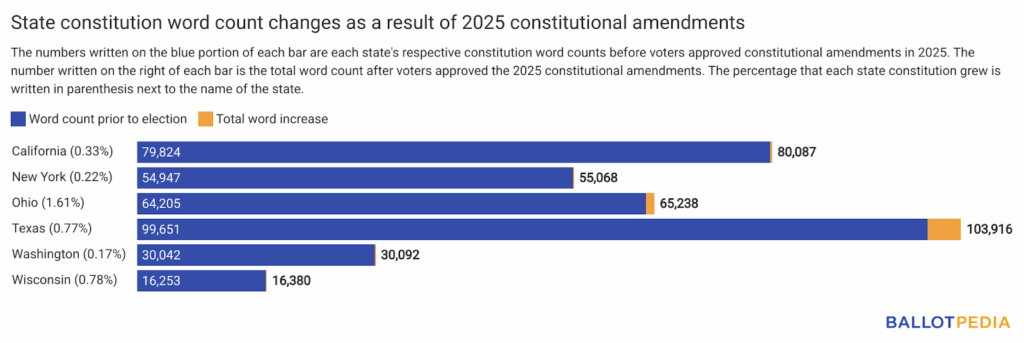
On average, the amendments were approved 63% to 37%. The amendments addressed:
- Redistricting in California
- Administration of state investments in Washington
- Land use in New York
- State tax policy, judicial structure and vacancies, and juvenile sentencing in Louisiana
- A bond issue in Ohio
- A variety of topics in Texas.
This year also had the second-highest number of amendments on the ballot among odd-numbered years from 2011 to 2023, with 26. 2023 had the most with 32. Constitutional amendments made up 87% of the 30 total statewide ballot measures in 2025 — the highest percentage for that period. An average of 23 amendments were decided in odd years from 2011 to 2025.
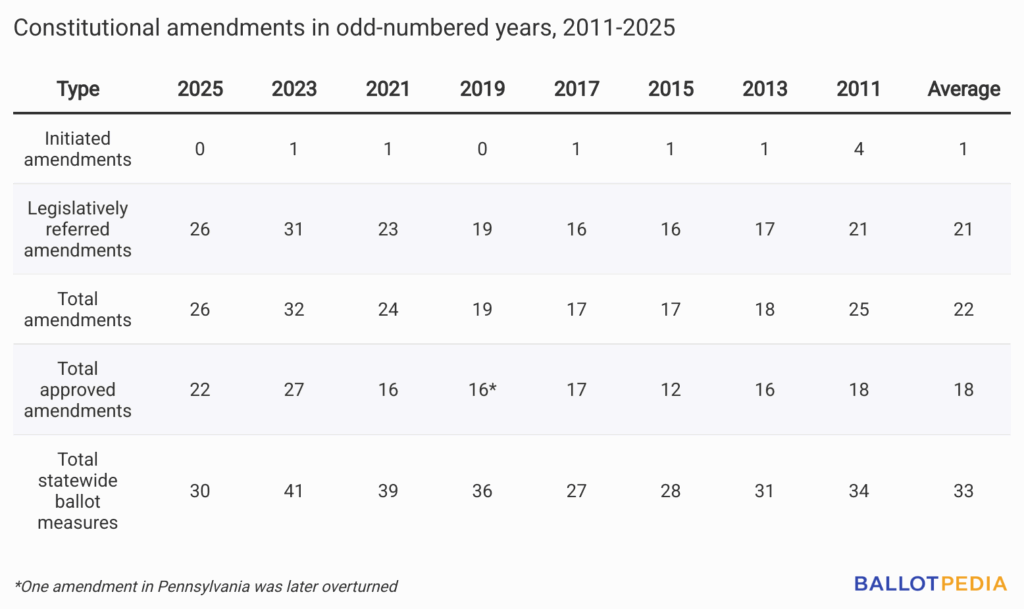
Texas had the most constitutional amendments on the ballot, with 17. All 17 amendments were approved, with support ranging from 57% to 89%. The average approval rate was 70%.
Two amendments in Texas added to or amended the state’s Bill of Rights. Proposition 3 required judges or magistrates to deny bail to individuals accused of certain violent or sexual offenses. It was approved with 61% of the vote. Proposition 15 added a new section to the state’s Bill of Rights saying that parents have the right "to exercise care, custody, and control of the parent’s child, including the right to make decisions concerning the child’s upbringing" and the responsibility "to nurture and protect the parent's child." It was approved with 70% of the vote.
Six of the amendments appeared on ballots before November. This includes the four that were defeated in Louisiana in March, an amendment in Wisconsin to require voter photo ID in April, and a local public infrastructure bond in Ohio in May.
Click here to learn more about 2025 ballot measures.
Alabama's Jones and Tuberville could become first current or former U.S. senators from opposite parties to face off in a governor’s race
On Nov. 24, former U.S. Sen. Doug Jones (D) announced his bid for governor of Alabama. Three other Democrats are also running for the nomination. On the Republican side, U.S. Sen. Tommy Tuberville, who defeated Jones in 2020, and one other Republican are running.
Jones’ entry makes him the fourth current or former U.S. senator running for governor in 2026 alongside Michael Bennet (D-Colo.), Marsha Blackburn (R-Tenn.), and Tuberville. This is the most senators running in one year since 2010, when four senators ran for governor.
Going back to 1913, when states ratified the 17th Amendment to the U.S. Constitution requiring voters rather than state legislatures to directly elect U.S. Senators, there were four years in which four senators ran for governor: 1920, 1954, 2010, and 2026. One other senator, Lisa Murkowski (R-Alaska), has expressed interest in running for governor. If she runs, 2026 would have the most senators running for governor in one year.
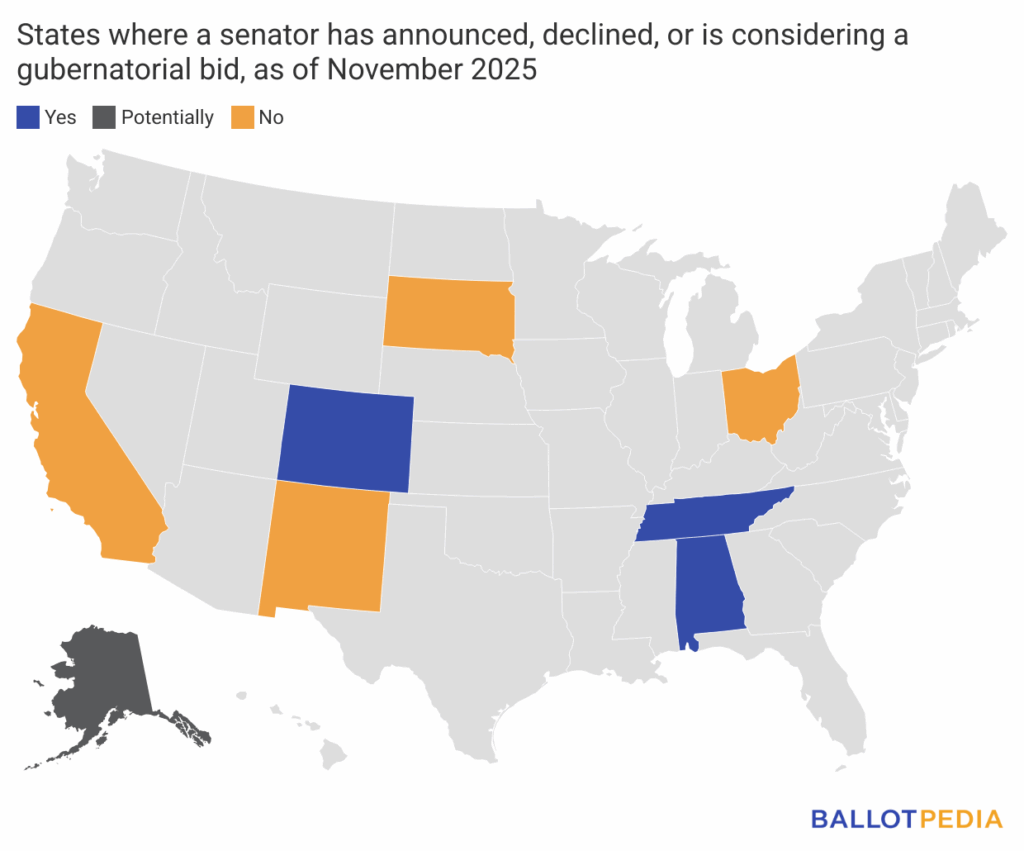
If Jones and Tuberville win their respective primaries, this would be the first gubernatorial election in U.S. history where directly elected current or former Democratic and Republican senators run against each other. Senators have run against each other two other times. In 1936, Elmer Benson defeated Magnus Johnson for the Farmer-Labor nomination for governor of Minnesota, and in 1956, Sen. Price Daniel (D) defeated Sen. W. Lee O’Daniel (D), who ran a write-in campaign for governor of Texas.
Jones and Tuberville are the first U.S. senators from Alabama to run for the state’s governorship. Alabama is one of 18 states where a senator has never been their party’s nominee for governor. Texas Senators have run for governor the most often, with five having sought the office.
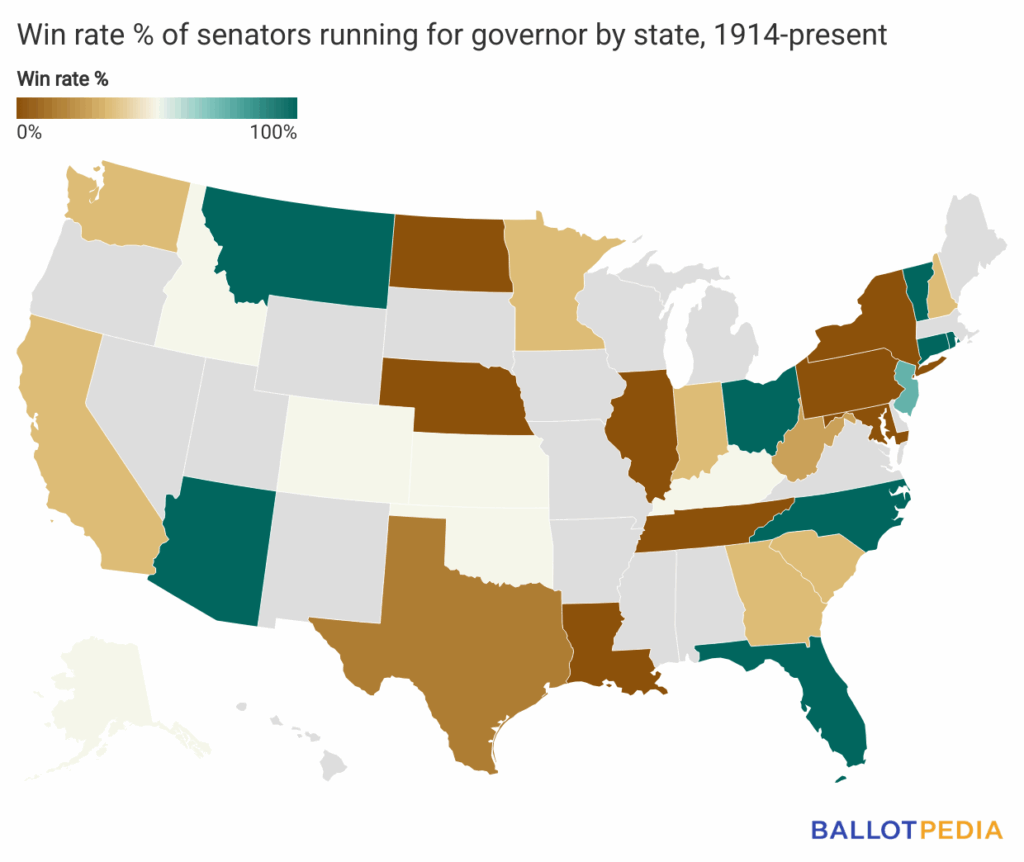
In 69 elections since 1914, senators who ran for governor won 27 times, lost the primary 21 times, and lost the general election 20 times. One senator lost a nominating convention and another lost both the primary and a write-in campaign for the general election.
Click here to see a full list of U.S. Senators who have run for governor since 1914.
Thirteen Democrats running in primary for Illinois' open 7th Congressional District on March 17
Thirteen candidates are running in the Democratic primary for Illinois' 7th Congressional District on March 17, 2026.
Incumbent Danny K. Davis (D) is retiring. The last time the district was open was 1996, when Davis was first elected. In 2024, Davis was re-elected with 83% of the vote. In the 2024 Democratic primary, Davis defeated four other candidates and won 52.4% of the vote. For a list of U.S. Representatives who are not running for re-election in 2026, click here.
The section below lists candidates leading in media attention and fundraising.
Richard Boykin (D) is a lawyer who served on the Cook County Board of Commissioners from 2014 to 2018 and previously was Davis’s chief of staff. Boykin says he would focus on lowering the cost of living and promoting public safety.
Kina Collins (D) is a political organizer. Collins says she supports "Medicare for All, housing as a human right, fair wages, clean air and water, and an economy that centers people over profit."
Melissa Conyears-Ervin (D) is the Chicago City Treasurer and served in the Illinois House from 2017 to 2019. Conyears-Ervin says she would focus on the economy and would support "apprenticeships, fair wages, and local manufacturing." Chicago City Clerk Anna Valencia and former Chicago Mayor Lori Lightfoot endorsed Conyears-Ervin.
Thomas Fisher (D) is an emergency physician. Highlighting his experience as a doctor, Fisher says he supports universal healthcare and would address "inadequate insurance, inflexible jobs, and a frayed safety net." 314 Action endorsed Fisher.
La Shawn Ford (D) is a former teacher and a member of the Illinois House. Ford says he would focus on creating jobs, improving public health, and supporting criminal justice reform. Davis endorsed Ford.
Jason Friedman (D) is the owner and former president of a real estate business. Friedman says he would work to create jobs, support unions, and improve the education system. The Joint Action Committee for Political Affairs endorsed Friedman.
Collins and Conyears-Ervin both ran in previous Democratic primaries for the district. Collins received 14% of the vote in 2020, 46% in 2022, and 19% in 2024. Conyears-Ervin received 21% of the vote in 2024.
As of November 2025, The Cook Political Report with Amy Walter, Inside Elections with Nathan Gonzales, and Larry J. Sabato's Crystal Ball each rated the general election Safe/Solid Democratic.
Also running are Anthony Driver Jr. (D), David Ehrlich (D), Rory Hoskins (D), Anabel Mendoza (D), Jazmin Robinson (D), Reed Showalter (D), and Felix Tello (D).
Click here to see our full coverage of the Democratic primary for Illinois’ 7th Congressional District.