


On Dec. 11, 2025, the Indiana Senate voted 31-19 against a new congressional map that would have shifted the state’s two Democratic U.S. House districts toward Republicans ahead of the 2026 elections. Twenty-one Republicans joined the chamber’s 10 Democrats in voting against the bill.
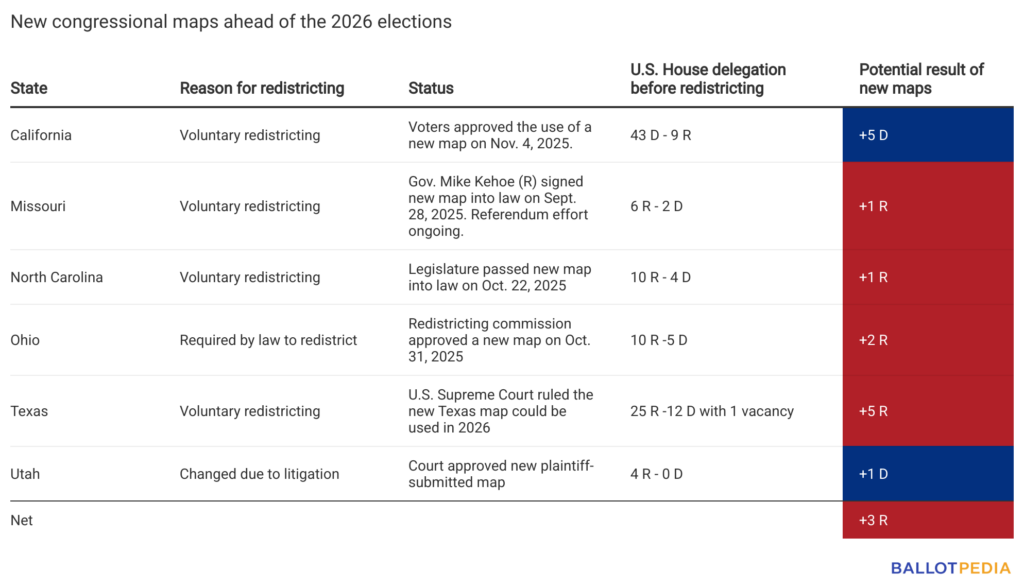
The vote against redistricting came despite pressure from the White House and political organizations to pass the new map and amid reports that the Trump administration suggested the state’s federal funding could depend on the map's passage. The new map would have expanded Republicans’ nationwide gains from redistricting from three to five districts.
Vice President JD Vance (R) first visited Indiana Republicans in August to discuss redistricting. Later that month, Indiana Republicans visited the White House for further conversation. Vance returned to the state in October, followed by a phone call from President Donald Trump (R) to state senators on Oct. 17.
On Oct. 27, 2025, Gov. Mike Braun (R) called a special session for mid-decade congressional redistricting to begin Nov. 3, 2025. On Nov. 3, Indiana lawmakers announced the General Assembly would instead meet early for its regular session. Senate President Pro Tempore Rodric Bray (R) said in a statement, “Making this shift allows the legislature to consider the topics presented to us in a thoughtful way without burdening Hoosier taxpayers with the cost of a special session.”
On Dec. 1, 2025, Indiana House Republicans released a draft congressional map aimed at producing nine Republican districts, a net gain of two from the existing map’s seven Republican districts and two Democratic districts. The House passed the bill by a 57-41 vote on Dec. 5, 2025, sending it to the state Senate.
On Dec. 9, two days before the Senate voted against redistricting, the Indiana Capital Chronicle’s Nikki Kelly reported that a group called Fair Maps Indiana Action had formed to influence the Indiana state legislative elections in 2026 according to members’ redistricting votes. The organization said, “For those that vote yes, we will be there to support their campaigns. For those that vote no, we will ensure that they will have a quality, well-funded opponent and those members are defeated in May.”
The week prior, Turning Point Action enterprise director Brett Galaszewski said at a Statehouse event that if the redistricting bill failed, “Turning Point Action is willing to throw more money and resources into these primary races than some congressional races.” At the same event, Gov. Braun said failure to redistrict “means you’re gonna have to clean house to get real conservatives in.”
On Dec. 11, Donald Trump Jr. wrote on X, “If Indiana Republicans side with these Never Trumpers to do the dirty work of Democrats, I'll be spending a lot of time in Indiana next year campaigning against every single one of them.” After the bill failed in the Indiana Senate, President Trump said he would “certainly support anybody that wants to go against [Bray]” in his next primary election.
All 100 of the Indiana House seats and half of the 50 Indiana Senate seats—not including Bray’s, whose current term ends in 2028—are up for election next year.