


Welcome to the Wednesday, Dec. 17, 2025, Brew.
By: Lara Bonatesta
Here’s what’s in store for you as you start your day:
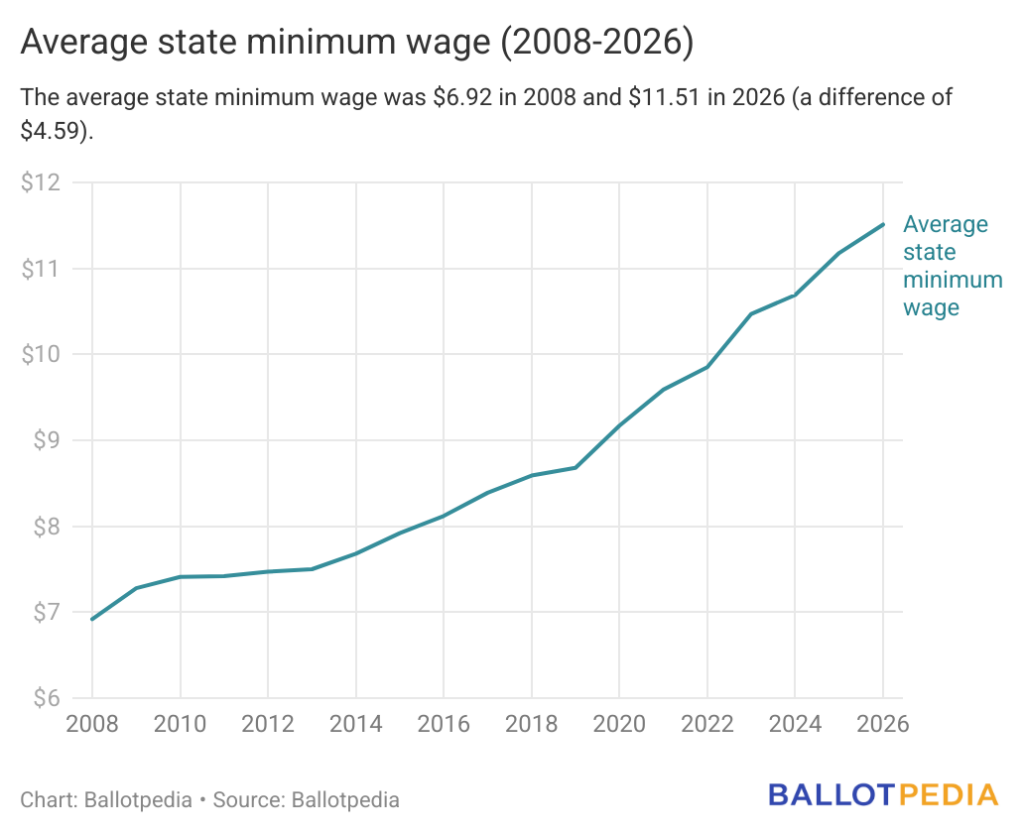
- Minimum wage set to increase in 22 states and D.C., raising the nationwide average to $11.51 an hour
- Fifty members of Congress have announced they will not seek re-election in 2026—the most at this point since 2018
- Indiana Senate votes against new congressional map
Minimum wage set to increase in 22 states and D.C., raising the nationwide average to $11.51 an hour
In 2026, the minimum wage will increase in 22 states and Washington, D.C. The increases range from $0.28 an hour in Minnesota to $2.00 an hour in Hawaii.
The 2026 increases come from existing state laws that provided for incremental increases and inflation adjustments. Lawmakers in Rhode Island and Michigan passed new minimum wage laws this year.
Nineteen states will have increases take effect on Jan. 1, 2026. Increases in Alaska, Oregon, and Washington, D.C., take effect on July 1. Florida’s minimum wage increase takes effect on Sept. 30.
Once all increases take effect, the average state minimum wage, including D.C., will be $11.51 an hour, up from $11.18 an hour in 2025. In states with increases, the minimum wage increased by an average of $0.70 an hour.
Highest and lowest minimum wages
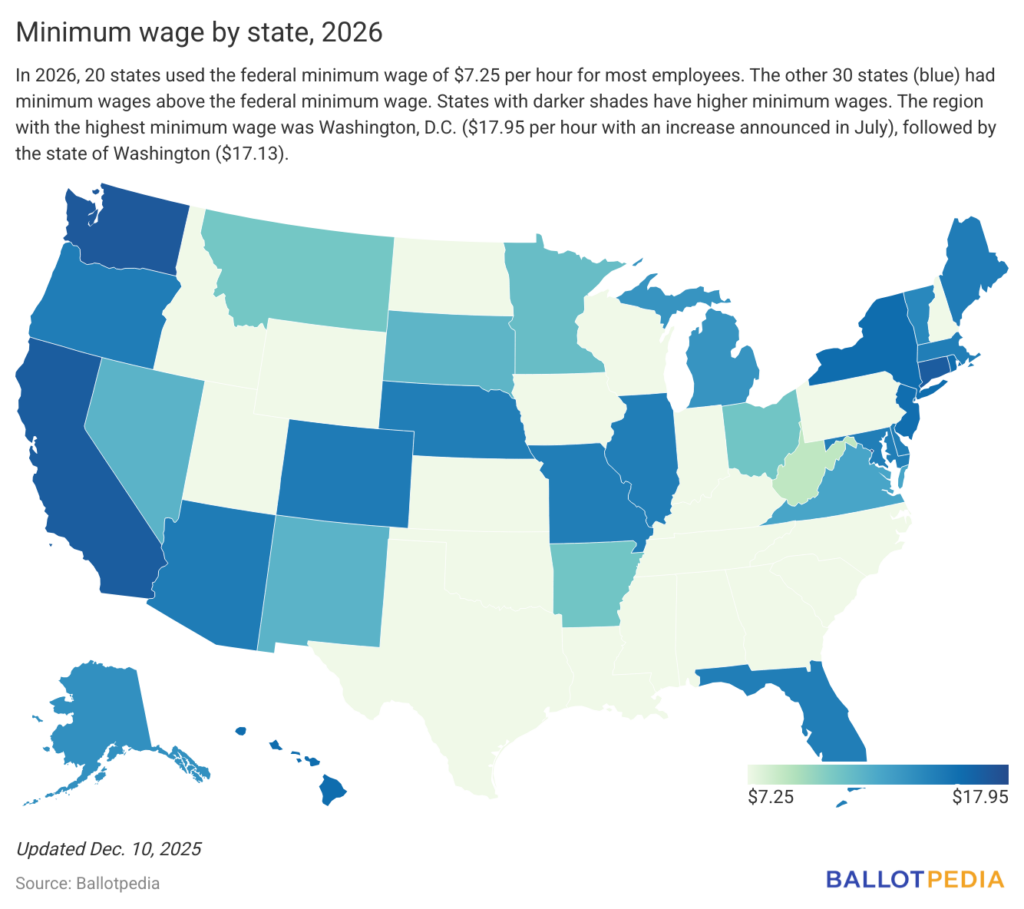
Washington, D.C., will have the highest minimum wage in the country. D.C.’s current minimum hourly wage of $17.95 took effect in July 2025. The next inflation-adjusted increase will take effect in July 2026. The highest state minimum wages will be in Washington ($17.13 per hour), Connecticut ($16.94), and California ($16.90).
Georgia and Wyoming have the lowest minimum wages in the country. Both states’ $5.15 minimum wages are superseded by the federal government’s $7.25 per hour requirement. Going into 2026, 20 states use the federal minimum hourly wage of $7.25. Thirty states have state minimum wages that are more than the federal minimum.
Largest and smallest increases in 2026
Hawaii will have the largest increase in 2026, rising $2 (14.3%) from its current hourly rate of $14 to the new rate of $16 on Jan. 1. A state law passed in 2022 mandates the increase. Hawaii’s minimum wage will increase to $18 per hour by 2028.
Minnesota will have the smallest increase in 2026, with the state’s minimum wage increasing by $0.28 an hour. Due to a 2014 state law, the minimum wage in Minnesota has been adjusted for inflation each year since 2018.
Minimum wage ballot measures:
There were no state ballot measures concerning minimum wage in 2025.
In June 2026, Oklahoma voters will decideState Question 832. The initiative would increase the minimum wage to $12 per hour in 2027, $13.50 in 2028, and $15 in 2029. After 2029, the yearly increase would be calculated according to the Consumer Price Index.
From 1996 to 2025, there were32 ballot measures to increase state minimum wages. Voters approved 28 (87.50%) and rejected four (12.50%).
Click here to read more about minimum wage increases in 2026.
Fifty members of Congress have announced they will not seek re-election in 2026—the most at this point since 2018
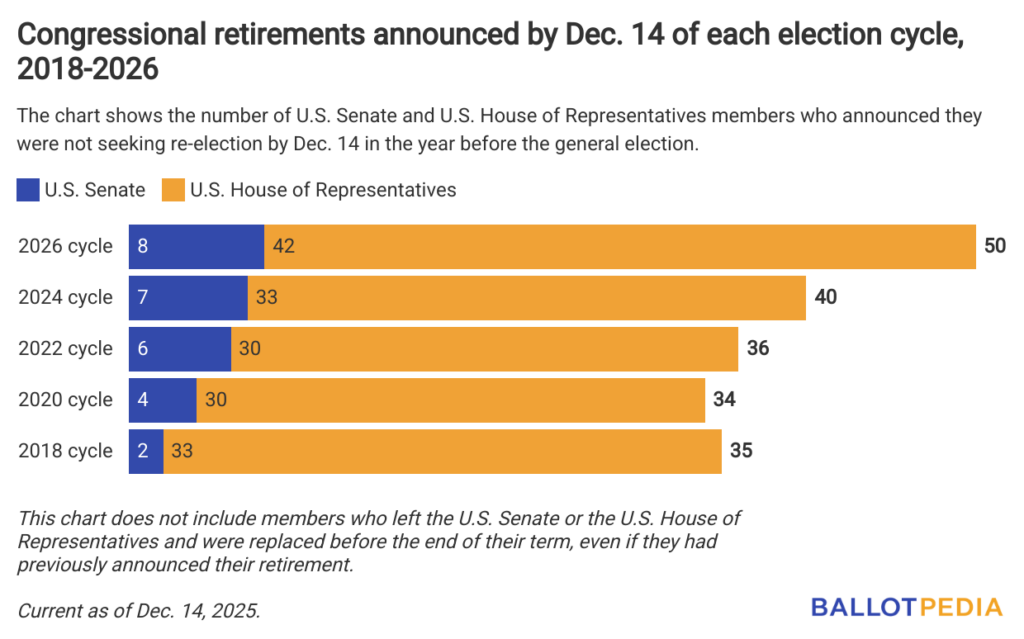
Fifty members of Congress—42 representatives and eight senators—have announced they will not seek re-election in 2026. That’s the most retirement announcements at this point in an election cycle since 2018.
Since our Nov. 11 update, five U.S. House members have announced they will not seek re-election. Here’s a list and how independent election forecasters have rated the 2026 general election for each district these incumbents currently represent. (Note: California and Texas both redrew their congressional maps in 2025. The following ratings are for the redrawn maps, which will be used in the 2026 elections.)
- Rep. Jasmine Crockett (D-Texas) announced on Dec. 8 that she will run for the Democratic U.S. Senate nomination. Election forecasters have rated the election for the House district as either Solid or Safe Democratic.
- Rep. Marc Veasey (D-Texas) announced on Dec. 8 that he is retiring from public office. Election forecasters have rated the election for the district as either Solid or Safe Democratic.
- Rep. Troy Nehls (R-Texas) announced on Nov. 29 that he is retiring from public office. Election forecasters have rated the election for the district as either Solid or Safe Republican.
- Rep. Eric Swalwell (D-Calif.) announced on Nov. 21 that he will run for governor of California. Election forecasters have rated the election for the district as either Solid or Safe Democratic.
- Rep. Nydia Velazquez (D-N.Y.) announced on Nov. 20 that she is retiring from public office. Election forecasters have rated the election for the district as either Solid or Safe Democratic.
U.S. House of Representatives
Forty-two representatives—19 Democrats and 23 Republicans—will not seek re-election in 2026. Of the 42 members not seeking re-election:
- Sixteen—11 Democrats and five Republicans—are retiring from public office.
- Thirteen—seven Democrats and six Republicans—are running for the U.S. Senate.
- Twelve—one Democrat and 11Republicans—are running for governor.
- One Republican is running for attorney general of Texas.
At this point in the last four election cycles, there were 33 retirement announcements in 2024, 30 in 2022, 30 in 2020, and 33 in 2018.
Five of the 42 retiring representatives—two Democrats and three Republicans—won by 10 percentage points or fewer in 2024. Three representatives—Jared Golden (D-Maine), Don Bacon (R-Neb.), and David Schweikert (R-Ariz.)—won by fewer than five percentage points.
U.S. Senate
Eight members of the U.S. Senate—four Democrats and four Republicans—announced they will not seek re-election in 2026. Sens. Joni Ernst (R-Iowa), Thom Tillis (R-N.C.), Dick Durbin (D-Ill.), Mitch McConnell (R-Ky.), Jeanne Shaheen (D-N.H.), Tina Smith (D-Minn.), and Gary Peters (D-Mich.) are retiring from public office. Sen. Tommy Tuberville (R-Ala.) is running for governor of Alabama.
At this point in the last four election cycles, there were seven retirement announcements in 2024, six in 2022, four in 2020, and two in 2018.
Looking at the last time those eight senators ran in 2020, four of them—two Democrats and two Republicans—won by 10 percentage points or less. Two of five senators—Tillis and Peters—won by less than five percentage points.
Click here to read more about members of Congress who are not seeking re-election in 2026. Plus, check out our recent episode of On The Ballot about the redistricting in Texas, and how that state’s U.S. House delegation is responding.
Indiana Senate votes against new congressional map
On Dec. 11, the Indiana Senate voted 31-19 against a new congressional map that would have shifted the state’s two Democratic U.S. House districts toward Republicans ahead of the 2026 elections. Twenty-one Republicans joined the chamber’s 10 Democrats in voting against the bill.
The redrawn map was intended to expand the number of Republicans in Indiana’s U.S. House delegation from seven to nine.
The table below shows states that have addressed redistricting this year, as well as the potential partisan gains from those efforts.
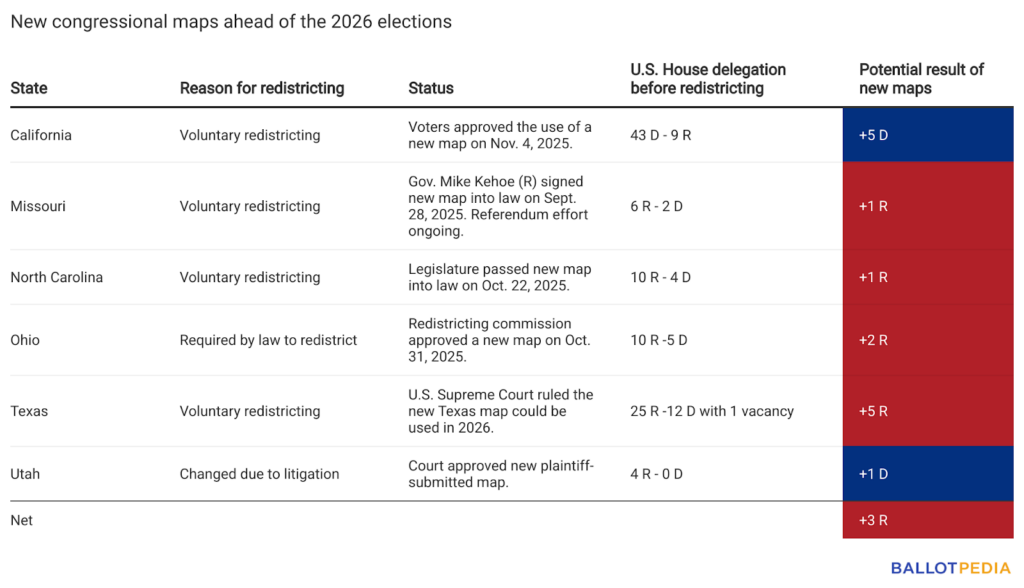
Litigation over redistricting continues in several states. Additionally, Missouri voters may decide on a veto referendum to repeal the state's new congressional map in 2026.
Indiana’s vote on redistricting occurred against the backdrop of a combined effort of the White House and allied organizations in support of the new map. News reports said the Trump administration had told several lawmakers it would withhold federal funding if the new map was not approved.
On Oct. 27, Gov. Mike Braun (R)called a special session for mid-decade congressional redistricting to begin Nov. 3. On Nov. 3, Indiana lawmakers announced the General Assembly would instead meet early for its regular session. Senate President Pro Tempore Rodric Bray (R)said in a statement, “Making this shift allows the legislature to consider the topics presented to us in a thoughtful way without burdening Hoosier taxpayers with the cost of a special session.”
On Dec. 1, Indiana House Republicans released a draft congressional map aimed at producing nine Republican districts, a net gain of two from the existing map’s seven Republican districts and two Democratic districts. The House passed the bill 57-41 on Dec. 5, sending it to the state Senate.
After the bill failed in the Indiana Senate, President Trump said he would “certainly support anybody that wants to go against [Bray]” in his next primary election.
All 100 Indiana House seats and 25 of the 50 Indiana Senate seats—not including Bray’s, whose current term ends in 2028—are up for election next year.
Click here to learn more about redistricting ahead of the 2026 elections.