


Welcome to Hall Pass, a newsletter written to keep you plugged into the conversations driving school board governance, the politics surrounding it, and education policy.
🧑🎄 A note to readers: We’ll return to your inbox again on Jan. 7, 2026. Thanks, as always, for reading, and we’ll see you in the New Year! Please take our survey, provided below, to tell us what topics, stories, and issues you’d like us to cover next year. Happy Holidays!
In today’s edition, you’ll find:
- On the issues: The debate over the state of K-12 student literacy
- Take our year-end survey and tell us what you hope to see in this newsletter in 2026!
- School board filing deadlines, election results, and recall certifications
- The top five Hall Pass education stories of 2025
- Extracurricular: education news from around the web
- Candidate Connection survey
Reply to this email to share reactions or story ideas!
On the issues: The debate over the state of K-12 student literacy
In this section, we curate reporting, analysis, and commentary on the issues school board members deliberate when they set out to offer the best education possible in their district. Missed an issue? Click here to see the previous education debates we’ve covered.
Is America in the midst of a literacy crisis?
Furman University education professor Paul L. Thomas says the country is not in a literacy crisis. Thomas says the claim that a large share of K-12 students struggle to read is based on a misunderstanding of the National Assessment of Educational Progress (NAEP), popularly known as the Nation’s Report Card. Thomas argues that the test, which the U.S. Education Department administers in all 50 states, holds students to a higher standard than most state-based assessments, overstating the percentage who are failing to meet expectations. Thomas says overheated concerns about a crisis in reading distract from the real problem — that disadvantaged students lack resources and opportunities. Thomas recommends that states and the federal government work together on a shared definition of proficiency based on age rather than grade level.
Idrees Kahloon, a staff writer for The Atlantic, says NAEP scores show a growing share of fourth- and eighth-grade students, particularly those at the bottom of the distribution, are falling behind on reading after years of improvement at the turn of the century. Kahloon considers different theories about why student achievement might be declining, such as the claim that K-12 public schools don’t receive enough funding or that cellphones and social media are rewiring kids’ brains. Ultimately, Kahloon says the most likely explanation is that the federal government and state education departments stopped holding districts accountable for student outcomes, and districts stopped holding students to high standards.
There is no reading crisis in the U.S. Here’s what’s really happening. | Paul L. Thomas, The Washington Post
“The NAEP has been a key mechanism for holding states accountable for student achievement for over 30 years. Yet, educators have expressed doubt over the assessment’s utility. In 2004, an analysis by the American Federation of Teachers raised concerns about the NAEP’s achievement levels: ‘The proficient level on NAEP for grade 4 and 8 reading is set at almost the 70th percentile,’ the union wrote. ‘It would not be unreasonable to think that the proficiency levels on NAEP represent a standard of achievement that is more commonly associated with fairly advanced students.’”
“The NAEP has set unrealistic goals for student achievement, fueling alarm about a reading crisis in the United States that is overblown. The common misreading of NAEP data has allowed the country to ignore what is urgent: addressing the opportunity gap that negatively impacts Black and Brown students, impoverished students, multilingual learners, and students with disabilities.”
America Is Sliding Toward Illiteracy | Idrees Kahloon, The Atlantic
“An explanation that deserves equal consideration is what one might call the low-expectations theory. In short, schools have demanded less and less from students—who have responded, predictably, by giving less and less. The timing lines up here, too. Around the same time that smartphones were taking off, a counterrevolution was brewing against the old regime of No Child Left Behind, the George W. Bush–era law passed in 2002 that required schools to set high standards and measured school progress toward them through stringent testing requirements. Bush famously said that he wanted to tackle ‘the soft bigotry of low expectations,’ and there’s real evidence that he did.
“As controversial as it was, No Child Left Behind coincided with increased school performance, especially for those at the bottom. That’s not to say the regime was perfect. The No Child Left Behind approach to struggling schools was largely punitive, including threats of mandatory restructuring for institutions that failed to meet targets. And expectations for progress rose higher and higher each year, ultimately seeding the demise of the law. Schools were supposed to have all their kids at grade level by 2014. But as this deadline approached, it became clear that schools would miss it. In 2012, the Obama administration began giving states waivers from the requirements. Then, in 2015, Congress passed the Every Student Succeeds Act, which returned responsibility for improving low-performing schools to the states. But according to Martin West, the academic dean of Harvard’s education school, ‘most states have not been particularly ambitious in the design of those systems.’”
Take our year-end survey and tell us what you hope to see in this newsletter in 2026!
K-12 education policy will continue to be front of mind for many policymakers at the federal, state, and local levels in 2026. There will be district and state budget issues, the Trump administration’s changes to federal education policy, efforts to advance early literacy policies, private and public school choice legislation, college and career readiness initiatives, debates about AI in the classroom, and much more.
We want to hear from you—tell us what stories and topics you’re most interested in seeing Ballotpedia cover. Please share your thoughts in a brief survey!
School board update: filing deadlines, election results, and recall certifications
In 2025, Ballotpedia covered elections for more than 30,000 school board seats. We’re expanding our coverage each year with our eye on covering the country’s more than 80,000 school board seats.
Below is an early look at the elections coming down the pike in the first part of 2026.
Upcoming school board elections
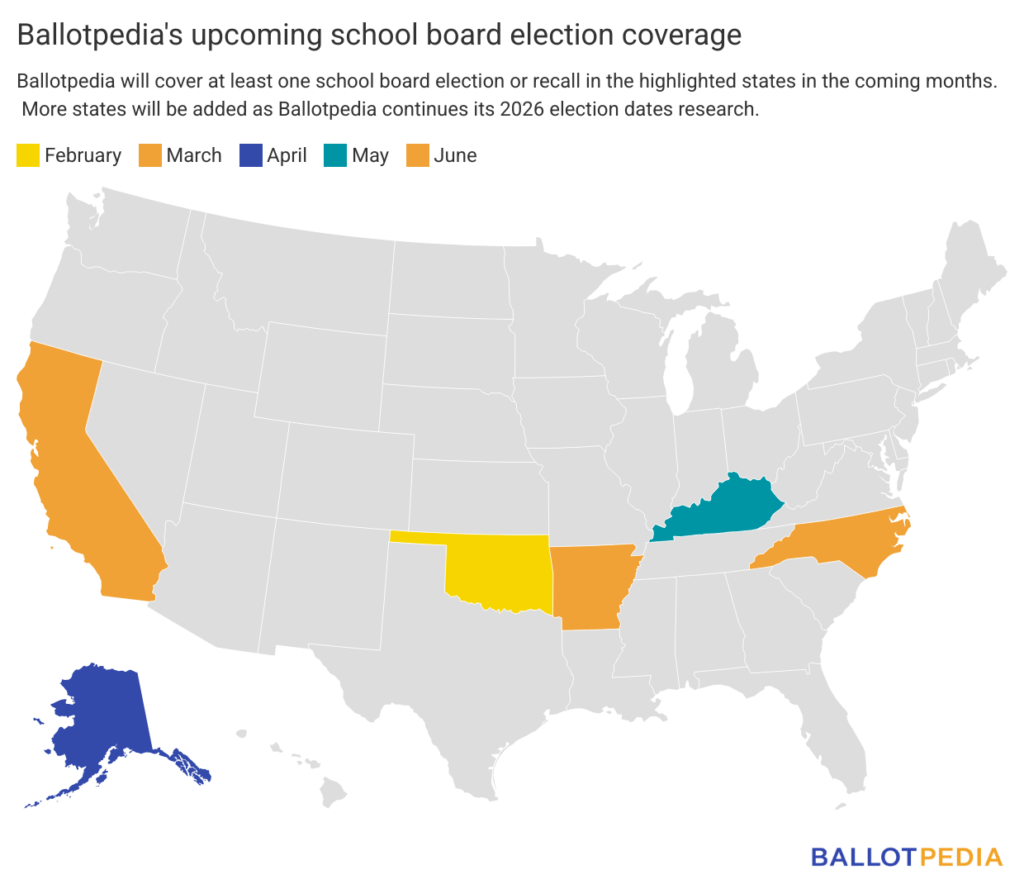
- Oklahoma: School districts across the state will hold primaries on Feb. 10 and general elections on April 7. In Oklahoma, elections are canceled if only one candidate runs for a seat. If there are two candidates, the primary is canceled and both advance to a general election. If there are more than two candidates, a candidate can win the primary outright with more than 50% of the vote. When that doesn’t happen, the two top vote-getters advance to the general.
- Arkansas: Ballotpedia will cover general elections for all seven of the seats on the Little Rock School District school board on March 3. Little Rock School District is the second largest in the state, with roughly 21,000 students.
- North Carolina: Ballotpedia will cover elections for several districts, including Guilford County Schools and Union County Public Schools, on March 3.
Fourteen states have school board elections in November of even-numbered years
The country’s roughly 13,000 public school districts hold school board elections at varying times. In some states, the law mandates a specific date. In others, laws allow districts to choose their own election date from a range or a list of allowed dates or through charter provisions.
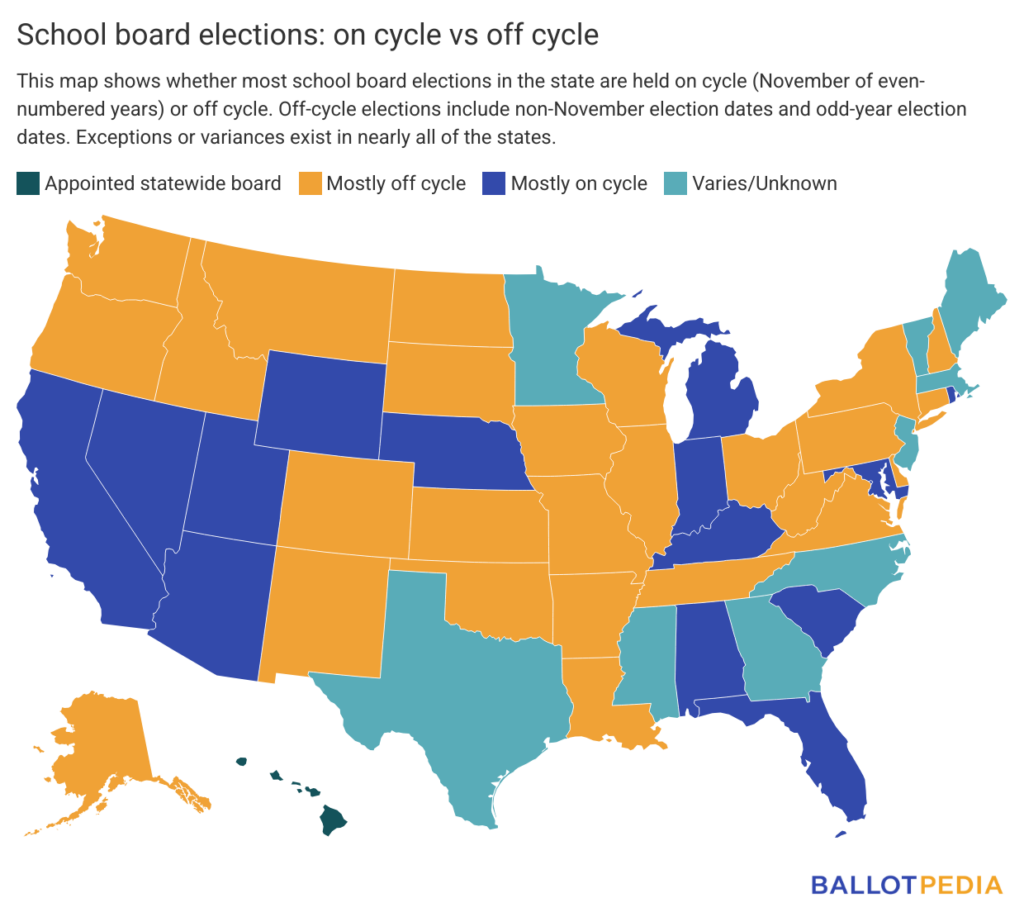
- 25 states have school board elections that are mostly held off cycle from federal elections. This includes both off-year and off-date elections.
- 10 of those states have school board elections that are mostly or at least commonly held on election dates in November of odd-numbered years.
- 16 of those states have school board elections mostly or at least commonly held on election dates that are not in November.
- 9 states either do not have state laws or overwhelmingly common practices that determine a specific school board election date or have varying school board election dates.
- Hawaii has a single, appointed school board.
Click here to learn more about school board election timing.
The top five Hall Pass education stories of 2025
Another year has—almost—come and gone! Thank you for joining us in this newsletter—we’re grateful to have you as a subscriber.
Every Wednesday, since early 2022, we’ve helped you understand the debates shaping education and make sense of school board politics. As we close out the year, let’s take a look back at our top stories. Click to find our 2022, 2023, and 2024 top stories.
Ballotpedia launches new portal on school choice in rural districts (April)
Private school choice has been one of the most talked-about K-12 education policy topics in the country over the last three years, as Republican-led states have expanded programs that provide government funding for private educational expenses. Debates about school choice, whether in legislatures, op-eds, or academic journals, frequently center on how the policies affect rural areas, where private schools are typically less common than in cities and school districts employ a disproportionate share of the local workforce.
In this story, we highlighted Ballotpedia’s new rural school choice portal, a comprehensive resource on how private school choice programs affect rural school districts. The portal includes data and academic studies on the effect the programs have on rural districts, a breakdown of the arguments for and against such programs, a state-by-state analysis of how lawmakers vote on school choice legislation, and much more.
U.S. Supreme Court rules 6-3 in favor of Maryland parents who wished to opt their children out of elementary school lessons with LGBTQ themes(July)
Several cases relating to K-12 education reached the U.S. Supreme Court (SCOTUS) this year, but none received more attention than Mahmoud v. Taylor. Mahmoud concerned whether public elementary schools can prohibit parents from opting their children out of classes that deal with themes of gender and sexuality.
In a 6-3 ruling, SCOTUS sided with a group of Muslim, Roman Catholic, and Ukrainian Orthodox parents within Montgomery County Public Schools, in Maryland, ruling the district’s policies of declining to notify parents of upcoming lessons with LGBTQ themes and allow students to opt out of class during those periods violated the parents’ right to the free exercise of their religion.
We explored the case’s background, the legal issues at play, the majority and dissenting opinions, and reactions to the ruling from the left and right.
University of Oregon review finds the four-day school week has mixed to negative effects on student outcomes (July)
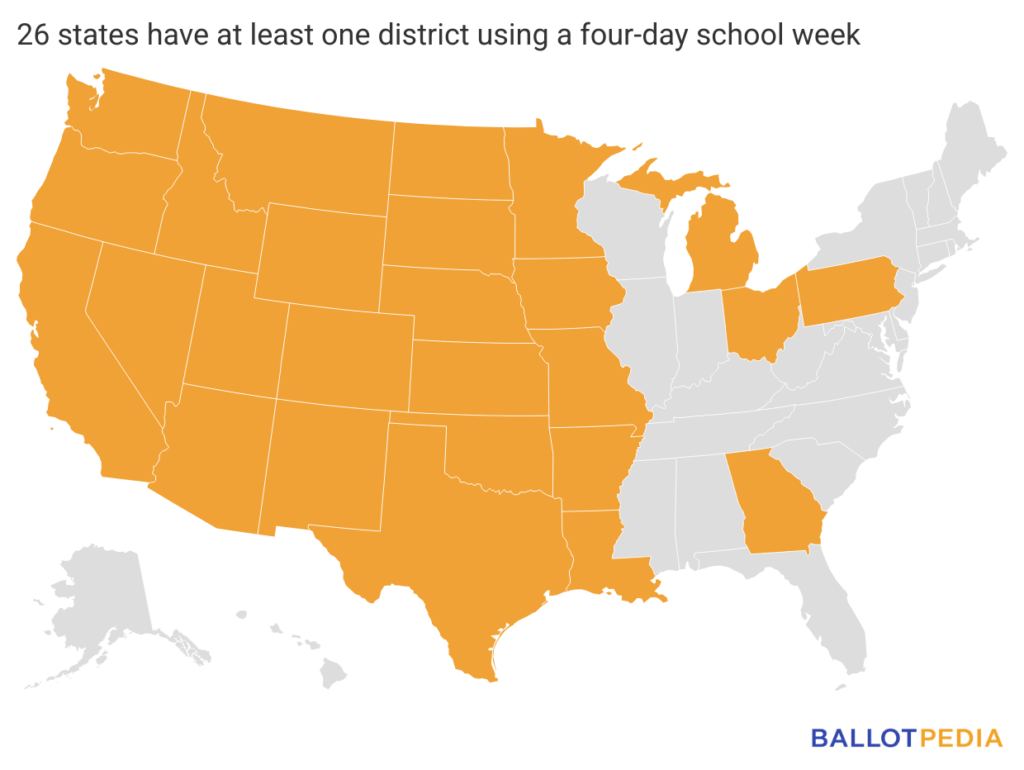
Earlier this month, Toledo Public Schools, the fifth largest district in Ohio, released a proposal for a four-day school week that would run from Tuesday to Friday. The district said the shorter week would reduce costs and help it attract and keep teachers.
Even though the schedule is becoming more popular, there is much that is still unclear about how it affects learning outcomes and other aspects of education. In this story, we looked at a new University of Oregon analysis of 11 peer-reviewed studies on how the four-day school week affects student achievement. Here’s a teaser: The review found mixed results for rural districts and mostly negative results for those in suburban and urban areas.
The right of first refusal: charter school access to district property (September)
Charter schools are funded by taxes, but they’re usually not guaranteed operating facilities. Charter school operators may try to buy vacant property that school districts put up for sale. However, districts have occasionally used deed restrictions and other tools to prevent buyers from turning school district facilities into charters.
In at least 14 states, lawmakers have tried to neutralize this strategy by giving charter schools a right of first refusal to school district property put up for sale. Only after charter school organizations have turned down the property can districts offer it to a wider category of potential buyers.
We looked at the political context and debate around right of first refusal laws and where they apply to charter schools.
Twenty-two states have restricted student cellphone use in K-12 public schools this year (November)
Few education topics loomed as large in state legislatures this year as K-12 cellphone restrictions. Indeed, states enacted laws regulating public school student cellphone usage at seven times the rate in 2025 as they did from 2023 to 2024.
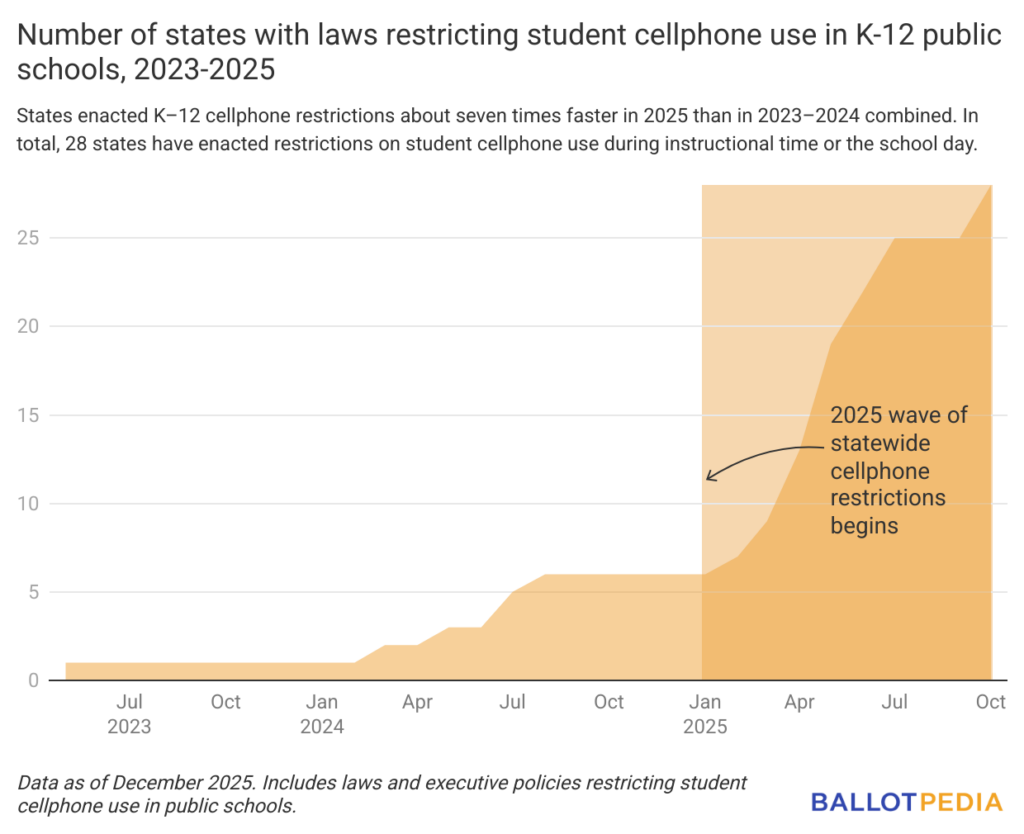
In this story, we looked back at the 22 states that passed restrictions this year, why Wisconsin Democrats were divided over the state’s new cellphone law, and in which states lawmakers could pass new legislation.
Extracurricular: education news from around the web
This section contains links to recent education-related articles from around the internet. If you know of a story we should be reading, reply to this email to share it with us!
- How Can Los Angeles’ Schools Have a Looming $1.6B Deficit With $19B in Revenues? | The 74 Million
- How the Phone Ban Saved High School | New York Magazine
- School district consolidation: Wisconsin, Pennsylvania join Ohio in debate | Cleveland.com
- The decline of human flourishing and what schools can do about it | Fordham Institute
- MSCS board members sue election commission over shortened terms | Commercial Appeal
- Moving Federal Education Programs Will Create More Bureaucracy, Not Less | Center for American Progress
- Another school board leaves transgender policy in place despite Maine’s lawsuit | Bangor Daily News
- Mead School Board approves new policy limiting classroom decor, teacher comments that espouse personal beliefs | The Spokesman-Review
Take our Candidate Connection survey to reach voters in your district
We’re highlighting noteworthy or thought-provoking responses to our Candidate Connection survey from this year’s school board election winners. The responses illuminate the range of experiences and viewpoints these elected officials bring to their districts.
If you're a school board candidate or incumbent planning to run in 2026, click here to take the survey. The survey contains more than 30 questions, and you can choose the ones you feel will best represent your views to voters. If you complete the survey, a box with your answers will appear in your Ballotpedia profile. Your responses will also appear in our sample ballot.
If there is an election next year in your community, share the link with your candidates and urge them to take the survey!
Maria Benzon is a member-elect of the Houston Independent School District (HISD) in Texas. She defeated Robbie McDonough 63-37% on Nov. 4. Benzon’s career experience includes working as an assistant principal, a professor at the University of Houston, and a math teacher.
HISD is the largest district in the state, with roughly 184,000 students.
Here’s how Benzon answered the question, “If you could be any fictional character, who would you want to be?”

“I’d be Ms. Frizzle from The Magic School Bus. She’s fearless, creative, and always puts her students first. She takes learning beyond the classroom and shows kids that curiosity and courage can open any door. That’s the kind of educator and leader I strive to be: someone who makes learning an adventure and helps others see their own potential.”
Click here to read the rest of Benzon’s responses.
Nicholas St. John a member-elect of the Manchester School District Board of School Committee in New Hampshire. He assumes office in 2026. St. John’s career experience includes working as a scientist.
Manchester School District is the largest in the state, with roughly 12,000 students.
Here’s how St. John answered the question, “What role should artificial intelligence have in your school district?”

“Artificial intelligence should serve as a tool to enhance learning, streamline operations, and support data-driven decision-making while maintaining ethical safeguards. In classrooms, AI can personalize instruction by analyzing student performance in real time, identifying gaps, and recommending tailored resources to accelerate growth. It can assist teachers with administrative tasks—grading, attendance, lesson planning—freeing more time for direct student engagement. District-wide, AI can optimize resource allocation, predict enrollment trends, and support early interventions for at-risk students. Crucially, AI use must include transparency, privacy protections, and teacher oversight to prevent bias or overreliance. Additionally, AI literacy should be part of the curriculum, equipping students with skills to understand, evaluate, and ethically apply these technologies in the real world. The goal is not to replace educators but to empower them and students, making learning more adaptive, efficient, and equitable.”
Click here to read the rest of St. John’s responses.