


Welcome to the Friday, Dec. 19, 2025, Brew.
By: Lara Bonatesta
Here’s what’s in store for you as you start your day:
- President Trump signed a record number of Congressional Review Act resolutions in 2025
- It’s your turn — tell Ballotpedia what you think, by Leslie Graves, Ballotpedia Founder and CEO
- Kicking off “12 Days of Ballotpedia”
- Elections Ballotpedia is covering in January 2026
President Trump signed a record number of Congressional Review Act resolutions in 2025
On Dec.11, President Donald Trump (R) signed five resolutions of disapproval under the Congressional Review Act (CRA) into law, bringing the total number he has signed this year to 22. That's more in a single year than all previous presidents combined since the CRA became law. The resolutions disapproved of Bureau of Land Management (BLM) resource management plans for areas of North Dakota, Montana, Wyoming, and northern and central Alaska.
The Congressional Review Act (CRA), which President Bill Clinton (D) signed into law in 1996, allows Congress to review and reject newly created agency rules.
Under the act, Congress has 60 working days to review any new rule, and both chambers have the chance to pass a joint resolution of disapproval. The president can then sign or veto the resolution. If the president signs it, the rule is overturned, and the agency that created it cannot issue a similar rule in the future.
Under the CRA, agency rules are subject to congressional review, with various exceptions for rules on internal agency matters. Agencies decide which actions to send to Congress as rules. When members of Congress disagree with such agency decisions, they may consult the Government Accountability Office (GAO) for an opinion about whether an agency should submit its action to Congress as a rule under the CRA. Congress’ 60-day window to review a rule begins when an agency submits it for review, even if the agency action took place some time before this.
Congressional use of the CRA has increased significantly since 2017. The CRA has been used to repeal 42 rules in its nearly 30-year history, mostly during the last few years. Between his two administrations, Trump has now signed 95% of all CRA resolutions that have become law (38 of 42).
Between 1996 and 2016, Congress passed six resolutions of disapproval. President George W. Bush (R) signed one, and President Barack Obama (D) vetoed five. During the first Trump administration, Congress passed 17 resolutions of disapproval. President Trump signed 16 resolutions and vetoed one. Congress passed 14 resolutions of disapproval during the Biden administration. Biden signed three resolutions and vetoed 11.
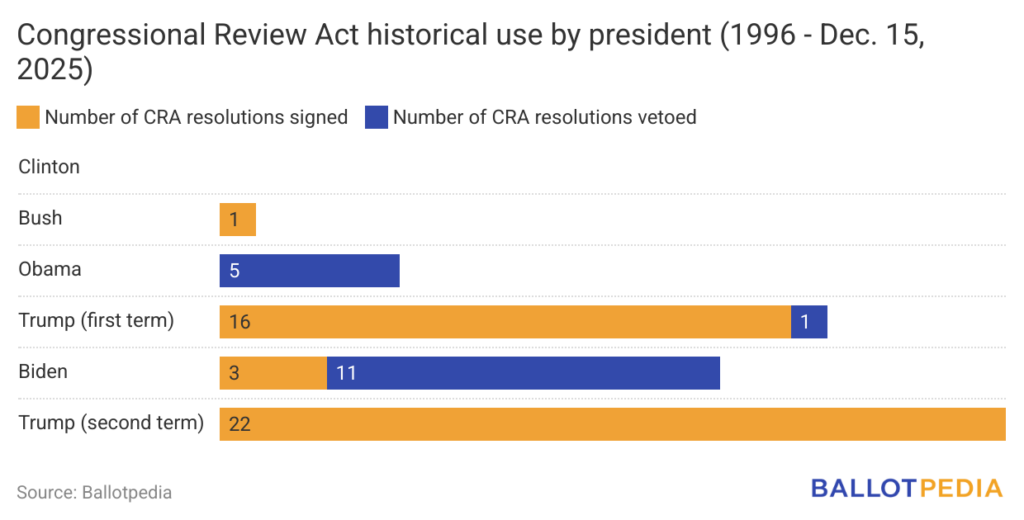
Congress has also expanded the scope of its use of the CRA this year, disapproving of different types of agency actions. The five resolutions disapproving of BLM rules that President Trump signed on Dec. 5 were the first time the CRA has been used to disapprove of a BLM resource management plan (RMP).
Additionally, this year Congress disapproved of three Environmental Protection Agency (EPA) notices of decision. The EPA used these notices to waive Clean Air Act emissions requirements for California, which allowed the state to adopt its own emissions standards. While Congress has used the CRA to disapprove of EPA rules before, this was the first time Congress used the CRA to disapprove of a waiver.
Trump also signed the first resolutions of disapproval for rules from the National Park Service, Department of Energy, Department of the Treasury, Internal Revenue Service, and Bureau of Ocean Energy Management this year.
Click here and here to learn more about the Congressional Review Act. You can also check out our episode of On The Ballot from earlier this year about President Trump’s use of the Congressional Review Act.
It’s your turn — tell Ballotpedia what you think

When I started writing this column back in April, my goal was to offer a look behind the curtain at the work Ballotpedia does to help voters understand not just when it’s time to head to the polls, but also to have a more complete understanding of the candidates and issues on their ballots.
In short, we educate voters and give them the confidence to make choices that best reflect their values. The reason is simple — an informed and engaged voter is essential to the health and future success of the American experiment in self-governance.
The obvious question, then, is this: how are we doing at that job?
That requires looking outside the four walls of Ballotpedia and gathering feedback from the people who read our newsletters, conduct research using our encyclopedia articles, interact with our social media channels, podcasts, and videos, or use tools like our Sample Ballot Lookup to help them make informed decisions on Election Day.
This is your opportunity to tell me how Ballotpedia is doing.
We listen to what our readers have to say. Your insights can help us refine our coverage or even discover new areas to write about. You can also help us understand how we can deliver news to you in the most effective way. Is it through newsletters? Podcasts? Videos? All of the above? Or something entirely different?
It’s important for me to know what you think as we prepare for the 2026 elections.
It’s going to be a very big year for us — more important than any election year in our history. Not just because we are covering the congressional midterm elections, statewide and state legislative elections, and tens of thousands of local elections.
What makes 2026 the most important election season ever for us is that we aim to provide robust election data on half of the candidates we’re covering.
We’re about to take our voter education and information efforts to an entirely new level.
Here’s my invitation to you: click the email link below and let me know how you think we’re doing with our coverage of politics and policy.
Please let me know if you think our Sample Ballot Lookup Tool has the features and information you need.
Tell me if there’s something we should be doing to make 2026 not only the biggest election year in Ballotpedia’s history, but the best one, too.
Thank you in advance for your insights and for your continued support of what we do.
Send your comments to: editor@ballotpedia.org
Kicking off “12 Days of Ballotpedia”
Happy holidays! Join us as we kick off the "12 Days of Ballotpedia" campaign, spotlighting the tools and data voters rely on and that are essential to our mission. You’ve seen or used these tools before - we’ll give a glimpse into how we provide voters with comprehensive information on politics and policy.
As we prepare for the 2026 elections, your tax-deductible gift today keeps these essential tools and resources free for everyone and fuels the work that makes informed voting possible. Thank you for your support!
Elections Ballotpedia is covering in January 2026
With 2025 nearly over, today we’re taking a look at some of the earliest elections happening in 2026. In January, Ballotpedia is covering 23 elections in 13 states. These include 18 special elections to fill vacancies in 10 states, and five local recall elections in four states.
Special elections
- Arkansas Senate District 26 and District 70 special primaries
- Connecticut House District 25 special general
- Georgia House District 23 and District 121 special general runoffs
- South Carolina House District 98 special general
- Virginia Senate District 15 and House District 77 special generals
- Alabama House District 63 special general
- Connecticut House District 139 special general
- Florida House Districts 87 special primaries
- Oklahoma House District 35 special primary runoff
Jan. 20: Georgia Senate District 18 special general
Jan. 27: Minnesota Districts 47A and 64A special generals
- Texas Congressional District 18 special general runoff
- Texas Senate District 9 special general runoff
- Plano, Texas City Council special general election
Recalls
Jan. 6: Mayor Pro Tem Elise Scafani in Blue Lake, California, and County Commissioner Chris Barnett in Josephine County, Oregon
Jan. 9: County Commissioner Claire Hall in Lincoln County, Oregon
Jan. 13: Trustee Terry Weible in Dunbar, Nebraska
Jan. 20: Mayor Jesse Nelson in Lynn Haven, Florida.
Battlegrounds
We are covering one battleground race: the special runoff election for Texas’ 18th Congressional District.
Christian Menefee (D) and Amanda Edwards (D) advanced from the Nov. 4 general election after neither candidate received an outright majority. The winner will become the fourth representative of the district since 2024 and will serve the remainder of former Rep. Sylvester Turner's (D) term through January 2027. Turner died on March 5, 2025.
The Texas Legislature redrew the state’s 38 congressional districts in 2025. The January runoff election will take place under the boundaries of the old district. The March 3 primary will be held under the boundaries of the new district. Four Democrats are running in that primary: Menefee, Edwards, Rep. Al Green (D), who currently represents Texas' 9th Congressional District, and Gretchen Brown.
Click here for a deep dive on the Jan. 31 runoff, and here to read more about Texas’ redistricting. You can also listen to a recent episode of Ballotpedia's On The Ballot podcast about the U.S. Supreme Court’s decision to uphold Texas’ redrawn map and what it means for the state’s congressional delegation.
Click here to see our elections calendar.