A note to readers: Ballot Bulletin will take a break over the next two weeks during the holiday season. Our coverage of election-related legislation and news will resume on Jan. 9.
Welcome to The Ballot Bulletin: Ballotpedia’s Weekly Digest on Election Administration. Every Friday, we deliver the latest updates on election policy around the country, including nationwide trends and recent legislative activity.
In this week’s Ballot Bulletin, we cover 14 bills state legislatures acted on in the past week. We also look at prefiled bills for 2026 and review the last year in election policy.
A look back at 2025
This week, in addition to our usual weekly update, we're reviewing the election-related bill activity over the course of this year. We’ve tracked nearly 5,000 election-related bills and resolutions in 2025—surpassing the total number of bills in any year since we began tracking election legislation in 2022.
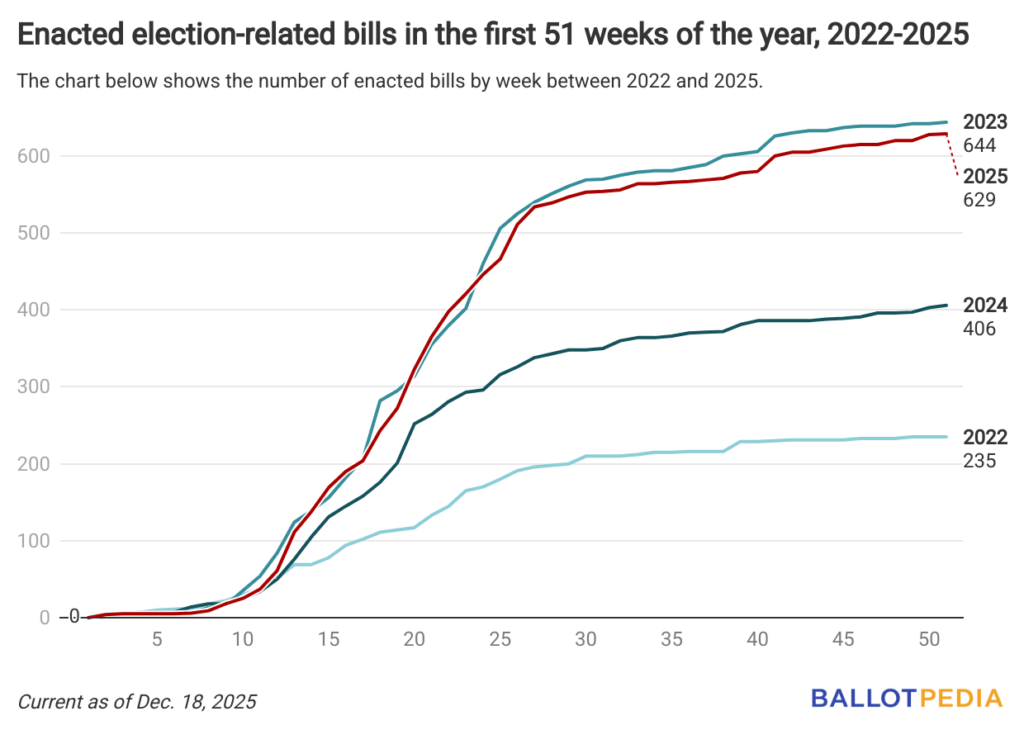
Lawmakers approved more than 600 new laws in 2025, the second most of any year in that time period. As in previous years, Republican lawmakers and Republican trifecta states have driven most of this activity. This trend reflects both their advantage in legislative control—holding majorities in 57 of the 99 state legislative chambers—and greater control of state governments in general, with 23 trifectas compared to 15 for Democrats.
States with Democratic trifectas passed 136 bills, Republican trifecta states passed 417 bills, and states with divided governments passed 74 bills.
In 2025, Republican lawmakers passed laws to:
- Implement checks of voters’ citizenship status through new data sources,
- Require absentee/mail-in ballots to arrive by Election Day to be counted,
- Ban ranked-choice voting (RCV), and
- Increase the signature requirement for initiatives to reach the ballot and raise the vote thresholds to approve those amendments once there.
Democratic lawmakers have passed laws to:
- Establish state-level voting rights acts (VRAs) that grant a private right of action to enforce election laws,
- Expand automatic voter registration services,
- Provide language accommodations for voting materials and services, and
- Increase drop box availability and security measures.
While election law changes can be contentious, lawmakers have still found common ground. Bipartisan efforts have advanced legislation to:
- Align election dates,
- Revise ballot access rules for candidates,
- Increase the frequency of some voter list maintenance activities, and
- Update ballot processing procedures to speed up election results.
Finally, congressional redistricting emerged as a topic of focus in the final months of the year. Since Aug. 29, five states—including three with Republican trifectas—passed legislation creating new congressional maps for the 2026 elections, or submitting new maps for voter approval. Before this year, only two states had voluntarily adopted new congressional maps between censuses since 1970.
Be sure to check out our 2025 year-end report, which provides in-depth analyses of the major trends in election-related legislation this year.
A look ahead to 2026
While Indiana lawmakers began their 2026 legislative session on Dec. 1, state legislators around the country are beginning to prefile legislation ahead of 2026 sessions. Here's an early look at where bills are being filed and what topics they cover:
- As of Dec. 14, 209 bills have been prefiled in 12 states. Those states are Alabama, Arizona, Florida, Maine, Missouri, New Hampshire, New York, Oklahoma, South Carolina, Utah, Virginia, and Washington.
- Legislators in Missouri have prefiled 80 bills, the largest number of any state and more than one-third of the bills prefiled to date. They are followed by New Hampshire (47) and Florida (26).
- Three of the states with prefiling underway have a Democratic trifecta, seven have Republican trifectas, and two have a divided government.
- Fifteen bills (7.2%) have been prefiled in states with a Democratic trifecta, 173 bills (82.8%) have been prefiled in states with a Republican trifecta, and 21 bills (10%) have been prefiled in states with divided governments.
- Democrats have sponsored 64 (27.7%) of prefiled bills, and Republicans have sponsored 134 (65.7%). Eleven of the bills (5.6%) are bipartisan.
- The most common bill topics are ballot measures and initiatives (32), ballot access for candidates (22), elected official term length (18), election dates (17), and campaign finance for candidates and offices up for election (15).
Click here to see the 2026 bills we’re currently tracking.
Weekly highlights
The big takeaways from the past week's legislative actions.
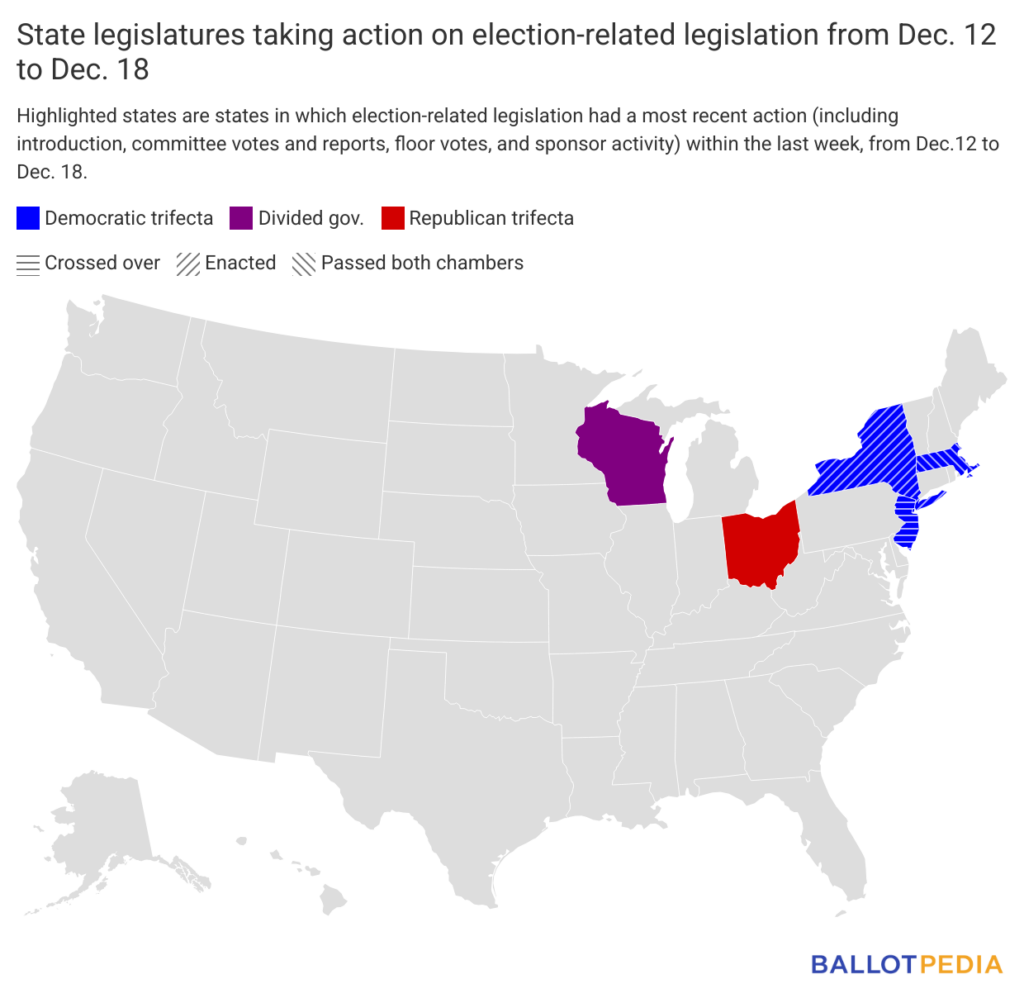
Lawmakers in five states acted on 14 bills over the last week, nine fewer than last week. Six state legislatures are still in regular or special sessions.
- One bill was enacted this week. Three bills were enacted during the same week in 2024, two bills were enacted during the same week in 2023, and no bills were enacted during the same week in 2022.
- Legislators acted on 20 bills in 2024 and 20 bills in 2023 during the same week.
- Three of the bills acted on this week are in states with Democratic trifectas, one is in a state with a Republican trifecta, and one is in a state with a divided government.
- The most active bill categories this week were voter registration and list maintenance (nine), election types and contest-specific procedures (eight), and absentee/mail-in voting and audits and oversight (three).
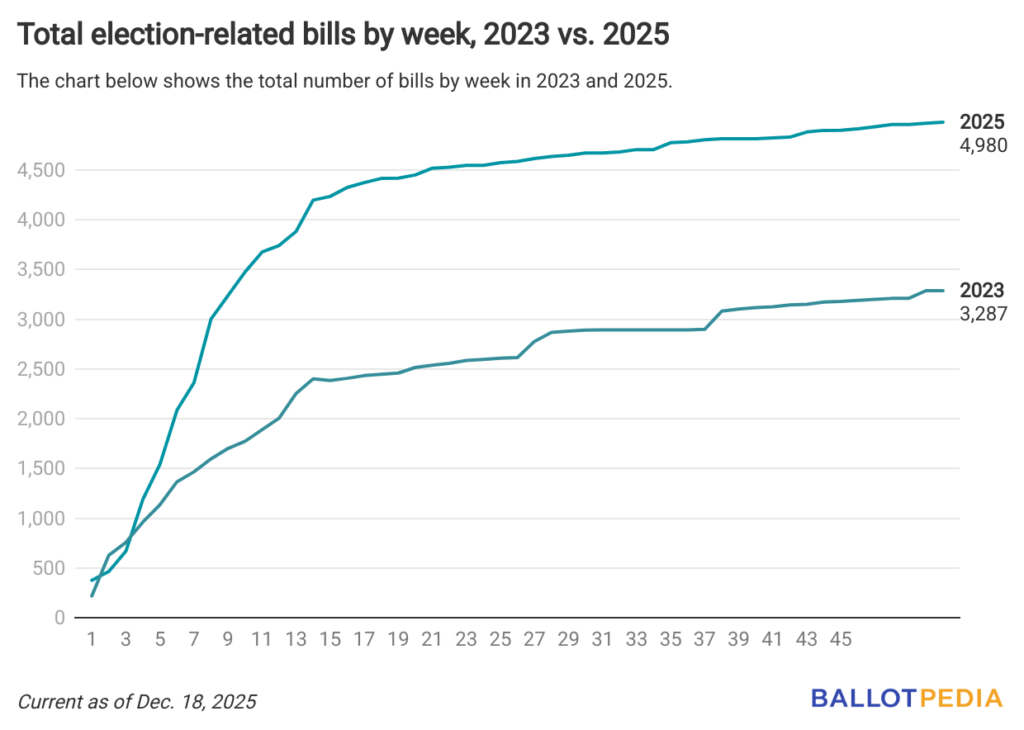
- We are currently following 4,980 bills. At this time in 2023, the last odd year when all states held legislative sessions, we were following 3,287 bills.
- Note: Indiana began its 2026 legislative session on Dec. 1. Between Dec. 1 and Dec. 18, there were 13 bills introduced in the Indiana General Assembly related to elections. The numbers above only include legislation from 2025 sessions.
In the news
A glance at what's making headlines in the world of election law.
- On Dec. 16, the Washington, D.C. City Council rejected a proposal delaying the implementation of ranked-choice voting, which is currently scheduled to be used in the June 2026 election. While D.C. voters approved a ballot measure in 2024 to use ranked-choice voting, some lawmakers argued that election officials didn’t have enough time to fully implement the system by next June. The legislation failed on an 8-5 vote.
- On Dec. 15, the U.S. Department of Justice sued Fulton County, Georgia, arguing the county elections board failed to comply with a subpoena seeking documents from the 2020 election. The lawsuit said that federal authorities are attempting to obtain “all used and void ballots, stubs of all ballots, signature envelopes, and corresponding envelope digital files from the 2020 General Election in Fulton County.” County officials have argued they cannot produce the records without a court order.
- On Dec. 15, a New Hampshire judge dismissed a lawsuit challenging voter ID requirements enacted earlier this year for absentee voters. Under SB 287, voters must include a photocopy of a valid photo identification or a notarized signature with their absentee ballot application or present photo ID at a town clerk’s office to request an absentee ballot. Rockingham Superior Court Judge David Ruoff ruled the law does not unreasonably burden a person’s right to vote.
- On Dec. 12, the Montana Supreme Court ruled that Attorney General Austin Knudsen erred in adding language to a ballot measure scheduled to appear on the ballot in 2026 that would require non-partisan judicial elections. The court ruled that the changes were outside the bounds of the attorney general’s authority and mandated new language to appear on the ballot. On Dec. 16, supporters of a separate ballot initiative filed a new lawsuit against Knudsen, arguing his office improperly rejected their measure from appearing on the 2026 ballot.
Key movements
A look at what bills are moving and where.
One bill was enacted in the past week. Three bills were enacted during the same week in 2024. Two bills were enacted in 2023, and no bills were enacted in 2022. To see all enacted bills, click here.
- New York (Democratic trifecta)
One bill passed both chambers of a state legislature. To see the full list of all bills awaiting
gubernatorial action, click here.
- Massachusetts (Democratic trifecta)
No bills were vetoed in the past week. Seventy-four bills have been vetoed so far this year. No bills were vetoed during this period in 2024, 2023, and 2022. To see all vetoed bills, click here.
The big picture
Zooming out to see the macro-level trends in election policy so far this year.
Enacted bills
One bill was enacted this week. The chart below shows the number of enacted bills in 2025 compared to previous years.
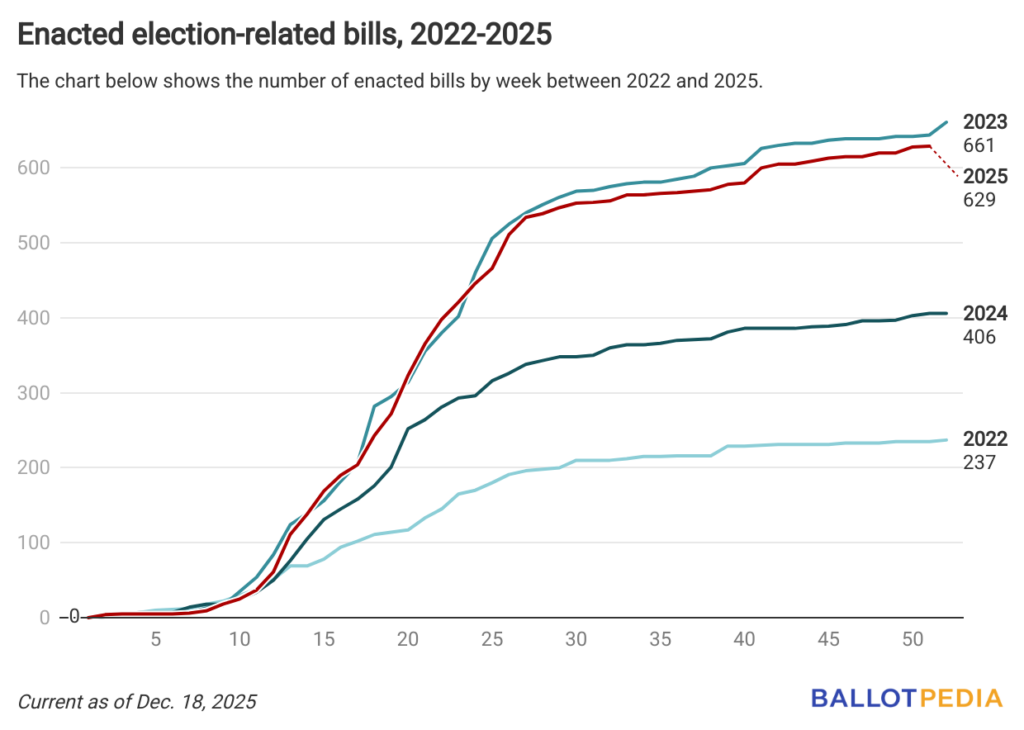
The chart below shows the number of bills enacted over the first 51 weeks of each year.
All bills
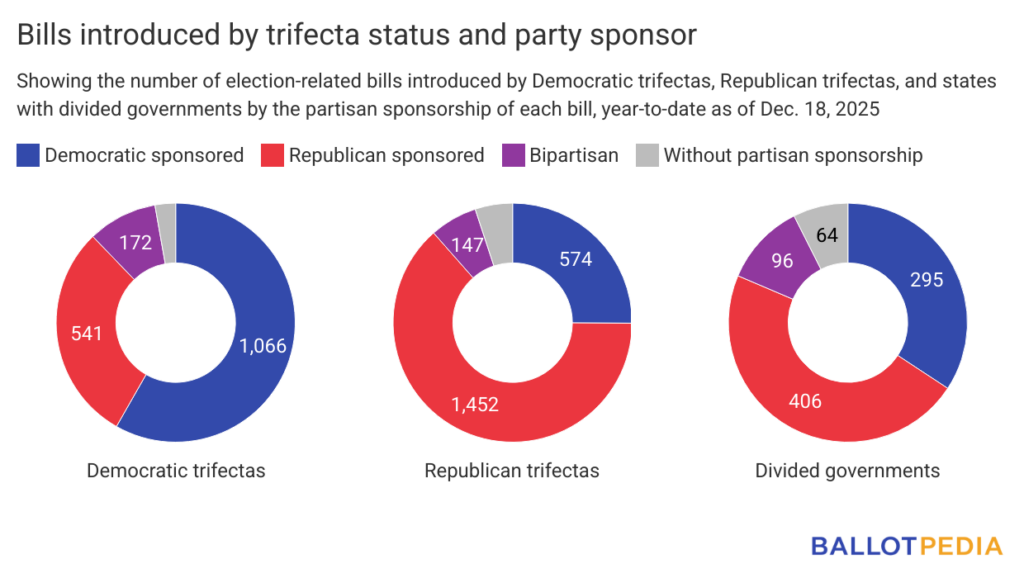
We are following 4,980 election-related bills this year, including bills carried over from the previous year.
- Trifecta status
- Democratic: 1,830 (36.7%)
- Republican: 2,289 (46%)
- Divided: 861 (17.3%)
- Partisan sponsorship
- Democratic: 1,935 (38.9%)
- Republican: 2,399 (48.2%)
- Bipartisan: 415 (8.3%)
- Other: 231 (4.6%)
We were following 3,287 bills at this point in 2023. Below is a breakdown of those bills by trifecta status and partisan sponsorship.
- Trifecta status
- Democratic: 1,627 (49.5%)
- Republican: 1,128 (34.3%)
- Divided: 532 (16.2%)
- Partisan sponsorship
- Democratic: 1,501 (45.7%)
- Republican: 1,225 (37.3%)
- Bipartisan: 375 (11.4%)
- Other: 186 (5.7%)
See the charts below for a comparison of total bills between 2023 and 2025 and a breakdown of all 2025 legislation by trifecta status and partisan sponsorship.