


Highlights from this edition of Checks and Balances include a Supreme Court case on presidential power to dismiss independent agency officials, and 2025 restrictions on judicial deference standards in six states
In Washington
Supreme Court hears case on presidential power to dismiss independent agency officials
On Dec. 8, 2025, the U.S. Supreme Court heard oral arguments in Trump v. Slaughter, a case on presidential power to remove commissioners of the Federal Trade Commission (FTC). The FTC is an independent federal agency created by the Federal Trade Commission Act, a statute that enumerated “inefficiency, neglect of duty, or malfeasance in office” as permissible reasons for presidential removal of a commissioner. President Donald Trump (R) dismissed FTC Commissioners Rebecca Slaughter and Alvaro Bedoya in March, writing in a letter that their continued service with the FTC was “inconsistent with my Administration’s priorities.”
Slaughter and Bedoya challenged the dismissal in March. On July 18, a federal district court judge ruled that Bedoya (who stepped down in June) lacked standing but that Slaughter should be reinstated. The federal government appealed, and the D.C. Circuit Court of Appeals declined to stay the order. The government then filed an emergency stay application with the Supreme Court on Sept. 4, 2025. On Sept. 22, the Court granted the stay in a 6–3 decision and set the case for full review during the Court’s 2025–2026 term.
In this case, the Court is considering whether Congress had the power to limit the reasons the president could remove a commissioner in the Federal Trade Commission Act. Court observers say the case could have wider implications for presidential power to remove independent agency officials, including officials Trump removed from the National Labor Relations Board, the Merit Systems Protection Board, and the Consumer Product Safety Commission in 2025.
What is an independent federal agency?
An independent federal agency is an executive agency established by statute outside of the Executive Office of the President and the 15 executive departments (led by cabinet secretaries). According to a report from the Administrative Conference of the United States — an independent agency itself — independent agencies may also be defined as having cause removal protections for top officials, which “in this context means independence from political interference, particularly removal by the President.”
A major precedent at issue in Slaughter is the 1935 case of Humphrey’s Executor v. United States. In this case, the Supreme Court ruled unanimously that the president could only remove a commissioner of the FTC for the reasons listed in the Federal Trade Commission Act (“inefficiency, neglect of duty, or malfeasance in office.”)
In administrative law, Humphrey’s Executor has served as an important precedent for independent agency cause removal protections. However, the Supreme Court has narrowed the scope of Humphrey’s Executor in the recent cases of Seila Law v. Consumer Financial Protection Bureau (2020) and Collins v. Yellen (2021). In these cases, the court found that statutory removal restrictions on presidential removal of Consumer Financial Protection Bureau and Federal Housing Finance Authority officials were unconstitutional violations of the separation of powers principle.
What were the arguments?
In the Dec. 8 arguments, Solicitor General D. John Sauer argued that the Court should further limit the scope of Humphrey’s Executor or overturn it entirely. He argued that the limitations on presidential removal power in the Federal Trade Commission Act are unconstitutional limitations of presidential authority over the executive branch. When the justices asked whether a ruling in this case should apply to presidential removal power over other independent agencies, Sauer replied that the Court could issue a narrow decision applying only to the FTC.
Arguing for Slaughter, attorney Amit Agarwal said that Congress did have the authority to write statutory language restricting presidential removal power over the FTC, and that this power had a long-standing history. When asked by the justices whether a ruling in favor of Slaughter would grant Congress additional power to prohibit the removal of agency officials or cabinet secretaries, Agarwal argued that Congress does not have this power and that the FTC and other multi-member independent executive agencies were not the same as cabinet departments.
Court observers noted that the questions asked by the justices seemed to indicate that they were divided on ideological lines, with the conservative majority seeming inclined to rule against Slaughter. A ruling in this case is expected later this year — most likely in June or July, at the end of the Court’s 2025-2026 term. During this term, the Court will also hear Trump v. Cook, a case on presidential power to dismiss a governor of the Federal Reserve.
Want to learn more?
- Independent federal agency
- Federal Trade Commission
- Humphrey’s Executor v. United States
- Separation of powers
In the states
Six states restricted judicial deference standards in 2025, twice as many as in 2024
2025 was a significant year for judicial deference to state agencies, with a total of six states restricting state courts’ use of the practice. Five states passed bills which prohibited courts from deferring to agency interpretations of statute and regulations, and were joined by several decisions issued by the North Carolina Supreme Court that similarly restricted deference practices. Ballotpedia tracked 34 judicial deference-related bills in 21 states in 2025.
These state-level moves came in the wake of the 2024 Loper Bright v. Raimondo case. In this case, the U.S. Supreme Court struck down the federal-level Chevron deference doctrine. While the 2024 Loper case did not directly affect the states, its move toward a less deferential standard of review was reflected in the six states which changed their deference doctrine in 2025. As of Jan. 16 2026, Ballotpedia has identified 22 states as having changed their judicial deference doctrines since 2008. Three states (Indiana, Nebraska, and Idaho) restricted judicial deference standards in 2024 — half as many as in 2025.
What is judicial deference?
Judicial deference to an agency is the practice of a court deferring to an agency’s interpretation of an ambiguously-written text in accordance with the standards of a legal doctrine. There are different judicial deference doctrines which enshrine different requirements for courts. For example, the Chevron deference doctrine was a federal-level precedent established in the 1984 Chevron v. NRDC case, under which federal courts deferred to agency interpretations of statute, while Auer deference doctrine requires federal courts to defer to agency interpretation of regulations. The degree of deference can also vary by doctrine. For instance, Skidmore deference doctrine (that federal courts may adopt a persuasively reasoned agency interpretation) requires less deference from courts than Chevron deference did.
The Chevron doctrine was overturned by the Supreme Court in the 2024 Loper Bright Enterprises v. Raimondo case. In Loper Bright, the Court held that federal courts should not defer to agency interpretations of statute, and should instead use a de novo standard of review, in which the court uses its own interpretation in place of any offered by the agency. Loper Bright did not strike down all federal-level judicial doctrines, with the Auer and Skidmore deference doctrines remaining live precedents after Loper.
Because it was a federal-level precedent, Loper Bright also did not directly affect judicial deference doctrines enshrined in state-level administrative law. Judicial deference doctrines have varied by state, with some states requiring courts to use a de novo review standard, while others have adopted a deference requirement for agency interpretation of statute or regulations akin to federal-level Chevron or Auer deference.
What changed in 2025?
All six states that changed their deference doctrine in 2025 moved to a more restricted deference standard for state courts. Kentucky, Louisiana, Missouri, Oklahoma, and Texas each passed bills which required de novo review for agency interpretations. The North Carolina Supreme Court also enshrined a de novo standard, striking down existing deference practices.
Kentucky’s SB 84 prohibited courts from deferring to agency interpretations of statute (akin to Chevron deference) and regulations (akin to Auer deference), requiring them to use a de novo review standard. The Kentucky House voted 74-18 and the Senate voted 32-6 along party lines to override Gov. Andy Beshear’s (D) veto of the bill, enacting it into law on March 27. Kentucky has a divided government.
Texas’ SB 14, Oklahoma’s HB 2729, Louisiana’s HB 99 (signed June 8), and Missouri’s SB 221 likewise prohibit deference to agency interpretations of statute and regulations, and require a de novo review standard. All four states have Republican trifectas. SB 14 passed the Texas Senate 26-5 (19 Republicans and 7 Democrats voted yes, 4 Democrats and 1 Republican voted no), passed the Texas House 97-51 (84 Republicans and 13 Democrats voted yes, 49 Democrats and 2 Republicans voted no), and was signed by Gov. Greg Abbott (R) April 23. HB 2729 passed the Oklahoma Senate 37-8 and passed the Oklahoma House 71-16 in party-line votes, and was signed by Gov. Kevin Stitt (R) May 5. HB 99 passed the Louisiana House 70-27 (64 Republicans and 6 Democrats voted yes, 19 Democrats and 8 Republicans voted no), passed the Louisiana Senate 28-10 (27 Republicans and 1 Democrat voted yes, 10 Democrats voted no), and was signed by Gov. Jeff Landry (R) June 8. SB 221 passed the Missouri Senate 25-7 (23 Republicans and 2 Democrats voted yes, 7 Democrats voted no), passed the Missouri House 120-20 (104 Republicans and 16 Democrats voted yes, 20 Democrats voted no), and was signed by Gov. Mike Kehoe (R) July 11. Utah, which also has a Republican trifecta, passed a resolution calling on state agencies to reassess federal mandates in light of the Loper Bright decision.
In addition to these statutory restrictions on judicial deference, the North Carolina Supreme Court decided several cases which established a precedent of de novo review. The Court’s 5-2 ruling in Thurman Crofton Savage v. N.C. Department of Transportation, announced August 22, struck down state courts’ deference to state agency interpretations of statute (akin to federal-level Chevron deference), and required a de novo review standard. The Oct. 17 Alvin Mitchell v. University of North Carolina Board of Governors decision, which was also decided 5-2, struck down deference to agencies’ interpretation of their own regulations (akin to Auer deference) and also required a de novo review standard.
Want to learn more?
Featured commentary
How deferential has the Supreme Court been to presidential power? SCOTUS Blog writer Adam Feldman argues that quantitative Supreme Court voting records show the Roberts Court has sided with the government at a lower rate than historically. Click here to read the full article.
Regulatory highlight
Congressional Review Act
The Congressional Review Act (CRA) allows Congress to repeal rules with joint resolutions of disapproval. Congress repealed more regulations under the CRA in 2025 (22) than in any other year. Congressmen have introduced 114 resolutions of disapproval so far this session.
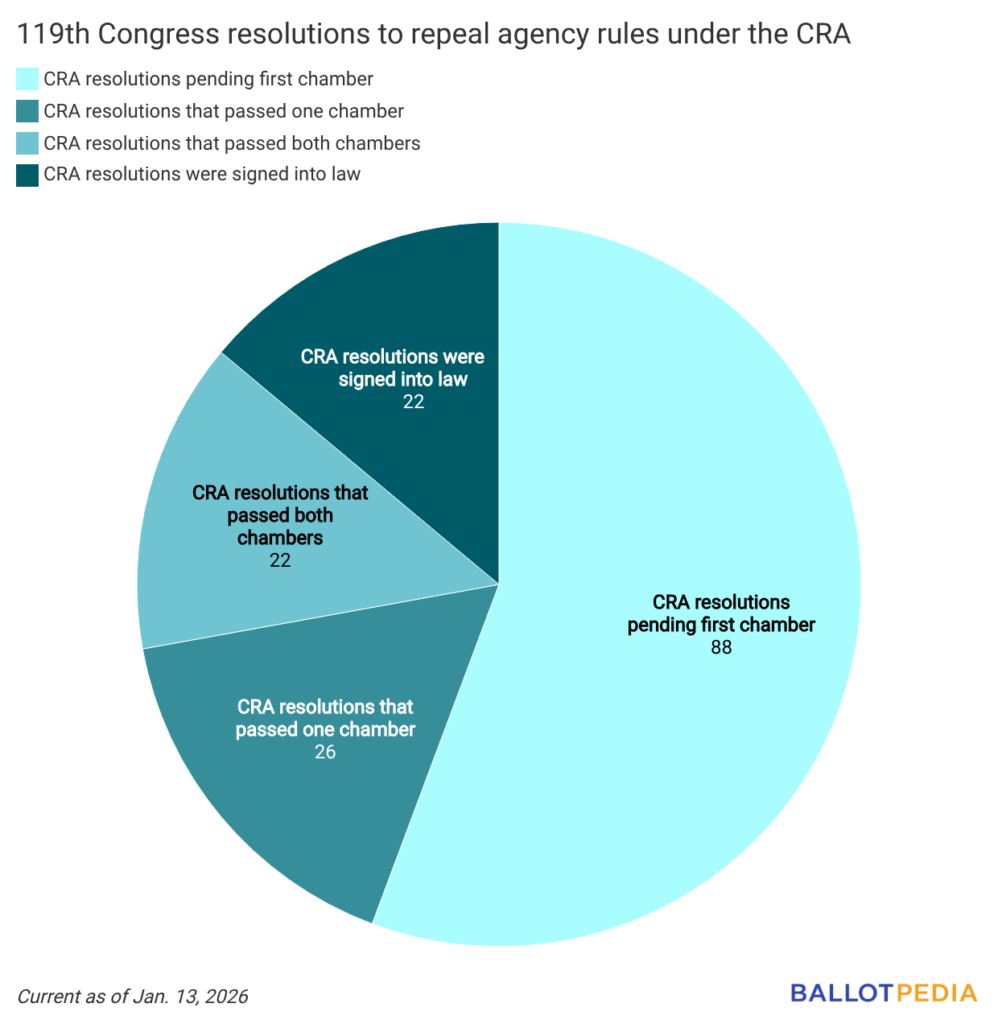
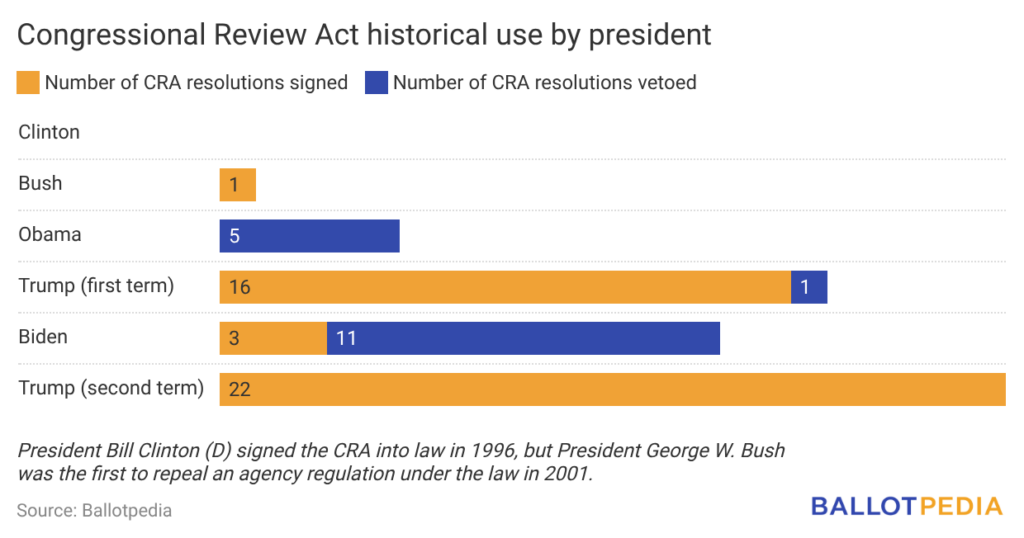
In his two terms, Trump (R) has signed 38 of the 42 total CRA resolutions ever adopted.
Notable regulation
- The Office of Information and Regulatory Affairs (OIRA) completed its review of a Federal Housing Finance Agency final rule that decreased single-family Fannie Mae and Freddie Mac housing goals for the years 2026-2028, while maintaining multifamily benchmark goals.
- Want to learn more?
Pick of the news
Federal
Trump signed more executive orders in 2025 than in all of his first term. President Trump signed 225 executive orders in 2025, more than in the 220 he signed all four years of his first term combined. Washington Post
Federal workforce shrinks 9% in 2025. The federal workforce shrank by about 9%, with about 271,000 net employees leaving federal employment in 2025 according to the Bureau of Labor Statistics. The federal workforce going into 2026 — about 2.7 million people — is now the smallest it has been since 2014. Axios
CFPB complies with court ruling, requests funding from Fed. Russell Vought, acting director of the Consumer Financial Protection Bureau, sent a request for funding to the Federal Reserve after a district court judge ruled against an argument that no funding from the Fed was available. New York Times
Prosecutors investigate Fed Chairman. Federal prosecutors opened an investigation of Federal Reserve Chairman Jerome Powell over allegations that he made false statements regarding renovations to the Federal Reserve headquarters building. Powell released a rare video statement questioning the investigation, calling “the threat of criminal charges… a consequence of the Federal Reserve setting interest rates based on our best assessment of what will serve the public, rather than following the preferences of the president.” New York Times
20 House Republicans join Democrats in voting to overturn executive order. H.R.2550, a bill which would reverse a Trump administration executive order on collective bargaining for some federal agencies, passed the House of Representatives 231-195. Twenty Republicans and 211 Democrats voted for the bill. Politico
Comptroller General Gene Dodaro retires, one day short of record term in office. Gene Dodaro, who served as Comptroller General since 2008, retired from the role in December. Government Accountability Office employee Orice Williams Brown will serve as the acting Comptroller General until President Trump and the Senate select a permanent replacement.Politico
Third Circuit rules for NLRB, deepening circuit split. The Third Circuit Court of Appeals declined to issue an injunction against proceedings before a National Labor Relations Board administrative law judge (ALJ), despite an earlier Fifth Circuit ruling that the NLRB’s employment of ALJs is unconstitutional. Observers believe that this circuit split makes a Supreme Court review of this challenge to NLRB authority more likely. Labor Relations Update
OPM announces ‘Tech Force’ initiative. The Office of Personnel Management announced a hiring initiative called the ‘U.S. Tech Force’ to bolster the government technology workforce. Federal News Network
OSC resumes Hatch Act enforcement for former federal employees. The Office of Special Council resumed enforcing the Hatch Act, which prohibits federal employees from engaging in political activities on the job, for former federal employees. The OSC had paused these enforcement efforts in April due to litigation which has since been resolved with a Merit Systems Protection Board administrative law judge finding the OSC can enforce the Hatch Act for former employees. Federal News Network
State
Trump signs executive order challenging state AI laws. President Trump signed an executive order which would allow the Attorney General to sue to overturn state laws that do not uphold the “United States’ global A.I. dominance.” New York Times
Judge rules against FEMA population data requirements. A federal magistrate judge ruled against a requirement by the Federal Emergency Management Agency on states receiving emergency preparation funds. FEMA promulgated the requirement that states receiving these funds provide updated population counts that account for deportations in October 2025. New York Times
Judge temporarily halts Health Department five-state funding freeze. A district court judge temporarily blocked a Department of Health and Human Services freeze on around $10 billion of social services funding for California, New York, Minnesota, Illinois and Colorado. DHHS had announced the funding freeze earlier in January. CBS News
Legislative committee votes to defund Wyoming Business Council. On Jan. 13, the Joint Appropriations Committee of the Wyoming Legislature voted to defund the Wyoming Business Council, a state economic development agency. News from the States
Wisconsin advocacy groups release deregulatory legislative agenda. A coalition of Wisconsin advocacy and business groups has released a deregulatory legislative agenda they are calling a “Red Tape Reset.” The groups support legislation including requirements for a cost offset and 7-year sunset review of agency rules. The Center Square
Legislative Tracking Update
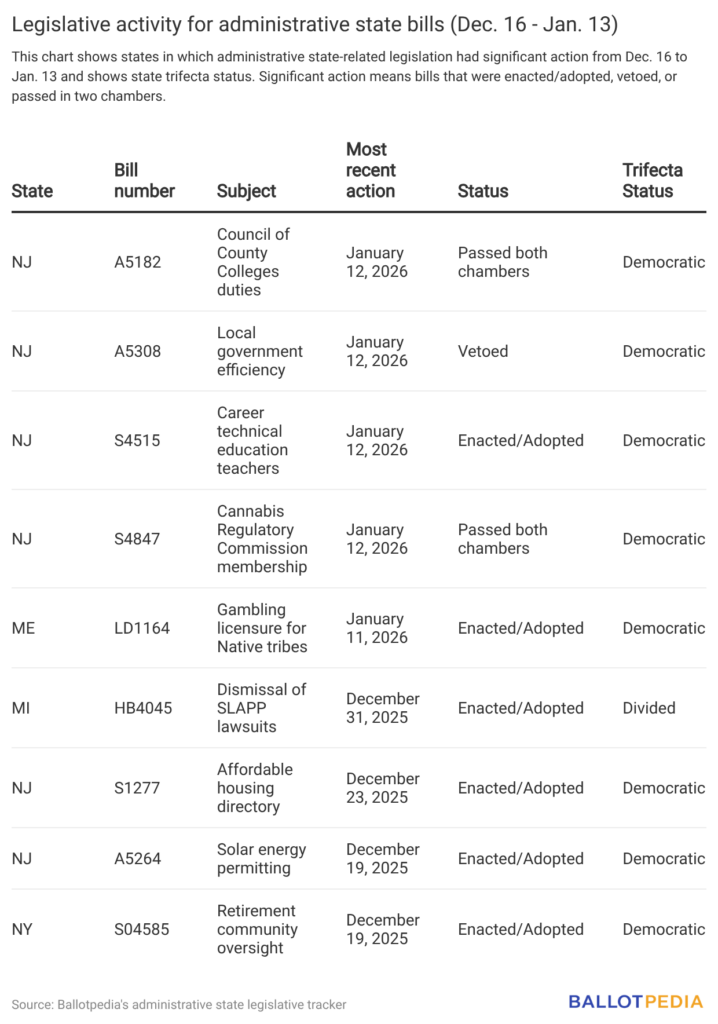
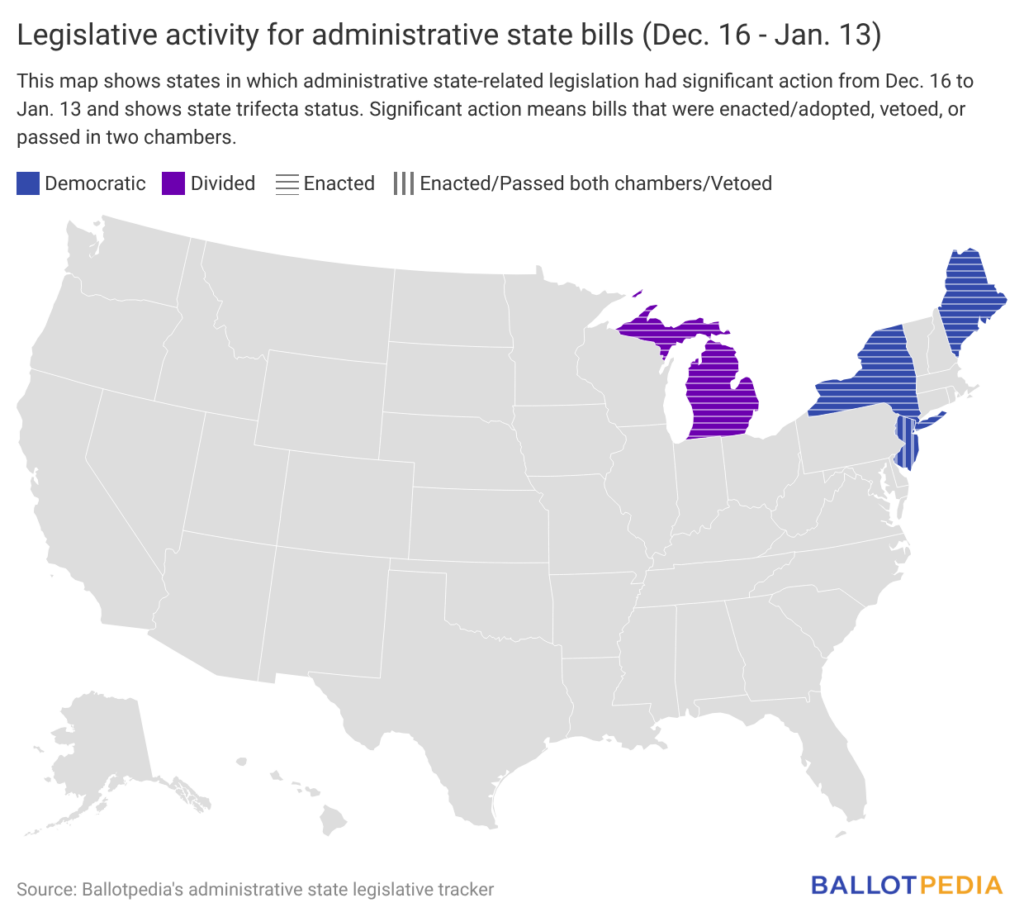
Since our last newsletter edition, Ballotpedia tracked significant legislative action (enactments, vetoes, and passage through both chambers) in three states on eight bills related to the administrative state, as of Jan. 14. Michigan Gov. Gretchen Whitmer (D), New York Gov. Kathy Hochul (D), and Maine Gov. Janet Mills (D) each signed one bill. New Jersey Gov. Phil Murphy (D) signed three bills and vetoed one bill. Both houses of the New Jersey legislature passed two other bills.
Ballotpedia tracked a total of 2,322 bills related to the administrative state in 2025, as of Jan. 14, 2026.
Correction: The “Pick of the News Section” of the January 2026 edition of Checks and Balances asserted that former Comptroller General Gene L. Dodaro was the second-longest serving Comptroller General in the history of the office. Dodaro served a full 15-year term, the same length as the term served by former Comptroller Generals John McCarl, Elmer Staats, and Charles Bowsher. Ballotpedia regrets this error.