


Welcome to the Tuesday, Jan. 27, Brew.
By: Briana Ryan
Here’s what’s in store for you as you start your day:
- Judge orders New York's redistricting commission to redraw the state's congressional map by Feb. 6
- Alaska could join three other states in deciding on a citizenship voting requirement ballot measure this year
- Three candidates are running in the Democratic primary for Mississippi's 2nd Congressional District on March 10
Judge orders New York's redistricting commission to redraw the state's congressional map by Feb. 6
On Jan. 21, New York state judge Jeffrey Pearlman ruled that New York's 11th Congressional District unconstitutionally diluted Black and Latino voting power. Pearlman ordered the New York State Independent Redistricting Commission to redraw the congressional map by Feb. 6. The case could be appealed.
The lawsuit, filed in October 2025, argued that the district's boundaries "confine Staten Island's growing Black and Latino communities in a district where they are routinely and systematically unable to influence elections." The district, which U.S. Rep. Nicole Malliotakis (R) represents, is New York City's only congressional district with a Republican representative.
New York is one of 11 states that use redistricting commissions to draw congressional district lines. The Associated Press' Anthony Izaguirre wrote that New York's "redistricting panel has the primary power to draw congressional maps, and is supposed to do so without gerrymandering the boundaries to give any party a political advantage. But, in the past, that commission has sometimes failed to reach an agreement on the makeup of a district, which has then given the Democrat-controlled state legislature the ability to tweak the lines in their favor."
Malliotakis said, "We are reviewing the judge's decision and our options to protect the voices of the people of Staten Island and Brooklyn. Nothing changes the fact that this is a frivolous attempt by Washington Democrats to steal this congressional seat from the people and we are very confident that we will prevail at the end of the day."
House Democratic Leader Rep. Hakeem Jeffries (D-N.Y.) said, "This ruling is the first step toward ensuring communities of interest remain intact from Staten Island to Lower Manhattan. The voters of New York deserve the fairest congressional map possible."
According to City & State New York's Rebecca C. Lewis, the ruling could affect this year's race for U.S. Rep. Dan Goldman's (D) 10th District seat as well: "[Goldman] faces a left-wing primary challenge from former New York City Comptroller Brad Lander. But the court ruling could place Goldman into a newly drawn, more moderate 11th District to face off against Malliotakis. It could leave Lander the 10th District, which would likely remain fairly progressive."
Democrats currently represent 19 of New York's 26 U.S. House districts. Because mid-decade redistricting would require a state constitutional amendment that could not take effect until the 2028 election cycle, the lawsuit may create the state's only opportunity to influence the national redistricting effort ahead of this year's midterms.
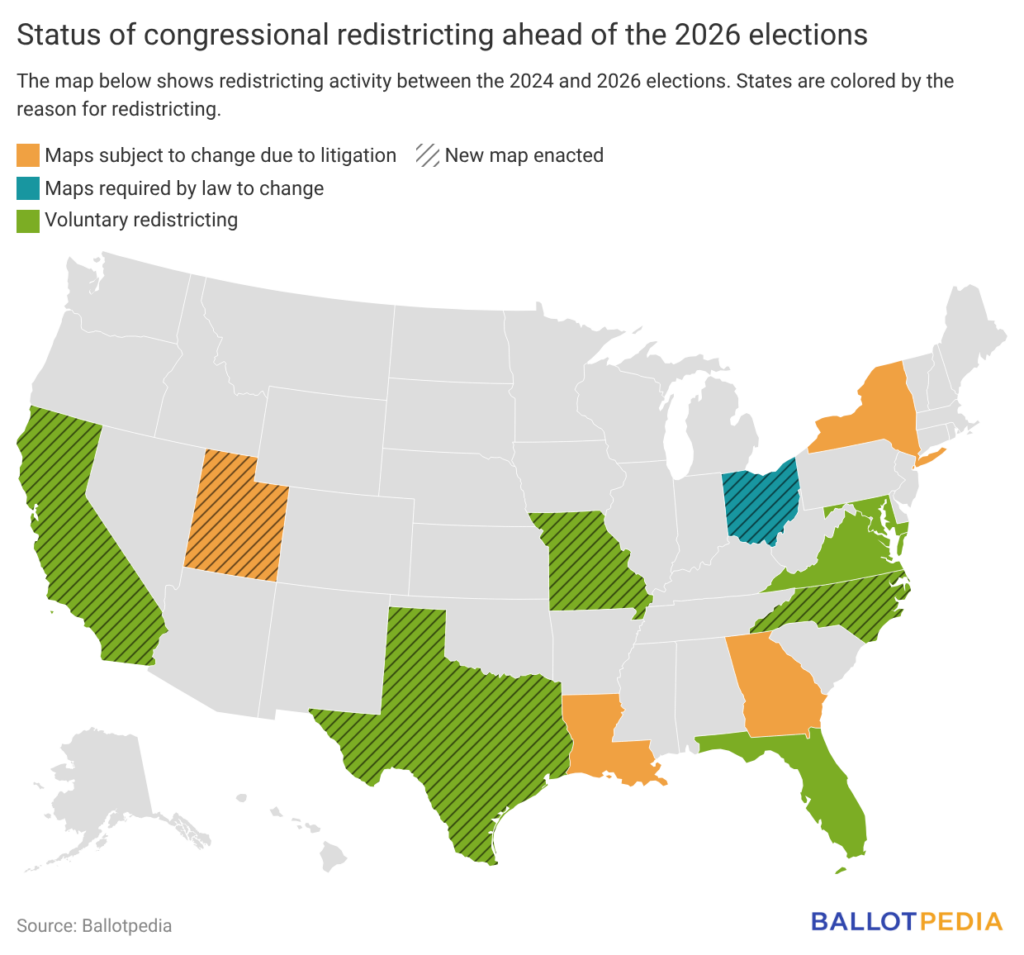
Six states have already revised their congressional maps ahead of the 2026 elections. Four states — California, Missouri, North Carolina, and Texas — voluntarily passed new congressional maps. Ohio was required by law to adopt a new map. New York would join Utah as the second state to have litigation lead to a new map. The redraw could create an additional Democratic district ahead of the 2026 elections, bringing Republicans' net gain from redistricting nationwide to two districts.
One Republican-led state and two Democratic-led states are also considering congressional redistricting in time for the elections this year.
The Florida Legislature will meet in April for a special legislative session on redistricting. Maryland Gov. Wes Moore's(D) redistricting advisory commission approved a congressional map that would shift the state's only Republican district toward Democrats. That proposal awaits the Maryland General Assembly's consideration. Virginia will hold a special election on April 21 to decide on a constitutional amendment that would allow the Virginia General Assembly to conduct mid-decade redistricting.
Click here to read more about redistricting ahead of this year's congressional elections.
Alaska could join three other states in deciding on a citizenship voting requirement ballot measure this year
On Jan. 19, proponents of a ballot initiative seeking to amend Alaska law to state "Only a person who is a citizen of the United States … may vote at any election." submitted 50,000 signatures to the state's Division of Elections. The initiative requires 34,098 valid signatures to qualify for the Nov. 3 ballot, pending the Division of Elections' certification.
Alaskans for Citizen Voting is the campaign supporting the initiative. As an initiated state statute, the initiative would amend a state statute rather than the state's constitution. Currently, the existing Alaska law regarding voter qualifications states: "A person may vote at any election who is a citizen of the United States."
Former State Sen. John Coghill (R) supports the initiative, saying, "The framers of our state's constitution intended that the voting privilege should be granted only to U.S. citizens. Recent actions in other states require Alaska to clarify our law. The response during the signature collection phase shows that many Alaskans agree."
State Sen. Bill Wielechowski (D) opposes the initiative, saying, "I think it may spread misinformation to people. People will look at it and say, 'Oh, there must be a reason this is on the ballot. There must be noncitizens who are voting.' And to the extent noncitizens are voting, they're breaking the law."
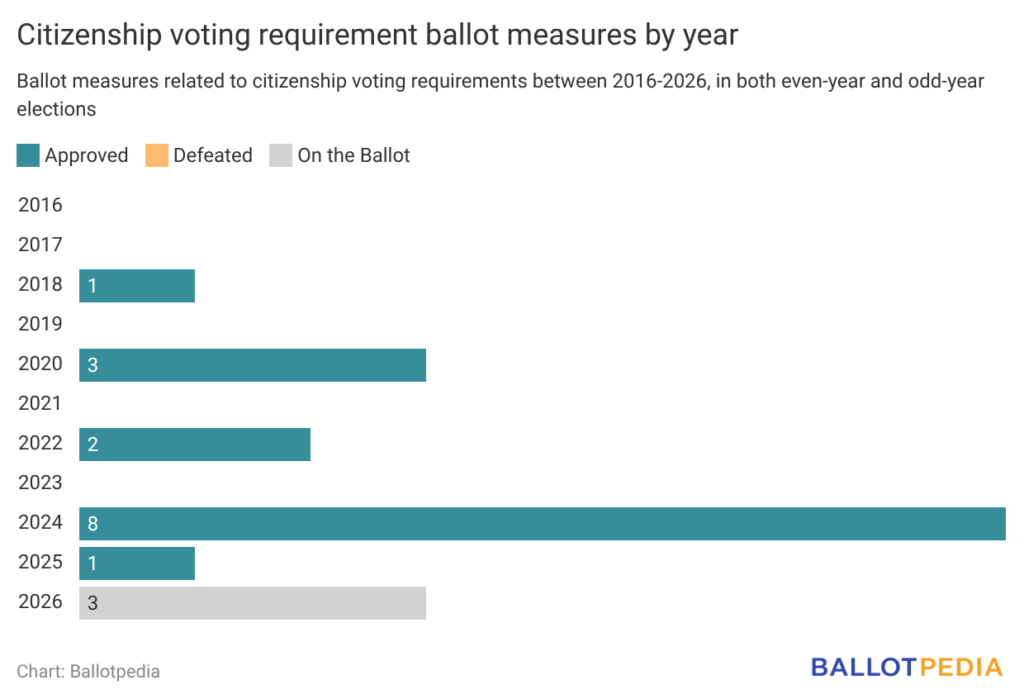
Ballot measures to prohibit noncitizen voting have become more common in recent years. From 2018 to 2025, voters approved 15 statewide measures adding language about citizenship requirements for voting.
In 2024, voters approved eight statewide measures to prohibit noncitizen voting — the most such measures to appear on statewide ballots in any election year.
In 1996, the U.S. Congress passed a law prohibiting noncitizens from voting in federal elections. This law does not apply to elections for state and local offices. Every state requires voters to attest that they are U.S. citizens when registering to vote.
While no state constitution explicitly allows noncitizens to vote in state or local elections, some states have jurisdictions that allow noncitizens to vote in some or all local elections. The District of Columbia and certain municipalities in California, Maryland, and Vermont allow noncitizens to vote in some or all local elections. Eighteen states include language explicitly prohibiting noncitizen voting in their state constitutions.
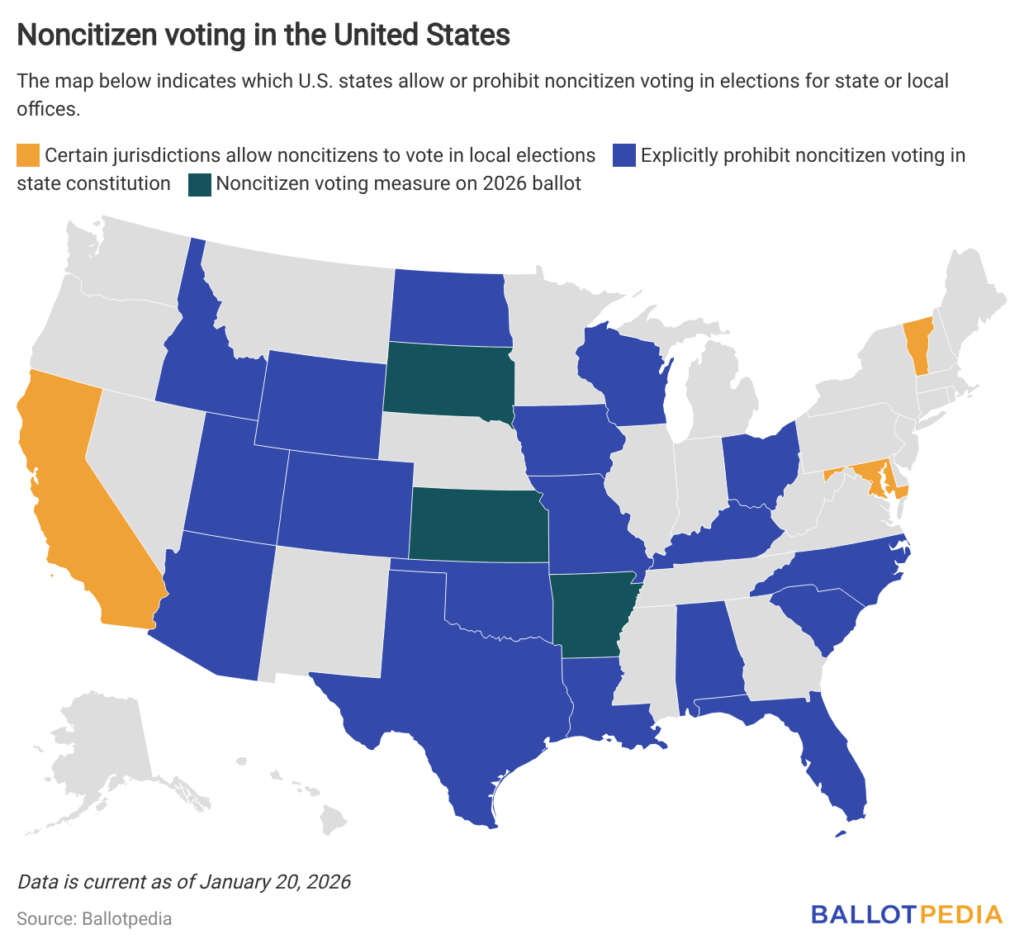
This year, voters in Arkansas, Kansas, and South Dakota will decide measures on citizenship voting requirements. California, Michigan, and West Virginia have potential measures that may appear on the ballot.
Click here to read more about the Alaska initiative.
Three candidates are running in the Democratic primary for Mississippi's 2nd Congressional District on March 10
Incumbent Rep. Bennie Thompson (D), Evan Turnage (D), and Pertis Williams III (D) are running in the Democratic primary for Mississippi's 2nd Congressional District on March 10. Thompson and Turnage lead in media attention.
According to the Associated Press' Sophie Bates Turnage's challenge is "the latest in a trend of young Democrats looking to oust the party's old guard and rebrand the party after the 2024 election."
The Clarion-Ledger's Charlie Drape wrote the election "[sets] the stage for a contest that could test whether seniority and national stature still outweigh calls for change in one of Mississippi's most reliably Democratic districts."
Thompson has represented the district since 1993. Thompson is running on his record, writing in a Facebook post, "Serving the people of this district isn't just my job, it's my honor and my responsibility. This work is rooted in the relationships built over time and the trust placed in me by the community I am proud to call home."
Turnage is an antitrust attorney and former counsel for Sens. Chuck Schumer (D-N.Y.) and Elizabeth Warren (D-Mass.). Turnage said the district wants a change in leadership, saying, "I've talked to so many people and it's clear that there's an appetite for new leadership, an appetite for a fighter from Mississippi. This is the poorest district in the poorest state in the country. It was like that when [Thompson] was elected, and it remains that way today."
If no candidate receives more than 50% of the vote, the primary will go to a runoff scheduled for April 7. As of Jan. 20, three independent race forecasters have rated the general election for the district as Solid Democratic or Safe Democratic.
Click here for more information about this Democratic primary. Also, if you're a voter in Mississippi's 2nd Congressional District, check out our Sample Ballot Lookup here to prepare for Election Day.