


Welcome to the Wednesday, Jan. 28, 2026, Brew.
By: Lara Bonatesta
Here’s what’s in store for you as you start your day:
- Wisconsin Legislature sends amendments on worship during states of emergency and discrimination to the November ballot
- An early look at North Carolina’s 2026 Republican state House primaries
- Oklahoma campaign submits signatures for initiative that would establish top-two primaries in the state
Wisconsin Legislature sends amendments on worship during states of emergency and discrimination to the November ballot
On Jan. 21, the Wisconsin Legislature advanced two proposed constitutional amendments for the Nov. 3 statewide general election ballot.
The first would prohibit state or local governments from ordering places of worship to close during a declared state of emergency, including a public health emergency. The second would prohibit government entities from discriminating or granting preferential treatment based on race, sex, color, ethnicity, or national origin in public employment, public education, public contracting, or public administration.
This was the second time the Legislature approved both amendments. In Wisconsin, a proposed constitutional amendment must receive majority approval in each chamber during two consecutive sessions before it can appear on the ballot. Constitutional amendments do not require the governor's approval to appear on the ballot.
Votes on both amendments largely followed party lines in both sessions. Wisconsin has a divided government, with a Democratic governor and a Republican-controlled Legislature.
Assembly Joint Resolution 10
The Wisconsin Assembly approved Assembly Joint Resolution 10 (AJR 10), which put the Prohibit Government Closure of Places of Worship During Emergencies Amendment on the ballot, 56-43. In the Senate, the vote was 18-15. Republicans, along with two Assembly Democrats, supported AJR 10, while remaining Democrats opposed the amendment.
Supporters cited state actions during the coronavirus pandemic as an impetus for the amendment. State Rep. Ron Tusler (R-3), who voted for the amendment, said, "The events of 2020 exposed a troubling inconsistency in how we apply constitutional rights. While liquor stores, bars, and casinos remained open under the label of 'essential,' houses of worship were shuttered, even when their leaders followed the same or stricter health protocols. This disparity sent a damaging message that faith, and those who practice it, are somehow less important or less worthy of protection."
In March 2020, Gov. Tony Evers (D) issued an emergency order directing individuals to stay home unless performing essential activities and placing restrictions on non-essential businesses. The order defined religious entities as essential but said that “any gathering shall include fewer than 10 people in a room or confined space at a time and individuals shall adhere to Social Distancing Requirements as much as possible.”
In April 2021, Evers vetoed a bill that would have prohibited local health officials from closing houses of worship in response to COVID-19 or any COVID-19 variant. Click here to see Ballotpedia’s extensive coverage of Wisconsin’s response to the COVID-19 pandemic.
State Sen. Chris Larson (D-7), who voted against the amendment, said, "None of us want to be in a position to prevent large, meaningful gatherings of our neighbors from taking place, and thanks to virtual meeting technology, we don’t have to. We do have a responsibility as government officials to preserve the lives of our constituents to the degree that we can. AJR 10 prevents public health officers from doing their jobs, endangering countless lives in any future pandemic. "
Assembly Joint Resolution 102
The Wisconsin Assembly approved Assembly Joint Resolution 102 (AJR 102), which put the Prohibit Government Discrimination or Preferential Treatment Amendment on the ballot, 54-45. In the Senate, the vote was 18-15. The vote in both chambers was along party lines, with Republicans supporting and Democrats opposing.
State Sen. Stephen Nass (R-11) said, "Preferential treatment to any individual or group is wrong, no matter who it targets or what the reason. Past discrimination, however wrong, cannot be corrected with more discrimination.”
State Sen. Dora Drake (D-04) said, "They’re saying that this constitutional amendment would prevent discrimination, but then it’s preventing the government from taking actions when discrimination actually happens, so essentially, you’re outlawing accountability when discrimination does occur."
Senate Joint Resolution 116
A third constitutional amendment — Senate Joint Resolution 116 (SJR 116) — could also appear on the ballot. SJR 116 would prohibit the government from using a partial veto to create or increase any tax or fee. The amendment was approved during the previous legislative session and received second-session approval in the state Senate on Jan. 21. It also requires approval in the state Assembly to be placed on the ballot.
Wisconsin voters have decided on 198 constitutional amendments since 1846, when voters decided on a ballot measure to form the state government. Of these, voters approved 145 and defeated 53, an approval rate of about 73%.
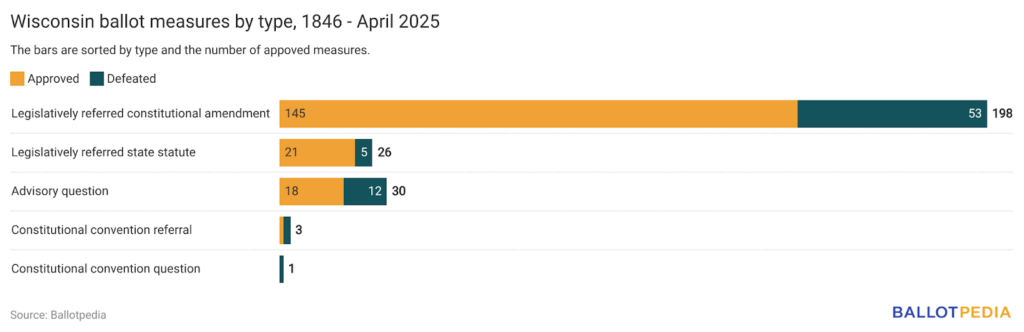
Click here to learn more about Wisconsin’s 2026 ballot measures.
An early look at North Carolina’s 2026 Republican state House primaries
North Carolina is holding elections for its state House on Nov. 3. The primary is March 3, and the primary runoff is May 12.
North Carolina has had a divided government with a Democratic governor since 2017. Republicans are one seat shy of a supermajority in the state House and hold a 30-20 supermajority in the state Senate. North Carolina requires a three-fifths vote from both of its legislative chambers to override a gubernatorial veto. Assuming no vacancies, that amounts to 72 of the 120 members in the state House and 30 of the 50 members in the state Senate. All 50 state Senate seats are also up for election this year.
Nine House seats are open, meaning no incumbent is running, the fewest open seats in the chamber since 2014. Twenty-nine Republican House incumbents face primary challenges, the most for the party since 2010.
The News & Observer's Luciana Perez Uribe Guinassi wrote, "Control of North Carolina’s General Assembly largely comes down to math: which party has enough seats to move bills and, critically, override the governor’s veto. But the numbers game could be complicated by a group of candidates running in the upcoming primary election who switched political parties last year." According to Guinassi, 26 legislative candidates switched party affiliations ahead of the elections. These included four who switched from Democratic to Republican, one who switched from Republican to Democratic, and one who switched from the No Labels Party to Republican. The other 20 were previously unaffiliated before joining a political party.
That includes six teachers, all previously Democrats or unaffiliated, who the group NC Educators on the Ballot recruited to run against current and former Republican incumbents in the Republican primaries. Group organizer Patricia Saylor said, "With the way our state is carved up into voter districts in a lot of places, the decision about who is going to Raleigh doesn’t happen in the November general election. It happens in the March primary. And so if that’s where it’s going to happen, then that’s where these people are entering the conversation and entering the race.”
On its website, NC Educators on the Ballot describes itself as "a statewide, grassroots effort to give voters across the state a choice to support educators on the ballot in Republican-held districts, keeping the needs of students and public schools at the center of the conversation." The state GOP said in a statement to the News and Observer, "NC Educators on the Ballot is led by a registered Democrat to interfere and mislead voters in Republican primaries. Republicans have led on education policy for years, from improving classroom performance to expanding school choice for every family."
There are at least 21 key battleground primaries:
- Six feature Republican candidates that NC Educators on the Ballot recruited to run against current and former Republican incumbents.
- Seven feature current or former officeholders (including five current municipal officeholders) running against Republican incumbents.
- One features a rematch between a Republican incumbent and a challenger who received 44.5% and 48.7% of the vote in the 2020 and 2022 primaries, respectively.
- One features a Republican incumbent and a challenger who finished fourth out of 11 candidates in the 2024 election for lieutenant governor.
- One features a Republican incumbent and a challenger endorsed by the State Commissioner of Agriculture.
- Five are open seats.
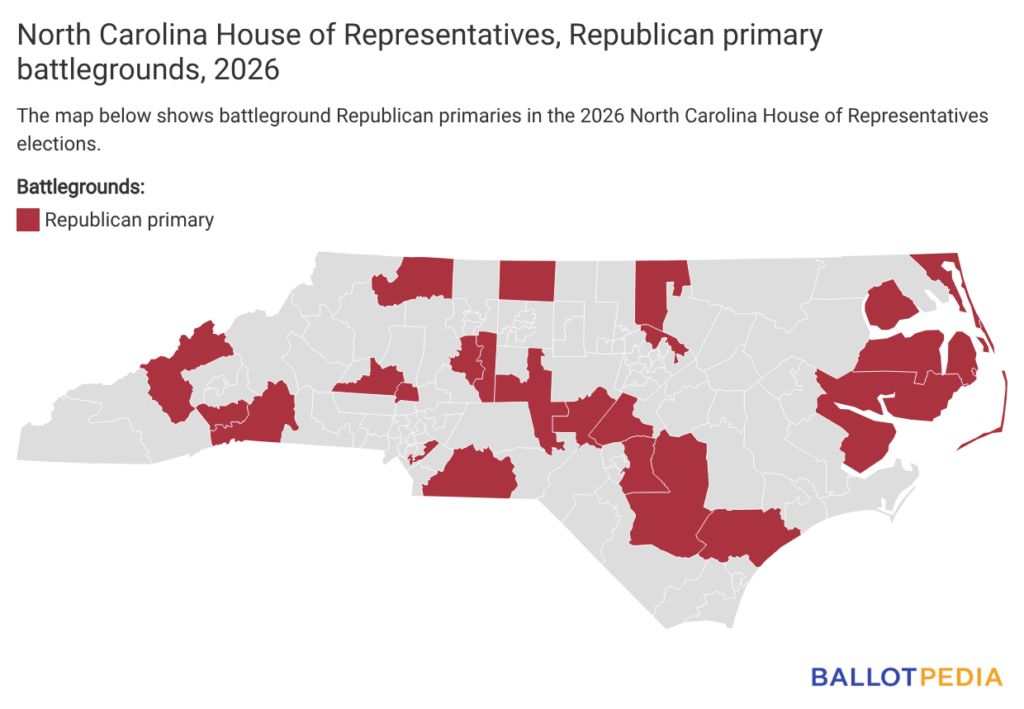
The North Carolina House of Representatives is one of 88 state legislative chambers with elections in 2026. There are 99 chambers throughout the country.
Click here to read more about the battleground Republican primaries for the North Carolina House of Representatives in 2026.
Oklahoma campaign submits signatures for initiative that would establish top-two primaries in the state
On Jan. 26, Vote Yes 836, the organization campaigning for Oklahoma State Question 836 (SQ 836), submitted more than 200,000 signatures to the Oklahoma Secretary of State. If approved, the initiative would create a top-two primary system for statewide and county offices, district attorney, state legislators, and congressional offices.
A top-two primary is a type of primary election where all candidates are listed on the same ballot and the top two vote-getters advance to the general election regardless of their partisan affiliations.
As of September 2025, three states — California, Nebraska, and Washington — used a top-two primary for some elections. Two additional states — Alaska and Louisiana — used some variation of a top-two primary for some elections.
To qualify for the ballot in Oklahoma, the petition must have 172,993 valid signatures. The Oklahoma Secretary of State’s office announced that it received 42 boxes of petition sheets with signatures. Beginning on Jan. 28, the office will verify that each signature is valid.
If enough signatures are verified and the initiative is certified for the ballot, the governor then has the authority to set the election date. In September 2024, Gov. Kevin Stitt (R) set the election date for State Question 832 for June 16, the same day as the state's gubernatorial primary. That measure would increase the state’s minimum wage to $15 by 2029.
Vote Yes 836
Vote Yes 836’s campaign website lists three reasons for their support for implementing top-two elections:
- Under the current system, “partisan primaries guarantee meaningless November elections in which the vast majority of all elected offices have already been filled in primaries or run-offs.”
- Oklahoma’s current primary election system “disenfranchises voters by barring them (especially independents) from participation in primaries, even though their tax dollars fund those elections.”
- A top-two party system would increase voter participation and voter turnout because “every voter [could] vote in every election.”
Letter from members of the state Legislature
On Jan. 22, 74 state representatives and 39 state senators, all Republicans, signed a letter opposing SQ 836 and urging Oklahomans not to sign the petition to put it on the ballot. The letter listed three main reasons for their opposition.
- The letter states the initiative would not increase voter turnout and says that California’s turnout “is actually lower today than it was before the adoption of that state’s chaotic SQ 836-style system.” The letter also says that top-two primaries would not “produce ‘moderate’ candidates but instead helps candidates advance to the November ballot by appealing to fringe voters…”
- The letter states that the initiative would limit voters' choices. It says that, “in many cases, SQ 836 would limit voter choice in November to two members of the same political party, as happens routinely in California in state and federal elections.”
- The letter states that the initiative would produce outcomes that are misaligned with voter preferences. The letter mentions the 2018 governor election: “Had SQ 836 been in place in 2018, Oklahomans would have had to choose between two Democrats for governor that November, because the Republican vote was split among 10 candidates in the primary. Thus, even though 452,606 Oklahomans cast a vote for a Republican gubernatorial candidate compared to just 395,494 for a Democrat, the 2018 general election would have involved only two Democratic candidates.”
Click here to read more about SQ 836 and here to read more about Oklahoma’s 2026 ballot measures.