


Welcome to the Thursday, Jan. 29, Brew.
By: Briana Ryan
Here’s what’s in store for you as you start your day:
- What to know about early voting, the second-most common way to cast a ballot
- Kansas legislators hear from Ballotpedia as they weigh election dates change
- Christian Menefee and Amanda Edwards are running in the runoff general election for Texas' 18th Congressional District
What to know about early voting, the second-most common way to cast a ballot
In the 2024 election, more than 48.8 million voters cast a ballot using early voting, according to Election Assistance Commission data, making it the second-most common method of casting a ballot behind Election Day voting.
Currently, 47 states and the District of Columbia offer no-excuse early voting in some form. Alabama and New Hampshire do not have early voting, and Mississippi offers excuse-required early voting for voters in eight categories.
The early voting process can be similar to casting a ballot on Election Day. States with voter ID laws, for instance, require individuals to show identification in order to vote early.
However, early voting locations and hours can differ from Election Day, as early voting is often held at local election offices and approved satellite locations rather than assigned polling places, and evening and weekend hours may not be offered.
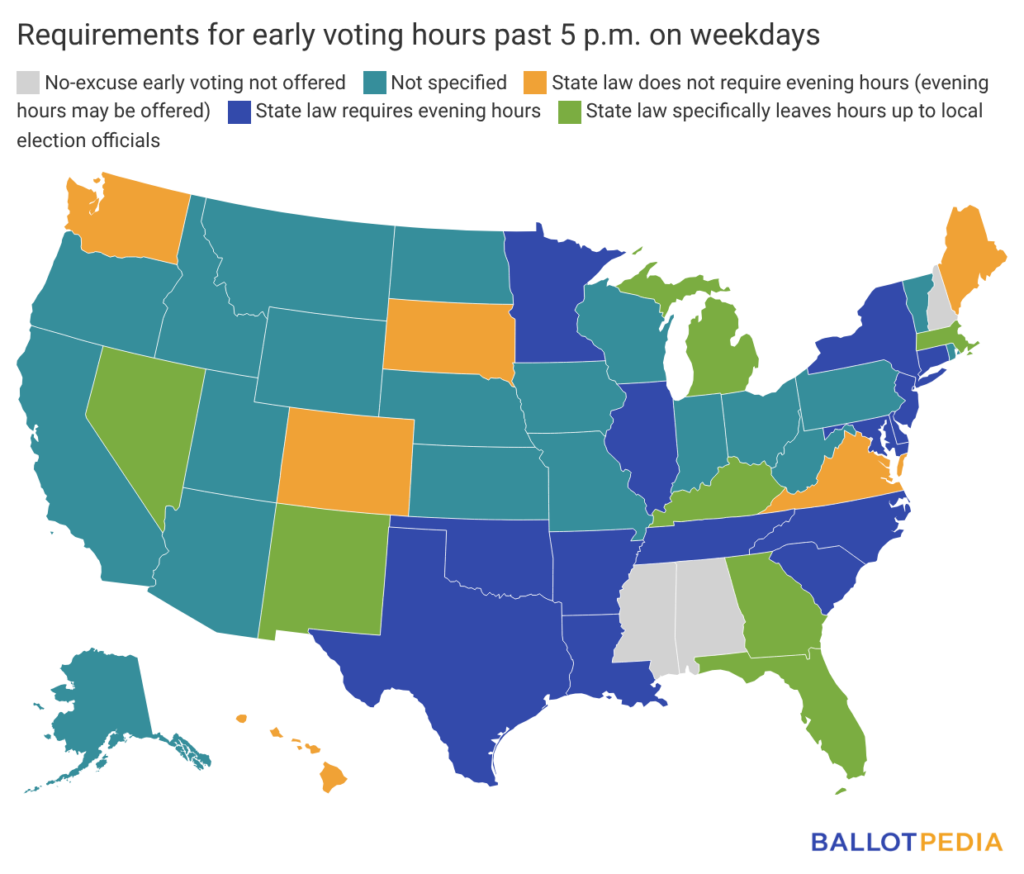
Fourteen states require at least one early voting site to be open past 5 p.m. on one or more days during the early voting period. Six states do not require evening hours, while seven states give local election officials the discretion to offer evening early voting. Twenty states do not specify whether early voting must be offered in the evening. Localities in some states that do not require evening early voting may offer expanded hours.
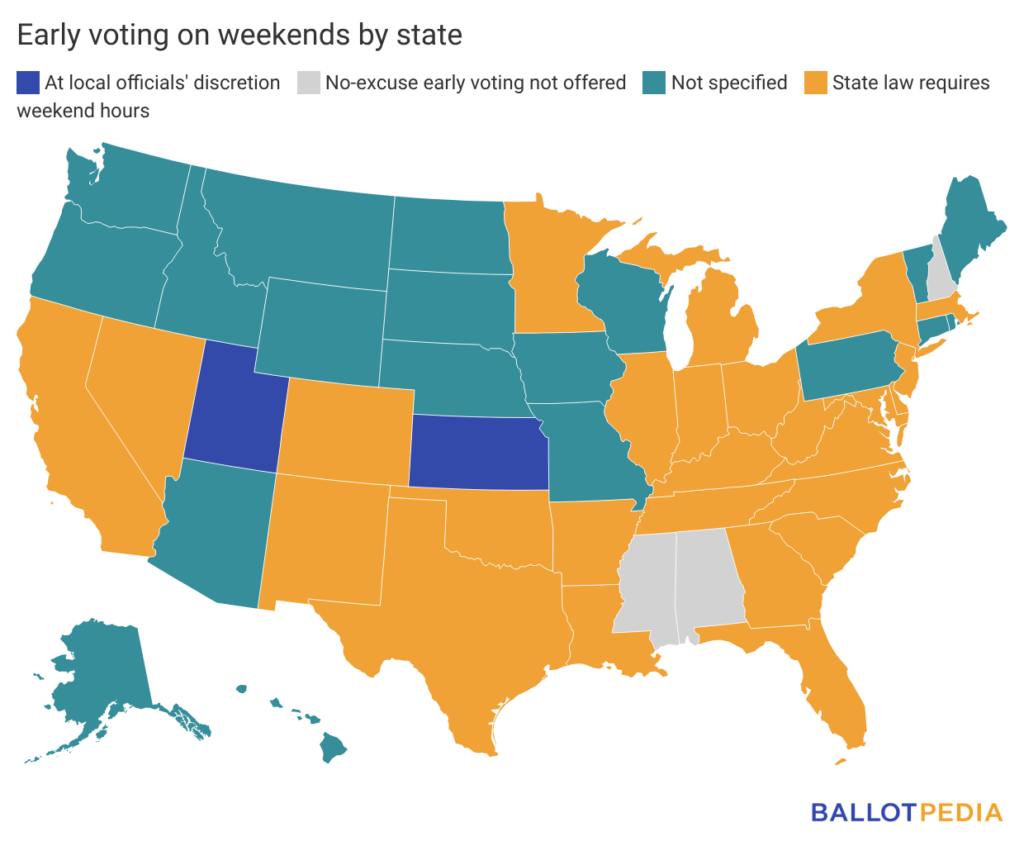
Some states also require early voting to take place on at least one weekend day during the early voting period. Twenty-six states require early voting on at least some weekend days. Twenty-one states do not specify whether weekend voting is required in their statutes or give local officials discretion to determine whether weekend early voting is offered.
So far this year, lawmakers in 26 states have introduced or carried over 100 bills related to how long early voting takes place, how it is administered, and who is eligible to vote.
None of those bills have been enacted yet. In 2025, legislators in nine states adopted 13 laws related to early voting. Those include:
- Arkansas HB 1878, which requires county election commissioners to hold early voting for preferential primaries and general elections in every city with a population over 15,000 that would not otherwise have early voting in a county clerk’s office.
- California AB 1249, which permits counties to begin offering early voting on the 29th day before the election. Previously, there was no start date in state law for early voting. The bill also added a requirement that early voting locations for statewide elections be open for at least six hours on one or more Saturdays.
- New Jersey S3990, which moved the start of early voting to seven days before a primary election. Previously, early voting began either four or six days before a primary, depending on whether it was a presidential primary. The end of early voting remains the second day before the election.
- Texas SB 2753, which changed the start and end dates for early voting. The legislation required early voting to begin 12 days before the election (rather than 17 days) and end on the day before Election Day (rather than four days before the election). In addition, the bill required at least 12 hours of early voting during each of the last four days of early voting for some elections, as well as nine hours on the Sunday before the election. Previously, there had to be at least 12 hours of early voting for the last seven days before the election.
In 2024, six states enacted 11 bills related to early voting. In 2023, 15 states enacted 22 early voting bills.
Click here to read more about laws governing early voting in each state.
Kansas legislators hear from Ballotpedia as they weigh election dates change
On Jan. 20, legislators on the Kansas House Elections Committee heard from Ballotpedia as they consider a bill to move local and school board elections from odd-numbered to even-numbered election years.
HB 2452 would apply to city and county races, as well as elections for school board, community college board, and public utility board.
The hearing featured testimony from Ballotpedia staff writer Spencer Richardson on turnout in on-cycle and off-cycle elections in Kansas. On-cycle elections are those held alongside federal elections in November of even years, with off-cycle elections making up all other elections.
In his testimony, Richardson compared election dates in the U.S. to a pyramid: "[I]f on-cycle presidential elections form the base, and on-cycle midterms fill out the middle portion, off-cycle elections make up the capstone,” he told committee members. “Because of the smaller turnout, it represents a smaller portion of the pyramid.”
Richardson’s research found that an average of 61.7% of registered voters cast ballots in Kansas during the last four presidential elections, compared with 88.5% nationally. In the last four midterm elections, turnout averaged 46.15% in Kansas, compared with 72.56% nationally. And turnout in Kansas’ four largest counties in the last four odd-numbered year elections averaged 20.91%. Richardson also found that turnout in Kansas’ largest counties in the 2025 election was around 44 percentage points lower than in the 2024 presidential election.
Rep. Pat Proctor (R), chair of the House Elections Committee, which sponsored the bill, said, “Turnout is determined by what’s on the ballot, and if you only have a handful of local races, you get less turnout.”
Harvey County Clerk Rick Piepho said that while more voters might cast a ballot if local races were in on-cycle elections, “it’s not proven whether they would be an informed voter or not, whereas, at least the ones that are turning out now, I would say, are probably informed, because they’re making an effort to come vote in an odd year.”
If lawmakers approve the bill, Kansas would become the 15th state to hold school board elections mostly in on-cycle years.
It would also be the second year in a row that legislators in a state voted to move at least some local elections to even-numbered years.
In 2025, West Virginia Gov. Patrick Morrisey signed SB 50, which requires all local municipal elections to be held concurrently with a regularly scheduled statewide primary or general election. Previously, municipalities could choose whether to have their elections in an odd-numbered or even-numbered year.
So far this year, state legislators are considering close to 150 bills related to election dates, including bills carried over from 2025.
Christian Menefee and Amanda Edwards are running in the runoff general election for Texas' 18th Congressional District
Christian Menefee (D) and Amanda Edwards (D) are running in the runoff general election for Texas' 18th Congressional District on Jan. 31.
Menefee and Edwards advanced to the runoff after no candidate received an outright majority in the special election on Nov. 4. In that election, Menefee received 28.9% of the vote, and Edwards received 25.6%. Candidates from all parties ran in the Nov. 4 election.
The winner of this election will be the fourth person to represent the district since 2024 and will serve the remainder of former Rep. Sylvester Turner's (D) term through January 2027. Turner died on March 5, 2025. As of Jan. 28, the vacancy has lasted for 329 days. That’s the third-longest congressional vacancy since the 113th Congress.
Former Rep. Sheila Jackson Lee (D) represented the district from 1995 until she died in July 2024. On Nov. 5, 2024, Erica Lee Carter (D) won the special election to fill the vacancy, and Sylvester Turner (D) won the general election. Carter represented the district from Nov. 12, 2024, to Jan. 3, 2025, when Turner assumed office.
Menefee was elected Harris County Attorney in 2020. Menefee's campaign website says that he "has been engaged in the national legal fight against Trump—challenging his administration’s efforts to cut funding for life-saving medical research and deny birthright citizenship to immigrant families" and that he is running because "Trump and his allies are making life harder for everyday Americans—rolling back voting rights, attacking reproductive freedom, and rigging the economy for billionaires."
Edwards is an attorney and nonprofit founder. Edwards was elected at large to the Houston City Council in 2015 and was a member of the Council from 2016 to 2020. Edwards' campaign website says she is "laser-focused on delivering transformative results for the community, from lowering the price of groceries, building better schools, roads, and homes, protecting our healthcare and social security, and standing up to the Trump administration."
Click here for more information about the runoff election.