


In the 2024 election, more than 48.8 million voters cast a ballot using early voting, according to Election Assistance Commission data, making it the second-most common method of casting a ballot behind Election Day voting.
As of January 2026, 47 states and the District of Columbia offer no-excuse early voting in some form. Alabama and New Hampshire do not have early voting, and Mississippi offers excuse-required early voting for voters in eight categories.
The early voting process can be similar to casting a ballot on Election Day. States with voter ID laws, for instance, require individuals to show identification in order to vote early.
However, early voting locations and hours can differ from Election Day, as early voting is often held at local election offices and approved satellite locations rather than assigned polling places, and evening hours may not be offered.
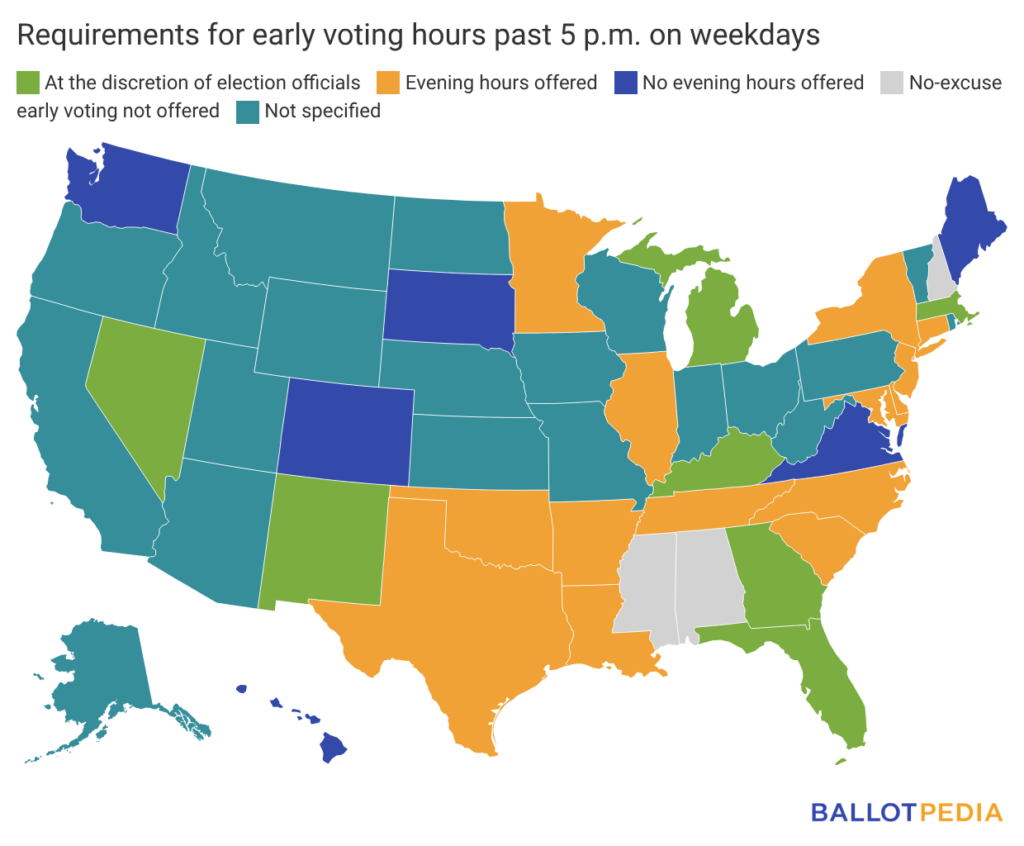
Fourteen states require at least one early voting site to be open past 5 p.m. on one or more days during the early voting period. Six states do not offer evening hours, while seven states give local election officials the discretion to offer evening early voting. Twenty states do not specify whether early voting must be offered in the evening.
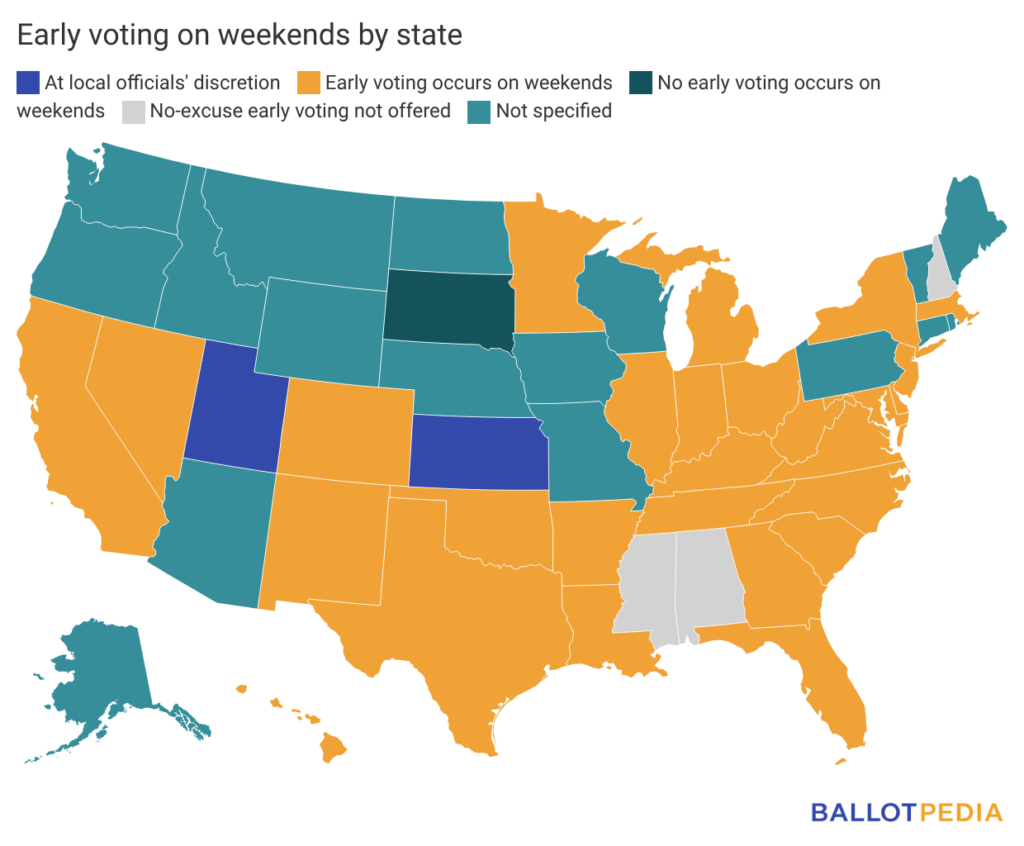
Some states also require early voting to take place on at least one weekend day during the early voting period. Twenty-eight states allow early voting on at least some weekend days. One state, South Dakota, does not allow early voting on weekends, and 18 states do not specify whether weekend voting is permitted in their statutes or give local officials discretion to determine whether weekend early voting is offered.
In 2026, lawmakers in 26 states have introduced or carried over 100 bills related to how long early voting takes place, how it is administered, and who is eligible to vote.
None of those bills have been enacted yet. In 2025, legislators in nine states adopted 13 laws related to early voting. Those include:
- Arkansas HB 1878, which requires county election commissioners to hold early voting for preferential primaries and general elections in every city with a population over 15,000 that would not otherwise have early voting in a county clerk’s office.
- California AB 1249, which permits counties to begin offering early voting on the 29th day before the election. Previously, there was no start date in state law for early voting. The bill also added a requirement that early voting locations for statewide elections be open for at least six hours on one or more Saturdays.
- New Jersey S3990, which moved the start of early voting to seven days before a primary election. Previously, early voting began either four or six days before a primary, depending on whether it was a presidential primary. The end of early voting remains the second day before the election.
- Texas SB 2753, which changed the start and end dates for early voting. The legislation required early voting to begin 12 days before the election (rather than 17 days) and end on the day before Election Day (rather than four days before the election). In addition, the bill required at least 12 hours of early voting during each of the last four days of early voting for some elections, as well as nine hours on the Sunday before the election. Previously, there had to be at least 12 hours of early voting for the last seven days before the election.
In 2024, six states enacted 11 bills related to early voting. In 2023, 15 states enacted 22 early voting bills.