


In Virginia, voters will decide on a constitutional amendment on Nov. 3, 2026, to repeal the provision defining marriage as between one man and one woman. It would also add new language prohibiting the state from denying marriage licenses to two adults based on sex, gender, or race.
The Virginia General Assembly voted in two successive sessions to place a proposal repealing the state’s same-sex marriage ban on the ballot. In Virginia, a constitutional amendment must be approved by a simple majority vote in both chambers during two legislative sessions. The amendment was first approved in 2025. On Jan. 14, 2026, the House of Delegates passed HJR 3 by a vote of 67–31. On Jan. 16, 2026, the Senate approved it by a vote of 26–13. Excluding members who were absent or did not vote, all Democratic legislators supported the amendment, along with 15% of Republican legislators.
Virginia will be the fifth state in U.S. history to decide on repealing a constitutional same-sex marriage ban.
Historically, there were 34 measures in 30 states to prohibit same-sex marriage or define marriage as between one man and one woman. Of these measures, 31 were approved, and three were defeated.
Since 2020, voters in four states have decided on measures to repeal previously approved same-sex marriage bans. Nevada was the first to do so in 2020, followed by California, Colorado, and Hawaii in 2024.
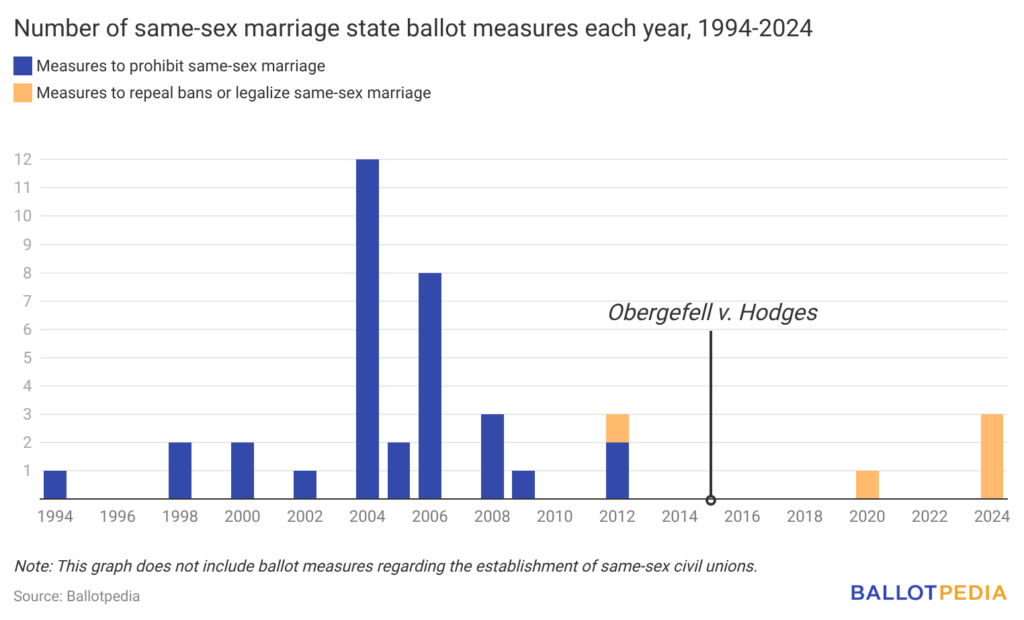
Activity regarding same-sex marriage ballot measures began in the early 1990s, when, in 1993, the Supreme Court of Hawaii ruled that denying marriage based on sex was unconstitutional. After this decision, states passed legislation or placed issues on the ballot defining marriage as between one man and one woman, and in 1996, the federal Defense of Marriage Act (DOMA) was enacted, defining marriage for federal purposes as a union between one man and one woman. Idaho was the first state to place a ballot measure related to same-sex marriage on the ballot—the measure would have established state policies around homosexuality, including providing that same-sex partnerships or marriage could not be legalized, but this measure was rejected by voters. Voters in Alaska were the first to approve a same-sex marriage ban in 1998. That year, Hawaii voters also passed an amendment that did not itself ban same-sex marriage but authorized the legislature to do so by statute.
Measures defining marriage as between a man and a woman, which banned same-sex marriage, occurred most frequently in 2004. Of the 34 measures in which voters across the states decided to ban same-sex marriage, 12 (35%) occurred that year. All of them were approved by voters.
Other states placed similar measures on the ballot in later years, including Proposition 8 in California, which reversed a state court ruling legalizing same-sex marriage and was approved by voters. The last states to decide on constitutional same-sex marriage bans did so in 2012, when voters in Minnesota rejected a proposed amendment and voters in North Carolina approved one
In the 2010s, two U.S. Supreme Court cases reshaped federal and state marriage law—in 2013, the U.S. Supreme Court ruled in United States v. Windsor that Section 3 of DOMA violated the Fifth Amendment, granting federal recognition of same-sex marriages based on state law. In 2015, the Supreme Court's Obergefell v. Hodges decision provided that same-sex marriage was constitutionally protected under the Fourteenth Amendment. This ruling rendered state constitutional amendments that prohibited same-sex marriage inoperative. In 2022, the Respect for Marriage Act was enacted, which repealed DOMA.
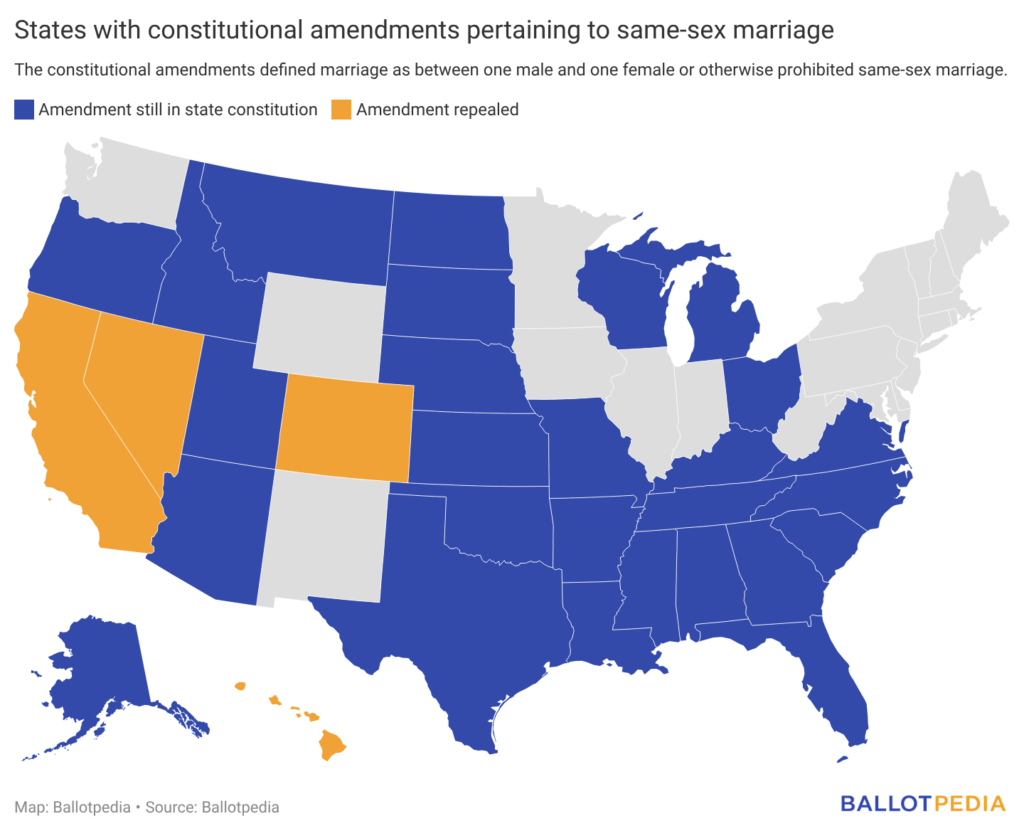
As of Jan. 2026, 27 states, including Virginia, have amendments in their constitutions prohibiting same-sex marriage or defining marriage as between a man and a woman.
For 2026, ballot initiatives to repeal same-sex marriage bans have been proposed in Missouri and Oregon, in addition to the constitutional amendment in Virginia.
Additional reading: