


Welcome to the Wednesday, Feb. 11, 2026, Brew.
By: Lara Bonatesta
Here’s what’s in store for you as you start your day:
- Of the $183 million raised for 2025 statewide ballot measures, 94% went to California Proposition 50
- Texas and Illinois both have the most candidates running for U.S. House since 2014
- On Feb. 11, 1889, Nevada banned duel participants from holding office and voting
Of the $183 million raised for 2025 statewide ballot measures, 94% went to California Proposition 50
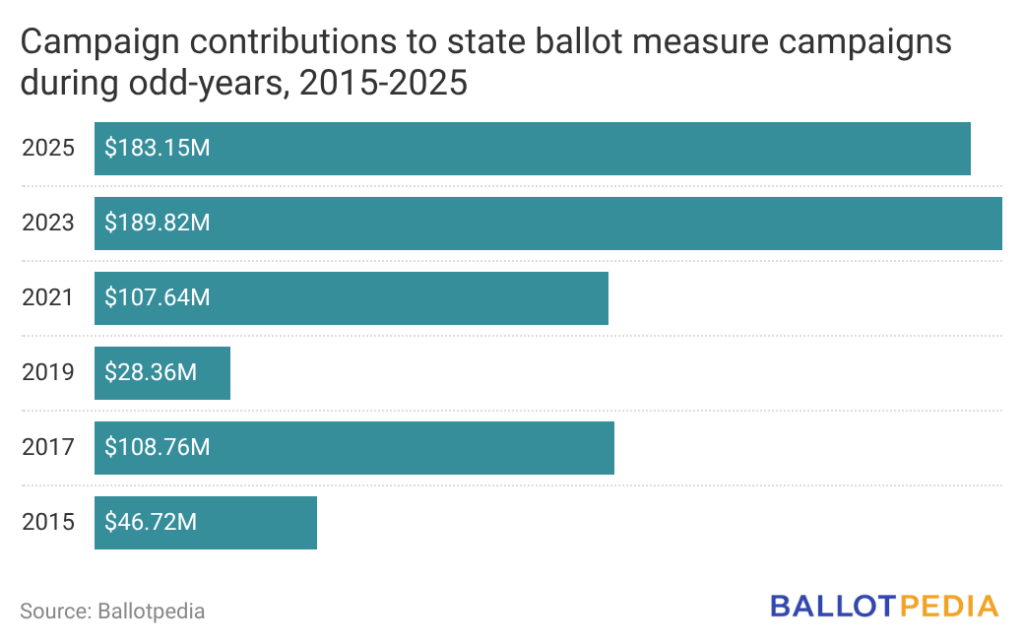
In 2025, campaigns supporting and opposing 30 statewide ballot measures in nine states raised $183.15 million. Ninety-four percent of that fundraising was either for or against California Proposition 50, which authorized the state to use a new congressional district map.
Here’s a closer look at ballot measure campaign finance from 2025 now that the final reporting deadlines have passed.
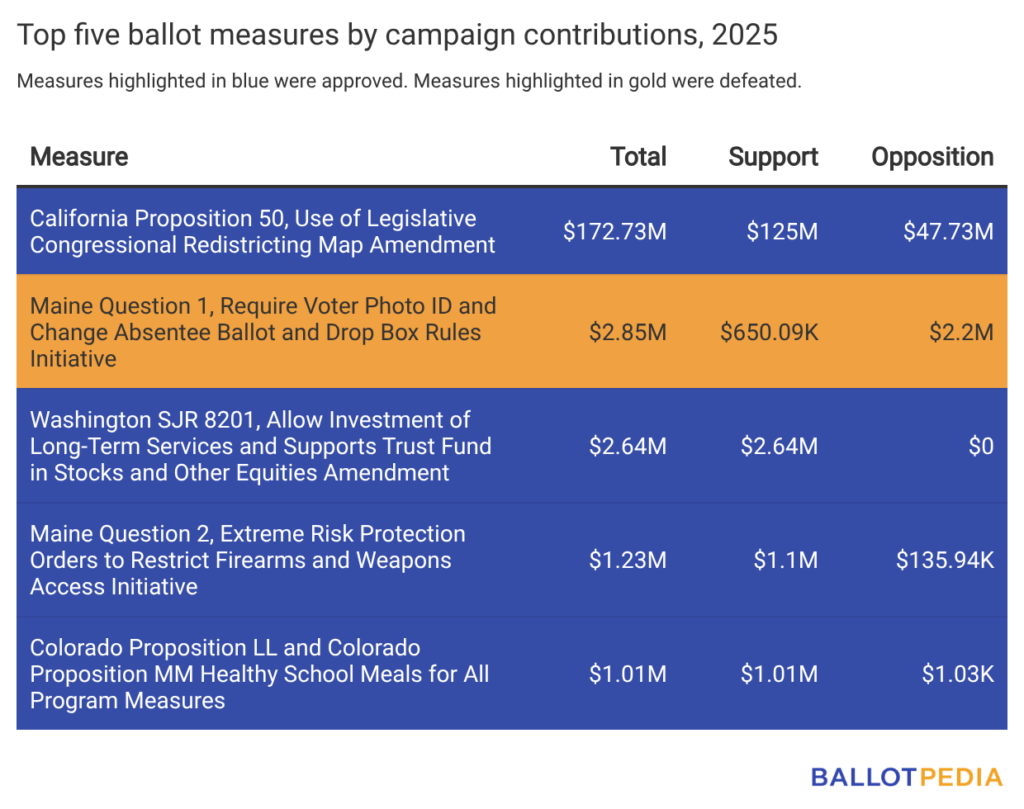
Campaigns supporting and opposing Proposition 50 raised $172.7 million, with $124.9 million going to PACs supporting the proposition and $47.7 million to PACs opposing it.
Top donors supporting the ballot measure included the House Majority PAC ($16.5 million) and Fund for Policy Reform ($10 million). The top donors opposing the measure were Charles Munger, Jr. ($36 million) and the Congressional Leadership Fund ($5 million).
2025 had fewer contributions than 2023, when there were 41 statewide measures on the ballot across eight states. That was the most statewide ballot measures in an odd-numbered year since 2007. Campaigns for and against these measures raised a combined $189.82 million. The measure that generated the largest amounts of money both for and against in 2023 was Ohio Issue 1. The measure would have increased the voter approval threshold for new constitutional amendments to 60% and changed certain requirements for citizen-initiated constitutional amendment campaigns. Voters defeated Issue 1, 57.1% to 42.9%. Proponents and opponents raised a combined $89.9 million. While Issue 1 of 2023 accounted for 47.3% of contributions in 2023, California Proposition 50 accounted for 94.3% in 2025.
Since 2015, California Proposition 50 has been the most expensive ballot measure in an odd-numbered year. The second-most-expensive odd-year ballot measure since 2015 was Maine Question 1 in 2021. In that election, proponents and opponents raised a combined $99.9 million.
Besides California Proposition 50, the other two most expensive ballot measures in 2025 were Maine Question 1, which had a combined $2.8 million raised for and against it, and Washington SJR 8201, at $2.6 million.
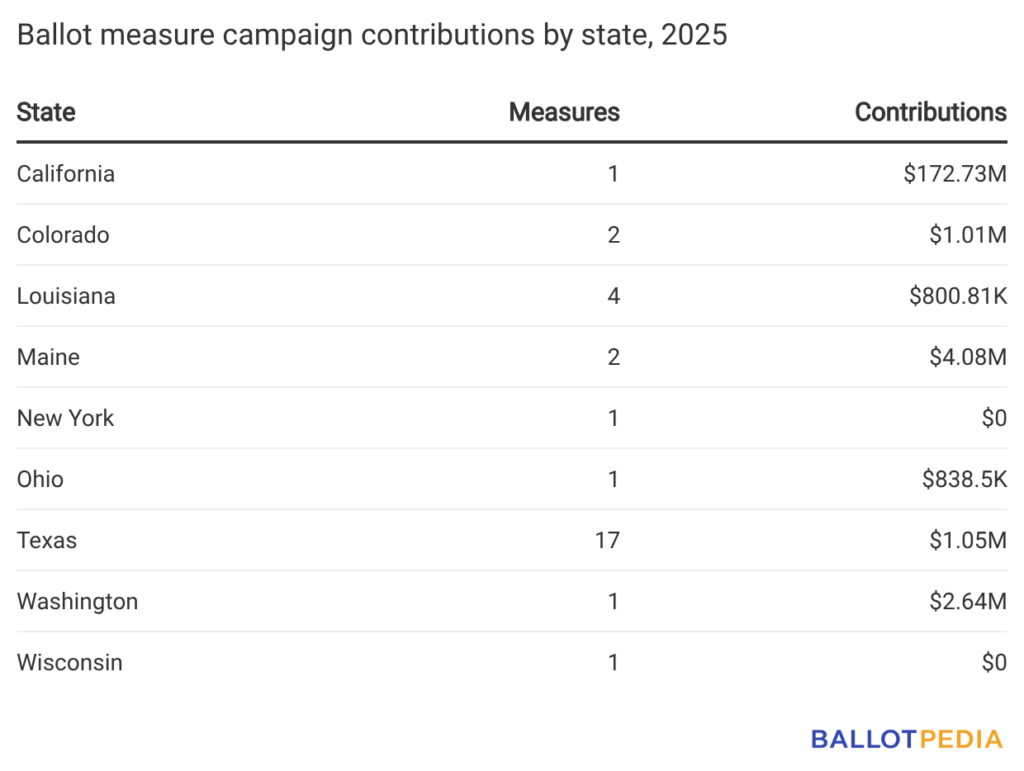
Ballot measures in 2025 appeared in California, Colorado, Louisiana, Maine, New York, Ohio, Texas, Washington, and Wisconsin. Behind California, measures in Maine and Washington had the most contributions in 2025. Maine had a total of $4.08 million in contributions for two measures, and Washington with $2.6 million for one measure. In 2023, the states with the greatest contributions were Ohio, Maine, and Colorado — Ohio with $126.7 million total, Maine with $48.4 million, and Colorado with $5.8 million.
There were two citizen initiatives in 2025, both in Maine. The campaigns for and against both initiatives raised a combined $4.08 million. State legislatures referred the remaining 28 measures to the ballot. Of those, 11 had at least one campaign supporting or opposing the measure that reported contributions.
Click here to learn more about ballot measure campaign finance in 2025.
Texas and Illinois both have the most candidates running for U.S. House since 2014
This year’s first congressional primaries are less than a month away, and today we’re taking a look at two of the states that are holding primaries in March: Texas and Illinois. Both states have record numbers of candidates and open districts this year. The totals for both are the highest since 2014.
Here’s a closer look at the congressional primaries in both states.
Texas
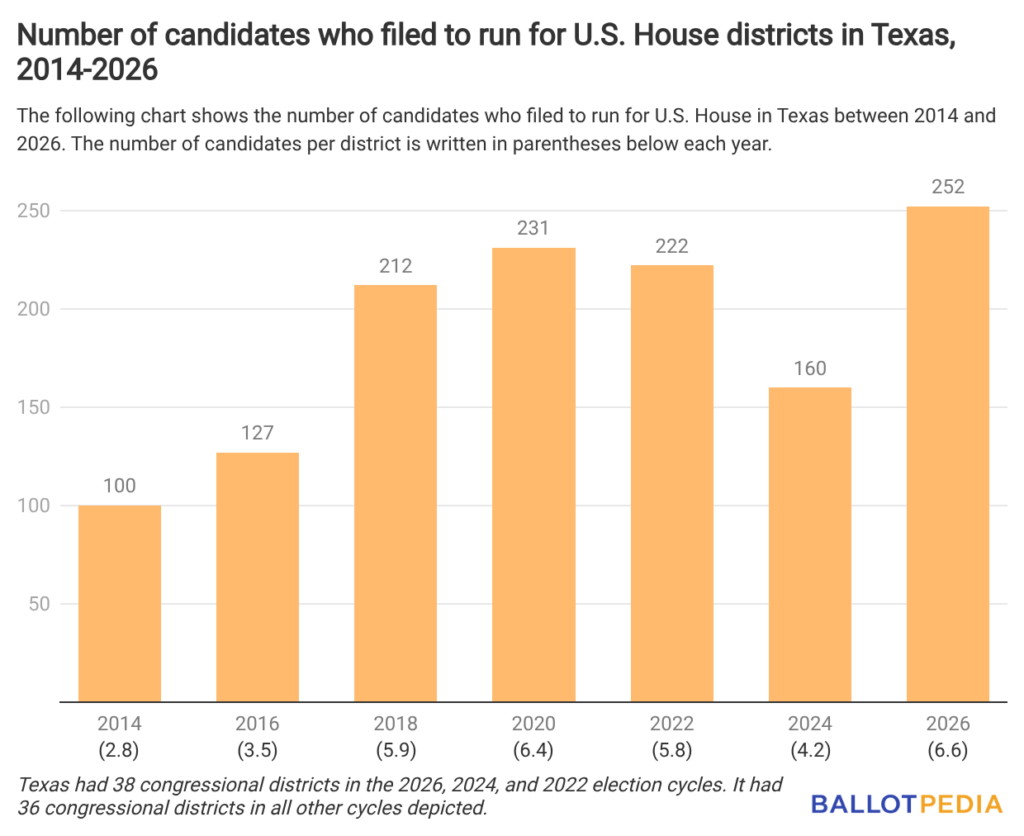
Two hundred fifty-two candidates — 98 Democrats and 154 Republicans — are running for Texas’ 38 U.S. House districts on March 3.
Ten districts are open this year, compared to three districts in 2024, six in 2022, six in 2020, eight in 2018, two in 2016, and one in 2014. An average of 11.2 candidates are running for each of the 10 open seats, compared to an average of five candidates running in each of the 28 districts, with incumbents running.
These are the first elections to take place since the Texas Legislature passed and Gov. Greg Abbott (R) signed a new congressional map in August 2025.
In a recent episode of Ballotpedia’s On The Ballot, the Texas Tribune’s Gabby Birenbaum explained how the redrawn map is driving competition in this year’s congressional primaries: “In multiple districts, you had multiple Democratic incumbents drawn into the same district…This is going to be a massive opportunity for Republicans … to make that jump to Congress. So you have a lot of interest in these seats. There’s going to be competitive Republican primaries in the open seats. And you had a lot of members sort of scrambling to figure out where to run. Multiple members of the delegation [are] jumping to run for higher office or to run for local office in Texas. And so it’s really scrambled the delegation.”
Reps. Morgan Luttrell (R-8th), Michael McCaul (R-10th), Jodey Arrington (R-19th), Troy Nehls (R-22nd), Marc Veasey (D-33rd), and Lloyd Doggett (D-37th) are retiring from public office. Reps. Jasmine Crockett (D-30th) and Wesley Hunt (R-38th) are running for the U.S. Senate. Rep. Chip Roy (R-21st) is running for Texas attorney general.
Here are some interesting details about this year’s filings:
- Two incumbents — Christian Menefee (D) and Al Green (D) — are running against each other in the redrawn 18th district. Menefee is the incumbent in the current 18th district, and Green is the incumbent in the 9th district. In 2024, only one U.S. House race – the Republican primary in Alabama’s 1st Congressional District – featured multiple incumbents.
- Fifty-nine primaries — 32 Democratic and 28 Republican — are contested. This is the most since at least 2014. There were 39 contested primaries in 2024, 44 in 2022, 50 in 2020, 46 in 2018, 33 in 2016, and 19 in 2014.
- Fifteen candidates are running in each of the open races in the 9th, 21st, and 35th districts, tying for the most in any district this year. In 2024, the largest number of candidates to run for a single seat was 14.
- Nineteen incumbents — eight Democrats and 11 Republicans — are facing primary challengers this year. This ties with 2024, 2022, and 2016 for the most in a single year since 2014. There were 19 incumbents in a contested primary in 2024, 19 in 2022, 18 in 2020, 15 in 2018, 19 in 2016, and 12 in 2014.
- Candidates are running in the Republican and Democratic primaries in all 38 districts. This means no districts are guaranteed to either party.
In Texas, primary winners are determined by majority vote. If no candidate receives more than 50% of the vote, the top two candidates proceed to a runoff election. If needed, Texas will hold runoff elections on May 26.
Click here to learn more about Texas’ 2026 U.S. House elections.
Illinois
One hundred five candidates — 69 Democrats and 36 Republicans — are running in the primaries for Illinois’ 17 congressional districts on March 17. Five districts are open this year. There were no open districts in 2024, four in 2022, one in 2020, one in 2018, one in 2016, and none in 2014.
According to Capitol News Illinois’ Brenden Moore, “There are more candidates running for Congress than usual on account of a once-in-a-generation turnover among Democratic elected officials. Democratic Sen. Dick Durbin’s retirement set off a domino effect, with two Democratic incumbents — Rep. Robin Kelly of Lynwood and Rep. Raja Krishnamoorthi of Schaumburg — giving up their seats in bids to succeed him in the upper chamber.”
Krishnamoorthi represents Illinois’ 8th District, and Kelly represents Illinois’ 2nd District. Additionally, Reps. Jesus Garcia (D-4th), Danny K. Davis (D-7th), and Jan Schakowsky (D-9th) are retiring from public office.
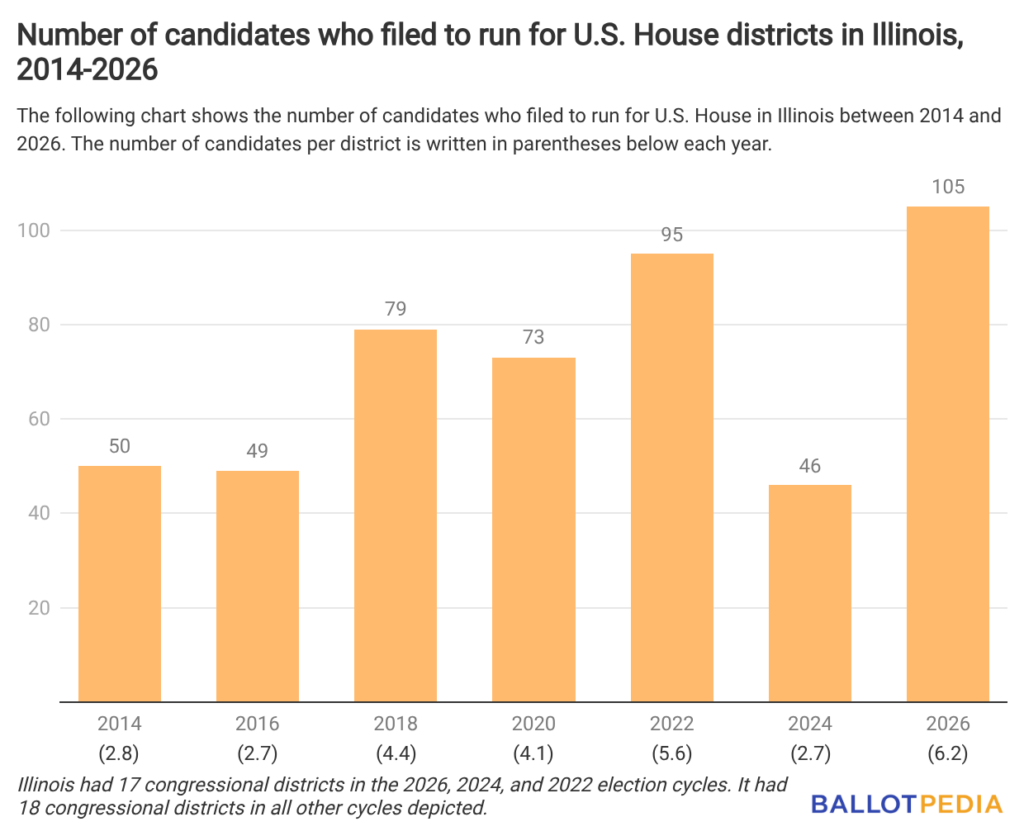
Here are some interesting details from this year’s filings.
- Twenty primaries — nine Democratic and 11 Republican — are contested. Since 2014, Illinois has had an average of between 15 and 16 contested primaries per year. There were 11 contested primaries in 2024, 19 in 2022, 21 in 2020, 20 in 2018, 14 in 2016, and nine in 2014.
- Twenty candidates — 16 Democrats and four Republicans — are running for the open 9th district, the most in any district in Illinois this year. In 2024, the largest number of candidates to run in a single district was six.
- Five incumbents — four Democrats and one Republican — are facing primary challengers this year. There were five incumbents in contested primaries in 2024, seven in 2022, 10 in 2020, seven in 2018, seven in 2016, and three in 2014.
- Candidates are running in the Republican and Democratic primaries in all 17 districts. This means no districts are guaranteed to either party.
In Illinois, the primary candidate who receives the most votes wins, even if they do not win an outright majority.
Click here to learn more about Illinois’ 2026 U.S. House elections.
On Feb. 11, 1889, Nevada banned duel participants from holding office and voting
On this day, Feb. 11, 1889, Nevada voters passed a constitutional amendment prohibiting individuals who participated in a duel from holding office and voting. The same amendment also allowed women who meet certain age and residency requirements to hold specific school offices.
The amendment, known as State Question 19, prohibited anyone who fought, sent, or accepted a challenge to fight in a duel with a deadly weapon within the state from holding any public office or voting. The prohibition also extended to any individual who acted as a second, knowingly conveyed a challenge, or assisted in any manner in fighting a duel.
State Question 19 also granted the Nevada Legislature the authority to pass laws that made women over the age of 21, who had lived in the state for one year, and had lived in a county or district for at least six months, eligible for the offices of superintendent of public schools and school trustees. Voters passed State Question 19 on Feb. 11, 1889, with 4,441 (56.08%) in favor and 3,478 (43.92%) against it.
Although the Nevada Constitution of 1864 is still in effect today, the prohibition on duel participants is no longer included. The state constitution has been amended more than 112 times through citizen initiatives and legislative referrals. Nevada voters last amended the state constitution on Nov. 5, 2024.
Click here to learn more about State Question 19. Plus, click here to learn more about dueling ban ballot measures in other states.