


On Feb. 11, the U.S. House of Representatives passed the SAVE America Act, which, if enacted, would require voters in all 50 states to provide documentary proof of citizenship to register to vote and voter ID to cast a ballot in federal elections.
The legislation, introduced by U.S. Rep. Chip Roy (R), is among several bills backed by House Republicans that would change national election policies.
The SAVE America Act would prohibit states from accepting voter registration applications for federal elections unless they are accompanied by documentary proof of citizenship, such as a REAL ID, birth certificate, passport, or naturalization certificate.
Voters who register by mail using a federal form would be required to present their proof of citizenship in person to an election official before the election or, if the state allows for same-day voter registration, at the polls on Election Day.
The legislation would also require states to check their voter rolls against U.S. Department of Homeland Security data to identify and remove non-citizens who are registered to vote.
In addition, the SAVE America Act would require individuals voting in a federal election to present photo identification. Absentee/mail-in voters would be required to include a copy of their ID with their ballot or provide the last four digits of their Social Security number and sign an affidavit. Eligible forms of ID include documents issued by state, federal, or tribal governments that have a photo of the voter, an identification number, and an indication that the person is a U.S. citizen.
Federal law currently requires individuals in all 50 states who register to vote by mail and who have not previously voted in a federal election in their state to provide documents to establish their name and identity, such as a copy of their driver's license or paycheck.
The bill passed on a 218-213 vote, with one Democrat and 217 Republicans voting in favor of the bill and 213 Democrats voting against. Politico’s Meredith Lee Hill and Mia McCarthy wrote on Feb. 6, “Democrats are certain to filibuster the bill in the Senate, and it’s unlikely the GOP is ready to take extraordinary steps to overcome that hurdle.”
In a social media post, President Donald Trump supported the bill, saying “America’s Elections are Rigged, Stolen, and a Laughingstock all over the World. We are either going to fix them, or we won’t have a Country any longer. I am asking all Republicans to fight for the [bill’s provisions].”
House Minority Leader Hakeem Jeffries (D) has opposed the legislation, saying “Republicans have adopted voter suppression as an electoral strategy. That's what the so-called SAVE Act is all about.”
Separate legislation, introduced by U.S. Rep. Bryan Steil (R), would also require voter ID and proof of citizenship for federal elections. The proposal also requires absentee/mail-in ballots be received by the close of polls on Election Day, bans ranked-choice voting and all-mail voting for federal elections, and requires voting systems to use voter-verifiable paper ballots.
The bills include provisions that are already in place in some states.
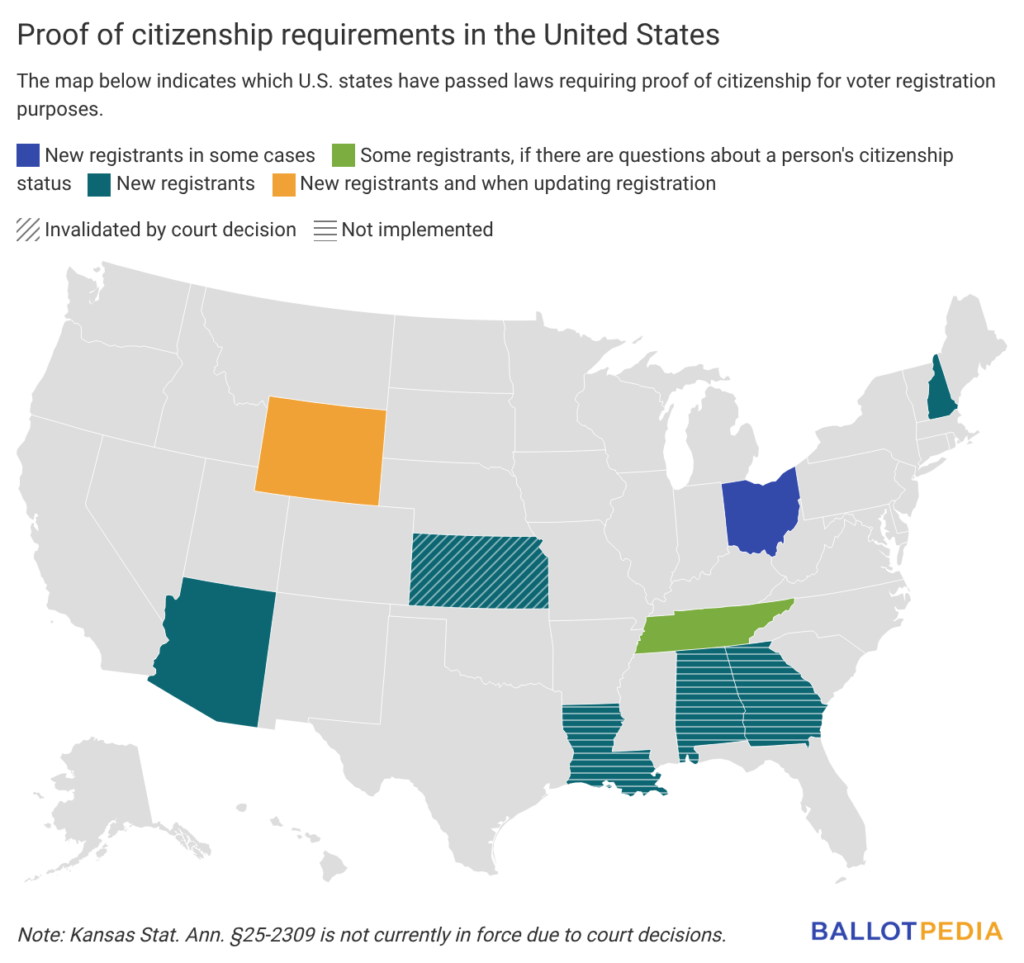
Alabama, Arizona, Georgia, Kansas, Louisiana, New Hampshire, and Wyoming have laws requiring proof of citizenship at the time of voter registration for state or federal elections. Ohio requires proof of citizenship only when registering to vote at a Bureau of Motor Vehicles facility. Court decisions invalidated Kansas' proof of citizenship law. Alabama, Georgia, and Louisiana have not implemented the requirements of their proof of citizenship laws. Alabama, Georgia, Louisiana, New Hampshire, Ohio, and Wyoming currently have Republican trifectas, while Arizona and Kansas have divided governments.
Thirty-six states require voters to present identification to vote at the polls on Election Day. Twenty-four of those states require voters to present identification containing a photograph, with certain exceptions. Twelve states do not require photo identification. Twenty-three states with voter ID laws currently have a Republican trifecta, six states have a Democratic trifecta, and seven states have divided governments.
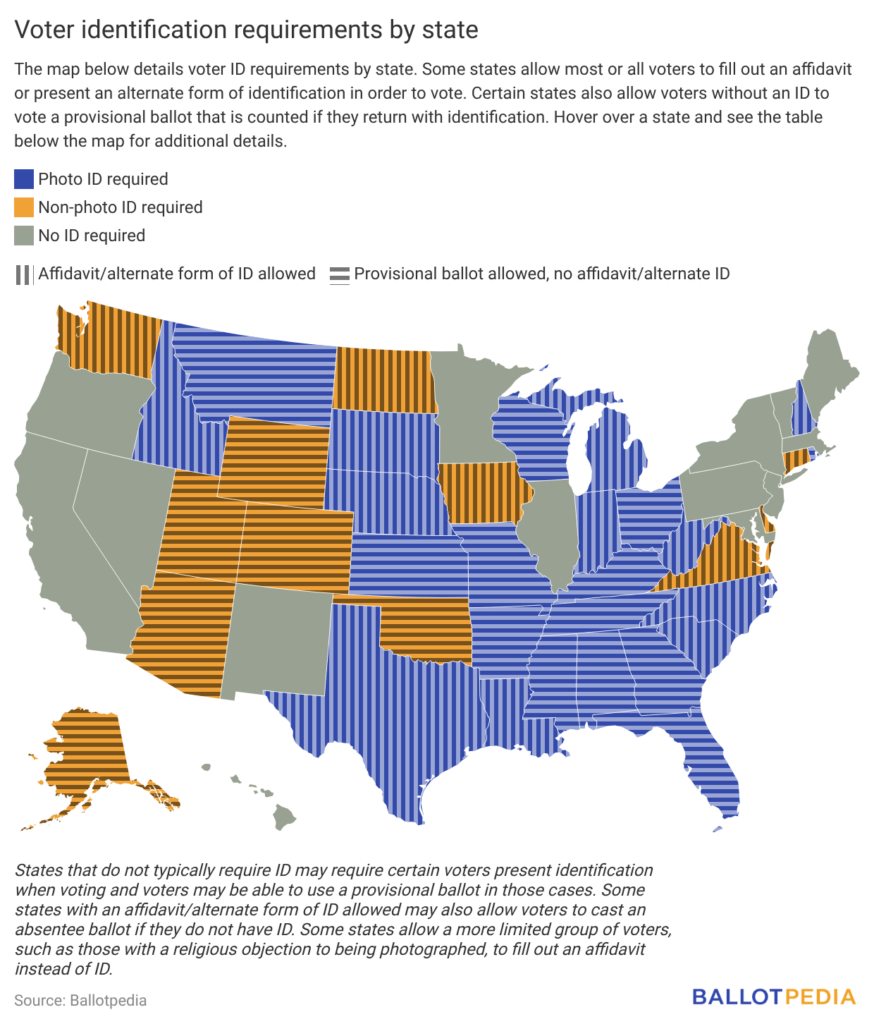
The remaining 14 states do not generally require voters to present identification to vote at the polls on Election Day. Ten of these states currently have a Democratic trifecta, while four have divided governments.
Most states have exceptions in their voter ID law for at least some voters, though nine states have none. In 16 states, some or all voters can sign an affidavit or a form instead of providing identification. Seven states allow election officials or other voters to vouch for a person's identity instead of an ID. In four states, voters who live and vote in state-licensed nursing homes or care centers do not have to provide ID.
So far this year, lawmakers in 17 states have introduced or retained from the 2025 session 30 bills related to proof of citizenship for voting. One bill requiring proof of citizenship to register to vote for non-federal elections, Utah HB 209, has passed in the state House. Bills requiring states to compare their voter rolls with federal data to identify potential non-citizens have passed at least one chamber in Mississippi and Tennessee.
Lawmakers in 25 states have introduced or retained from the 2025 session 115 bills related to voter ID, either for in-person or absentee/mail-in voting. Bills that have passed at least one chamber include Arizona HCR 2001, which would amend the state constitution to require voter ID, and HB 323 in New Hampshire, which would remove student IDs and out-of-state driver’s licenses from the list of acceptable forms of ID.