


Welcome to the Friday, Feb. 27, 2026, Brew.
By: Lara Bonatesta
Here’s what’s in store for you as you start your day:
- Almost 32% of congressional incumbents not seeking re-election this year have endorsed a successor
- Incumbent justices are running for each other's seats on the Arkansas Supreme Court on March 3
- Thirteen states have filing deadlines in the next two weeks
Almost 32% of congressional incumbents not seeking re-election this year have endorsed a successor
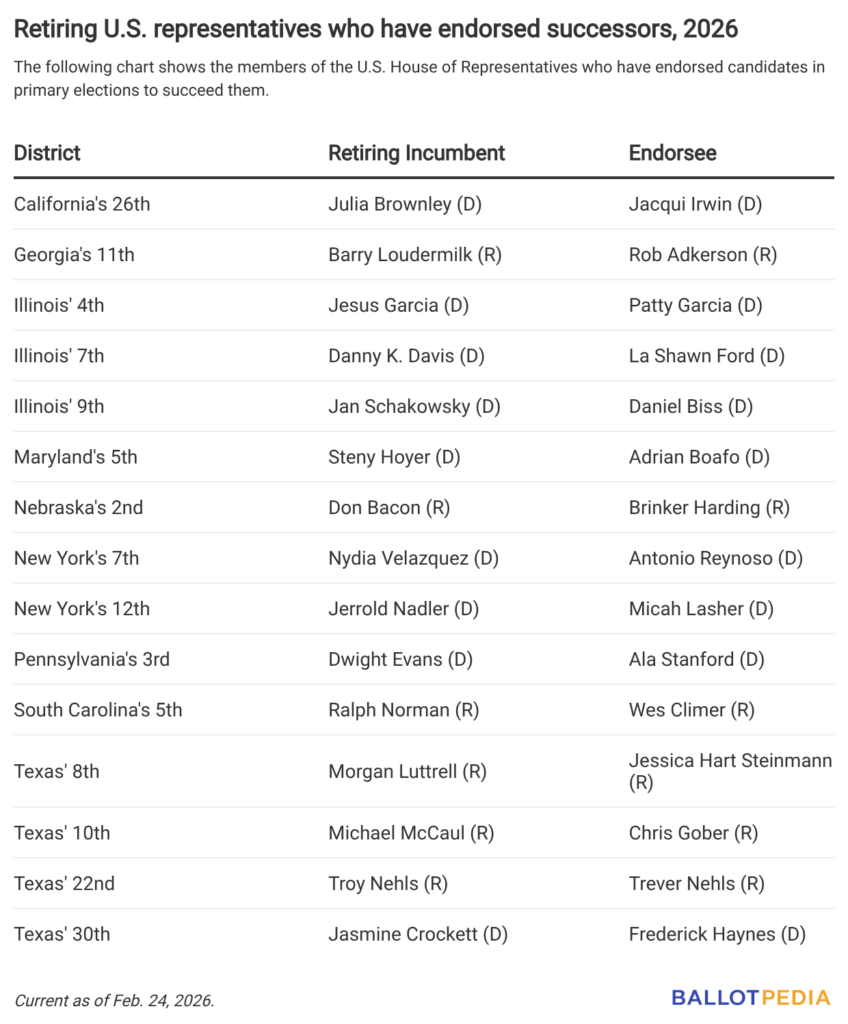
On Feb. 24, U.S. Rep. Barry Loudermilk (R-Ga.), who is not seeking re-election this year, endorsed Rob Adkerson (R) in the primary election for the Republican nomination to succeed him in representing Georgia’s 11th Congressional District.
Loudermilk is the 19th retiring member of the U.S. Congress to endorse a successor candidate in a primary election this year – representing 31.6% of the 60 members of Congress who have so far announced they are not seeking re-election to their current office.
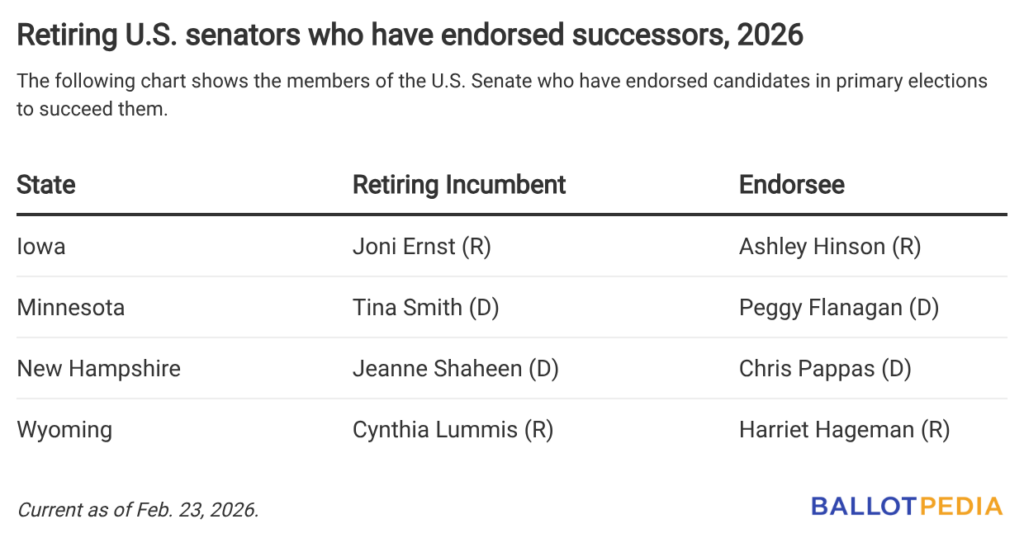
Four of the nine U.S. senators (44.4%) who are not seeking re-election this year have endorsed a candidate in the respective primaries to succeed them. Two of those endorsed candidates are Democrats, and two are Republicans.
All four of those endorsed candidates are running in contested primaries.
Fifteen of the 51 U.S. representatives (29.4%) who are not seeking re-election this year have endorsed a candidate in the respective primaries to succeed them. Nine of those endorsed candidates are Democrats, and six are Republicans.
Thirteen of those endorsed candidates are running in contested primaries, while two are uncontested. The two candidates running in uncontested primaries are Patty Garcia (D) in Illinois' 4th Congressional District, and Brinker Harding (R) in Nebraska's 2nd Congressional District.
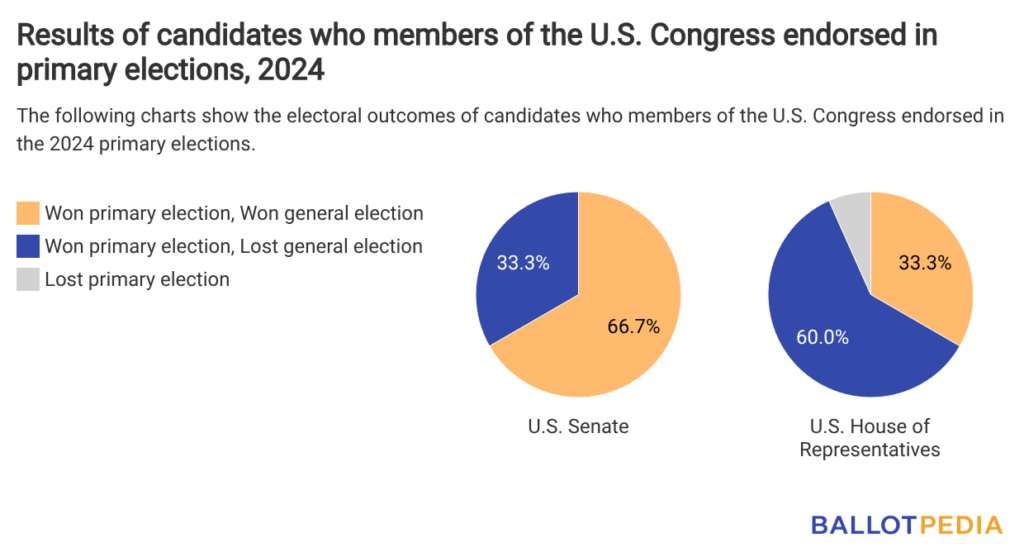
In 2024, three of the eight U.S. senators (37.5%) who did not seek re-election endorsed a candidate in the respective primaries to succeed them. Two of those endorsed candidates were Democrats, and one was a Republican.
One of those endorsed candidates ran in and won a contested primary, but lost the general election. The two endorsed candidates who were uncontested in the primaries went on to win their respective general elections.
In 2024, 14 of the 45 U.S. representatives (31.1%) who did not seek re-election endorsed a candidate in the respective primaries to succeed them. Nine of those endorsed candidates were Democrats, and five were Republicans.
Thirteen of those endorsed candidates ran in contested primaries. Five lost in the primaries. The eight who won their contested primaries also won their respective general elections. The one endorsed candidate who did not run in a contested primary lost the general election.
Click here to read more about the 2026 midterm congressional elections.
Incumbent justices are running for each other's seats on the Arkansas Supreme Court on March 3
Two Arkansas Supreme Court justices are running for each other's seats in a March 3 election, something that hasn't happened in at least 25 years, according to Bolts Magazine's Daniel Nichanian. State law bars appointed justices from running for re-election but allows them to run for a different seat. Governor Sarah Huckabee Sanders (R) appointed both Justices Nicholas Bronni and Cody Hiland, who are each seeking the seat the other currently holds.
Bronni faces one other candidate, John Adams, in the race to succeed Hiland. Hiland is running unopposed to succeed Bronni.
According to Nichanian, this is the first time two justices have run for another justice's seat since 2000. According to the same Bolts analysis, in that time there were five justices who were eligible to run for another justice's seat, but none did so.
Arkansas and Louisiana are the only states that prohibit appointed justices from succeeding themselves. Amendment 29, Section 2 of the Arkansas Constitution, prohibits officials appointed to fill a vacancy from succeeding themselves, and Article V, Section 22(B) of the Louisiana Constitution prohibits appointed justices from running in a special election.
Although court seats are officially nonpartisan, the Arkansas Republican Party endorsed Bronni, and Adams is a former Democratic congressional candidate. Hiland is affiliated with the Republican Party.
The Arkansas Advocate's Ainsley Platt wrote, "The outcome of the race won’t change the ideological tilt of the court, where justices linked to Republicans hold a 5-2 majority...But whoever wins will sit on a court that’s expected to take up several high-profile cases winding their way through the court system, including lawsuits over abortion, school vouchers and executions."
Arkansas is one of 32 states holding an election for state supreme court in 2026. To read more about state supreme court elections in 2026, clickhere.
Thirteen states have filing deadlines in the next two weeks
Ahead of the first statewide primaries of the 2026 cycle, midterm races are continuing to take shape.
Thirteen states have candidate filing deadlines in the next two weeks. The map and bulleted list below show which states have candidate filing deadlines scheduled between Feb. 28 and March 14.
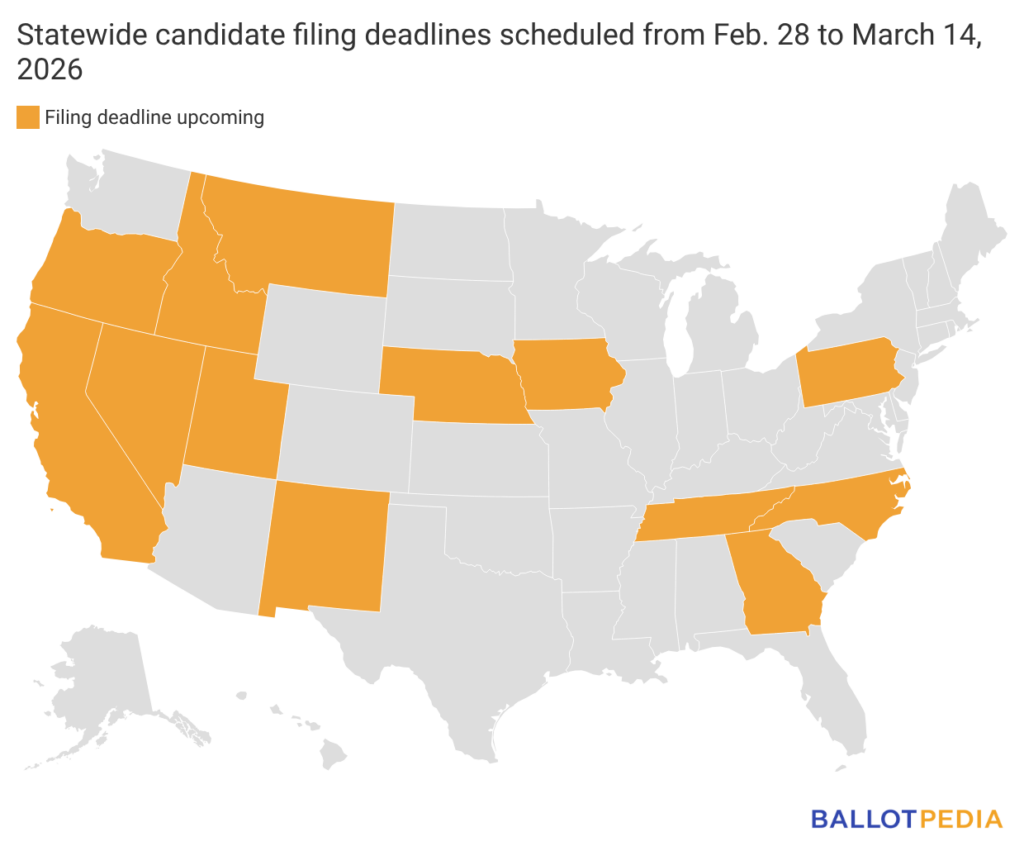
- Nebraska: March 2 (statewide filing deadline for non-incumbent primary candidates)
- North Carolina: March 3 (statewide filing deadline for unaffiliated candidates)
- Oregon: March 3 (statewide filing deadline for incumbent primary candidates)
- Montana: March 4 (statewide filing deadline for primary candidates)
- California: March 6 (statewide candidate filing deadline)
- Georgia: March 6 (statewide filing deadline for primary candidates)
- Idaho: March 6 (statewide filing deadline for write-in primary candidates)
- New Mexico: March 10 (statewide filing deadline for primary candidates not seeking pre-primary designation)
- Oregon: March 10 (statewide filing deadline for non-incumbent primary candidates)
- Pennsylvania: March 10 (statewide filing deadline for primary candidates)
- Tennessee: March 10 (statewide candidate filing deadline)
- Iowa: March 13 (statewide filing deadline for primary candidates)
- Nevada: March 13 (statewide filing deadline for primary candidates)
- Utah: March 13 (statewide filing deadline for U.S. House primary candidates)
Looking back
Three states had a candidate filing deadline in the past two weeks:
- Nebraska: Feb. 17 (statewide filing deadline for incumbent primary candidates)
- Ohio: Feb. 23 (statewide filing deadline for write-in primary candidates)
- Idaho: Feb. 27 (statewide filing deadline for primary candidates)
Candidates must meet various state-specific filing requirements and deadlines to appear on primary and general election ballots. These regulations, known as ballot access laws, determine whether and how candidates can make it onto the ballot. These laws are set at the state level and apply to candidates running for state and federal offices.
Upcoming primaries
Looking ahead, here are the five states with statewide primaries coming up in March, and some dates voters in those states should be aware of.
- Voter registration deadline: Feb. 2
- Early voting start date: Feb. 16
- Primary date: March 3
- Voter registration deadline: Feb. 17 by mail (March 1 online, March 17 in person.)
- Early voting start date: Feb. 5
- Primary date: March 17
- Voter registration deadline: Feb. 9
- Mississippi does not permit no-excuse early voting.
- Primary date: March 10
- Voter registration deadline: Feb. 6
- Early voting start date: Feb. 12
- Primary date: March 3
- Voter registration deadline: Feb. 2
- Early voting start date: Feb. 17
- Primary date: March 3
To read more about candidate filing deadlines for the upcoming midterm elections, click here. Click here to see a full list of statewide primaries.