


Welcome to the Monday, March 2, Brew.
By: Briana Ryan
Here’s what’s in store for you as you start your day:
- Indiana becomes the 18th state to ban ranked-choice voting
- Why Arkansas’ school board elections are now held only in March of even-numbered years
- Ballot Bulletin relaunches on March 3
Indiana becomes the 18th state to ban ranked-choice voting
On Feb. 24, Indiana Gov. Mike Braun (R) signed legislation prohibiting the use of ranked-choice voting (RCV) in the state, making it the 18th state to do so.
Indiana’s law states that an election “may not be determined by ranked choice voting” and a “candidate may not be nominated for or elected to an office by means of ranked choice voting.”
On Jan. 20, the legislation passed the Indiana Senate 38-9. Thirty-seven Republicans and one Democrat voted in favor of it, and nine Democrats voted against it. On Feb. 17, it passed the Indiana House of Representatives 58-30. Fifty-eight Republicans voted in favor of it, and 28 Democrats and two Republicans voted against it.
The prohibition on RCV in Indiana takes effect on July 1. No municipalities in the state currently use RCV. In 2020, in lieu of a convention, the Indiana Republican Party held a mail-in, RCV contest for lieutenant governor and attorney general nominations due to the coronavirus pandemic.
RCV is a system where voters rank candidates by preference on their ballots. In the RCV system most commonly used in the United States, a candidate who wins a majority of first-preference votes is the winner. If no candidate wins a majority of first-preference votes, the candidate with the fewest first-preference votes is eliminated.
Ballots that ranked an eliminated candidate as their first, or highest choice, depending on the round, are then reevaluated and counted as first-preference ballots for the next-highest-ranked candidate in that round. A new tally is conducted to determine whether any candidate has won a majority of ballots. The process is repeated until a candidate wins an outright majority.
Sixteen of the 18 that prohibit RCV had Republican trifectas at the time that the states banned it. That means the Republican party controlled the governorship and majorities in both legislative chambers. The other two states — Kansas and Kentucky — had divided governments. In the case of those two states, both had Democratic governors and Republican majorities in both legislative chambers.
Alaska, Hawaii, and Maine use RCV for at least some statewide elections. At the time those states approved it, Alaska had a divided government, Hawaii had a Democratic trifecta, and Maine had a divided government. In Maine, Republicans controlled the governorship and the state Senate, while Democrats controlled the state House. In Alaska, Republicans controlled the governorship and the state Senate, while control of the state House was split between parties.
Municipalities in 14 states use RCV for local elections.
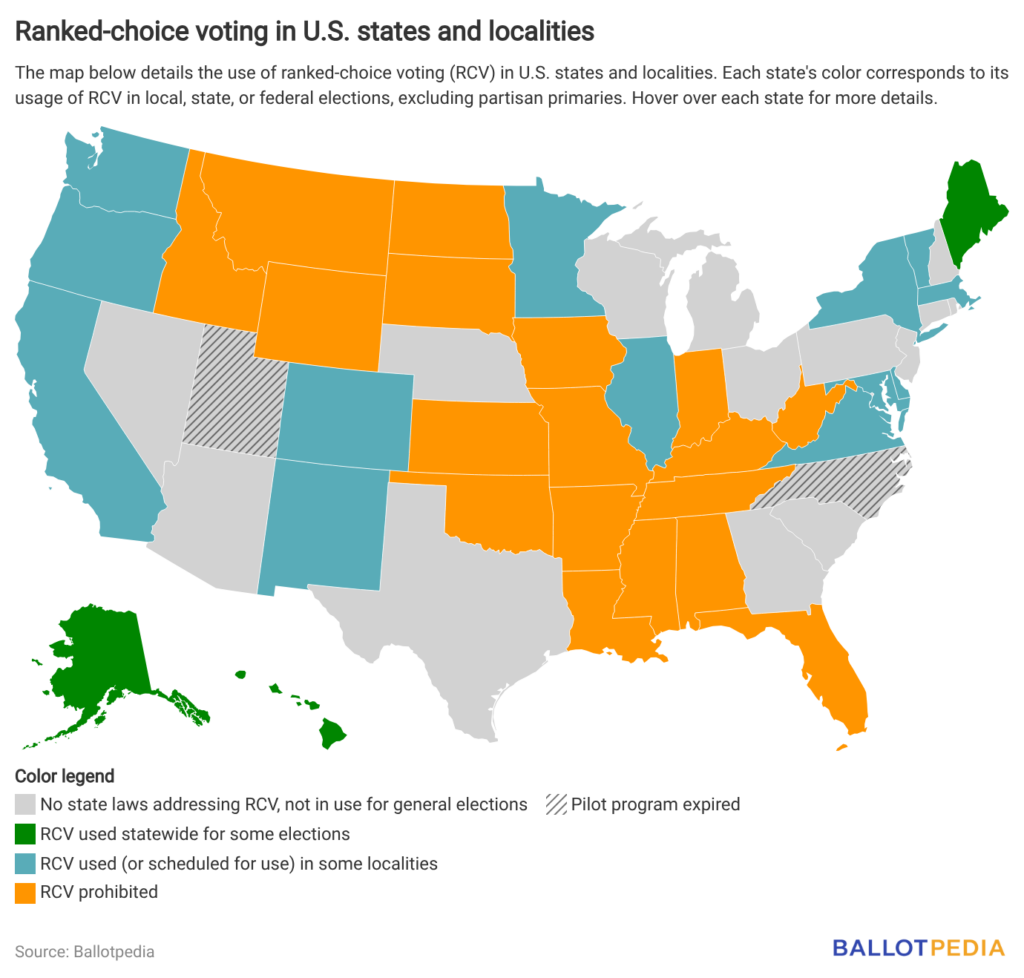
Ohio may soon become the next state to ban RCV. On Feb. 25, the Ohio House of Representatives approved a prohibition on RCV 65-27. The Ohio Senate passed it 27-5 in May 2025. The state House added in a separate provision on the public inspection of candidate petitions, meaning the state Senate will need to vote on the bill again before it can be sent to Gov. Mike DeWine (R). Ohio has a Republican trifecta.
So far this year, state legislators have introduced or carried over 18 bills from the 2025 session to prohibit or repeal RCV.
Legislators have introduced or carried over 36 bills that would allow or require RCV. Two of those bills, in Maine and Virginia, have passed at least one chamber of a state legislature.
In 2025, six states enacted legislation prohibiting RCV. Six states also passed laws banning RCV in 2024.
Click here to read more about RCV in the United States.
Why Arkansas’ school board elections are now held only in March of even-numbered years
Tomorrow, March 3, voters in Arkansas, along with those in North Carolina and neighboring Texas, will kick off the 2026 midterm elections. In Arkansas, voters will decide elections for U.S. House and Senate, governor, state House and Senate, numerous judicial and municipal offices, and school boards.
Arkansas’ elections this year look a little different than they have in the past because of two laws enacted in 2025. This is especially true for the state’s school board elections.
In brief:
- SB 353, which Gov. Sarah Huckabee Sanders (R) signed in March 2025, established March as the month of Arkansas’ statewide primary in presidential and non-presidential election years and shifted school board elections to March of odd-numbered years. Arkansas’ statewide primary date used to vary depending on the year.
- HB 1724, which Sanders signed in April 2025, then eliminated the ability of school boards to choose to hold spring or fall elections, requiring them to be held only in March. HB 1724 also changed the length of school board terms, effectively ending school board elections in odd-numbered years.
Let’s dig into the details.
SB 353, now Act 405, consolidated state and local election dates and set the statewide primary for March going forward. Previously, Arkansas primaries were held in March of presidential election years. In midterm election years like this one, primaries were held in May. Because of SB 353, Arkansas voters will decide primaries in March in both presidential- and non-presidential election years.
SB 353 affected school board elections, as well. Before Sanders signed the bill into law, Arkansas’ school board elections occurred annually, and districts could decide whether to hold them in the spring or fall. In spring-schedule districts, the election date would shift between March and May depending on the year. In presidential election years, school board elections occurred in March on the same date as the statewide primaries. In non-presidential election years, they occurred in May, only overlapping with the statewide primaries in even-numbered years. In odd-numbered years, school board elections did not align with any statewide elections.
HB 1724, now Act 503, mandated March elections for school boards. Additionally, HB 1724 mandated that school board members serve four- or six-year terms. Previously, school board member terms lasted three, four, or five years, depending on the board, meaning that some elections happened in odd-numbered years. Because of HB 1724, school board elections will now only occur in March of even-numbered years.
The passage of SB 353 and HB 1724 required some districts in Arkansas, such as the one in Little Rock, the state’s capital, to move their elections from November 2025 to March 2026. Three seats on the Little Rock School District were originally set to be on the ballot in November of last year, but the elections are now scheduled for March 3.
Both SB 353 and HB 1724 passed in near-unanimous votes. SB 353 passed the Arkansas House 89-0 and the Senate 32-0. Both the House and Senate voted along similar lines for HB 1724. Arkansas has a Republican trifecta.
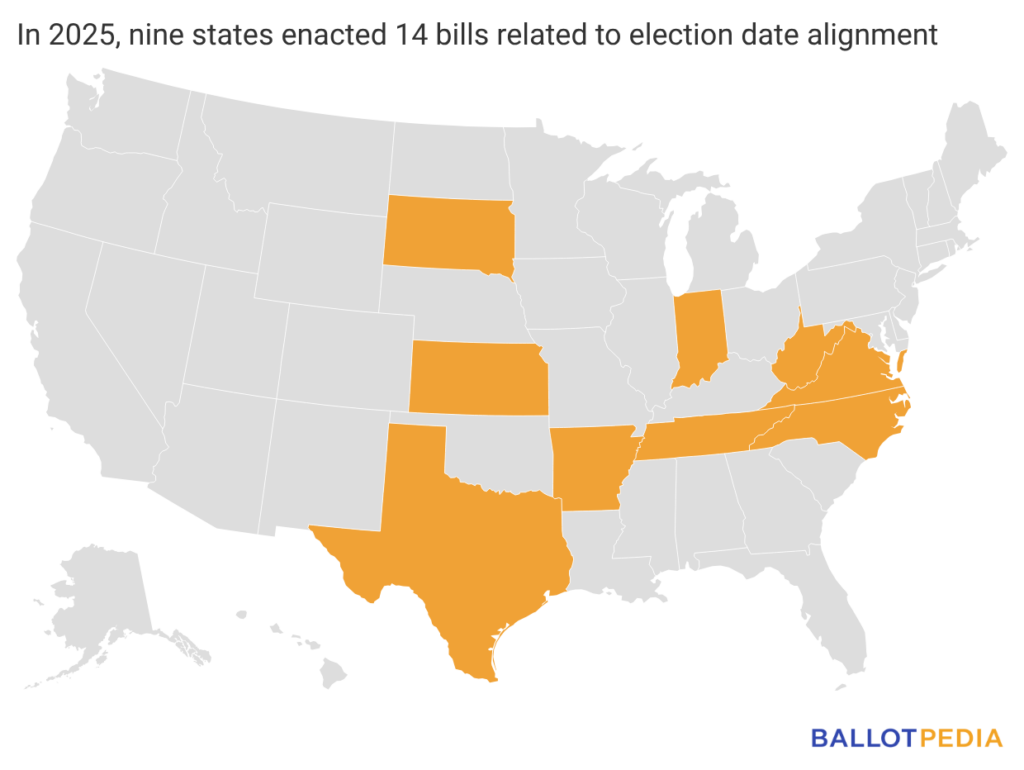
Arkansas is a microcosm of the debate over election date alignment playing out across the country. Indeed, the state was one of nine in 2025 that enacted 14 bills related to election date alignment. Six of those states had Republican trifectas, one had a Democratic trifecta, and two had divided governments.
As of Feb. 13, lawmakers in 25 states have introduced 61 bills in 2026 to align or study aligning at least some election dates.
The U.S. has more than 500,000 elected offices, most of them at the local level. Most of those local elections happened on dates other than November of even-numbered years. This is especially true for school board elections, most of which don’t align with federal election dates.
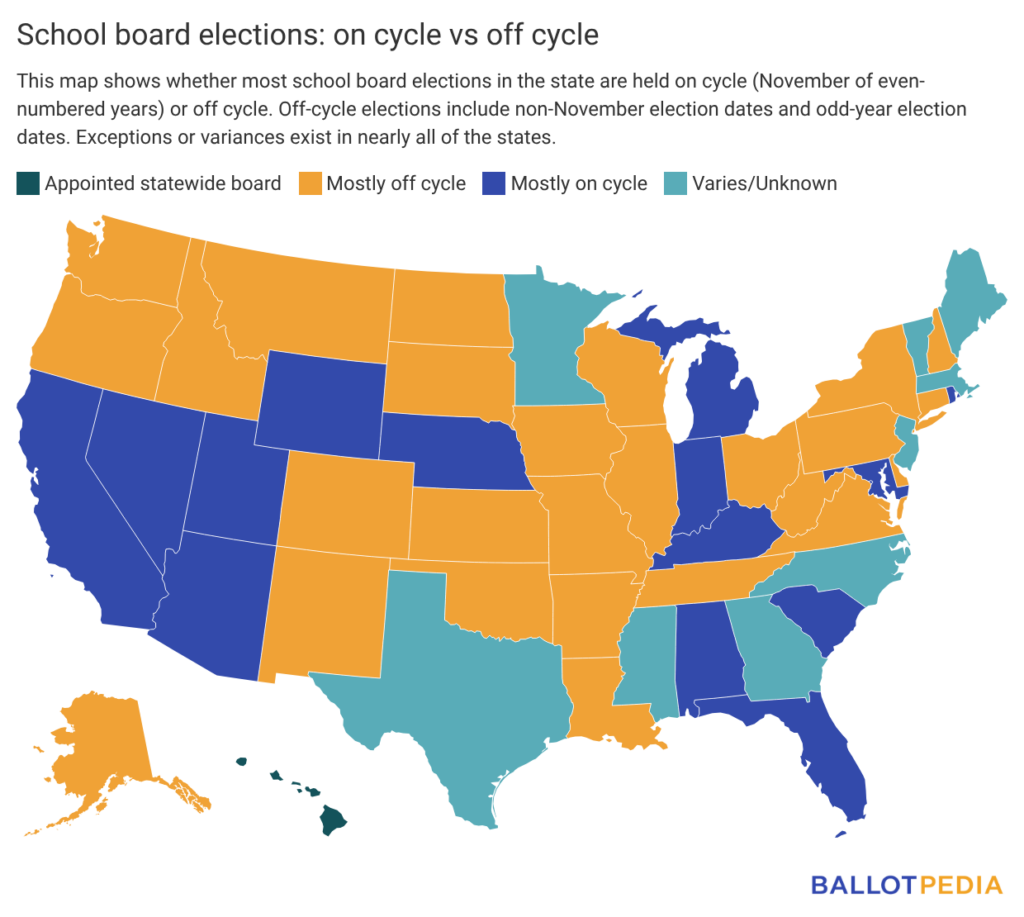
In addition to the election consolidation bills lawmakers are currently considering, the New Mexico Legislature voted on Feb. 19 to send an amendment to voters in November that would repeal the constitutional requirement that school elections be held at different times from partisan elections (including statewide and federal elections).
If voters approve the amendment, it would open the door to legislation aligning school board election dates with statewide and federal races.
We’re covering 122 contested school board elections featuring 265 candidates in Arkansas on March 3.
Click here to see the school board and other local elections happening in your county in Arkansas.
Ballot Bulletin relaunches on March 3
Ballotpedia is relaunching its Ballot Bulletin newsletter with a new send schedule and format — but with the same in-depth data on election legislation across the United States.
Starting tomorrow, March 3, we’ll be sending the latest developments in election legislation to subscribers on Tuesdays instead of Fridays. The updated newsletter will provide deeper news coverage and analysis of key developments in election policy from around the country, while continuing to leverage the power of Ballotpedia’s Election Legislation Tracker to keep readers up to date on state legislative activity.
The new format will devote more space to the biggest stories from the past week on notable legislative developments, litigation, and other election policy changes. It will also include featured work from Ballotpedia writers on key election policy topics and more details on noteworthy bills making their way through the legislative process.
Current subscribers will get the revamped edition in their inboxes on March 3. If you haven’t subscribed yet, now is the perfect time to do so! Click here to subscribe to Ballot Bulletin and find past editions of the newsletter in the archives here.
Editor's note: This post has been updated to revise Indiana's status from the 19th state to prohibit RCV to the 18th. Our initial tally included Utah, which had a pilot program authorizing RCV that expired on Jan. 1, 2026. After further review, we have recategorized Utah to better delineate between Utah and states which have passed laws explicitly prohibiting the use of RCV.