


Welcome to Hall Pass, a newsletter written to keep you plugged into the conversations driving school board governance, the politics surrounding it, and education policy.
In today’s edition, you’ll find:
- On the issues: The debate over mandating cursive instruction in schools
- School board filing deadlines, election results, and recall certifications
- New Mexico voters will decide whether to allow school elections to be held at the same time as state or federal partisan elections
- Idaho Supreme Court upholds state school choice tax credit
- Extracurricular: education news from around the web
- Candidate Connection survey
Reply to this email to share reactions or story ideas!
On the issues: The debate over mandating cursive instruction in public schools
In this section, we curate reporting, analysis, and commentary on the issues school board members deliberate when they set out to offer the best education possible in their district. Missed an issue? Click here to see the previous education debates we’ve covered.
A growing number of states are requiring students in K-12 schools to learn cursive writing. In the first two months of 2026, New Jersey (SB 1783) and Pennsylvania (HB 17) joined more than 25 states that now mandate cursive writing instruction in classrooms.
Is this a trend more states should join?
Montclair State University education professor Dierdre Glenn Paul says the New Jersey law is yet another example of lawmakers burdening teachers with unnecessary curriculum mandates. She says technology has made cursive largely irrelevant for navigating modern life, and contends that cursive mandates penalize boys, whose fine motor skills develop later than girls.
Akron Beacon Journal columnist and Akron Public Schools phonics tutor Holly Christensen says learning cursive helps children develop their fine motor skills and enhances cognitive development, especially for students with learning disabilities. Christensen says that students, who are rarely required to develop the hand strength that comes from writing by hand, struggle with the writing sections on in-class exams. She says Americans are losing the ability to read historical documents because of an unfamiliarity with cursive script.
Fussing over teaching cursive is foolish. Can NJ ever learn? | Deirdre Glenn Paul, NorthJersey.com
“Aside from the fact that this type of excessive emphasis on writing mechanics and form is plausibly distressing to the majority of young children on its receiving end, there’s a more consequential negative to be broached here. Some literacy professionals contend that the intensive focus on writing mechanics further exacerbates the problematic relationship that so many young boys experience with their schools on a daily basis. In large part, the problem, as it pertains to writing form, is rooted in a societal diminishment of or ignorance about biology.
“Pediatricians largely agree that boys’ gross motor skills develop before girls do. As a result, boys are usually able to run, catch balls and balance more quickly than their female counterparts do. It’s just the opposite with girls; their fine motor skills develop ahead of those same skills in boys. Thus, girls are often predisposed to writing neatly, coloring within the borders and cutting with scissors.”
Schools were wrong to write off benefits of teaching cursive to kids | Holly Christensen, Akron Beacon Journal
“This [the decline in cursive instruction in schools] is unfortunate on many levels, not the least of which is the acquisition of reading skills and comprehension, which might seem odd at first blush. But according to the University of California Riverside, ample research suggests that ‘learning cursive can enhance brain development, particularly in areas related to language, memory, and fine motor skills. When students engage in the intricate movements required for cursive writing, this activates different parts of the brain compared to typing or printing.’
“This is not new information. When my eldest child, now 31, was first diagnosed with dyslexia, the professionals handling his remediation told me to sign him up for occupational therapy. OT focuses on fine motor skills — picking up small objects with the forefinger and thumb, buttoning clothes and properly holding a pencil. I was told an early indicator of a learning disability is weak hand strength. Furthermore, if a child with a learning disability builds hand strength, their reading skills improve because of the connection between physical activity and the parts of the brain that manage reading.”
School board update: filing deadlines, election results, and recall certifications
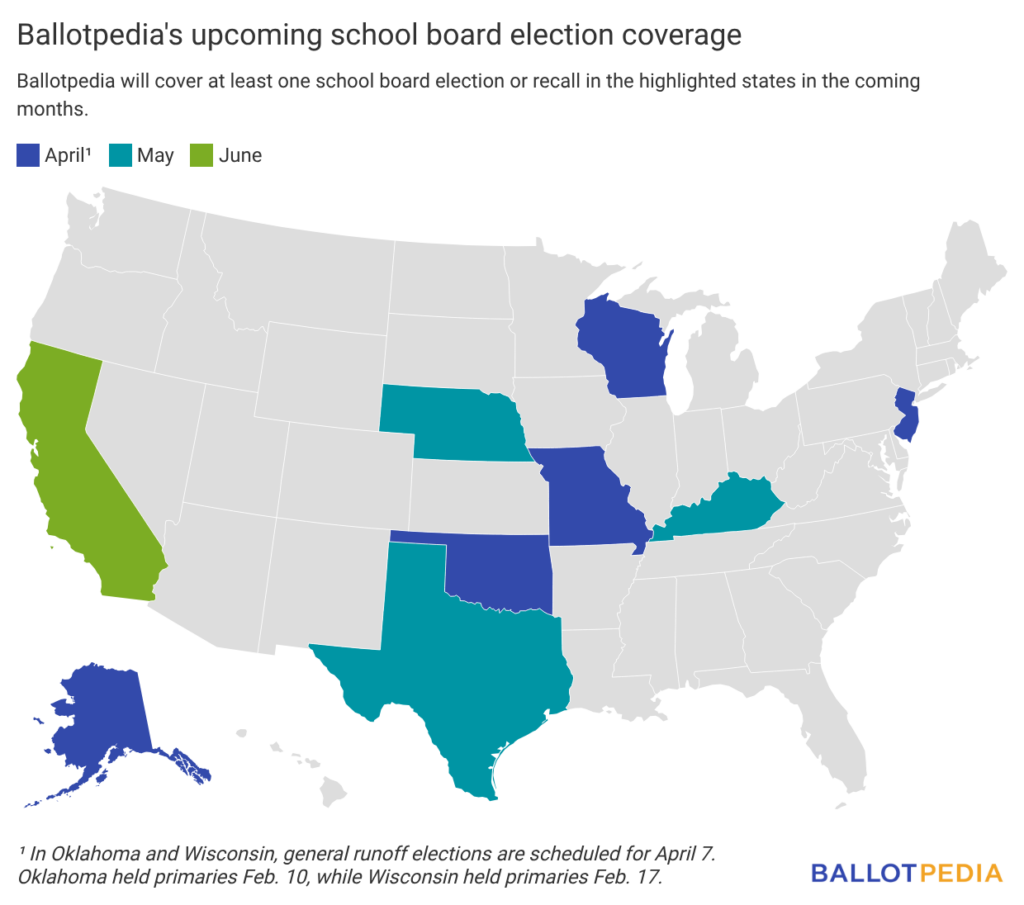
In 2026, Ballotpedia will cover elections for more than 30,000 school board seats. We’re expanding our coverage each year with our eye on covering the country’s more than 80,000 school board seats.
New Mexico voters will decide whether to allow school elections to be held at the same time as state or federal partisan elections
On Feb. 19, the New Mexico Legislature placed a constitutional amendment on school board election timing to the November ballot. The amendment would repeal a requirement that school board elections be held at different times from partisan elections, allowing them to be held on the same dates as statewide and federal elections.
The amendment, Senate Joint Resolution 1 (SJR 1), passed the state Senate by a vote of 38-0, with four members not voting, on Feb. 5. SJR 1 passed the state House by a vote of 50-9, with 11 members not voting, on Feb. 19. It received support from 100% of voting Democrats and 77% of voting Republicans across both chambers.
New Mexico has a Democratic trifecta.
Section 1 of Article VII of the New Mexico Constitution reads: “All school elections shall be held at different times from partisan elections.”
That provision about school elections has been the subject of previous ballot measures—and a state supreme court case.
Before 2016, Section 1 prohibited school elections from being held on the same date as all other elections. The legislature placed two amendments on the ballot in different years to change that requirement:
- In 2008, the legislature placed Amendment 4 on the ballot. Amendment 4 would have changed Section 1 to allow school board elections to be held at the same time as other nonpartisan elections. While voters approved the amendment by a margin of 74% to 26%, the New Mexico Compilation Commission did not update the constitution to reflect the change. The commission said Section 3 of Article VII requires that three-fourths of voters (75%) are necessary to approve amendments that restrict rights.
- In 2014, voters weighed in on a similar amendment, but that measure also failed because it did not meet the three-fourths supermajority requirement. The vote margin was 58% in support to 42% opposed.
In 2016, the League of Women Voters of New Mexico filed a lawsuit alleging that the supermajority requirement does not apply because the 2008 and 2014 amendments do not restrict rights and should therefore be considered approved by a simple majority.
The New Mexico Supreme Court ruled in favor of the League of Women Voters and ordered the compilation commission to apply the 2008 and 2014 amendments to the constitution. The end result was that New Mexico school districts were allowed to hold school board elections alongside other nonpartisan elections.
At the time of the ruling, New Mexico’s school board elections were held on the first Tuesday in February in odd-numbered years. In 2018, the legislature passed the Local Election Act, consolidating local and municipal elections, including school elections.
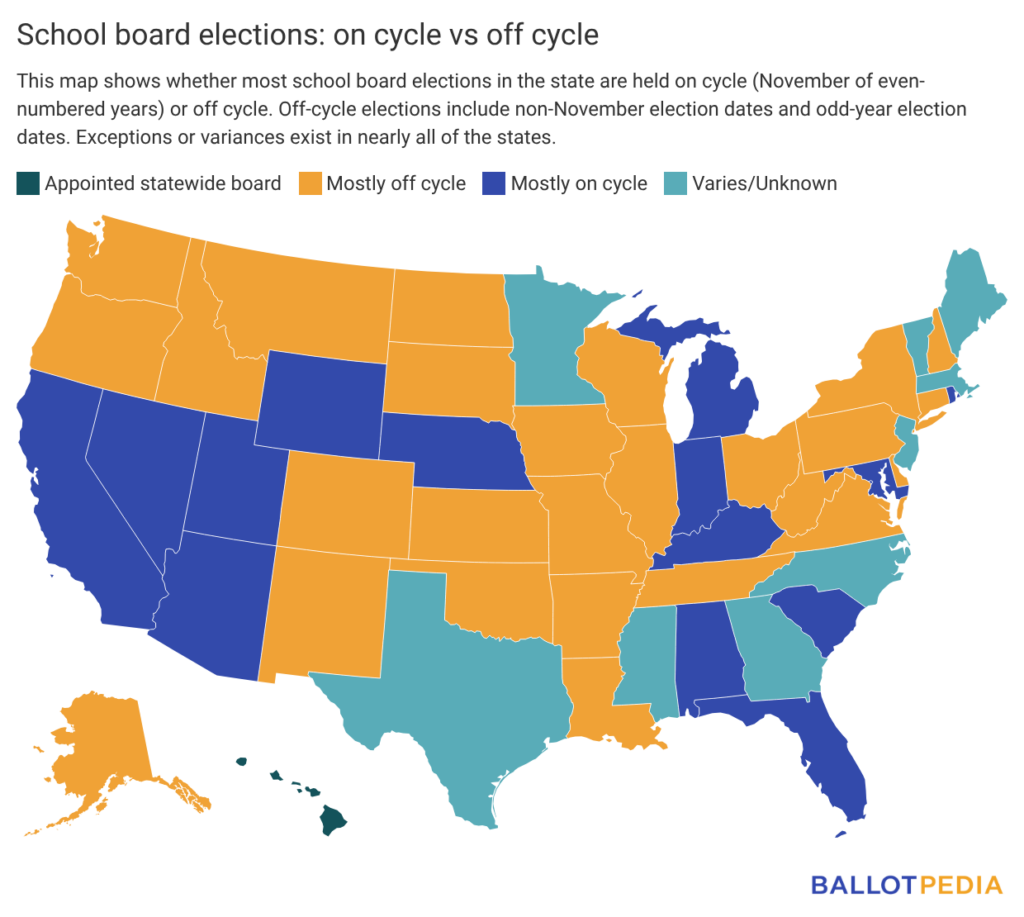
New Mexico is one of 25 states that have mostly off-cycle school board elections. The map below shows whether most school board elections in the state are held on-cycle (November of even-numbered years) or off-cycle.
Idaho Supreme Court upholds state school choice tax credit
On Feb. 5, the Idaho Supreme Court unanimously upheld the state's private school choice refundable tax credit, rejecting the plaintiff's argument that the program violates the Idaho Constitution and judicial precedent.
The Idaho Parental Choice Tax Credit was enacted in 2025 when Gov. Brad Little (R) signed HB 93. It is a refundable tax credit for up to $5,000 per student enrolled in a private school, or $7,500 for students with qualifying disabilities. The Legislature capped the program at $50 million annually and required the Idaho State Tax Commission to prioritize awarding refunds to families with an adjusted gross income below 300% of the federal poverty level, though all families are eligible to apply.
The plaintiffs in the lawsuit included Mormon Women for Ethical Government, the Moscow School District, and the Idaho Education Association. The groups argued the program violated Article IX, section 1 of the Idaho Constitution and the public purpose doctrine. The public purpose doctrine is a judicial precedent established by Idaho Water Res. Bd. v. Kramer in 1976. That decision requires that “activities engaged in by the state, funded by tax revenues, must have primarily a public rather than a private purpose.”
Article IX, section 1 charges the Idaho Legislature with establishing and maintaining a "general, uniform, and thorough system of public, free common schools."
Chief Justice G. Richard Bevan held that Article IX, section 1, did not limit the Legislature’s authority to do more than what the provision minimally required, and that the Legislature has plenary authority to enact laws, so long as they are not unconstitutional. Bevan held that the express intention of the tax credit was to increase education choice for parents. He said that since education was a public purpose, the tax credit did not violate the public purpose doctrine.
The application period for the program opened on Jan. 15. According to the Tax Commission, more than 4,650 students had applied as of Jan. 21. Idaho had roughly 300,000 public school students enrolled during the 2024-25 school year.
Idaho is one of 18 states in which all students are eligible to participate in private school choice programs.
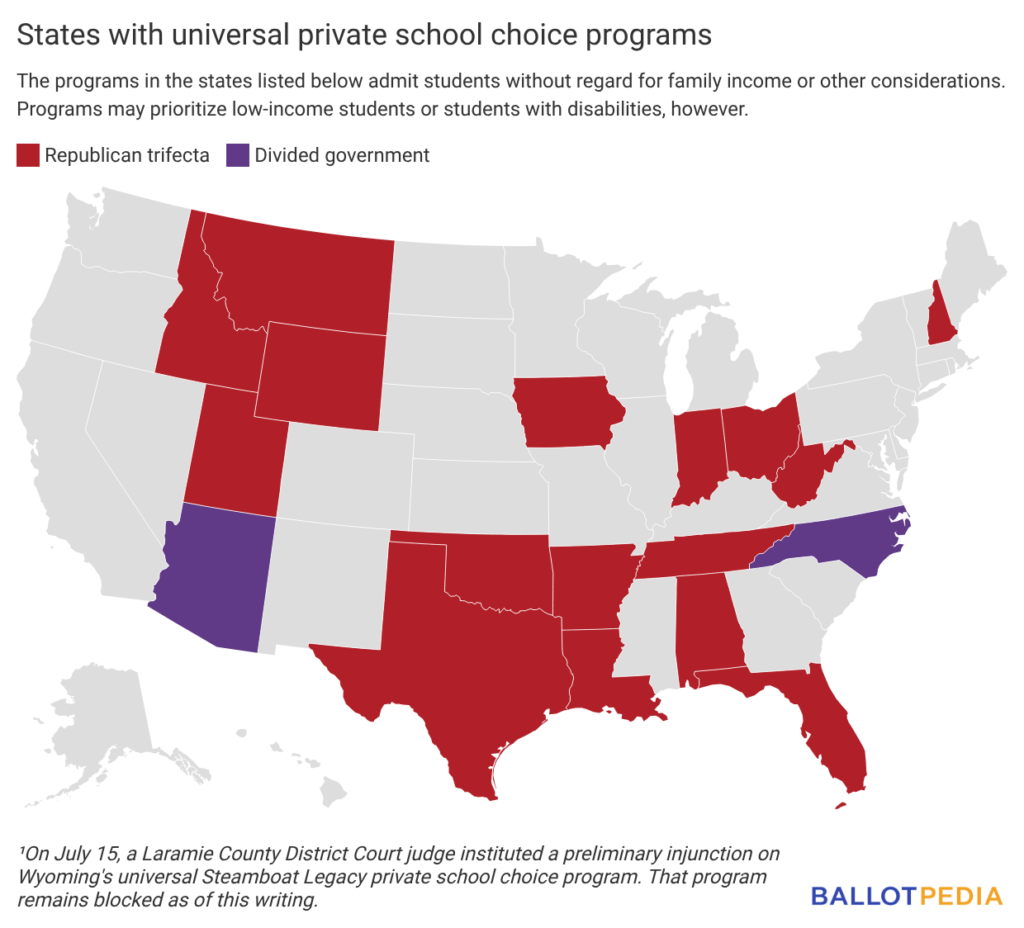
Several universal private school choice programs in other states are the subject of ongoing litigation. Here is a roundup of recent developments in some of those cases:
- Arkansas: On Feb. 27, U.S. District Court for the Eastern District of Arkansas Judge D.P. Marshall Jr. scheduled a trial for July 12, 2027, in a lawsuit to stop the state’s Education Freedom Accounts program. The program, created when Gov. Sarah Huckabee Sanders (R) signed the LEARNS Act in 2023, provides eligible students with roughly $6,800 for educational expenses. The plaintiffs, parents of students attending Arkansas public schools, argue the program violates the U.S. Constitution’s First and Fourteenth Amendments. The defendants include the Arkansas Department of Education and three parents of children who participate in the Education Freedom Accounts program. The plaintiffs are also pursuing a separate lawsuit against the program in the state courts on the grounds that it violates the Arkansas Constitution. In the 2024-25 school year, 14,256 students participated in the program.
- Wyoming: On Feb. 10, the Wyoming Supreme Court heard oral arguments in a case concerning the state’s Steamboat Legacy Scholarship program. The program was enacted in 2025. A Laramie County District Court judge issued a preliminary injunction against the program on July 15, 2025. Opponents of the program, including the Wyoming Education Association, argue it violates the state’s constitution guarantee of a right to public education and prohibition on government funding of religious organizations. Under the program, students would receive accounts worth up to $7,000 in government funding to eligible students for private school tuition, tutoring, and other educational expenses.
- Florida: On Feb. 19, seven K-12 private schools sued Step Up for Students, a nonprofit organization that manages and distributes more than 90% of the funding for Florida’s private school choice programs. In a press release, the coalition of private schools said the “lawsuit alleges documented scholarship payment delays, funding reductions, and instances of non-payment affecting eligible students enrolled at participating private schools.” Step Up for Students has denied the charges. Florida has three private school choice programs, including the Family Empowerment Scholarship for Educational Options, which serves more than 220,000 students. According to EdChoice, a nonprofit that advocates for private school choice, the Family Empowerment Scholarship for Educational Options is the largest private school choice program in the country. The average scholarship amount during the 2024-25 school year was $8,200, according to the Florida Department of Education.
Click here to learn more about private school choice programs.
Extracurricular: education news from around the web
This section contains links to recent education-related articles from around the internet. If you know of a story we should be reading, reply to this email to share it with us!
- Whitmer literacy plan boosts pre-K but underfunds children 0–3, advocates say | Detroit Free Press
- Phones at school: Less learning, more loneliness | Generation Tech
- More Than Half of Teens Use Chatbots for Schoolwork, Survey Finds | The New York Times
- Teaching Kids to Read: How One School District Gets It Right | Mother Jones
- School districts can set aside prayer time under a new Texas law. Few have done so. | Spectrum News 1
- Idaho has $1.3 billion in rainy-day funds. Should that money help public schools? | Idaho Ed News
Take our Candidate Connection survey to reach voters in your district
Today, we’re looking at survey responses from two of the four candidates running in the April 7 general election for three at-large seats on the Park Hill School District Board of Education, in Missouri.
Incumbents Janice Bolin and Alexia Norris are running for re-election in this race but have not completed the survey as of this writing.
Park Hill School District is the 15th largest in the state with roughly 12,000 students.
Deanna Muñoz says she is “a community advocate, arts organizer, and mother of four.” Her career experience includes working as a nonprofit executive director. Here’s how Muñoz answered the question, “What are the main points you want voters to remember about your goals for your time in office?”
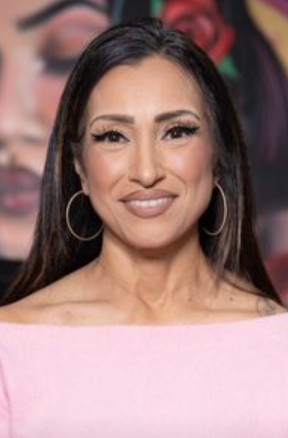
- “Strong Public Schools, Strong Community I am committed to protecting and strengthening our public schools by keeping classrooms the priority and ensuring every decision supports student success.
- Support Teachers, Elevate Students Great schools start with great educators. I will advocate for competitive pay, manageable workloads, and the resources teachers need so every student can thrive.
- Fiscal Responsibility with Transparency I believe in responsible budgeting that protects classrooms first, maintains financial stability, and ensures families understand how and why decisions are made.”
Click here to read the rest of Muñoz’s responses.
Brandon Kleinmeyer says “My connection to Park Hill is deeply personal. My wife works for the district, and our two daughters attend school here.” Kleinmeyer’s career experience includes working as an accountant. Here’s how he answered the question, “What areas of public policy are you personally passionate about?”
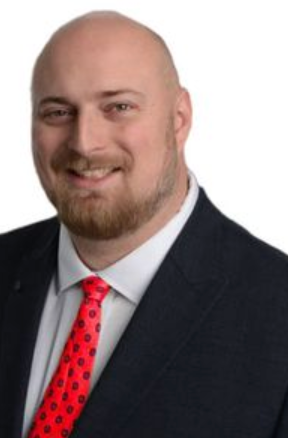
“I am intensely passionate about public education finance and resource allocation. Having spent over a decade in tax and accounting, I know that a budget shows what an organization truly values. I am passionate about ensuring that public tax dollars are treated with the utmost respect and are directed to where they have the highest return on investment: the classroom. I am dedicated to policies that trim administrative bureaucracy, protect taxpayers, and fully fund the teachers and students who rely on a strong, sustainable school district.”
Click here to read the rest of Kleinmeyer’s responses.
As a reminder, if you're a school board candidate or incumbent planning to run this year, click here to take the survey. If you complete the survey, your answers will appear in your Ballotpedia profile. Your responses will also appear in our sample ballot. If there is an election in your community, share the link with your candidates and urge them to take the survey!