


Welcome to the Monday, March 9, 2026, Brew.
By: Lara Bontesta
Here’s what’s in store for you as you start your day:
- Reform California submits 1.3 million signatures for voter ID initiative
- Two seats on the San Francisco Board of Supervisors are up for special election on June 2
- Six U.S. House primaries are contested in Alabama this year — the third-most since 2014
Reform California submits 1.3 million signatures for voter ID initiative
On March 2, the organization Reform California announced that it was submitting more than 1.3 million signatures to county election officials for verification of an initiative that would require voter identification and a constitutional requirement for state and county election officials to verify the citizenship of registered voters.
Supporters of the proposed amendment must submit 874,641 valid signatures, which is 8% of the votes cast in the previous gubernatorial election, to qualify for the ballot. The deadline to qualify a ballot initiative for the 2026 ballot in California is June 25.
It would require individuals to present government-issued identification in order to vote in person or provide the last four digits of a unique government-issued identifying number for mail-in ballots. The amendment would require the state to provide voter ID cards upon request and at no charge. The initiative would also require the secretary of state and county election officials to maintain accurate voter registration lists, including verifying citizenship attestations and reporting the percentage of voter rolls that have been citizenship-verified.
The amendment would allow citizens to seek judicial review and remedy of the state's or any county's compliance with the amendment. The amendment would also require the state auditor to review state and county compliance, publicly report its findings, and make recommendations to improve the integrity of elections every odd-numbered year.
California does not require voters to present photo identification. However, some voters may be asked to show a form of identification when voting if they are voting for the first time after registering by mail to vote and did not provide a driver's license number, California identification number, or the last four digits of their Social Security number.
California also does not require individuals to provide proof of citizenship when registering to vote. Individuals who become U.S. citizens less than 15 days before an election must bring proof of citizenship to their county elections office to register to vote in that election. An individual applying to register to vote must attest that they are a U.S. citizen under penalty of perjury.
U.S. Rep. Ken Calvert (R-41), state Sen. Tony Strickland (R-36), state Rep. Bilal Essayli (R-63), state Rep. Alexandra Macedo (R-33), and state Rep. David Tangipa (R-8) have endorsed the initiative.
The ACLU of Northern and Southern California, Asian Law Caucus, California Common Cause, California Donor Table, Disability Rights California, and League of Women Voters of California announced their formation of an opposition coalition to the initiative.
Between 2004 and 2025, voters in 11 states decided on 12 ballot measures related to voter identification requirements. Voters approved nine of these measures and rejected three. Maine and Wisconsin were the last states to vote on such measures in 2025. Maine voters defeated an initiative that would have required voter photo identification and changed absentee voting and ballot drop box rules. Wisconsin voters approved an amendment to require a valid photo ID to vote.
Background on Voter ID
Thirty-six states require voters to show some form of ID to vote at the polls on Election Day. Of these, 24 states require voters to present photo ID, with certain exceptions, and 12 states do not explicitly require photo ID. The remaining 14 states did not generally require voters to present an ID to vote at the polls on Election Day.
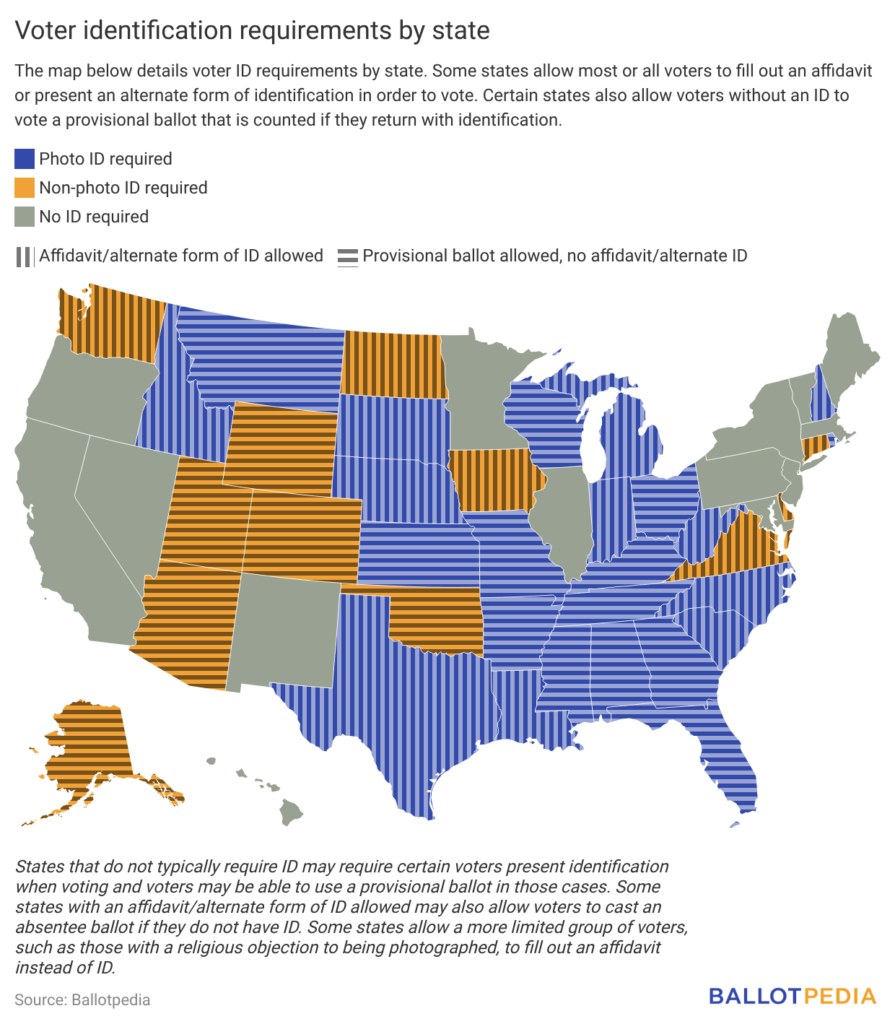
California is one of 16 states with a Democratic trifecta. This means Democrats control the governorship and both state legislative chambers.
- Of the 24 states that require photo ID, 18 have Republican trifectas, five have divided governments, and one has a Democratic trifecta.
- Of the 12 states that do not explicitly require photo ID, five have Republican trifectas, five have Democratic trifectas, and two have divided governments.
- Of the 14 states with no voter ID requirements, 10 have Democratic trifectas, and four have divided governments.
Ballotpedia covers voter ID legislation and various other topics in our Election Administration Legislation Tracker. Below is a selection of bills that we’re currently following. Each has passed through at least one chamber of its respective state legislatures.
- Idaho S1322: Would require voters to provide their date of birth or driver's license or ID card number when filling out an affidavit instead of presenting ID.
- Kentucky SB 154: Would remove Social Security cards, Supplemental Nutrition Assistance Program (SNAP) cards, and electronic benefit transfer cards from the list of eligible voter identification.
- New Hampshire HB 323/SB 223: Would remove student IDs from being considered acceptable forms of identification for voting purposes.
- Oklahoma HB 1005: Would remove the option to vote with an ID card issued by a county election board without a photograph or expiration date. This bill would move Oklahoma from a non-photo ID required state to a photo ID required state.
- West Virginia HB 5203: Would prohibit a municipality from issuing an ID for voting in a municipal election.
Additionally, as we mentioned on our Feb. 12 edition of the Daily Brew, the SAVE America Act would require voters in all 50 states to provide documentary proof of citizenship to register to vote and voter ID to cast a ballot in federal elections. The U.S. House passed the SAVE Act in February.
Click here to see a list of the current requirements to vote in California.
Click here to read about the voter ID initiative in California and here to read more about California’s 2026 ballot propositions.
Two seats on the San Francisco Board of Supervisors are up for special election on June 2
San Francisco is holding special elections for two seats on its Board of Supervisors on June 2. These elections, along with the city's November elections, could affect the ideological control of the board. Today, we’re taking a look at who’s running, the board’s current makeup, and one local conflict dividing the candidates.
Incumbent Stephen Sherrill, Lori Brooke, and Jeremy Kirshner are running in District 2. Incumbent Alan Wong, Albert Chow, Natalie Gee, Jeremy Greco, and David Lee are running in District 4. Sherrill and Brooke have raised the most money and received local media coverage in District 2. Wong, Chow, and Gee lead in the number of endorsements and money raised in District 4.
The winners of both elections will serve through January 2027. Both seats will be up for election again in November 2026 for full terms. Former Mayor London Breed appointed Sherrill to the board in December 2024 to fill the vacancy that was created when Catherine Stefani (D) resigned after she was elected to the California Assembly. Mayor Daniel Lurie appointed Wong to the board in December 2025 after voters recalled Joel Engardio.
Both the June and November elections could affect the board’s balance of power. According to a San Francisco Chronicle analysis, the 2024 elections resulted in a “major shakeup in the coalitions” on the board. In her September 2025 article analyzing board members’ voting records, the San Francisco Chronicle’s Nami Sumida wrote, “For the first time since 2019, the city’s left-leaning supervisors are outnumbered by a more centrist group that not only has more seats but also consistently votes together.” Not including Engardio, Sumida grouped four board members as part of a moderate bloc, three members as part of a progressive bloc, and three members as swing voters.
Sherrill is a former staffer for both Breed from 2022 to 2024 and former New York City Mayor Michael Bloomberg from 2009 to 2013. Brooke is an activist and the president of the Cow Hollow Association.
Wong is a former member of the San Francisco Community College Board. Gee is the chief of staff for District 10 board member Shamann Walton. Chow is a hardware store owner and an organizer of the Engardio recall campaign.
The Democratic Party of San Francisco and Lurie endorsed both Sherrill and Wong. As of this writing, neither Brooke nor Chow had endorsements published on their campaign websites.
One local issue that the candidates have spoken about is a zoning plan that the Board passed in December 2025.
Both Sherrill and Wong voted in December 2025 to pass the zoning proposal, which Lurie backed. The plan increased height limits from four stories to six or eight stories for both new and existing structures throughout much of the city, with affected structures including both commercial and residential lots. Brooke is the co-founder of Neighborhoods United SF, which opposes the zoning plan. Both Chow and Gee oppose the zoning plan.
The 11-member Board of Supervisors is the City of San Francisco's legislative body. Members are elected by district to four-year terms in nonpartisan elections. All five seats in even-numbered districts are up for election in November 2026. Four of the members up for election this year supported the rezoning proposal.
Click here to read more about the Board of Supervisors elections in San Francisco.
Six U.S. House primaries are contested in Alabama this year, the third most since 2014
Alabama’s statewide primary elections are coming up on May 19. All seven of the state’s seats in the U.S. House of Representatives are up for election this year, and there are six contested U.S. House primaries. Since 2014, only two years have had more contested primaries in Alabama: 2024, when there were eight, and 2018, when there were seven.
Twenty-five candidates — 10 Democrats and 15 Republicans — are running for Alabama’s seven U.S. House districts. This ties with 2020 as the second-most U.S. House candidates running in Alabama since 2014. The year with the most candidates was 2024, with 36.
There are 3.6 candidates per district. There were 5.1 candidates per district in 2024, three in 2022, 3.6 in 2020, 3.3 in 2018, 2.3 in 2016, and 2.9 in 2014.
Here are some other highlights from this year’s filings:
- The 1st Congressional District is open this year because Rep. Barry Moore (R) is running for the U.S. Senate. There was one open district in 2024, one in 2022, two in 2020, none in 2018, none in 2016, and one in 2014.
- Six primaries — two Democratic and four Republican — are contested this year. In total, there were eight contested primaries in 2024, five in 2022, five in 2020, seven in 2018, four in 2016, and four in 2014.
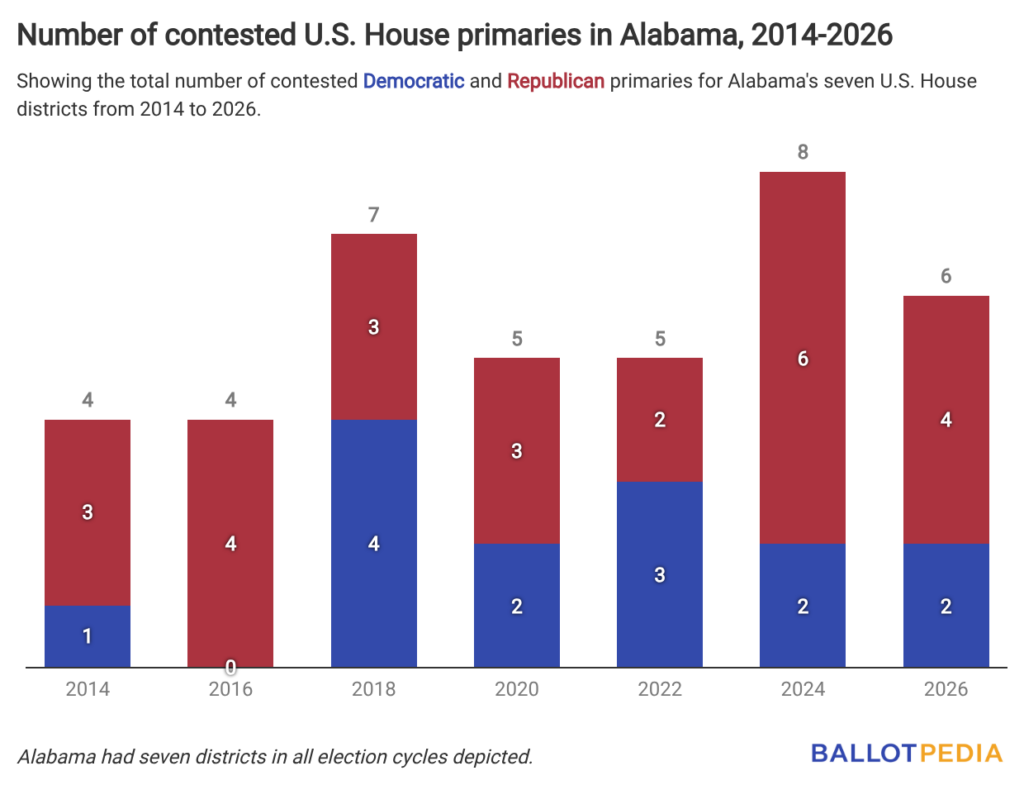
Eight candidates — one Democrat and seven Republicans — are running for the open 1st Congressional District, the most candidates running for a district this year.
- Three incumbents — all Republicans — are facing primary challengers this year. There were six incumbents in a contested primary in 2024, one in 2022, one in 2020, three in 2018, four in 2016, and three in 2014.
- The 7th Congressional District is guaranteed to Democrats because no Republican will appear on the ballot. Democrats filed to run in all seven districts, meaning none are guaranteed to Republicans.
Five other states — Georgia, Idaho, Kentucky, Oregon, and Pennsylvania — are holding U.S. House primaries on May 19. Click here to see a list of statewide election dates this year.
In Alabama, a primary candidate must win a majority of the vote in order to be declared the winner. If no candidate wins a majority, a runoff election will be held on June 16 between the top two vote-getters.
Click here to read more about Alabama’s U.S. House elections.