



State legislatures oversee executive agency rulemaking through a variety of mechanisms that vary by state. Legislatures may be tasked with reviewing regulations, or explicitly approving them prior to their adoption. They can also disapprove of or nullify regulations, and hold hearings about proposed or adopted rules. The specific role of the legislature depends on the state, and even the nature of the regulation or rule in some instances.
In 2025, Ballotpedia conducted a study regarding legislative oversight of executive agency rulemaking which identified legislative oversight requirements, designated oversight authorities, and the scope of regulatory oversight in each state. The study asked and answered the following questions:
- Legislative oversight requirements: Is legislative oversight action optional, required, or both?
- Designated oversight authorities: What legislative body is authorized (or required) to oversee agency regulations?
- Scope of regulatory oversight: Is oversight required for all rules, some rules, or no rules?
Here's what we found:
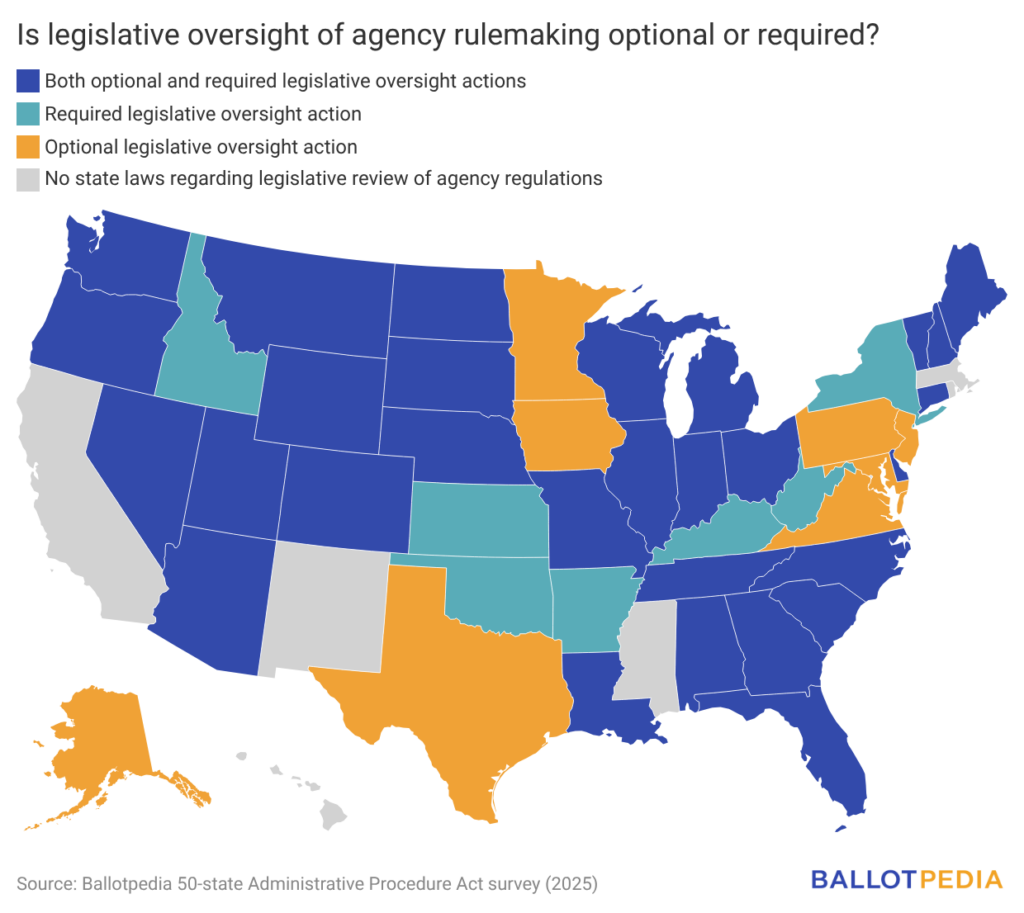
Is legislative oversight action optional, required, or both?
- Thirty-four (34) states required legislative review of some or all agency regulations.
- Seven states included both optional and required legislative oversight mechanisms, and 27 states only had required legislative oversight mechanisms.
- Ten (10) states authorized, but did not require, legislative oversight of agency regulations.
- In the remaining six states, Ballotpedia did not identify provisions of the law regarding legislative review of agency regulations.
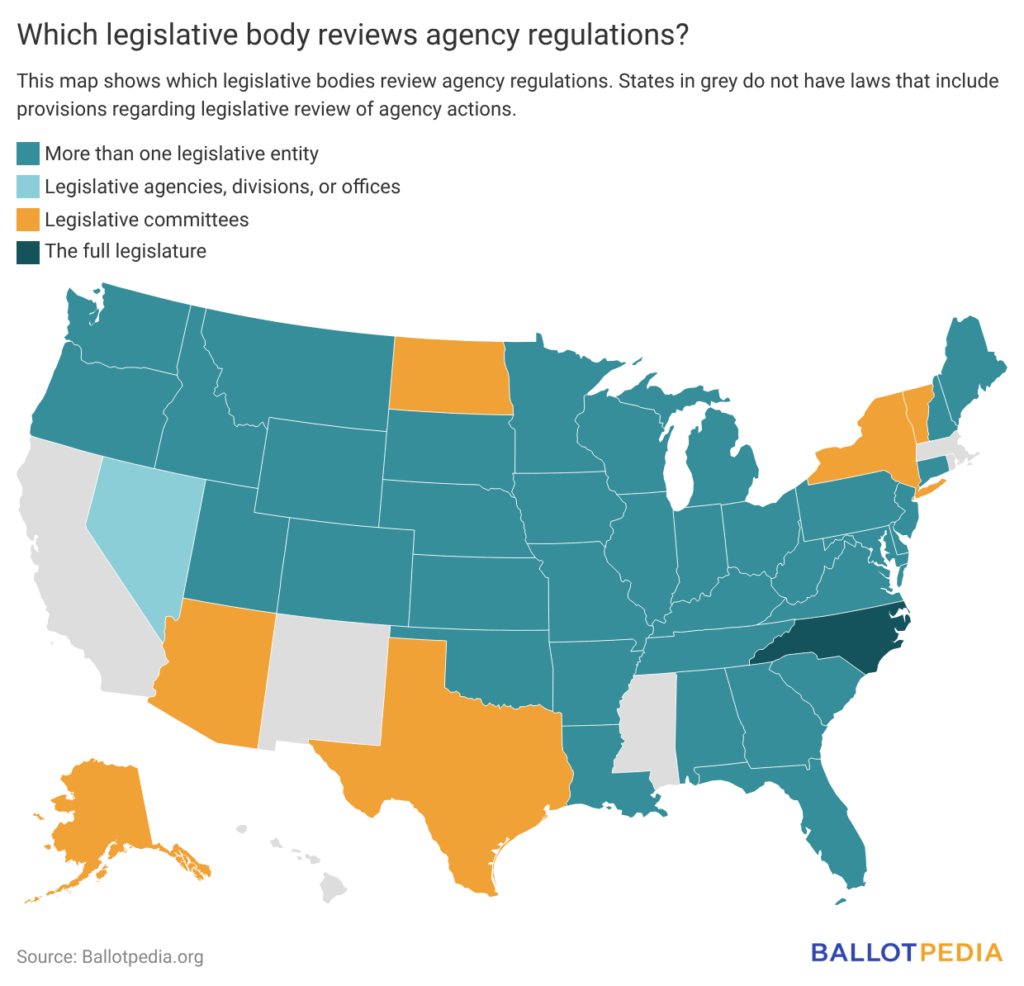
What legislative body is authorized (or required) to oversee agency regulations?
Because several states had multiple procedures for legislative review that involved different legislative entities with different levels of authority, some states appear more than once in the totals below.
- Thirty-three (33) states authorized or required more than one legislative entity to review agency regulations. These states all fall into at least two of the categories below.
- Thirty-one (31) states authorized or required the full legislative body to review agency regulations. Some states required full legislative bodies to pass bills authorizing regulations, and some states allowed full legislatures to vote to disapprove of regulations.
- Forty-one (41) states authorized or required legislative committees to review agency regulations. These states authorized committees to either disapprove, delay, approve, or recommend changes to regulations, or any combination of those actions.
- Thirteen (13) states authorized or required legislative agencies, divisions, or offices to review agency regulations. These states authorized agencies, divisions, or offices to review regulations for compliance with procedural requirements, fiscal impact, or correct formatting, among other types of review.
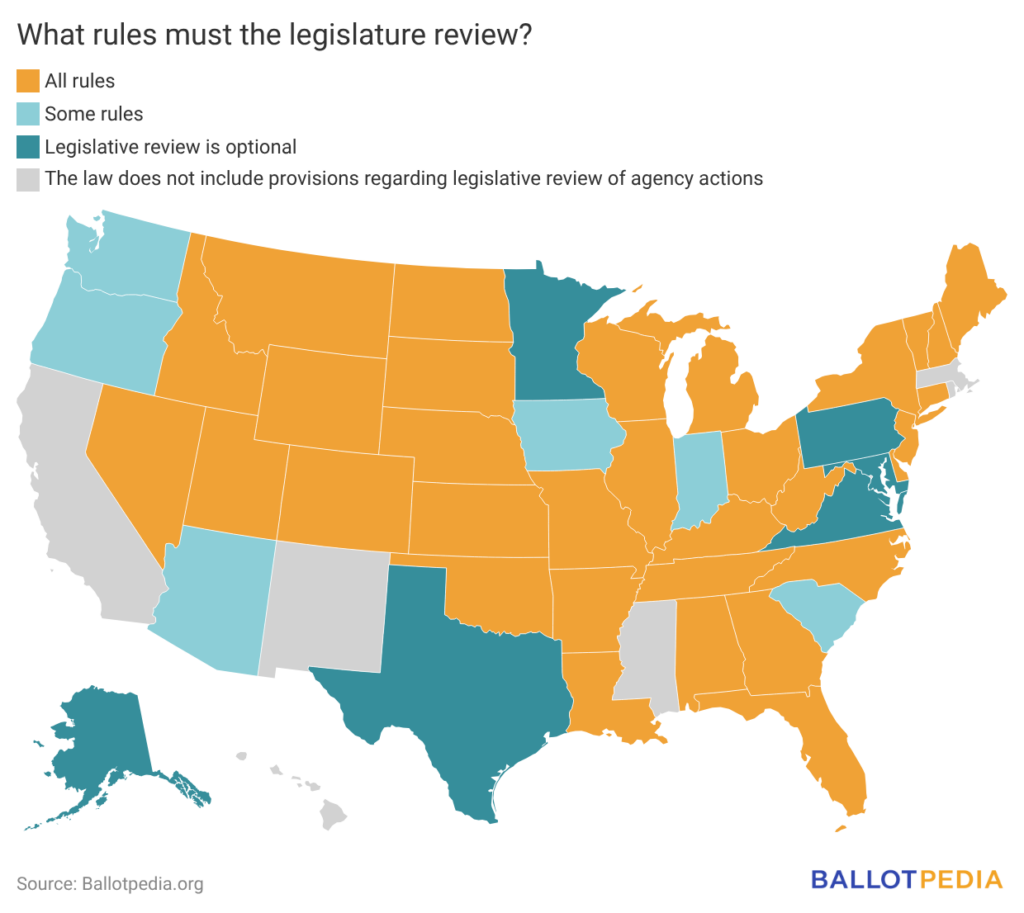
Is oversight required for all rules, some rules, or no rules?
- Thirty-two (32) states required legislative review of all rules. Some states required different levels of review for rules that meet different criteria, such as having an estimated fiscal impact that exceeds a certain threshold.
- Six states required legislative review of some rules. Some states required legislatures to only review rules that met certain criteria, which are policies similar to REINS-style state laws. Other states required legislative review of rules that received a public complaint.
- Six states did not require, but explicitly authorized, legislative review of rules.
- In the remaining six states, Ballotpedia could not identify provisions of the law regarding legislative review of agency regulations.
State-by-state details.
Ballotpedia's research demonstrates the diversity of approaches to legislative oversight of regulation across state laws. Policies differ in each state by review entity, scope of review, and the authority of the reviewing entity. Some states, like Idaho and West Virginia, required the approval of the full legislature for all agency regulations before they could take effect. Elsewhere, in Alaska, legislative standing committees were authorized, but not required, to review regulations within their jurisdiction. Below is a sample of some of the findings:
- Connecticut: Agencies submit all proposed regulations to the Legislative Regulation Review Committee (LRCC). The LRCC can approve, disapprove, reject, or hold public meetings for all rules. The LRCC can disapprove rules; such rules are sent to the relevant standing committee in the general assembly for review, where the committee either sustains or overturns the committee's decision without gubernatorial input. The full legislature, or a committee within the legislature, can override executive branch regulations without the approval of the governor.
- Illinois: The Joint Committee on Administrative Rules (JCAR) reviews all agency proposed rules. After review, they either notify the agency that no objection is made or that JCAR is objecting to the rule. JCAR can, by three-fifths majority vote, stop an agency rule from taking effect. The general assembly can lift the objection through a joint resolution.
- Montana: Montana agencies must send all proposed rules to the relevant interim legislative committee, which can hold hearings, request economic impact statements, and recommend adopting, amending, or rejecting the rules. Agencies may promulgate rules if the committee objects, but it bears the burden of proof in a court of law if challenged to defend the promulgation of the rule. Agencies must also notify primary sponsors of the legislation being implemented by a proposed rule with a notice of proposed rulemaking. The full legislature can disapprove rules by joint resolution, requiring the governor's signature.