


Welcome to the Tuesday, March 10, Brew.
By: Briana Ryan
Here’s what’s in store for you as you start your day:
- State supreme court elections are happening in 32 states this year
- Eight incumbents in the North Carolina General Assembly lost re-election on March 3
- Net Zero Asset Managers relaunches with fewer U.S. firms
State supreme court elections are happening in 32 states this year
Thirty-two states are holding elections for 64 seats on 34 state supreme courts this year. That count includes Oklahoma and Texas' courts of criminal appeals in addition to their supreme courts.
Nonpartisan justices hold 45 of the seats up for election, Republican justices hold 13, and Democratic justices hold six. Twelve of the courts with seats up for election have Democratic majorities, and 22 have Republican majorities.
Nationwide, 20 courts have Democratic majorities, and 32 have Republican majorities. In eight states, the courts' partisanship is explicitly labeled a result of partisan elections. Democrats control three of these states, and Republicans control five. The remaining 42 states do not have explicitly partisan courts. We use three methods to determine a state court's partisan balance:
- How many justices were registered members of a political party
- The partisan affiliation of the governor who appointed each justice
- If those methods didn't work, we survey media coverage of the court and its decisions to determine partisan leanings
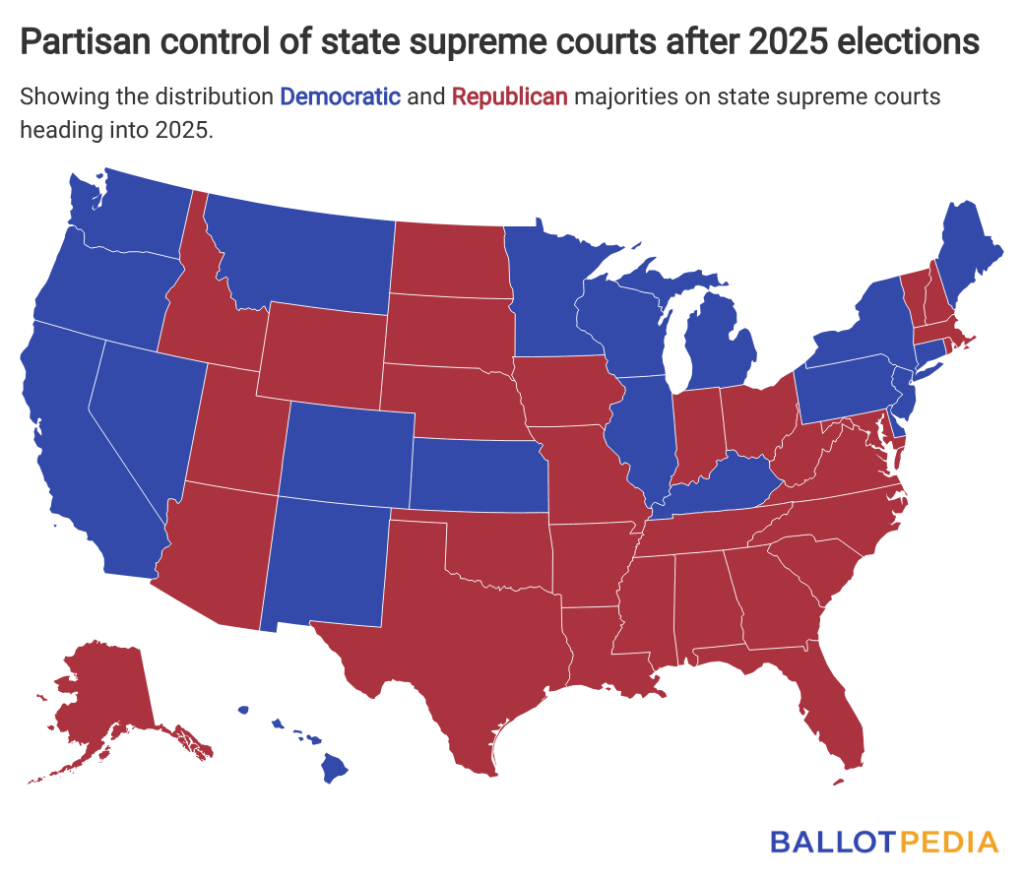
Here's a look at the type of elections each state holding elections this year uses, along with a few upcoming elections to watch.
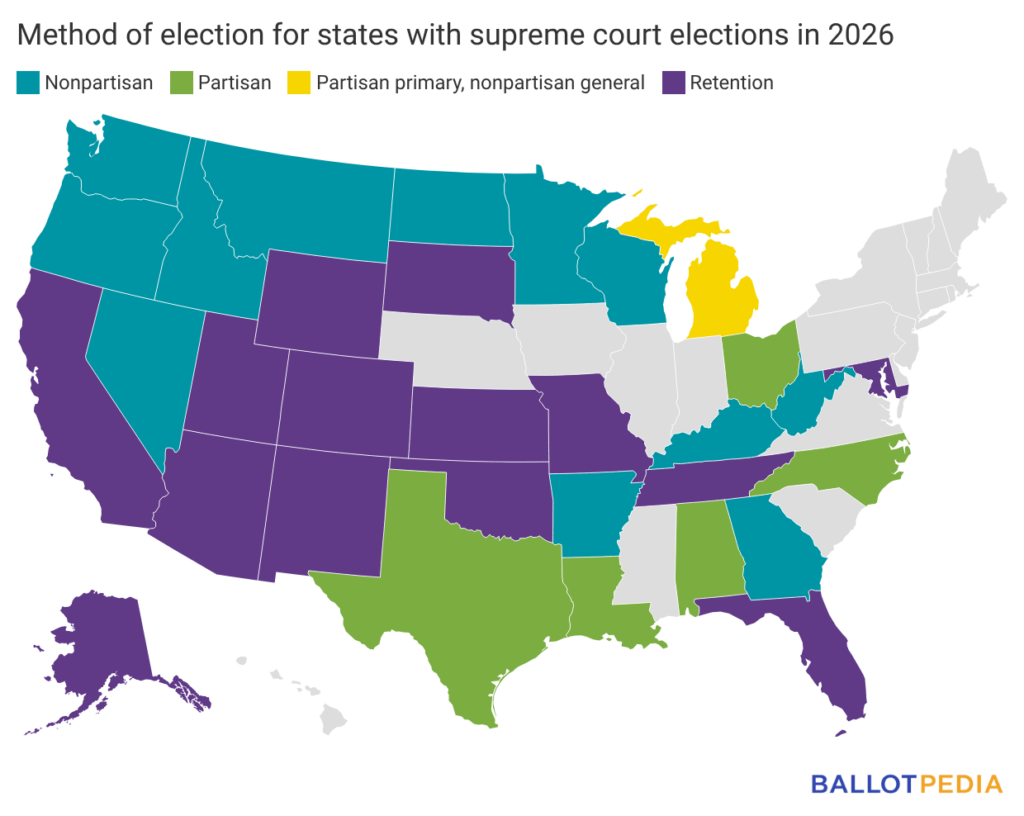
Six states are holding partisan elections in which voters elect justices listed on the ballot with their political affiliations indicated. Here's what to watch:
In Alabama, three seats are up for election on Nov. 3. All nine justices on the Court are Republicans.
In North Carolina, one seat is up for election on Nov. 3. Five of the Court's seven justices are Republicans. The justice whose seat is up for election this year is a Democrat. In November 2024, Justice Allison Riggs (D) defeated Jefferson Griffin (R) by 734 votes. However, the election remained undecided until May 2025 due to recounts and legal challenges. Democrats could gain control of the chamber if they retain the seat this year and win at least two of the three Republican-held seats in 2028. If Democrats do not retain the seat this year, they will need to win all three Republican-held seats in 2028 to win control of the chamber.
In Ohio, two seats are up for election on Nov. 3. Six of the Court's seven justices are Republicans. One of the justices up for election this year is a Democrat, and the other is a Republican.
Twelve states are holding nonpartisan elections in which voters elect justices listed on the ballot without their political affiliation indicated. Here's what to watch:
In Michigan, two seats are up for election on Nov. 3. Six of the Court's seven justices — including the two whose seats are up for election this year — are affiliated with the Democratic Party.
In Montana, one seat is up for election on Nov. 3. Four of the Court's seven justices — including the justice whose seat is up for election this year — were initially elected in nonpartisan elections. A Democratic governor initially appointed two justices, and a Republican governor initially appointed one. The State Court Report's Douglas Keith wrote that "More than possibly any other state high court, the Montana Supreme Court has attracted the ire of the state's more conservative legislature and governor."
In Wisconsin, one seat is up for election on April 7. Four of the Court's seven justices are part of the liberal majority. The Associated Press' Scott Bauer wrote that liberals are expected to have a majority on the Court until at least 2028. Incumbent Justice Rebecca Bradley — who is not running for re-election — is part of the Court's conservative minority. This election could result in the Court maintaining its 4-3 liberal majority or increasing it to 5-2.
Fourteen states are holding retention elections, in which voters decide whether an incumbent justice should remain in office for another term. The justice, who does not face an opponent, is removed from the position if a certain percentage of voters decide not to retain the justice. Since 1990, justices have won retention 98% of the time. Here are three elections to watch:
In Arizona, Justice John Lopez IV is up for retention on Nov. 3. Republican governors appointed six of the seven justices on the Court, including Lopez. In the last few elections, the margins of victory (MOV) for justices have narrowed. In 2022, a justice fell under 60% for the first time since 1990, receiving 56%. In 2024, neither of the justices received more than 60%.
In Kansas, Justices Eric Rosen and Larkin Walsh are up for retention on Nov. 3. Democratic governors appointed five of the seven justices on the Court, including Rosen and Walsh. On Aug. 4, Kansas voters will vote on an amendment that, if passed, would make state supreme court elections partisan, making these the last retention elections in the state.
In Oklahoma, six justices — four on the Supreme Court and two on the Court of Criminal Appeals — are up for retention on Nov. 3. Republican governors appointed six of the nine Supreme Court justices, including the four up for retention. Republican governors appointed four of the five Court of Criminal Appeals justices, including both up for retention.
Click here for more information about the state supreme court elections happening this year.
Eight incumbents in the North Carolina General Assembly lost re-election on March 3
On March 3, eight incumbent members of the North Carolina General Assembly — three Democrats and five Republicans — were defeated in primaries. That ties with 2018 for the most legislators who lost primaries since 2010.
Democratic primary results
All three Democratic legislators who lost re-election are members of the North Carolina House of Representatives.
According to the Raleigh News & Observer's Luciana Perez Uribe Guinassi, the three Democratic incumbents — Carla Cunningham in District 106, Nasif Majeed in District 99, and Shelly Willingham in District 23 — often voted with Republicans, including to override Gov. Josh Stein's (D) vetoes.
WUNC News' Colin Campbell wrote, "Willingham was the only Democrat last year to vote for a bill to allow non-public school employees and volunteers to carry a firearm on campus with written permission and a concealed carry permit. [...] Cunningham faced criticism for her vote and speech in favor of a bill requiring sheriffs to cooperate more closely with ICE. Gov. Josh Stein had endorsed her opponent, Charlotte pastor Rodney Sadler.” WCNC’s Julie Kay wrote that “Last year, [Majeed] sided with Republicans to override a veto by Gov. Josh Stein on legislation stating there were only two sexes and genders in the state.”
Republican primary results
Four Republican legislators who lost re-election are members of the state House, and a fifth is a member of the North Carolina Senate.
The only state Senate incumbent to lose re-election is Phil Berger (R) — the state Senate Majority Leader — in District 26. The four state House incumbents who lost re-election are A. Reece Pyrtle, Jr. in District 65, Keith Kidwell in District 79, Mark Pless in District 118, and Kelly Hastings in District 110.
Director of the John Locke Foundation's Civitas Center for Public Integrity, Andy Jackson, said, "Among Republicans, the incumbent losses and close calls are a sign of dissatisfaction with the party establishment. Incumbency and money do not guarantee victory." According to the John Locke Foundation’s website the Civitas Center's mission is "to improve the trustworthiness of North Carolina's democratic institutions and, as a result, increase the public's faith in those institutions."
Looking ahead to November
North Carolina's state Senate and state House are two of the 88 legislative chambers holding elections in 2026. Heading into the elections, Republicans have a 30-20 supermajority in the state Senate and have a 71-49 majority in the state House, which is one seat shy of a supermajority. The state's current governor, Stein, was elected in 2024 and is not on the ballot this year.
Click here to learn more about incumbents seated in state legislative elections this year.
Net Zero Asset Managers relaunches with fewer U.S. firms
On Feb. 25, the Net Zero Asset Managers (NZAM) initiative announced its relaunch with 253 signatories after suspending operations for a year. NZAM is an international group of asset management companies (AMCs) that, according to its website, is a voluntary initiative for asset managers committed to supporting investing aligned with the global goal of net zero greenhouse gas emissions.
The coalition revised its membership commitments, removing explicit references to aligning portfolios with a goal of reaching net zero emissions by 2050 and instead allowing firms to set their own climate targets and strategies.
NZAM reported 330 signatories overseeing $57.5 trillion in assets under management as of October 2024. Before the suspension, 44 U.S. firms were members. Following the relaunch, 12 U.S. companies are members, with several large American asset managers remaining absent.
The relaunch follows sustained political and legal scrutiny of climate-focused investor coordination in the United States. Republican state attorneys general and federal officials have argued that coordinated climate commitments by large asset managers raise antitrust concerns. NZAM said the revised framework clarifies that participating firms independently set their own climate targets and strategies and use the initiative to disclose how they manage climate-related financial risks and opportunities.
In early 2025, BlackRock exited the initiative, citing legal inquiries from public officials. Soon after, NZAM suspended its activities and began reviewing its commitment framework.
NZAM launched in December 2020 as part of the Glasgow Financial Alliance for Net Zero, which describes itself as “an independent, private-sector-led initiative focused on mobilizing capital and removing barriers to investment in the global transition,” with the goal of aligning financial institutions with reaching net zero greenhouse gas emissions by 2050.
We follow support for and opposition to the environmental, social, and corporate governance (ESG) investing movement. To learn more about arguments for, against, and about ESG, click here. For more information on reform proposals related to ESG policy, click here.
Click here to read more about the Net Zero Asset Managers Initiative.