


Welcome to the Tuesday, March 17, 2026, Brew.
By: Lara Bonatesta
Here’s what’s in store for you as you start your day:
- It’s Election Day in Illinois
- Democrats gain two more state legislative seats in March special elections
- Nationally, more U.S. House races have a Democratic candidate than a Republican candidate
It’s Election Day in Illinois
Voters in Illinois are headed to the polls today, March 17. In addition to congressional and state-level primaries, there are also local elections on the ballot.
If you live in Illinois, make sure to check out our Sample Ballot Lookup Tool before you get to the polls. Plus, check out our page on voting in Illinois to make sure you’re prepared.
Here’s an overview of what voters will see on their ballots today.
Illinois is holding primaries for one U.S. Senate seat and all 17 of its U.S. House seats. At the state level, there are primaries for six state executive offices, 39 state Senate seats, and all 118 state House seats.
Congressional elections
Both major party Senate primaries are contested. There are nine contested Democratic House primaries and 11 contested Republican House primaries.
According to Capitol News Illinois’ Brenden Moore, “There are more candidates running for Congress than usual on account of a once-in-a-generation turnover among Democratic elected officials. Democratic Sen. Dick Durbin’s retirement set off a domino effect, with two Democratic incumbents — Rep. Robin Kelly of Lynwood and Rep. Raja Krishnamoorthi of Schaumburg — giving up their seats in bids to succeed him in the upper chamber.”
There are six members of Congress not running for re-election in Illinois this year. This is the first open Senate seat in Illinois since 2010, and the most open U.S. House seats in Illinois since Ballotpedia started tracking this data in 2014. Nationally, 66 members of Congress — 10 U.S. Senators and 56 U.S. Representatives have announced that they will not seek re-election this year, as of March 16.
Heading into the 2026 elections, both of Illinois’ U.S. Senators are Democrats. Fourteen of Illinois’ U.S. Representatives are Democrats, and three are Republicans.
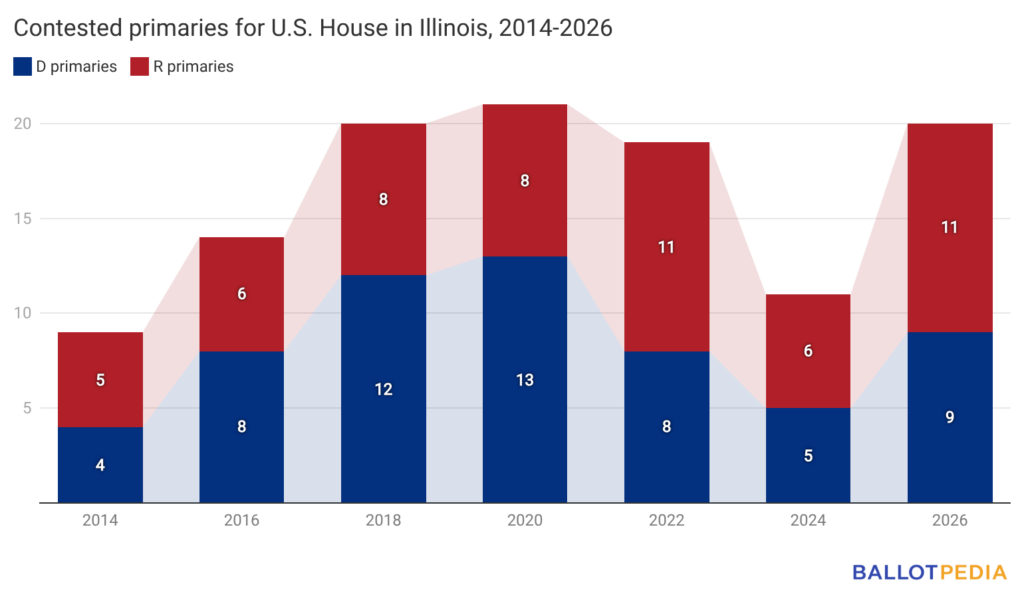
Below is a list of the congressional primary battlegrounds we’re following in Illinois:
- U.S. Senate Democratic primary: Eleven candidates are running for the Democratic nomination to succeed Durbin, who was first elected in 1996. Among them are U.S. Reps. Robin Kelly (D-2) and Raja Krishnamoorthi (D-8), and Lt. Gov. Juliana Stratton (D). Endorsements are split among the candidates. Governor J.B. Pritzker (D), Sen. Tammy Duckworth (D), and Illinois House Speaker Chris Welch (D) endorsed Stratton. Several labor unions, including the Teamsters and the American Federation of Government Employees, and former Lt. Gov. Sheila Simon (D), endorsed Krishnamoorthi. The Congressional Black Caucus Political Action Committee, BradyPAC, and Sen. Chris Murphy (D-Conn.) endorsed Kelly.
- Illinois' 2nd Congressional District Democratic primary: Eleven candidates are running in the open race to replace Kelly. Among them are former U.S. Rep. Jesse L. Jackson, Jr. (D), who represented the district from 1995 to 2012, Cook County Commissioner Donna Miller (D), and state Sens. Robert Peters (D) and Willie Preston (D).
- Illinois' 7th Congressional District Democratic primary: Thirteen candidates are running in the open race to succeed retiring incumbent Danny K. Davis (D). The last time the seat was open was 1996, when Davis was first elected.
- Illinois' 9th Congressional District Democratic primary: Fifteen candidates are running in the open race to succeed retiring incumbent Jan Schakowsky (D). The last time the seat was open was 1998, when Schakowsky was first elected.
State executive elections
Illinois has six state executive offices up for election this year. These include the offices for governor, lieutenant governor, attorney general, secretary of state, comptroller, and treasurer.
Pritzker, who is seeking a third term, is running unopposed in the Democratic gubernatorial primary. There are four candidates running in the Republican gubernatorial primary. Illinois does not have term limits for governor. The last governor to serve more than two terms was Jim Thompson (R), who served four consecutive terms from 1977 to 1991.
The incumbent attorney general, secretary of state, and treasurer, all Democrats, are all running unopposed in the Democratic primaries for their offices. There are two Republicans – including one write-in candidate–running for attorney general, and two Republicans running for secretary of state. Two Republicans – both write-in candidates – are running for treasurer.
There are two open state executive offices: Lieutenant Governor and Comptroller.
In Illinois, gubernatorial and lieutenant gubernatorial candidates run together on a single ticket in both the primary and the general elections. On the Democratic side, Christian Mitchell is Pritzker’s running mate. Click here to see a list of the Republican candidates for lieutenant governor. Incumbent Lt. Gov. Juliana Stratton is running for U.S. Senate.
Four Democrats are running to succeed retiring incumbent Susana Mendoza (D) in the election for Comptroller, who took office in 2016. Only one candidate – Bryan Drew (R) – filed to run in the Republican primary. According to Capitol News Illinois' Ben Szalinski, the next comptroller will take office "as the state faces growing financial uncertainty." Each candidate is proposing different approaches to managing state finances. Click here to learn more.
State legislative elections
Among Illinois’ 157 state legislative elections, there are 28 contested primaries. These include 17 Democratic primaries and 11 Republican primaries. From 2010 to 2024, there were an average of 40.8 contested state legislative primaries each cycle.
Heading into the 2026 elections, Democrats have a 40-19 majority in the Illinois Senate and a 78-40 majority in the Illinois House.
Other local elections
At the local level, Ballotpedia is covering 1,183 local elections involving 1,605 candidates. Illinois is one of 31 states in which Ballotpedia is expanding our coverage to include all local elections in 2026. Click here to learn more about that coverage.
Additionally, voters in 31 counties will have a non-binding advisory question about the federal school choice tax credit on their ballots. Click here to see our Brew coverage on those from March 13.
Click here to see a list of elections Ballotpedia is covering on March 17. After March 17, the next statewide primary elections will be on May 5 in Indiana and Ohio. Click here for a list of 2026 election dates.
Democrats gain two more state legislative seats in March special elections
Democrats won two additional state legislative seats in a pair of early March special elections.
Alex Holladay (D) won a March 3 special election for Arkansas House District 70, 57.4%-42.6%. In 2024, Holladay ran against incumbent Carlton Wing (R) in 2024. In that election, Wing won 51% to 49%.
In New Hampshire, Bobbi Boudman (D) won an open March 10 special election for New Hampshire House District Carroll 7, 51.9% to 48.1%. Republicans won the 2024 election for the seat 56.8% to 43.1%.
In the Arkansas election, Democrats received 56% of the number of votes cast for Democrats in the previous general election for the seat, and Republicans received 40% of the number of votes previously cast for Republicans. In New Hampshire’s Carroll 7, Democrats received 57% of the number of votes cast for Democrats in the previous general election, and Republicans received 40%.
In total, Democrats have gained 10 legislative seats nationwide through special elections since January 2025. Republicans have gained no seats from special legislative elections in that time.
Here’s a closer look at voter totals and margin shifts in the special state legislative elections since January 2025.
Vote total comparison
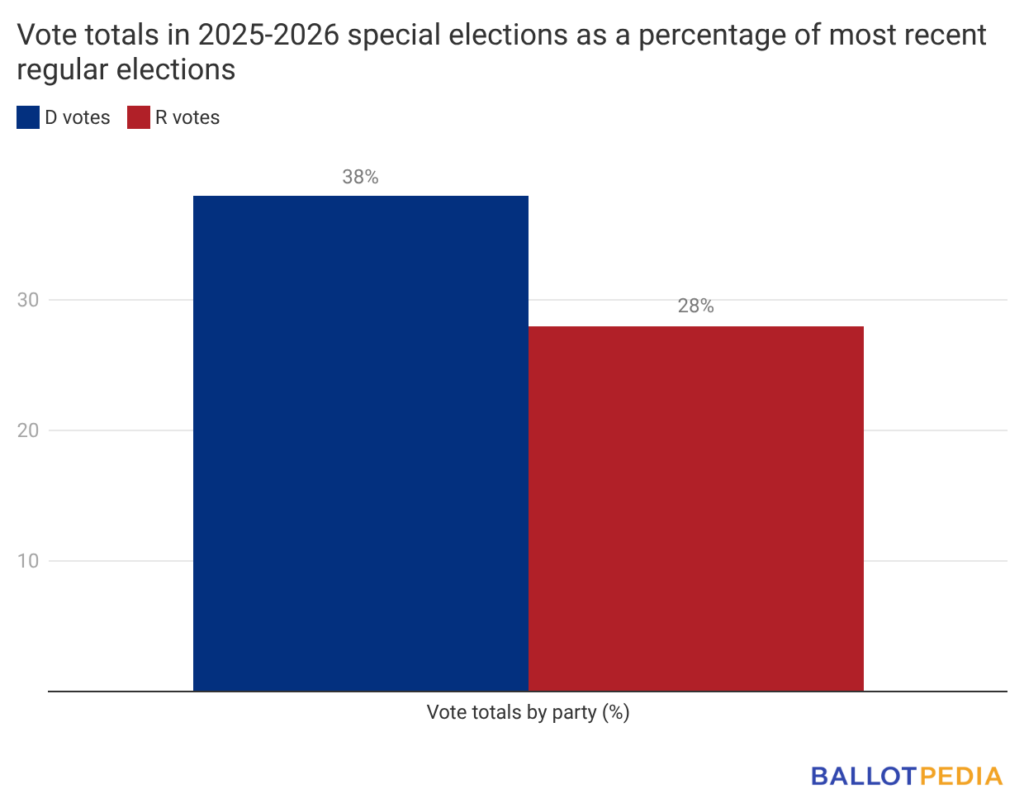
In special state legislative elections since January 2025, Democratic candidates received 10 percentage points more of their party’s vote total from the previous election than Republicans.
There were 80 districts where a Democrat had appeared on the special election ballot and on the previous general election ballot. On average in those districts, Democratic vote totals in the special election were 38% of the party’s vote totals in the previous general elections.
There were 77 districts where a Republican had appeared on the special election ballot and on the previous general election ballot. On average, Republican vote totals in the special election were 28% of the party’s vote totals in the previous general election.
Margin of victory shifts
There were 54 districts where both the special election and the most recent general election had candidates from both major parties. Democrats won 40 of those special elections, and Republicans won 14. Democrats won 33 of the previous general elections in those districts, and Republicans won 21.
Forty-two of those districts shifted toward Democrats in the special election compared to the previous election, and 12 shifted toward Republicans. Overall, the average shift across all 54 districts was 4.7 percentage points toward Democrats.
The map below shows the average partisan shift in each state that had at least one state legislative special election since January 2025. The data below includes all 100 special general elections that have been called through March 11.
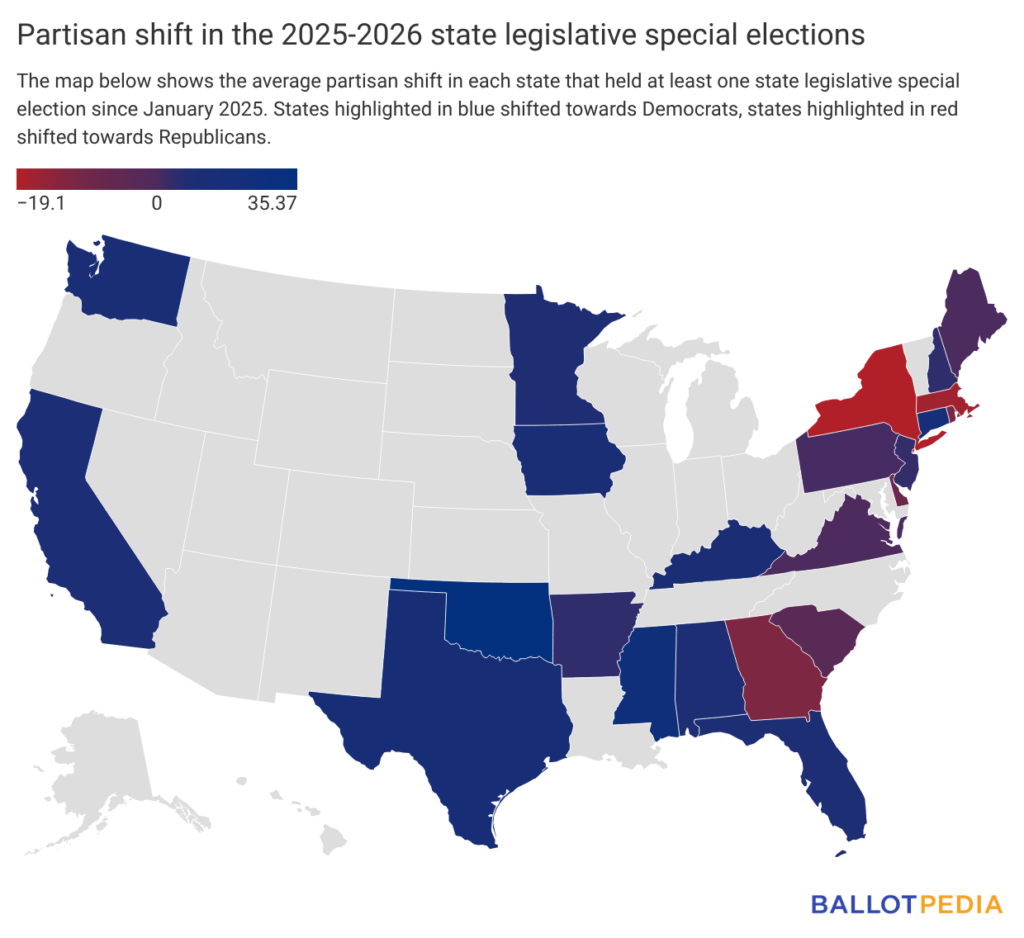
Click here to read more about 2025 state legislative special elections, and here for 2026 state legislative special elections.
Nationally, more U.S. House races have a Democratic candidate than a Republican candidate
There are 35 U.S. House districts without a Republican on the ballot so far this year, compared to three districts without a Democratic candidate on the ballot. That's a change from recent years, when there were more districts without a Democratic candidate on the ballot.
In the 2024 general elections, there were 20 races without a Democratic candidate and 18 without a Republican.
At this point in the 2024 election cycle, Ballotpedia identified 40 races without a Democratic candidate and 28 without a Republican. At this stage in 2022, 97 races had no Democratic candidate, and 66 had no Republican.
Below is a look at this year’s races without either a Democratic or a Republican candidate so far. (Note: These include states where filing deadlines have not yet passed. Click here to see our complete list of state and federal filing deadlines in 2026.)
The races without a Democratic candidate are:
- New Jersey’s 11th Congressional District (Filing deadline: March 23)
- Rhode Island’s 1st Congressional District (Filing deadline: June 24)
- Wyoming’s At-Large Congressional District (Filing deadline: May 29)
Thirteen states have races without a Republican candidate. New York leads with seven of its 26 congressional districts without a Republican candidate. Next is Massachusetts, where five of the state’s nine congressional districts have no Republican candidate. New York’s filing deadline is April 6, and Massachusetts’ filing deadline is June 2.
All 435 U.S. House districts are up for election in 2026. As of March 5, 54 incumbents — 21 Democrats and 33 Republicans — are not running for re-election. Click here to see our full analysis of U.S. House elections without a Democratic or Republican candidate.