


Welcome to Hall Pass, a newsletter written to keep you plugged into the conversations driving school board governance, the politics surrounding it, and education policy.
In today’s edition, you’ll find:
- On the issues: The debate over public school open enrollment in New Hampshire
- School board filing deadlines, election results, and recall certifications
- Legislatures in nine states have adjourned—here are some of the education-related bills that made it through
- Extracurricular: education news from around the web
- Candidate Connection survey
Reply to this email to share reactions or story ideas!
On the issues: The debate over public school open enrollment in New Hampshire
In this section, we curate reporting, analysis, and commentary on the issues school board members deliberate when they set out to offer the best education possible in their district. Missed an issue? Click here to see the previous education debates we’ve covered.
New Hampshire’s HB 751 would, among other things, amend the state’s open enrollment laws to allow public school students to transfer to any public school in the state, so long as there are seats available.
Open enrollment policies govern how public school students can move across the geographic boundaries to attend schools other than the one for which they are zoned. According to the Reason Foundation, a libertarian think tank that advocates for open enrollment policies, 21 states allow students to transfer schools or districts without the approval of their assigned school.
Currently, New Hampshire allows districts to decide whether to accept transfer students. When a student transfers to an out-of-district school, the student’s previous district is required to pay a minimum of 80% of its average per-pupil costs to the new district. Under HB 751, if the receiving district spends more per pupil than the sending district, then the family of the transfer student would be responsible for paying the difference.
The New Hampshire Senate passed HB 751 on Jan. 31, but the House did not vote on it. House leadership requested a committee of conference, meaning that a group of lawmakers from both chambers will work to resolve disagreements over the bill. According to the Concord Monitor, the committee had not met as of March 5.
New Hampshire has a Republican trifecta.
Below, you’ll find two contrasting opinions on HB 751 from New Hampshire.
Somersworth School District Superintendent John Shea says that HB 751 will benefit districts in wealthier and often whiter areas while taking funding away from poorer districts. Shea argues that families with the means to transport their kids across district lines will seek out high-performing schools, leaving poorer communities struggling with declining funding and worsening student outcomes. Shea says that chronic underfunding and private school choice programs already beset the New Hampshire public school system, and that HB 751 will only hasten its destruction.
Peter Angerhofer, an entrepreneur who has served on the board of a New Hampshire private school, responds to Shea, saying competition between districts can spur them to offer better educational experiences to students and families. Angerhofer says that in California, a state with open enrollment policies, districts convened community meetings to find out why families were sending their kids to out-of-district schools. Angerhofer also says that in California and elsewhere, open enrollment policies are popular with Hispanic and low-income students. Angerhofer argues that local tax dollars are for giving students the best education possible, even if that means sending those students to other districts.
Open enrollment threatens to destroy public education in NH | John Shea, Seacoast Online
“More affluent communities with richer property tax bases and better-funded school systems will be flooded with open enrollment applications. Where there is capacity, we will inevitably have districts creaming top students, athletes, musicians, et al. from other districts and bringing in significant additional revenues at minimal marginal costs. Less affluent communities with poorer property tax bases and inadequately funded school systems will be crushed. The outgoing tuition expenses will far outweigh the savings in marginal cost reductions. It might very well crush entire communities. It could turn out to be like a bank run — and the death knell of universal public education in New Hampshire.”
Public education exists to benefit students, not superintendents | Peter Angerhofer, Seacoast Online
“I understand that as the leader of a school district, the injection of competition might seem daunting, perhaps even scary. But discomfort can spur positive change. The introduction of competition creates strong incentives to improve educational services without increasing costs. This is just what has happened in other states, benefitting both students and taxpayers.
“Shea gives an example of a family choosing to enroll their children in a neighboring district, and he emphasizes that the neighbor’s tax dollars would be leaving the district. But those tax dollars are for educating students. If the next district over can better educate a student, there is no benefit gained by forcing neighbors to pay for an education that produces worse results. Public education exists to benefit students, not superintendents.”
Your voice belongs in this research
Ballotpedia is conducting the first-ever national survey dedicated to the rural school board experience, and we want to hear from you. Whether you serve on a board, work alongside one, or follow local education closely, your perspective belongs in this research.
The survey takes about 10 minutes, and responses are confidential. Findings will be published here in Hall Pass.
School board update: filing deadlines, election results, and recall certifications
In 2026, Ballotpedia will cover elections for more than 30,000 school board seats. We’re expanding our coverage each year with our eye on covering the country’s more than 80,000 school board seats.
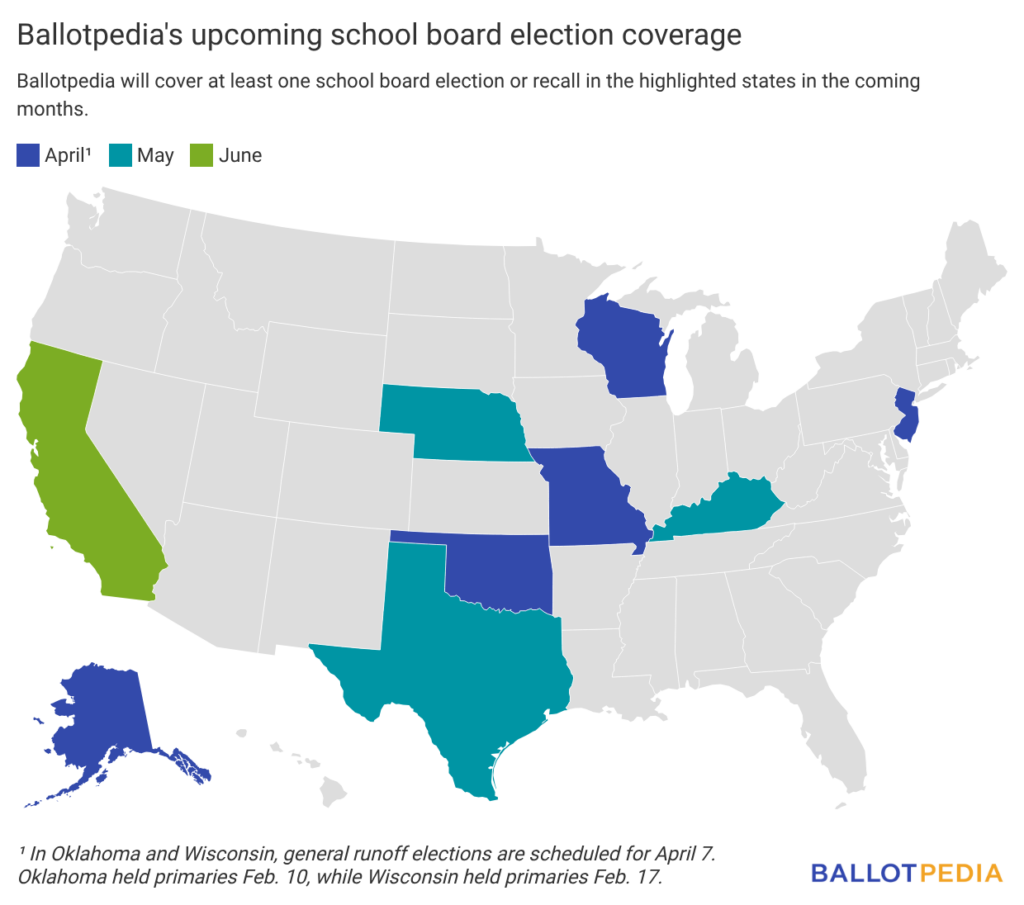
Click here to learn more about school board elections.
Legislatures in nine states have adjourned — here are some of the education-related bills that made it through
In his dissent in the 1932 case New State Ice Co. v. Liebmann, U.S. Supreme Court Justice Louis Brandeis compared states to laboratories, where lawmakers could experiment with new laws and policies. That idea is most visible in state capitols during annual legislative sessions, when lawmakers come together to propose, debate, and in some cases vote on hundreds of thousands of bills touching on most areas of life, including K-12 education.
Legislatures in Florida, Indiana, New Mexico, Oregon, Utah, Virginia, Washington, West Virginia and Wyoming have adjourned. On K-12 education, lawmakers in those states passed legislation on math and literacy requirements, cellphones in classrooms, career and technical education (CTE), graduation requirements, chronic absenteeism, teachers unions, and more.
Here’s a look at some of those noteworthy education bills. The list is not comprehensive. The examples showcase the diversity of education topics lawmakers have addressed in 2026.
Florida
Lawmakers in the Sunshine State ended their 60-day session on March 13 having passed a total of 234 bills out of 1,896 filed.
Florida has a Republican trifecta.
SB 1296: The bill would require public-sector unions, including teachers unions, to receive support from at least 50% of the workers they seek to represent. Under current law, unions need a majority of ballots cast. SB 1296 passed the Senate 20-14. No Democrats supported the bill, and five Republicans joined with Democrats in opposition. In the House, SB 1296 passed 73-37, once again with no Democratic support. Eight Republicans joined with Democrats in voting no. The bill now awaits Gov. Ron DeSantis’ (R) signature.
Indiana
Indiana’s legislative session ended on Feb. 27. The state has a Republican trifecta. Here are three education bills Gov. Mike Braun (R) recently signed.
SB 78: This bill requires charter schools and districts to adopt policies prohibiting students from accessing their cellphones and other wireless devices during the school day. Indiana was already one of 32 states that regulated student cellphone use during the school day, but the previous law only prohibited cellphones during class time. The Senate voted 36-12 to pass SB 78, and the House voted 82-13.
SB 239: The bill shortens the timeframe in which school districts are required to sell unused facilities to charter schools. Indiana requires public school districts to offer unused facilities to charter schools first for $1. Previously, school districts had 90 days to complete the transaction if a charter school expressed interest in the property. Under SB 239, districts will have 30 days to transfer the property, and if they don’t, the charter school can bring a civil suit against the district. Read our earlier deep dive on the legal issues around charter school facilities. Additionally, the bill allows districts to convert schools to charter schools but prohibits the districts from serving as the authorizer. The bill also requires districts to notify the parents of eighth graders who are at risk of not achieving proficiency in math. SB 239 passed the Senate and House along mostly partisan lines, with Republicans in support.
HB 1423: It establishes the Indiana Public Education Corporation, reshaping charter and public school governance in Indianapolis. The Indianapolis mayor will appoint the nine members of the Indiana Public Education Corporation, which will oversee transportation, facilities, and accountability systems for charter schools and Indianapolis Public Schools. Read our deep dive into the debate over the state-mandated task force that informed HB 1423. HB 1423 passed along mostly partisan lines in both the House and Senate.
New Mexico
New Mexico’s legislative session ended Feb. 19. New Mexico has a Democratic trifecta.
SB 37: The High Quality Literacy Act, which Gov. Michelle Lujan Grisham (D) signed on March 9, requires research-based literacy curriculum for K-3 graders and, among other things, allocates $14 million for low-performing schools to hire literacy coaches. The bill also requires schools to administer reading assessments to K-3 graders. House and Senate members voted unanimously to pass the bill.
SB 29: Lujan Grisham also signed SB 29 on March 9. The bill adds new math course requirements for teachers’ licenses and mandates new screening assessments and interventions for students struggling with math. Like SB 37, the bill passed unanimously in both chambers.
Oregon
Oregon’s legislative session ended March 6. Oregon has a Democratic trifecta.
HB 4154: The bill requires the Oregon Department of Education to collect and publish school attendance data four times a year, as opposed to the previous annual requirement. Oregon’s rate of chronic absenteeism among K-12 public school students is about 33%, one of the highest rates in the country. HB 4154 passed the House 40-1 and the Senate 26-3 and now awaits action from Gov. Tina Kotek (D).
HB 4079: This bill requires school districts to alert parents, staff, and some students when federal officers enter school property for the purpose of immigration enforcement. The bill passed the House and Senate along mostly partisan lines, with Democrats supporting it and Republicans in opposition, and now awaits Kotek’s signature.
Utah
Utah’s legislative session ended March 6. Utah has a Republican trifecta.
SB 241: This bill establishes a statewide goal of 80% third grade reading proficiency according to the state's year-end benchmark assessment by 2030. The bill requires districts to develop literacy interventions for students who do not score proficient in reading, including discussing retention — repeating a grade — with parents. Beginning in 2030, retention becomes mandatory for students who do not score proficient, though the bill provides certain good cause exemptions. The bill passed the House 62-7 and the Senate 24-1. The bill now goes before Gov. Spencer Cox (R).
SB 69: This bill requires districts to enforce a bell-to-bell ban on student cellphone usage. Like Indiana, Utah already prohibits cellphones in class. The bill passed the House 46-21 and the Senate 19-0. If Cox signs it into law, districts would have the option of establishing a policy allowing students to access their cellphones during school hours.
Virginia
Virginia’s legislative session ended March 14. Virginia has a Democratic trifecta.
HB 332: This bill requires the Virginia Board of Education to issue three-year renewable licenses to college and university instructors allowing them to also teach career and technical education (CTE) or dual enrollment courses at K-12 public high schools. The bill passed the House and Senate unanimously, and now awaits Gov. Abigail Spanberger’s (D) consideration.
SB 378: This bill repeals the state’s ban on public-sector collective bargaining for most public employees, including K-12 teachers (though the bill excludes university faculty). Virginia partly repealed its longstanding ban on public-sector collective bargaining in 2020, allowing local governments and school boards to vote to engage in bargaining with their employees. The bill passed the Senate 20-18 along party lines, with Democrats in support and Republicans opposed. It passed the House 61-36 along mostly party lines—one Democrat joined with all Republicans in voting no.
Washington
Washington’s legislative session ended March 12. Washington has a Democratic trifecta.
SB 6346: This bill would establish a 9.9% tax on individuals who earn more than $1 million each year beginning in 2029. Revenue raised from the tax would be used to, among other things, provide free universal school meals for K-12 public school students. Washington is one of nine states without an income tax. The Senate voted 27-21 along mostly partisan lines, with three Democrats joining Republicans in voting no. The House voted 51-46, once again mostly along partisan lines. The bill now awaits action from Gov. Bob Ferguson (D).
West Virginia
West Virginia’s legislative session ended March 14. West Virginia has a Republican trifecta.
SB 155: This bill creates an adjunct teaching permit, allowing districts to fill vacant positions when they cannot find a certified teacher. The bill passed the House 92-5 and the Senate 33-0.
Wyoming
Wyoming’s legislative session ended March 11. Wyoming has a Republican trifecta.
SF 59: Gov. Mark Gordon (R) signed this bill into law on March 6. The bill creates a statewide, K-12 literacy framework and requires each district to use curricula aligned with the science of reading. The bill also bans the three-cueing method of teaching reading and mandates universal screening assessments three times a year for students in grades K-3 and annually for students in grades 4-12 who haven’t reached grade-level proficiency. The bill passed the Senate 30-1 and the House 46-14.
We’ll keep you apprised of the most consequential and noteworthy state education bills in the coming months as more state legislative sessions come to an end.
Extracurricular: education news from around the web
This section contains links to recent education-related articles from around the internet. If you know of a story we should be reading, reply to this email to share it with us!
- Pandemic-era infants, toddlers exhibit elementary learning lag | K-12 Dive
- More American students are attending private school. Why do so few take NAEP? | Chalkbeat
- After fights over social studies standards, conservative activists come for math | The Hechinger Report
- Southern States Made Major 4th Grade Reading Gains. They Disappear by Middle School. | Governing
- Sonoma Valley Schools Approve Specific Rules for AI Use | GovTech
- America faces an education depression. Why are Democrats silent? | Washington Post
- No Homework? No Problem. | Education Next
- Voters will choose between newcomers and city leaders in Newark’s April school board election | Chalkbeat Newark
- In Deep-Red Idaho, a Republican Rift Over Schools and ‘Parental Choice’ | The New York Times
Take our Candidate Connection survey to reach voters in your district
Today, we’re looking at responses from two candidates running for school board in Anchorage, Alaska, on April 7.
Anchorage School District is the largest district in Alaska, with roughly 43,000 students.
Paul McDonogh is one of three candidates running to represent Seat D on the Anchorage School District Board of Education. McDonogh’s career experience includes working as an educator.
Here’s how McDonogh answered the question, “What areas of public policy are you personally passionate about?”

“I'm passionate about inclusive public policy that uplifts the conditions of working families like mine. The government should be working for the benefit of all people in the community. To do this, the government must be committed to giving working families like mine a real voice.”
Click here to read the rest of McDonogh’s responses.
Alexander Rosales is one of two candidates running to represent Seat C on the Anchorage School District Board of Education. Rosales’ career experience includes working as an educator, administrator, and as the owner of Alpenglow Basecamp Rentals. Rosales was also a substitute teacher and cafeteria manager.
Here’s how Rosales answered the question, “What areas of public policy are you personally passionate about?”

“My primary passion is K-12 education policy, particularly improving student safety, academic outcomes, and parental involvement. I want to ensure every child graduates reading and math-proficient and prepared for adulthood.
I strongly support fiscal responsibility in education spending, merit-based hiring and promotions, and policies that expand school choice options such as charters and strong public schools. I believe in evidence-based curricula, transparent budgeting, and collaboration among the school board, assembly, and legislature to achieve better returns on investment for Alaska’s students and families.”
Click here to read the rest of Rosales’ responses.
As a reminder, if you're a school board candidate or incumbent planning to run this year, click here to take the survey. If you complete the survey, your answers will appear in your Ballotpedia profile. Your responses will also appear in our sample ballot. If there is an election in your community, share the link with your candidates and urge them to take the survey!