


The U.S. Supreme Court will hear oral arguments on March 23 in Watson v. Republican National Committee, a case challenging the legality of a Mississippi law that allows absentee ballots postmarked by Election Day to be counted if they are received up to five business days after the election.
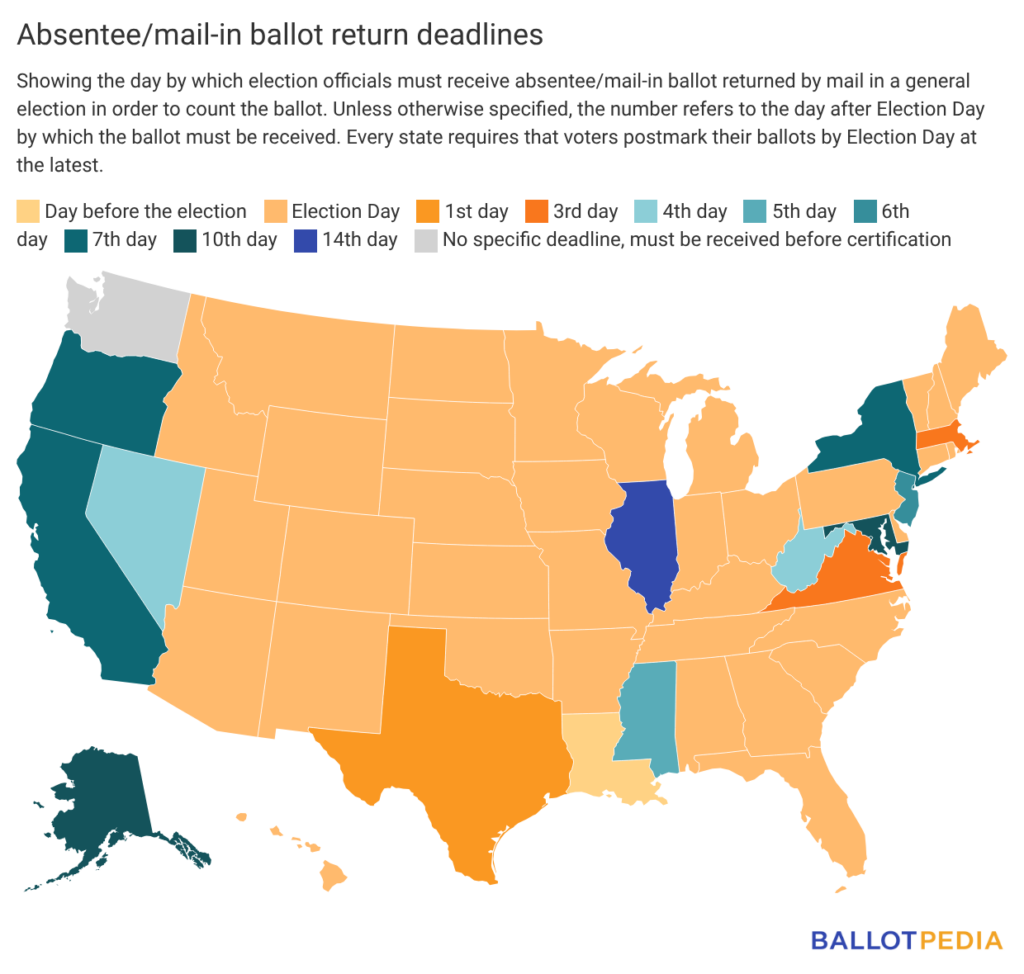
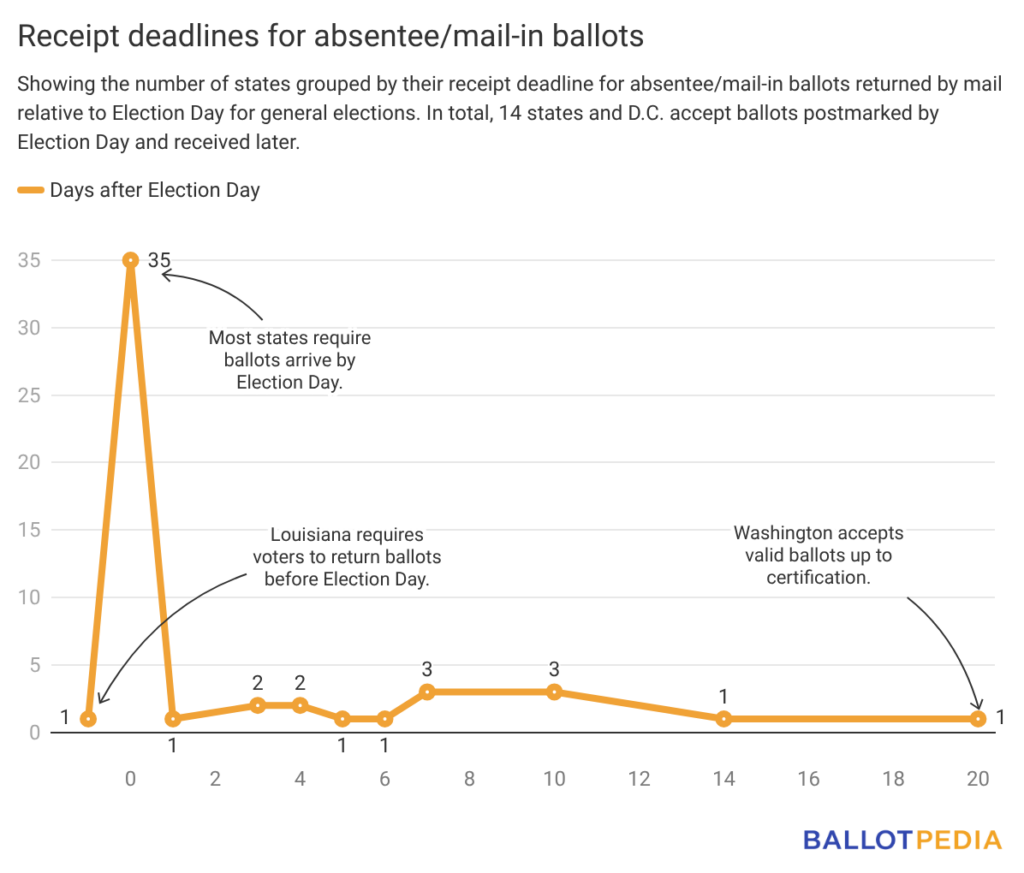
Mississippi is one of 14 states that allow absentee/mail-in ballots postmarked by Election Day to be counted if they arrive within a set period of time after the election. The state passed a law allowing for a five-day grace period in 2020. Most states, including Mississippi, also allow at least some absentee/mail-in ballots from military or overseas voters to be counted if they arrive after Election Day.
The Supreme Court agreed to hear Watson v. Republican National Committee in November, after a federal appeals court ruled that Mississippi’s law was preempted by federal statutes.
The Republican National Committee, the Mississippi Republican Party, the Libertarian Party of Mississippi, George County Election Commissioner Matthew Lamb, and former Hinds County Republican Party Chair James Perry challenged the law in 2024.
The U.S. District Court for the Southern District of Mississippi ruled in favor of the state in July 2024. Plaintiffs appealed to the U.S. Court of Appeals for the Fifth Circuit, where a three-judge panel in October 2024 held that Mississippi's statute was unlawful and ordered the case be sent back to the district court. Mississippi then appealed to the U.S. Supreme Court.
Opponents of the Mississippi law have asked the Supreme Court to uphold the appeals court ruling, arguing that federal law establishes a uniform, national Election Day for congressional and presidential elections.
"The Fifth Circuit rightly held that the 'day for the election' has a fixed meaning," attorneys for the RNC and three other plaintiffs wrote in a brief. "It doesn’t mean whatever each State wants it to mean. It means the day by which ballots must be 'received by state officials.'"
Supporters of the law, including Mississippi Secretary of State Michael Watson (R), argue that Mississippi’s statutory requirement that ballots be postmarked by Election Day complies with federal law.
"[T]he federal election-day statutes require only that the voters cast their ballots by election day," Mississippi Attorney General Lynn Fitch’s (R) office wrote. "The election has then occurred, even if election officials do not receive all ballots by that day."
In 2025, four states — Kansas, North Dakota, Ohio, and Utah — passed laws requiring absentee/mail-in ballots to be received by the close of polls on Election Day.
Previously, Kansas required ballots to be received by the end of business on the third day following the election, Ohio counted ballots if they arrived within four days after the election, Utah required ballots to be received by noon on the day of the canvass, and North Dakota did not have a specific deadline in statute.
On March 10, 2026, Mississippi lawmakers sent HB 908 to Gov. Tate Reeves (R), which would repeal Mississippi’s five-day grace period if the Supreme Court rules it is unlawful.
So far this year, lawmakers in 21 states have introduced or carried over from the 2025 session 56 bills related to absentee/mail-in voting deadlines. Legislators in five states — Alaska, Illinois, New Jersey, New York, and West Virginia — have introduced bills requiring absentee/mail-in ballots to be received by the close of polls on Election Day. Illinois, New Jersey, and New York have Democratic trifectas, West Virginia has a Republican trifecta, and Alaska has a divided government.
West Virginia HB 4600, which ends the state’s current four-day grace period for absentee ballots and requires ballots to be received by 8 p.m. on Election Day, passed the House of Delegates on a 79-17 vote on Feb. 10. Seventy-nine Republicans voted in support of the bill, while 8 Democrats and 9 Republicans voted in opposition. The bill is currently under consideration in the state Senate.