


Welcome to the Friday, March 20, Brew.
By: Briana Ryan
Here’s what’s in store for you as you start your day:
- The many ways in which American voters select nominees in primary elections
- Three candidates are running in the Michigan Senate District 35 special election on May 5
- Nine new measures have been certified for this year’s statewide ballots
The many ways in which American voters select nominees in primary elections
Today, we're sharing the second installment in our project marking America's 250th anniversary: The Blueprints of Democracy.
There are a few basic concepts in American politics that just about everyone understands. One of those is the phrase "primary election." It conjures images of two or more candidates facing off for the right to represent their particular party in a general election.
But the truth is that primary elections vary considerably from state to state, and even within states and between political parties.
Ballotpedia's comprehensive overview found that 39 states require major parties to hold an open, closed, semi-closed, or top-two style primary for most congressional and state offices. Eleven states allow political parties to choose between at least two possible primary types.
Primary election types
The most common primary types are open primaries, where any voter can cast a ballot regardless of partisan affiliation; closed primaries, open only to registered party members; and semi-closed primaries, which allow party members and unaffiliated voters to participate. In top-two primaries, all candidates appear on the same ballot and the top vote-getters advance to the general election.
Variations within states and parties
Primary rules often vary within a single state. In 40 states, both major parties use the same primary system for most statewide offices. In seven states, the parties operate different types of primaries. West Virginia exemplifies this complexity. The Republican Party will hold a closed primary this year, while the Democratic Party continues allowing independents to vote.
Louisiana uses a unique majority-vote system where all candidates appear on the same ballot regardless of party. If a candidate receives more than 50% of the vote, they win outright. Otherwise, a second-round election is held with the top two vote-getters. Starting in 2026, Louisiana will use semi-closed primaries instead for Congress and state offices.
Nebraska's rules depend on which races and parties are involved. State legislative primaries are nonpartisan, with the top two advancing. Congressional primaries are partisan, but unaffiliated voters may choose which party's primary to participate in. For other statewide offices, parties decide whether to allow unaffiliated voters.
Local elections and nonpartisan offices
More than 500,000 officeholders are elected at the local level. In places with nonpartisan primaries, like many Wisconsin elections, the primary narrows the field for the general ballot. For example, if eight candidates file for three city council seats, voters select up to three candidates, and the top six vote-getters advance to the general election.
Some localities use runoffs instead, while others hold no primary at all, with all candidates appearing on the general election ballot.
Primary cancellations
Primaries are sometimes canceled entirely. In nonpartisan elections, a primary is only needed if more than twice as many candidates file as there are seats available. If a nonpartisan city treasurer race has just two candidates, both automatically advance to the general election, saving money and reducing ballot length.
Partisan primaries can also be canceled, typically when the number of candidates is less than or equal to the number of nominations available. However, rules vary by state. Montana's municipal primaries are triggered not just by candidate numbers but also by how many offices are on the ballot.
Deciding who wins
Some states have unusual rules for multi-seat races. In Arizona, some candidates can win outright in the primary while others advance to the general election. Arizona calculates a winning threshold by dividing total votes cast by the number of seats, then dividing that number in half. Candidates exceeding this threshold win outright; remaining seats are filled by advancing the next-highest vote-getters.
Primaries have been a key feature of American politics since Wisconsin adopted them in 1904. State legislatures continue modifying how primaries operate, who can participate, and the role of political parties.
Click here to read more about how American voters select nominees in primary elections.
Three candidates are running in the Michigan Senate District 35 special election on May 5
Chedrick Greene (D), Jason Tunney (R), and Ali Sledz (L) are running in the special general election for Michigan Senate District 35 on May 5. Greene and Tunney lead in media attention.
The race could affect control of the Michigan Senate, where Democrats currently have a 19-18 majority. If Greene wins, Democrats would maintain control of the chamber. If Tunney wins, the chamber would tie 19-19, with Lt. Gov. Garlin Gilchrist II (D) casting tie-breaking votes if needed.
In the 2022 general election for the district, Kristen McDonald Rivet (D) defeated Annette Glenn (R) 53% to 47%. In the 2024 U.S. Senate election, Elissa Slotkin (D) defeated Mike Rogers (R) in the district 51% to 47%
The winner will serve the remainder of Rivet's term, which ends in January 2027. Rivet resigned on Jan. 3, 2025, after being elected to represent Michigan's 8th Congressional District in 2024.
Governor Gretchen Whitmer (D) announced a timeline to fill the vacancy on Aug. 29, 2025. Michigan Public Radio’s Colin Jackson wrote that Whitmer’s “decision to wait months to call a special election has drawn criticism from all sides of the political spectrum, who argued residents of the 35th district were being disenfranchised by not having a voice in the state Senate for most of the year.” According to the Detroit Free Press' Clara Hendrickson, "Whitmer has never publicly explained why she waited so long."
Greene is a U.S. Marine Corps veteran and the Saginaw fire captain. In his Candidate Connection Survey, Greene said he was “committed to investing in our communities and schools to make them more attractive for economic development, and to equip our workforce with the skills needed to compete for better-paying jobs.”
Tunney is a practicing lawyer and former assistant prosecutor in Saginaw County. In his Candidate Connection Survey, Tunney said he is “passionate about fixing our education system, restoring public safety, reducing burdensome regulation, and lowering taxes so Michigan families can thrive.”
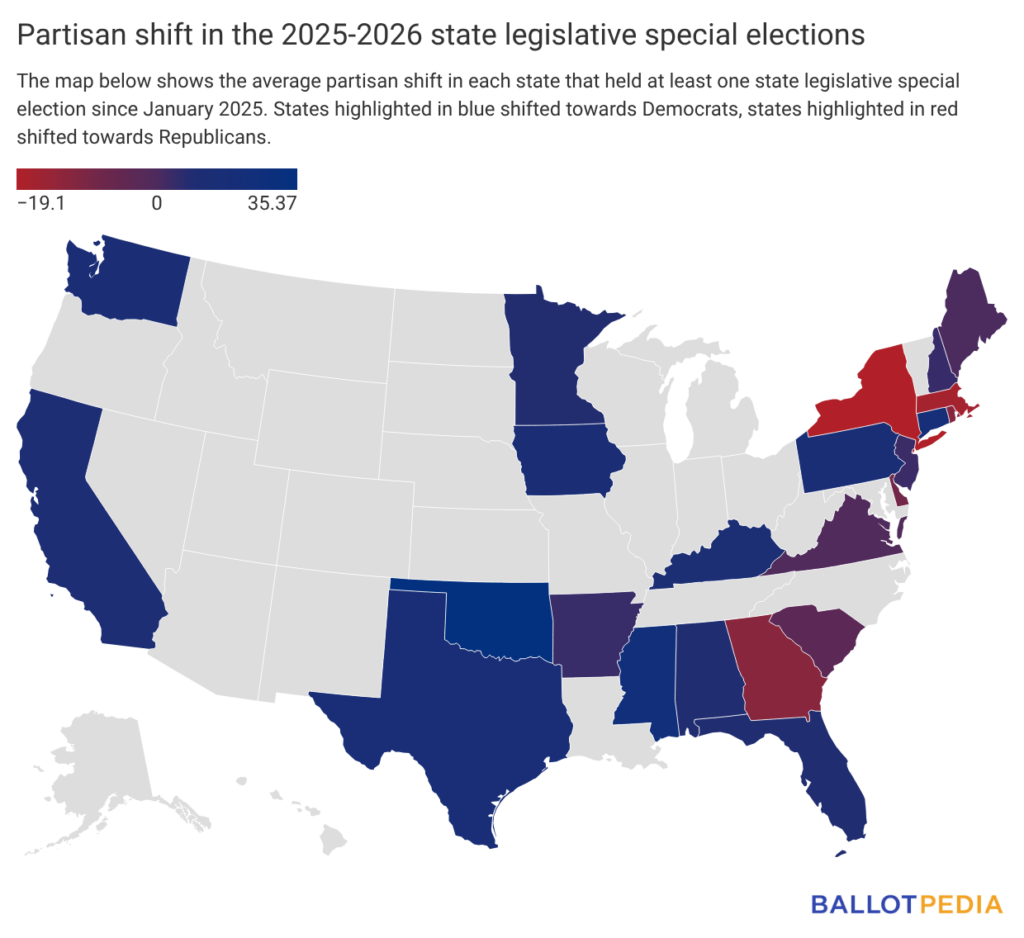
Since January 2025, 10 state legislative districts have changed from Republican to Democratic control. No state legislative districts have changed from Democratic to Republican control.
Since January 2025, there were 54 districts where both the special election and the most recent general election had candidates from both major parties. Overall, the average shift across those districts was 5.3 percentage points toward Democrats compared to the previous regular elections for those seats.
Click here to read more about the special election in Michigan Senate District 35.
Nine new measures have been certified for this year’s statewide ballots
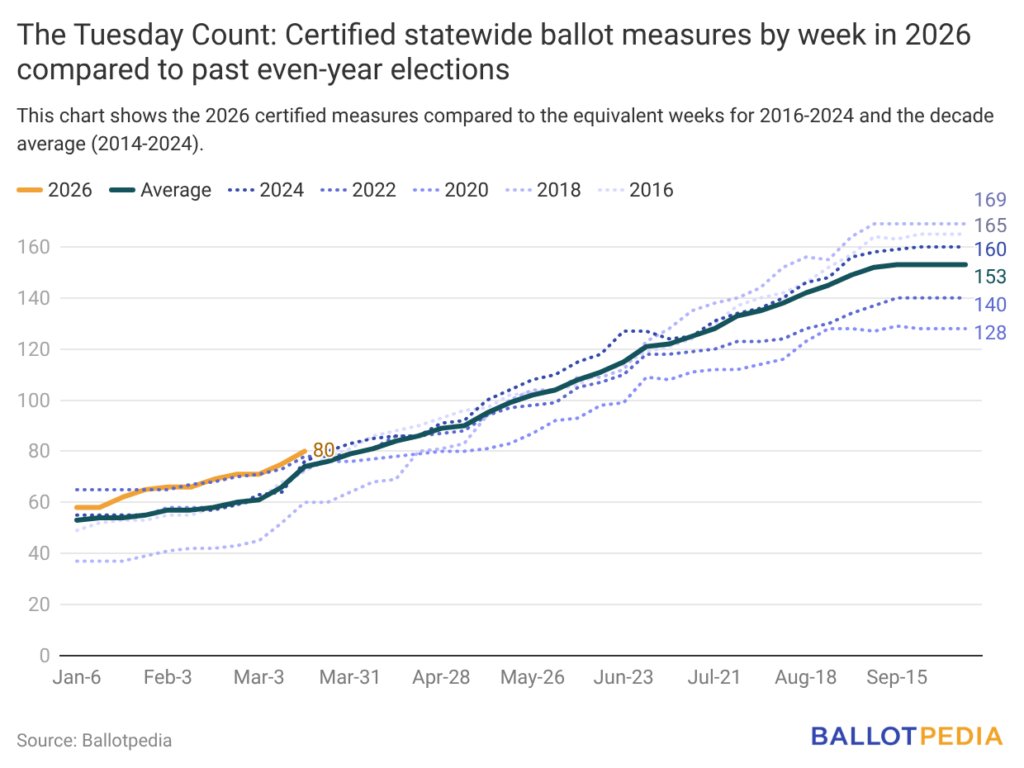
As of March 17, the 80 statewide measures certified for statewide ballots in 2026 are above the historical average for this point in the cycle across even-numbered years from 2014 through 2024.
By this time during even-numbered years from 2014 through 2024, an average of 74 statewide measures had been certified for the ballot. From 2014 to 2024, an average of 153 statewide measures were certified.
Over the past two weeks, nine new measures were certified for the ballot in their respective states:
- Colorado Prohibit Surgeries for Treatment in Response to Minors' Perception of Sex or Gender Measure
- Colorado Require Life in Prison for Human Trafficking of Minors Measure
- Colorado Sex Requirement for School and College Sports Initiative
- New Mexico Higher Education Improvements Bond Issue
- New Mexico Library Acquisition Bond Issue
- New Mexico Senior Citizen Facilities Bond Issue
- Washington Parental Right to Review Education Materials, Receive Notifications, and Opt Out of Sexual-Health Education Initiative
- Washington Sex Verification Requirements for Female School Sports Initiative
- West Virginia Citizenship Voting Requirement Amendment
Signatures have been submitted and are pending verification for seven initiatives:
- Alaska Citizenship Requirement for Voting Initiative
- California Homeownership Loan Program and Single-Family Home Construction Initiative
- California Two-Thirds Vote Requirement for Special Taxes and Charter City Real Estate Transfer Tax Prohibition Initiative
- California Voter Identification and Voter List Maintenance Requirements Initiative
- Michigan Citizenship Requirement for Voting Initiative
- Missouri Congressional Map Referendum
- Utah Eliminate the Independent Redistricting Commission Initiative
Enough signatures were verified for 12 indirect initiatives to certify them to their respective state legislatures:
- Maine Birth Certificate Sex Requirement for Public School Sports Initiative
- Massachusetts Change State Tax Revenue Limit Initiative
- Massachusetts Decrease State Income Tax Rate to 4% Initiative
- Massachusetts Eliminate Recreational Marijuana Sales and Allow Limited Possession Initiative
- Massachusetts Establish the Nature for All Fund Initiative
- Massachusetts Legislative Stipend Calculation and Payment Rules Initiative
- Massachusetts Limit on Required Lot Size for Single-Family Homes Initiative
- Massachusetts Permit Collective Bargaining for Committee for Public Counsel Services Employees Initiative
- Massachusetts Permit Same-Day Voter Registration Initiative
- Massachusetts Public Records Requirements for Legislature and Governor’s Office Initiative
- Massachusetts Rent Control Initiative
- Massachusetts Top-Two Primary Elections Initiative
The next signature deadline is April 1 in Idaho, where initiatives related to the sales tax, abortion, medical marijuana, and recreational marijuana have been approved for signature gathering.
Click here for more information about the ballot measures that could be on the ballot this year.