


Welcome to the Tuesday, March 24, Brew.
By: Briana Ryan
Here’s what’s in store for you as you start your day:
- Voters in at least five jurisdictions will decide ballot measures related to data centers this year
- Texas voters to head back to the polls on May 26 to decide primary runoff elections
- Four candidates are running in the Republican primary for the U.S. Senate in Louisiana on May 16
Voters in at least five jurisdictions will decide ballot measures related to data centers this year
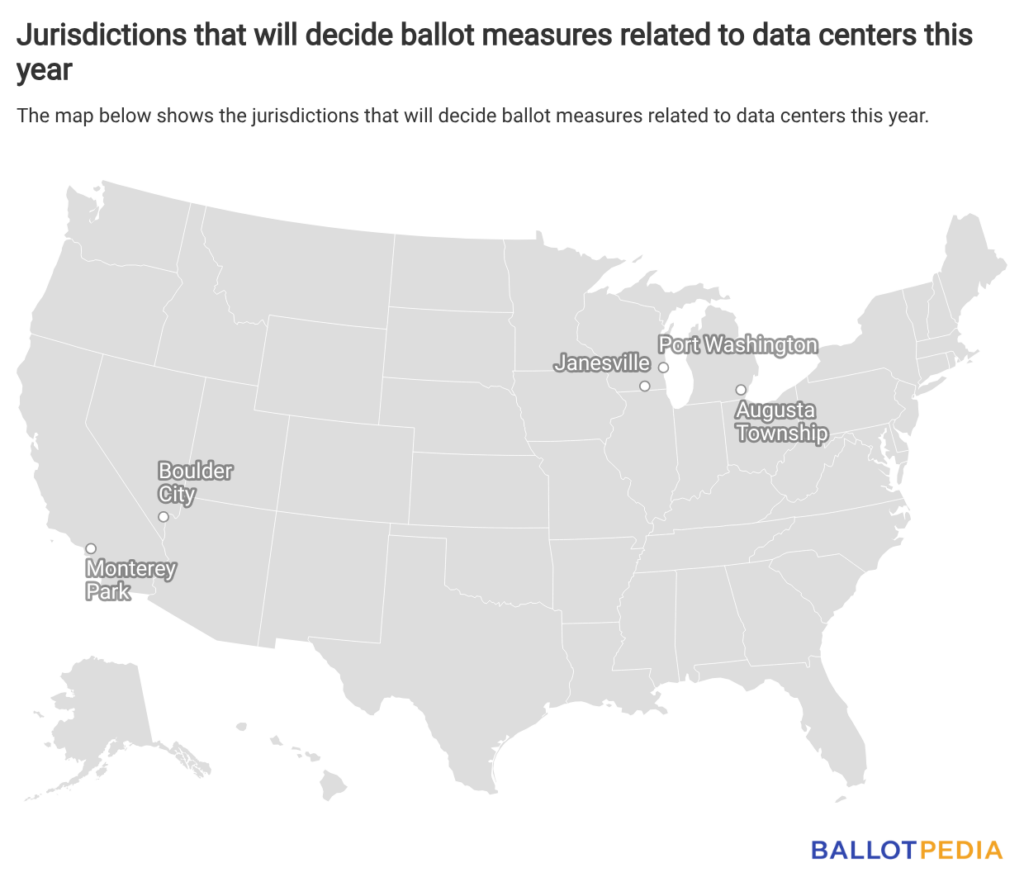
Voters in multiple jurisdictions will decide on at least five local ballot measures related to data center development this year. One measure would allow data center development, and four would limit, prohibit, or create additional steps for data center development.
Additionally, Ohio voters may decide on a statewide measure to prohibit the construction of data centers for digital data processing with an aggregate power demand exceeding 25 megawatts. Supporters of the initiative have submitted signatures along with the initial petition application. If the Attorney General approves the petition, it will go to the Ohio Ballot Board to decide whether supporters can collect the 413,488 valid signatures needed to make the ballot.
A data center is a physical facility that houses computer systems and related equipment used to store, manage, process, and transmit digital information. Data centers typically contain rows of computer servers, data storage systems, and networking equipment, along with the power and cooling infrastructure needed to operate them.
Data centers vary in size and type. A large, warehouse-sized facility is known as a hyperscale data center. According to the Congressional Research Service, increasing demand for data storage and computing power, particularly for AI, has driven the construction of hyperscale data centers.
Here's a closer look at the five local measures that voters will decide on this year:
Boulder City, Nevada: The measure would allow data center facilities to be considered an approved land use within the Eldorado Valley Transfer Area, excluding the Multi-species Habitat Conservation Easement.
Monterey Park, California: The measure would amend the Monterey Park Land Use and Urban Design Element to prohibit data centers.
Augusta Township, Michigan: The measure, a veto referendum, will allow voters to decide whether to overturn or support Ordinance No. 2025-02, which rezoned seven parcels totaling 522.2 acres from Agricultural Residential (AR) to General Industrial (GI) for a proposed data center. A 'yes' vote would uphold the ordinance, while a 'no' vote would repeal the ordinance. The rezoned land would become part of a larger 810.5-acre, 19-parcel data center campus. On July 22, 2025, the Augusta Township Board of Trustees voted unanimously to approve the ordinance. Opponents of the rezoning also began a recall effort against the township's board of trustees, as well as the treasurer, clerk, and supervisor.
Port Washington, Wisconsin: The measure would require voter approval before the City of Port Washington could create or approve a Tax Incremental District (TID) with either a projected base property value of $10 million or more or projected project costs of $10 million or more. Proponents of the measure proposed it in response to the Port Washington City Council's approval of a development agreement with Vantage Data Centers Management Company, LLC on Aug. 19, 2025. Vantage planned to construct a $15 billion data center campus, to be operated by OpenAI and Oracle, spanning 670 acres across four buildings and requiring an estimated 3.5 gigawatts of electricity. According to Milwaukee Business News’ Ashley Smart, the measure “would not impact the TID for the Vantage Data Center project, since it is already approved.”
Janesville, Wisconsin: The measure would require voter approval before the City of Janesville could approve development on undeveloped portions of the GM/JATCO site if the project's cost exceeds $450 million. As of March 2026, the Janesville City Council was considering a proposal from Viridian Partners to redevelop the site into an 800-megawatt, 11-building data center campus. The project was estimated to cost $8 billion.
Measures related to data centers have also been proposed in Marana, Arizona; Frederick County, Maryland; Festus, Joplin, and Independence, Missouri; and Wilmington, Ohio.
Click here to read more about data center-related measures.
Texas voters to head back to the polls on May 26 to decide primary runoff elections
While most primary elections in Texas were decided on March 3, some are headed to runoffs because no candidate received more than 50% of the vote. Since then, there have been some updates on where those runoffs stand heading into May 26. Let's check out the latest news in the congressional runoffs we're following as battlegrounds.
U.S. Senate
Incumbent Sen. John Cornyn (R) and Ken Paxton (R) are running in the Republican primary runoff for the U.S. Senate. Cornyn and Paxton advanced from the primary after receiving 42.5% and 40.8% of the vote, respectively, in a field of eight candidates.
Following the primary, President Donald Trump (R) posted on Truth Social that he would endorse one of the candidates and ask the other to withdraw from the race. As of March 23, he has not endorsed either candidate. Additionally, the March 17 deadline to withdraw from the race passed, meaning both candidates will appear on the ballot.
U.S. House of Representatives
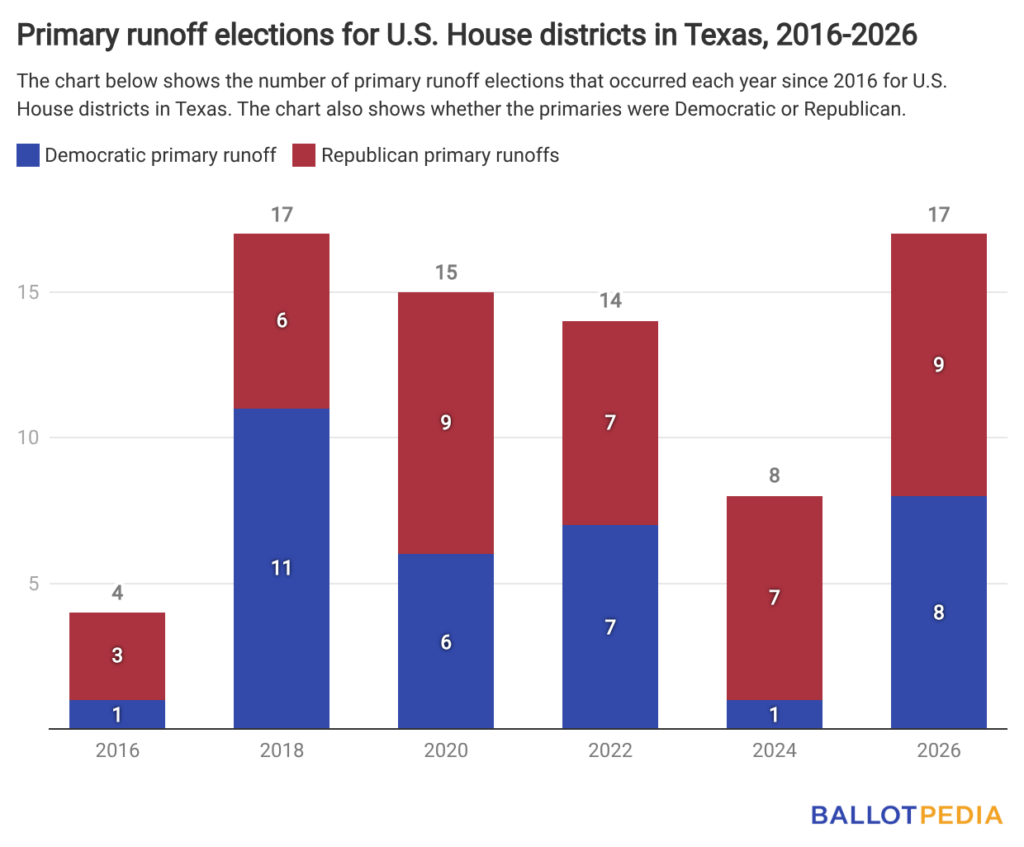
There will be 17 U.S. House primary runoffs this year. That means this year ties with 2018 for the year with the most runoffs since 2016. Originally, there were 19, but two were canceled due to withdrawals. Incumbent Rep. Tony Gonzales (R) withdrew from the runoff in the 23rd Congressional District, and Ryan Binkley (R) withdrew from the runoff in the 32nd Congressional District. Since they both withdrew before the deadline, their names will not appear on the ballot. As a result, Brandon Herrera (R) will be the Republican nominee for the 23rd Congressional District, and Jace Yarbrough (R) will be the Republican nominee for the 32nd Congressional District.
Here are the six runoffs that we're following as battlegrounds:
Incumbent Reps. Al Green (D) and Christian Menefee (D) are running in the Democratic primary runoff for the 18th Congressional District. Menefee and Green advanced from the primary after receiving 46% and 44.2% of the vote, respectively, in a field of four candidates. The primary is one of two this year where an incumbent is running against another incumbent due to redistricting.
Tom Sell (R) and Abraham Enriquez (R) are running in the Republican primary runoff for the open 19th Congressional District. Sell and Enriquez advanced from the primary after receiving 40.4% and 18.75% of the vote, respectively, in a field of seven candidates. The race remained too close to call in the weeks following the primary because a third candidate, Matthew Smith (R), was close behind Enriquez. The official results from the Texas Secretary of State showed 186 votes separating Enriquez and Smith.
Incumbent Rep. Julie Johnson (D) and Colin Allred (D) are running in the Democratic primary runoff for the 33rd Congressional District. Allred and Johnson advanced from the primary after receiving 45.5% and 34% of the vote, respectively, in a field of four candidates. Allred previously represented the 32nd Congressional District, the district that Johnson currently represents, from 2019 to 2025. According to The Texas Tribune’s Gabby Birenbaum, due to redistricting, the new 33rd Congressional District includes approximately a third of the old 32nd Congressional District's residents.
A pair of runoffs that we’re following battlegrounds are happening in the only two districts where Trump and Gov. Greg Abbott (R) endorsed opposing candidates.
- Carlos De La Cruz (R) and John Lujan (R) are running in the Republican primary runoff for the open 35th Congressional District. Lujan and De La Cruz advanced from the primary after receiving 32.5% and 27.1% of the vote, respectively, in a field of 11 candidates. Trump endorsed De La Cruz, and Gov. Greg Abbott (R) endorsed Lujan.
- Alex Mealer (R) and Briscoe Cain (R) are running in the Republican primary runoff for the open 9th Congressional District. Mealer and Cain advanced from the primary after receiving 36.6% and 30.8% of the vote, respectively, in a field of nine candidates. Trump endorsed Mealer, and Abbott endorsed Cain.
Jon Bonck (R) and Shelly deZevallos (R) are running in the Republican primary runoff for the open 38th Congressional District. Bonck and deZevallos advanced from the primary after receiving 47.7% and 18.6% of the vote, respectively, in a field of 10 candidates. Since then, third-place finisher Michael Pratt (R), who received 10.9% of the vote in the primary, has endorsed Bonck.
Click here to read more about the elections happening in Texas this year.
Four candidates are running in the Republican primary for the U.S. Senate in Louisiana on May 16
Incumbent Bill Cassidy (R), John Fleming (R), Julia Letlow (R), and Mark Spencer (R) are running in the Republican primary for the U.S. Senate in Louisiana on May 16. Cassidy, Fleming, and Letlow lead in fundraising and polling.
This is the only U.S. Senate primary in which President Donald Trump (R) endorsed a challenger to a Republican incumbent. Trump endorsed Letlow on Jan. 17, ahead of her official announcement. In response, Cassidy posted on X, "I'm proudly running for re-election as a principled conservative who gets things done for the people of Louisiana. If Congresswoman Letlow decides to run I am confident I will win." Cassidy was one of seven U.S. senators who voted to convict Trump in his 2021 impeachment trial.
Cassidy has represented Louisiana in the U.S. Senate since 2015. He previously represented Louisiana's 6th Congressional District from 2009 to 2015. According to Cassidy's campaign website, "As a conservative in the Senate, he is focused on passing legislation that actually addresses the kitchen-table issues every family faces. Bill is fighting to lower the cost of health care and ensuring Louisianans can choose the doctor and care that's best for their families."
Fleming has served as Louisiana Treasurer since 2024. He previously represented Louisiana's 4th Congressional District from 2009 to 2017. According to Fleming's campaign website, he would focus on "defending our values, securing our borders, protecting Louisiana jobs, and standing shoulder-to-shoulder with President Trump to put America First."
Letlow has represented Louisiana's 5th Congressional District since 2021. She previously worked as a university professor and administrator. Letlow said, "I have fought alongside President Trump to put America first — standing up for our parents, securing our borders, supporting law enforcement, rooting out waste, fraud, and abuse that drives up inflation, and fighting to fix an education system too focused on woke ideology instead of teaching."
Louisiana will use closed party primaries for some offices, including the U.S. Senate, this year. That means there will be separate primaries to select Democratic and Republican nominees for the general election. If no candidate receives a majority of the vote, the top two finishers will advance to a runoff on June 27.
Previously, Louisiana used the majority-vote primary in which all candidates appeared on the same ballot, and the top two finishers advanced to the general election regardless of their party. A candidate who earned a simple majority of the vote in the primary won the election outright.
Click here to read more about the Republican primary for the U.S. Senate in Louisiana. Also, if you're a Louisiana voter, check out our Sample Ballot Lookup here to prepare for Election Day.