


On March 17, the U.S. Senate began debate on the SAVE America Act, which would require individuals to provide documentary proof of citizenship to register to vote and voter ID to cast a ballot in federal elections. As of March 24, debate continued in the Senate, and a final vote had not been scheduled.
On Feb. 11, the U.S. House passed the SAVE America Act 218-213 with 217 Republicans and one Democrat voting in favor and 213 Democrats voting against.
On March 17, the Washington Post's Theodoric Meyer wrote, "Republicans, who control the Senate, do not have the 60 votes they need to overcome a Democratic filibuster. Nor do they have enough votes to attempt a riskier gambit that some Republican senators favor: attempting to exhaust Democrats by forcing them to speak on the Senate floor for weeks to block the bill, known as a 'talking filibuster.'"
The bill would prohibit states from accepting voter registration applications for federal elections unless accompanied by documentary proof of citizenship, such as a passport, military ID, or an enhanced REAL ID. Applicants could also present a different government-issued photo ID plus another document, such as a birth certificate or naturalization certificate.
Voters who register by mail would be required to present their proof of citizenship in person to an election official before the election. In states that have same-day voter registration, voters could provide such proof at the polls on Election Day.
Individuals who have changed their name would need to provide proof of citizenship with their old name, as well as either "additional documentation as necessary to establish that the name on the documentation is a previous name of the applicant" or an affidavit attesting that the name on the documentation is their previous name.
For reference, individuals currently applying for a U.S. passport must submit either a certified birth certificate, naturalization or citizenship certificate, consular report of birth abroad, or a valid and undamaged passport. Passport applicants must also provide a photo ID.
The legislation would also require states to check their voter rolls against U.S. Department of Homeland Security data to identify and remove non-citizens who are registered to vote.
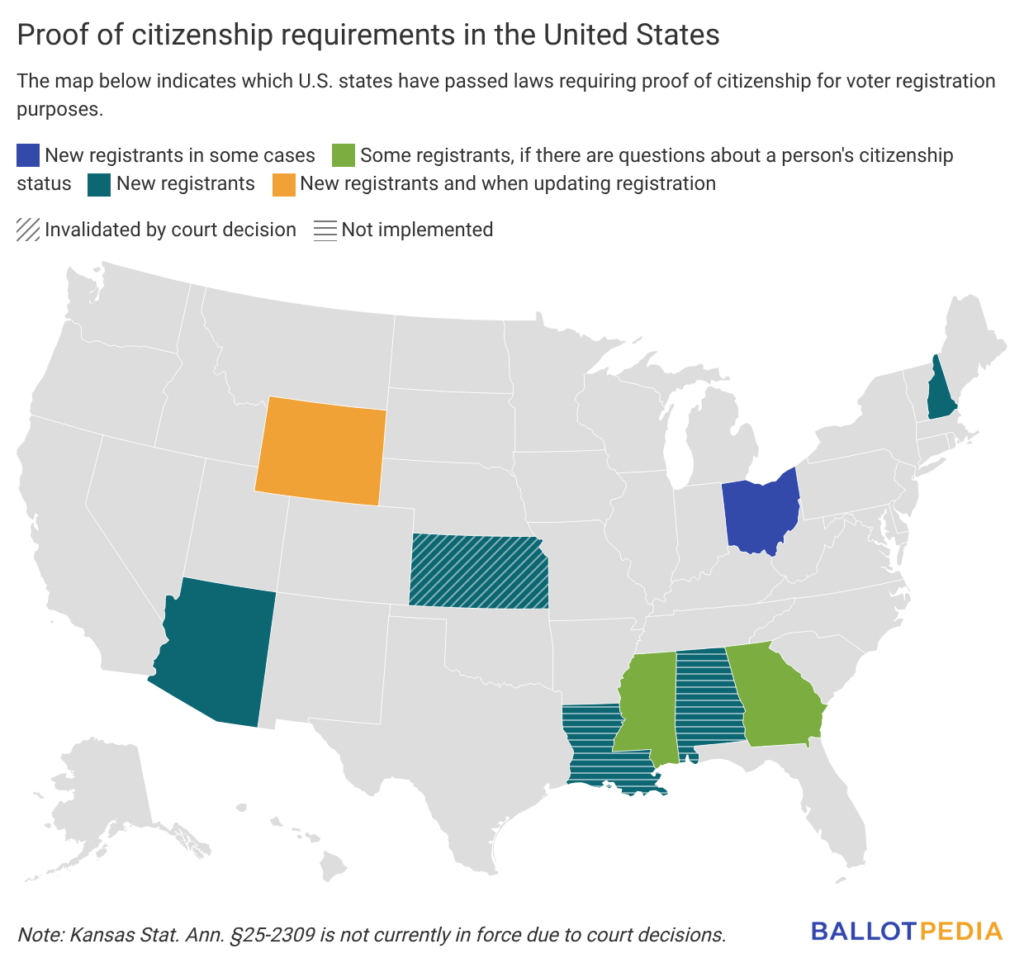
Some states have laws similar to the SAVE America Act’s documentary proof-of-citizenship requirement.
Nine states — Alabama, Arizona, Georgia, Kansas, Louisiana, Mississippi, New Hampshire, Ohio, and Wyoming — have laws requiring proof of citizenship to register to vote in at least some cases. Alabama and Louisiana have not implemented their proof-of-citizenship laws. A U.S. District court blocked Kansas' proof-of-citizenship law in 2018.
Seven of the nine states with laws requiring proof of citizenship have Republican trifectas, while Arizona and Kansas have divided government. Of the states without documentary proof of citizenship laws, 16 have Democratic trifectas, 16 have Republican trifectas, and nine have divided government.
Fifteen states have introduced legislation requiring documentary proof of citizenship for registration. In Florida, South Dakota, and Utah, proof-of-citizenship bills have passed both chambers of the state legislature. In Iowa and Mississippi, a proof-of-citizenship bill has passed in one chamber.
Additionally, the SAVE America Act would require individuals voting in federal elections to present photo identification in order to cast a ballot.
Absentee/mail-in voters would be required to include a copy of their ID when requesting and returning their ballot or provide the last four digits of their Social Security number and sign an affidavit. Eligible forms of ID include driver’s licenses, state-issued ID cards, passports, or tribal or military IDs.
Federal law currently requires individuals in all 50 states who register to vote by mail and who have not previously voted in a federal election in their state to provide documents to establish their name and identity, such as a copy of their driver's license or paycheck.
Currently, 36 states require voters to present identification to vote at the polls on Election Day, though many states provide exceptions to these rules. Six of those states have Democratic trifectas, 23 states have Republican trifectas, and seven states have divided government.
Of these states, 24 require voters to present identification containing a photograph, with certain exceptions.
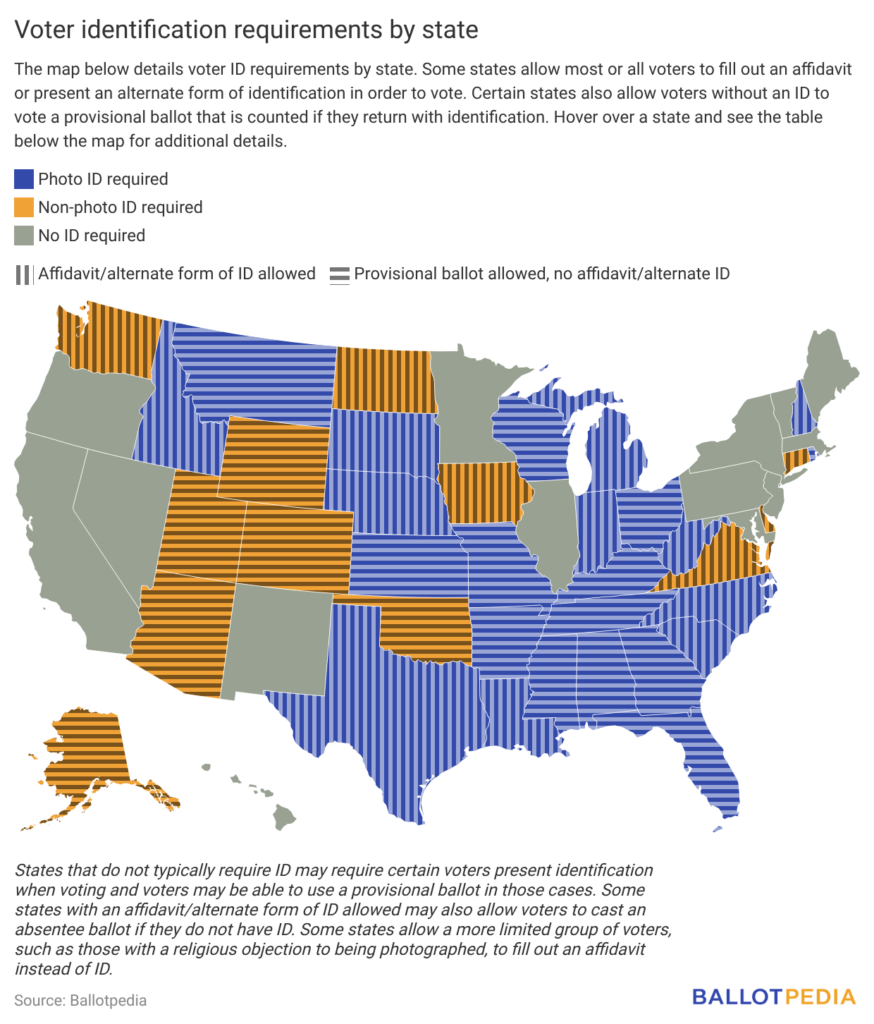
The remaining 14 states do not generally require voters to present identification to vote at the polls on Election Day, aside from what is required in federal law. Of the states without voter ID laws, 10 states have Democratic trifectas, and four states have divided government.
Lawmakers in Arizona and Oklahoma have advanced bills this session to require a photo ID instead of a non-photo ID. Florida and New Hampshire have advanced bills prohibiting certain forms of identification from being used for voting.
Read more here for information on documentary proof of citizenship laws across the country. Read more here for information on voter ID laws in each of the 50 states.