


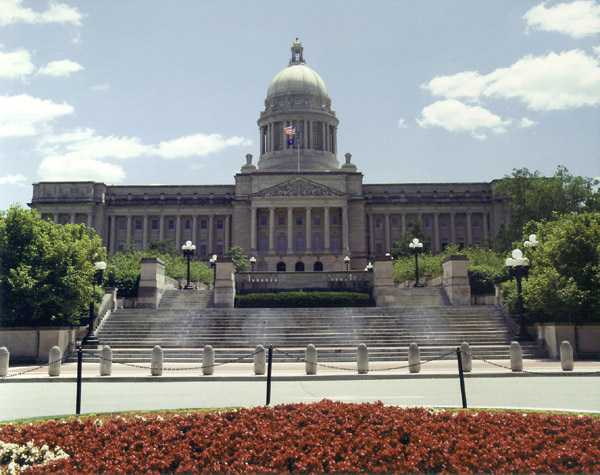
On March 17, 2026, the Kentucky General Assembly voted to override Gov. Andy Beshear's (D) veto of House Bill 1, which requires the secretary of state to annually opt the state into the federal school choice tax credit scholarship program.
Gov. Beshear vetoed the bill on March 13, and the Kentucky House voted on March 16 to override the veto 77-14, with eight representatives not voting and one abstaining. On March 17, the Kentucky Senate voted 31-5 on complete the override. Across both votes, no Democrats voted for the override, and no Republicans voted against it.
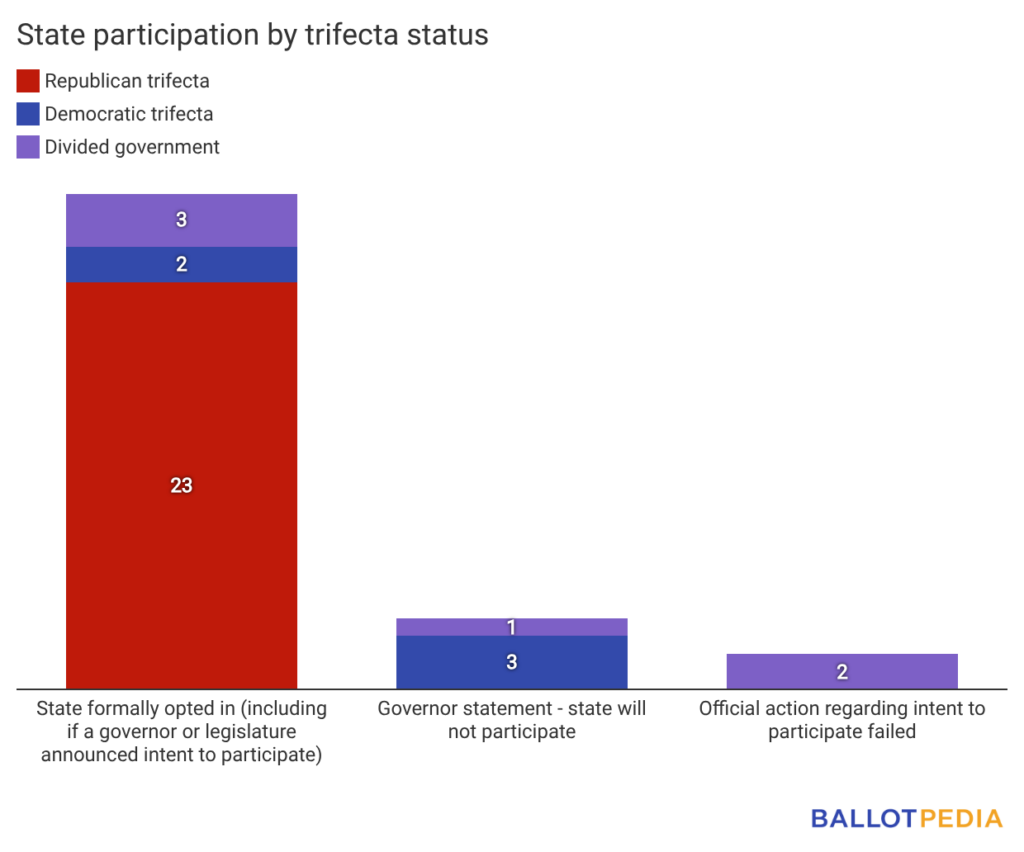
Kentucky is one of 11 states with a divided government, and one of four states where there is a Democratic governor and Republicans control both chambers of the legislature—along with Arizona, Kansas, North Carolina, and Wisconsin.
Kentucky is the second state to enact legislation requiring the state to opt into the federal program, and the first to indicate they would participate through legislation. Indiana enacted a bill requiring the state to participate in the program on March 12, 2026, but Gov. Mike Braun (R) had already opted the state into the program in January. Indiana has a Republican trifecta.
About the program
The One Big Beautiful Bill Act, enacted on July 4, 2025, established the school choice tax credit, which requires states to opt in to participate. Under the program, individuals can receive federal tax credits for donations up to $1,700 to authorized scholarship-granting organizations (SGOs), which then disburse scholarships to students for either public or private school expenses. The U.S. Treasury and Internal Revenue Service (IRS) are responsible for implementing the program. States must submit a list of eligible SGOs to the U.S. Treasury by Jan. 1 of each year to participate in the program.
Read more about the program here.
Kentucky school choice history
Kentucky has historically rejected school choice programs.
- In 2022, the Kentucky Supreme Court struck down a school choice tax credit program, citing a state constitutional provision requiring voter approval to use public funds for private education.
- In 2024, 64.76% of Kentucky voters voted against a ballot measure to amend the state constitution to allow public funds to be used for private educational expenses.
- On Feb. 19, 2026, the state supreme court struck down a 2022 law that established charter schools in the state.
In his March 13, 2026, veto message regarding House Bill 1, Gov. Beshear said, "Throughout our history, Kentuckians have been firm that public dollars should only be used for public education…Yet time and time again, the Republican supermajority in Kentucky's General Assembly has failed our public schools and shirked its constitutional duty to sufficiently fund them… With House Bill 1, the supermajority is at it again, wanting to use a federal tax credit to divert public dollars to private schools. While the Kentucky Constitution says that's up to the voters, the bill allows the Secretary of State - an office with no public education or taxation duties – to decide."
Senator David Givens (R), who supported the bill, said, "No public dollars are directed to any particular school. Instead, contributions go to scholarship-granting organizations, which then provide scholarships directly to eligible students, including those served by public schools."
Tammy Crowder, a Kentucky teacher in a rural area, said, "This isn't school choice. This is student choice... I just don't understand how this doesn't benefit students in Kentucky."
Other state legislative actions
- The Wisconsin Legislature passed a bill requiring the state to participate in the program on January 23, 2026, but Gov. Tony Evers (D) had not acted on it as of March 19.
- Arizona Gov. Katie Hobbs (D) vetoed a bill on Jan. 16, 2026, that, among other provisions, required the state to opt into the program.
- North Carolina Gov. Josh Stein (D) vetoed a bill requiring the state to opt into the program on Aug. 6, 2025.
As of March 19, 28 states had either elected to participate in the program or had indicated they would participate, either through a governor's statement or legislative action.
Additional reading: