


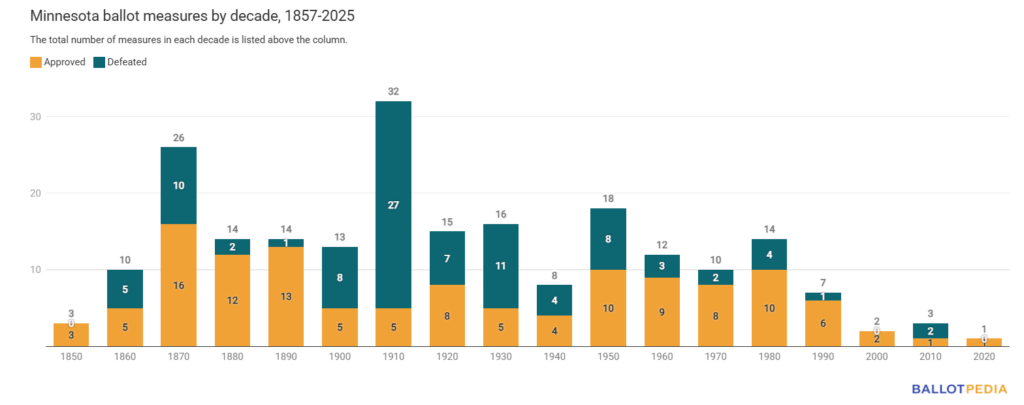
Ballotpedia completed an inventory of all Minnesota ballot measures dating back to 1857, the year Minnesota voters ratified the state constitution and the year before Minnesota was admitted to the union. Between 1857 and 2025, Minnesota voters decided on 218 ballot measures. In total, 123 measures were approved (56.4%), and 95 were defeated (43.6%).
Two hundred and seventeen (217) ballot measures were legislatively referred constitutional amendments placed on the ballot by the Minnesota State Legislature. The remaining measure was a constitution ratification measure referred to the ballot by the state constitutional convention. In Minnesota, citizens do not have the power to initiate constitutional amendments, veto referendums, or state statutes.
The Minnesota state legislature has placed a constitutional amendment on the ballot that would establish an initiative and referendum process in the state three times (1914, 1916, and 1980). All three amendments gathered more yes votes than no votes, but none of them gathered approval from the majority of all individuals voting in the election. As such, none of the amendments were ratified, and Minnesota remains one of 24 states without an initiative and referendum process.
Minnesota ballot measures have addressed 88 unique topics with some addressing multiple topics in one measure. The top three most commonly addressed topics were state legislative authority, public education funding, and highways and bridges. Other notable topics include women's suffrage, same-sex marriage, the initiative and referendum process, redistricting, prohibition of alcohol, and supermajority requirements for ballot measures:
- Minnesota voters have decided on three constitutional amendments to grant women suffrage in select state and local elections:
- In 1875, voters approved an amendment allowing women to vote in matters relating to school affairs and allowing women to hold offices pertaining solely to school management.
- In 1877, voters defeated an amendment which would have allowed women to vote in local option elections.
- In 1898, voters approved an amendment allowing women to vote for and serve on school and library boards.
- In 1888, voters passed a constitutional amendment declaring that monopolizing markets for food products in the state, or interfering with or restricting those markets, constitutes a criminal conspiracy subject to penalties established by the legislature.
- In 1896, voters approved a constitutional amendment that removed the ability to vote for noncitizens who had declared intent to become citizens and resided in the United States for at least one year.
- Two ballot measures to allow for the recall of public officers have been on the ballot in Minnesota. Amendment 8, in 1914, would have allowed for the recall of any public official, elected or appointed. The measure was defeated. Amendment 1, in 1996, allowed for the recall of only specific elected public officials. The measure was approved.
- In 1918, voters defeated a constitutional amendment that would have prohibited the sale, manufacture, transportation, and possession of alcohol, except for sacramental, medicinal, mechanical, or scientific purposes.
- Voters defeated Amendment 2 in 1948; the measure would have permitted the state legislature to, under certain circumstances, bypass the state's separate vote requirement when amending the state constitution.
- In 1974, the state legislature placed a measure on the ballot that would change the vote requirement for constitutional amendments to be 55% of electors voting on the issue or a majority of those voting in the election. The amendment was defeated. While 57.4% of those voting on the measure voted yes, only 49.3% of those voting in the election did.
- In 1980, Minnesota voters rejected Amendment 4, which would have created a bipartisan commission with the authority to redraw legislative and congressional districts. The commission would have been bipartisan in that its members would have been appointed by members of the state legislature from different political parties.
- Voters approved an amendment in 1998 to provide for a state constitutional right to hunt, fish, and take game. Minnesota became the second state in the country to implement a constitutional right to hunt and fish by ballot measure.
On average, around 12 measures appeared on the ballot each decade, with an average approval rate of 65.5%. The decade with the most ballot measures was the 1910s, with 32 ballot measures. The 1910s also had the lowest approval rate at 15.6%. Voters approved five ballot measures and defeated 27 (84.4%). The 1850s, 2000s, and 2020s had the highest approval rates, at 100%.
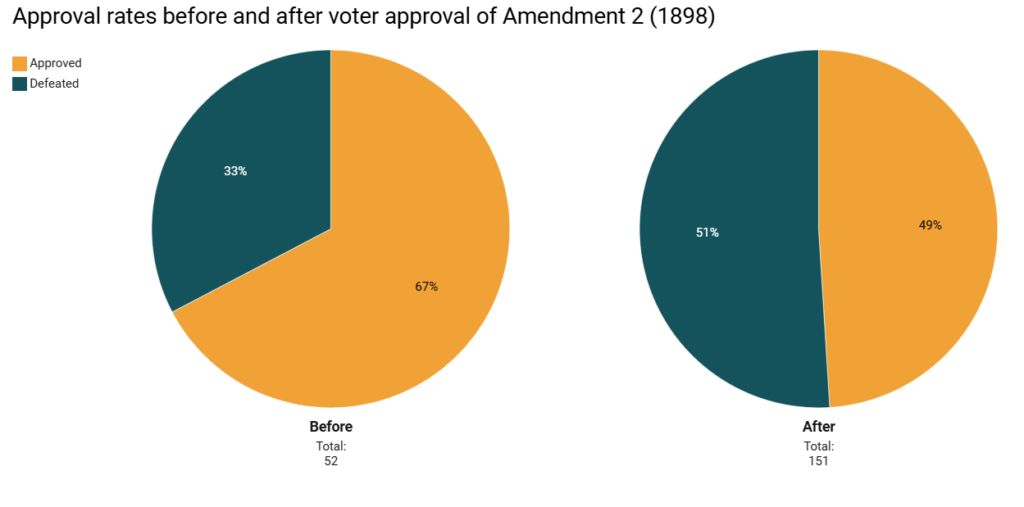
In 1898, voters approved Amendment 2, which changed the vote requirement for amending the state constitution. Beginning in 1900, ratifying an amendment required a 'Yes' vote from a simple majority of all voters casting a ballot in the election, rather than a simple majority of those voting on the question. In 1974, the state legislature placed a measure on the ballot to lower the vote requirement to 55% of voters voting on the issue or a majority of those voting in the election. The amendment was defeated; while 57.4% of those voting on the measure voted yes on the amendment, only 49.3% of those voting in the election voted yes.
The chart below shows the percentage of amendments approved by voters before and after the supermajority requirement was instituted in 1898.
The inventory of Minnesota statewide ballot measures is part of Ballotpedia's Historical Ballot Measure Factbooks, which document nearly 200 years of direct democracy in the United States. This ongoing research effort will provide an unparalleled resource for researchers, reporters, and voters on how ballot measures have evolved, the issues they've covered, and the role they have played in our civic life. Click here to see the 21 completed Historical Ballot Measure Factbooks.