


On March 20, 2026, Kansas Gov. Laura Kelly (D) signed a bill enacting a statewide ban on cellphones in K-12 schools. The ban applies to all public and nonpublic accredited schools and prohibits the use of cellphones during the school day, commonly referred to as a “bell-to-bell” ban. School district boards and governing authorities of accredited nonpublic schools must submit a certification that they have adopted cellphone policies in accordance with the bill to the Kansas State Board of Education by Sept. 1, 2026. In 2024, the Kansas State Board of Education adopted a policy encouraging, but not requiring, school districts to adopt policies regulating cellphone use in the classroom.
Kansas is the 33rd state to enact a K-12 cellphone ban and the fifth to do so in 2026. On March 5, Gov. Mike Braun (R) signed SB 78, expanding the existing cellphone limit to a bell-to-bell cellphone ban. On Feb. 12, the Hawaii Board of Education adopted a statewide policy barring public school students in most grades from using their phones during the school day beginning in the 2026-27 school year. Just days earlier, on Feb. 10, Michigan Gov. Gretchen Whitmer (D) signed a bill prohibiting public school students from using their cellphones in class beginning in the 2026-27 school year. New Jersey was the first state to enact a ban in 2026, when then-Gov. Phil Murphy (D) signed S3695 on Jan. 8.
Florida became the first state to pass a statewide law regulating cellphones in schools when Gov. Ron DeSantis (R) signed HB 379 in 2023.
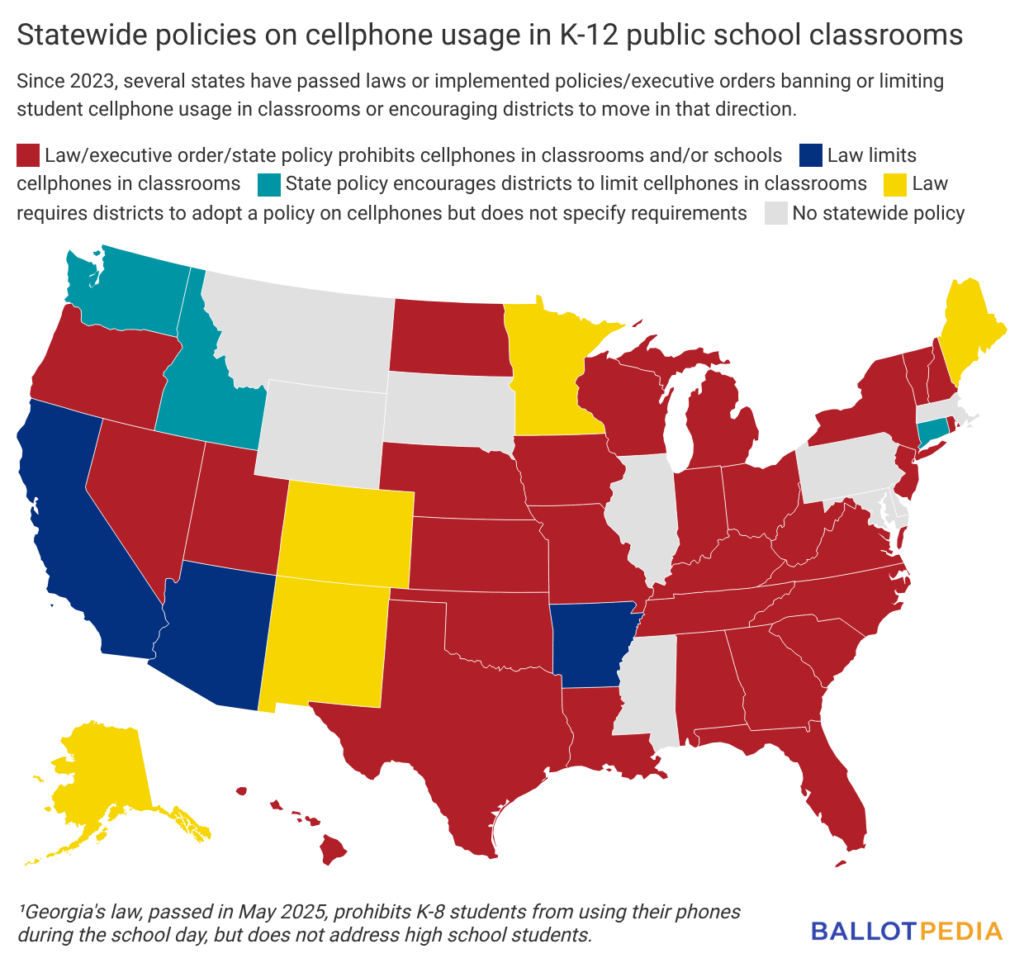
In total, 41 states have passed laws addressing phones in school. These bills generally require school district boards to adopt cellphone policies that align with the legislation. In eight of those states, however, laws either encourage districts to limit student cellphone use or require them to adopt policies on technology in the classroom without specifying the form those policies should take.
Of these states with statewide cellphone policies, 18 had a Republican trifecta when the laws went into effect, while six had a Democratic trifecta. The remaining nine states had divided governments.
Other states' action on cellphone bans
The following states have taken recent action on bills to regulate cellphone use in schools:
- Maryland: On March 23, the Maryland House of Delegates passed HB 0525 135-1. The Maryland Senate passed its companion bill, SB 0928, on March 20 40-0. The bills advanced to the opposite chambers for consideration. Maryland has a Democratic trifecta.
- Georgia: On March 23, the Georgia General Assembly passed HB 1009 to regulate cellphone use in high schools. Georgia passed a law in 2025, limiting cellphone use in elementary and middle schools. Georgia has a Republican trifecta.
- South Dakota: On March 5, the South Dakota House of Representatives voted 28-39 against SB 198, after the South Dakota Senate voted 19-15 to pass it on Feb. 17. South Dakota has a Republican trifecta.
- New Mexico: SB 23 did not reach the floor of the New Mexico House of Representatives before the legislative session ended on Feb. 19. The New Mexico Senate voted 32-6 to pass it on Feb. 15. New Mexico has a Democratic trifecta.
- Pennsylvania: On Feb. 3, the Pennsylvania Senate passed SB 1014 46-1. It advanced to the Pennsylvania House for consideration. Pennsylvania has a divided government.
Differences among statewide cellphone bans
In the 33 states with that limit student cellphone use through state law, the laws either bar students from using their cellphones in class or during the entire school day. As in the Kansas bill, most states give school boards authority regarding how to enforce the bans or limits, though the Kansas bill specifies that phones must be stored away from a student's person, either in a pouch in the school, in a student's locker, or in their vehicle.
Examples of differing cellphone policies include the following:
- Arizona's statewide cellphone policy requires school boards to pass policies that limit the use of cellphones during the school day. It requires the policies to include procedures for student-parent communication during the day, and requires an exception to limits when students use phones for education purposes, emergencies, or medical conditions.
- North Carolina's cellphone policy requires school boards to adopt policies that prohibit the use of cellphones during instructional time, and includes exceptions for individualized education plans, curricular activities authorized by a teacher, or student health care management. The policy also requires teachers to instruct students on social media and mental health in elementary, middle, and high schools.
- Minnesota's cellphone policy requires school districts and charter schools to adopt policies on student possession and use of cellphones, but does not specify what those policies should be.
Additional reading: