


Welcome to the Tuesday, March 31, Brew.
By: Briana Ryan
Here’s what’s in store for you as you start your day:
- 12 indirect initiatives pending before state legislatures, which have sent 75% to voters since 2018
- Alabama becomes the 24th state to enact a law prohibiting foreign nationals or governments from contributing to ballot measure committees
- A look at the April 7 special runoff election for Georgia’s 14th Congressional District
12 indirect initiatives pending before state legislatures, which have sent 75% to voters since 2018
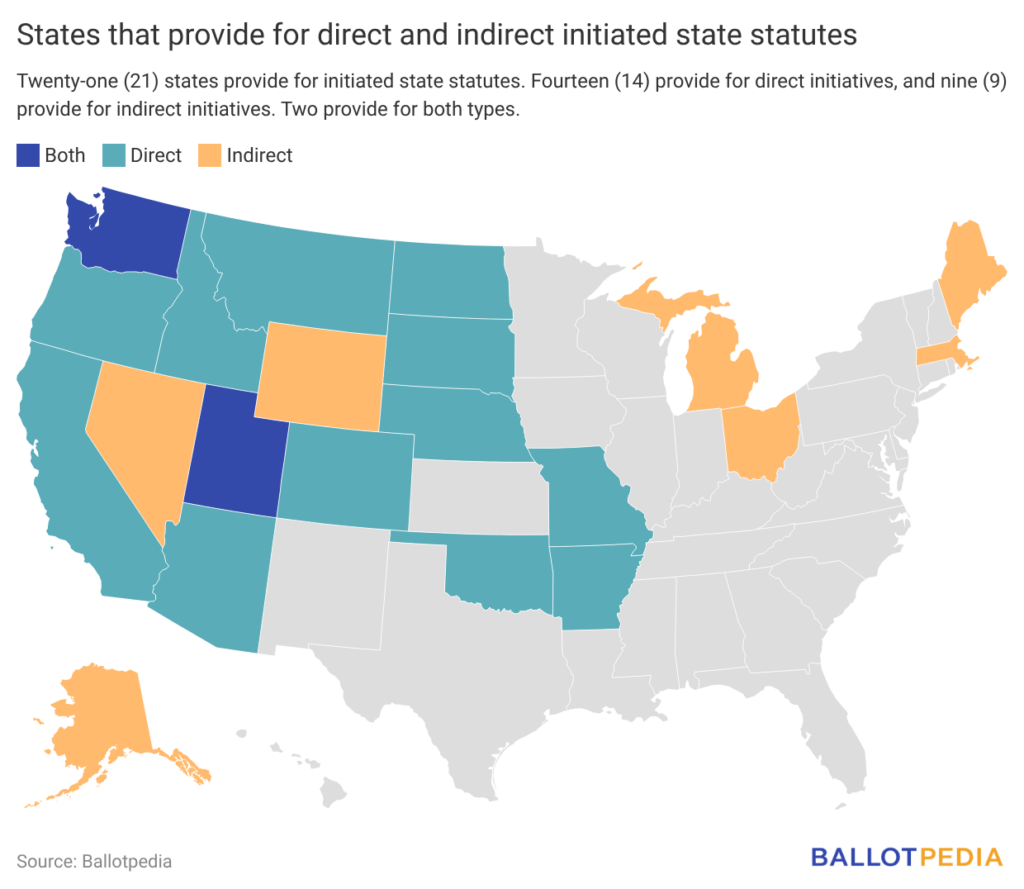
Nine states authorize indirect initiatives, either statutes or constitutional amendments, where citizen-proposed ballot measures are first presented to state legislatures for consideration. Legislators have a certain number of days, depending on the state, to adopt the initiative into law. Should legislators take no action or reject the initiative, the initiative is put on the ballot for voters to decide.
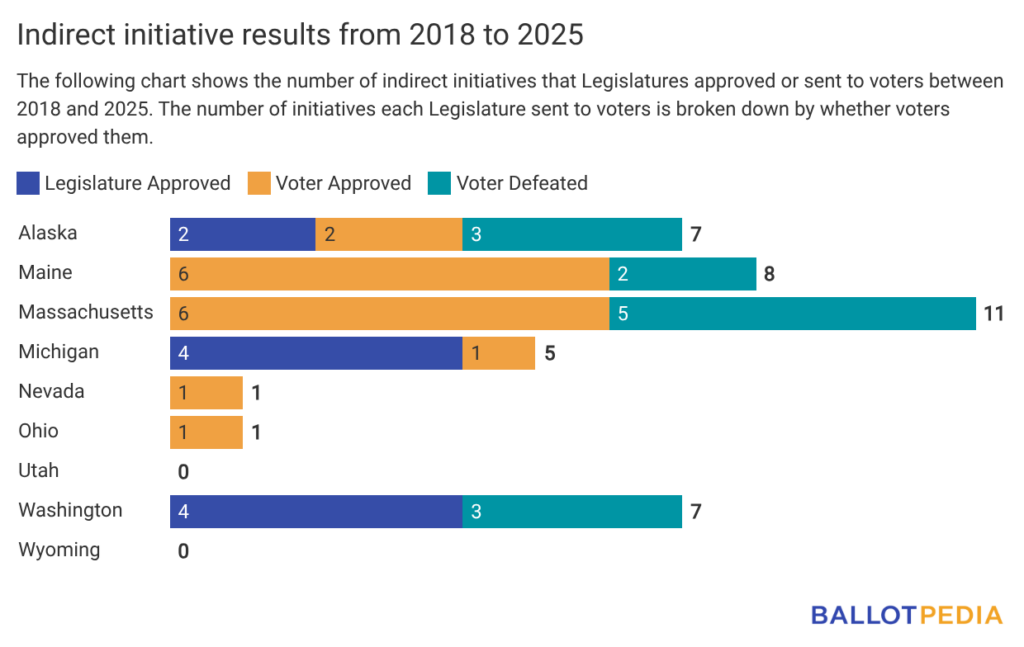
As of March 29, there are 12 indirect initiated state statutes pending before state legislatures — one in Maine and 11 in Massachusetts. Since 2018, these legislatures have sent all indirect initiatives they have received to voters.
The Maine Legislature has until the end of the legislative session on April 15 to pass the statute, which would establish a sex requirement for public school sports teams. If the Legislature approves the initiative and the governor signs it, the measure becomes law. If the Legislature does not approve the initiative, or the governor vetoes the measure, it goes to voters for approval. Maine has had a Democratic trifecta since 2019, and Gov. Janet Mills (D) has said that she would not support the measure.
Since 2018, the Maine Legislature has sent all eight indirect initiatives it received to voters, who approved six and defeated two.
The Massachusetts General Court has until May 6, the first Wednesday in May of the election year, to pass 11 statutes. If the General Court does not act, proponents must collect a second round of signatures equal to 0.5% of the votes cast in the previous gubernatorial election, or 12,429 signatures. Massachusetts has a Democratic trifecta.
The initiatives in Massachusetts would:
- Change the state tax revenue limit
- Decrease the state income tax rate from 5% to 4%
- Repeal laws that permit the sale of recreational marijuana and the personal cultivation of cannabis in homes
- Create a state fund for nature conservation efforts
- Change the method for calculating the stipends that state legislators receive
- Require cities and towns to allow single-family homes on residentially zoned lots that meet minimum standards of at least 5,000 square feet in area
- Permit collective bargaining for Committee for Public Counsel Services employees
- Permit same-day voter registration
- Make records held by the state legislature and the governor's office public records
- Establish rent control
- Eliminate political party primaries for state elections and establish top-two primaries
Since 2018, 11 other indirect initiated state statutes have been certified to the Massachusetts General Court. The General Court sent all 11 to voters, who approved six and defeated five.
The states with indirect initiated state statutes are Alaska, Maine, Massachusetts, Michigan, Nevada, Ohio, Utah, Washington, and Wyoming.
Between 2018 and 2025, 40 indirect initiatives were certified to state legislatures. State legislatures approved 10, while voters approved 17 and defeated 13.
Click here for more information about indirect initiatives.
Alabama becomes the 24th state to enact a law prohibiting foreign nationals or governments from contributing to ballot measure committees
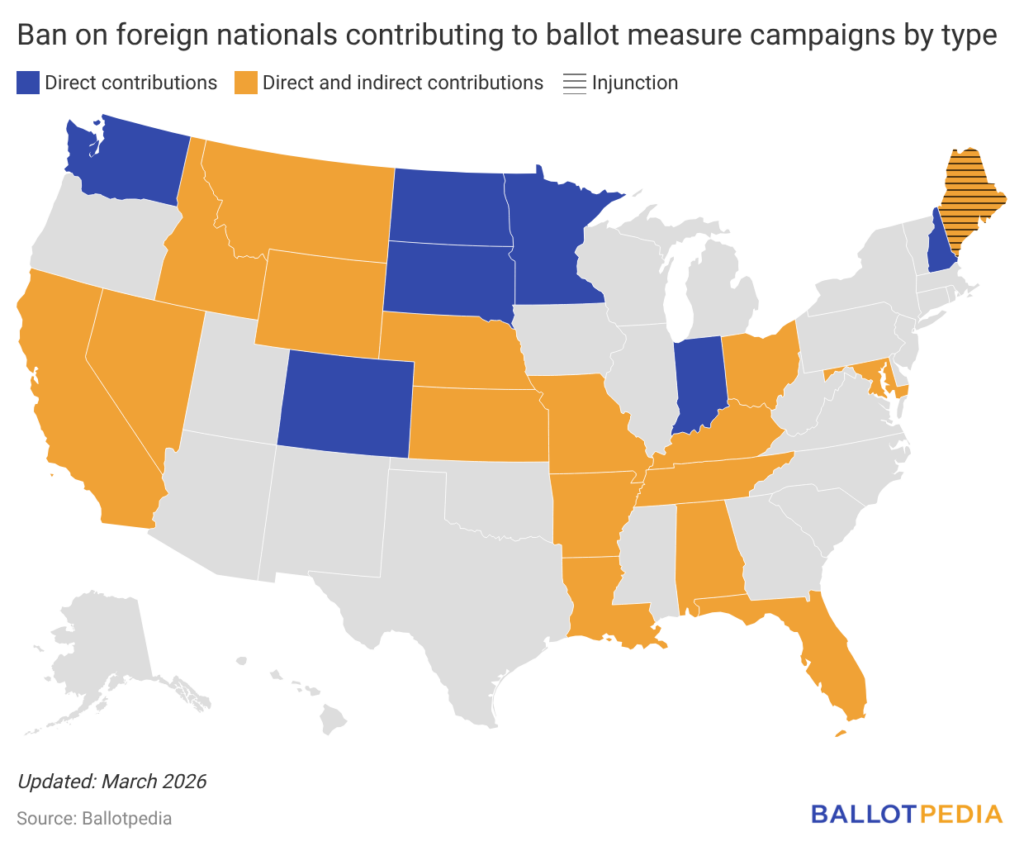
On March 17, Alabama became the 24th state to pass a ban on foreign spending in ballot measure elections when Gov. Kay Ivey (R) signed House Bill 214 (HB 214). HB 214, which takes effect on Oct. 1, prohibits foreign nationals from making contributions related to ballot measures, prohibits recipients from accepting those contributions, and makes violations a Class C felony. The Alabama House of Representatives and the Alabama Senate both passed the bill unanimously. Alabama has a Republican trifecta.
Seven of the 24 states have enacted bans on direct contributions, while 17 have banned direct and indirect contributions from foreign individuals or entities. Bans on direct and indirect contributions include those received directly from the foreign individual or entity, as well as contributions from intermediaries such as independent expenditure committees.
Alabama is the first state to pass such a ban this year. In 2025, Arkansas, Indiana, Kansas, Kentucky, Louisiana, Missouri, Montana, Tennessee, and Wyoming enacted bills prohibiting foreign nationals from making contributions or expenditures to support or oppose ballot measures. California changed its existing law by adding foreign nationals to the list of banned foreign entities.
Four of the 24 states enacted bans via ballot measures. In 2023, Maine voters approved Question 2, an indirect initiated state statute, prohibiting foreign governments, or entities with at least 5% foreign government ownership or control, from spending money to influence ballot measures or candidate elections. The three other bans were citizen-initiated constitutional amendments in Colorado (2002), Missouri (2016), and North Dakota (2018).
Campaign finance rules for ballot measures differ from those for candidate elections. In 1978, the U.S. Supreme Court ruled that spending on ballot measure campaigns is similar to issue advocacy, such as lobbying, in the lawmaking process. In 2012, the Court affirmed that, under the Federal Election Campaign Act (FECA), foreign nationals were prohibited from making contributions to candidates. However, FECA "does not bar foreign nationals from issue advocacy," which includes ballot measure campaigns. The Federal Election Commission (FEC), following the Court's orders, has held that ballot measure campaigns are not regulated under FECA. According to the FEC, since ballot measure campaigns are similar to issue advocacy, foreign individuals, corporations, and governments can contribute to them.
In addition to the federal ban on foreign nationals contributing to candidate elections, 30 states have additional laws governing campaign contributions to candidates from foreign individuals or entities.
Click here for more information about laws governing foreign spending in ballot measure campaigns.
A look at the April 7 special runoff election for Georgia’s 14th Congressional District
Shawn Harris (D) and Clayton Fuller (R) are running in the April 7 special runoff election for Georgia's 14th Congressional District. The district's previous representative — Marjorie Taylor Greene (R) — resigned on Jan. 5.
All 17 candidates appeared on the same ballot in the March 10 special general election, regardless of party. Since no candidate received more than 50% of the vote, the top two vote-getters advanced to the special runoff election. Harris and Fuller received 37.3% and 34.9% of the vote, respectively.
According to The Cook Political Report with Amy Walter, the district is the most Republican-leaning congressional district in Georgia.
Emory University's Andra Gillespie said, "I think that Democrats are hankering for a fight. And so even though I don't think anybody really expects Harris to win this race, I think they want to demonstrate that they can organize well enough so that they can overperform and they could use that as a sign to talk about their enthusiasm."
Harris is a retired U.S. Army brigadier general and cattle producer. Fuller is a former district attorney for the Lookout Mountain Judicial Circuit and an officer in the Air National Guard.
Six special elections have happened so far in the 119th Congress for the U.S. House of Representatives. None of those special elections resulted in a change in partisan control.
The chart below includes the five special elections that have already taken place between members of opposing parties. In the two Democratic-held districts, Democratic candidates had larger margins of victory than Kamala Harris (D) had in those districts in the 2024 presidential election. In the three Republican-held districts, Republicans had smaller margins of victory than President Donald Trump (R) had in the 2024 presidential election.
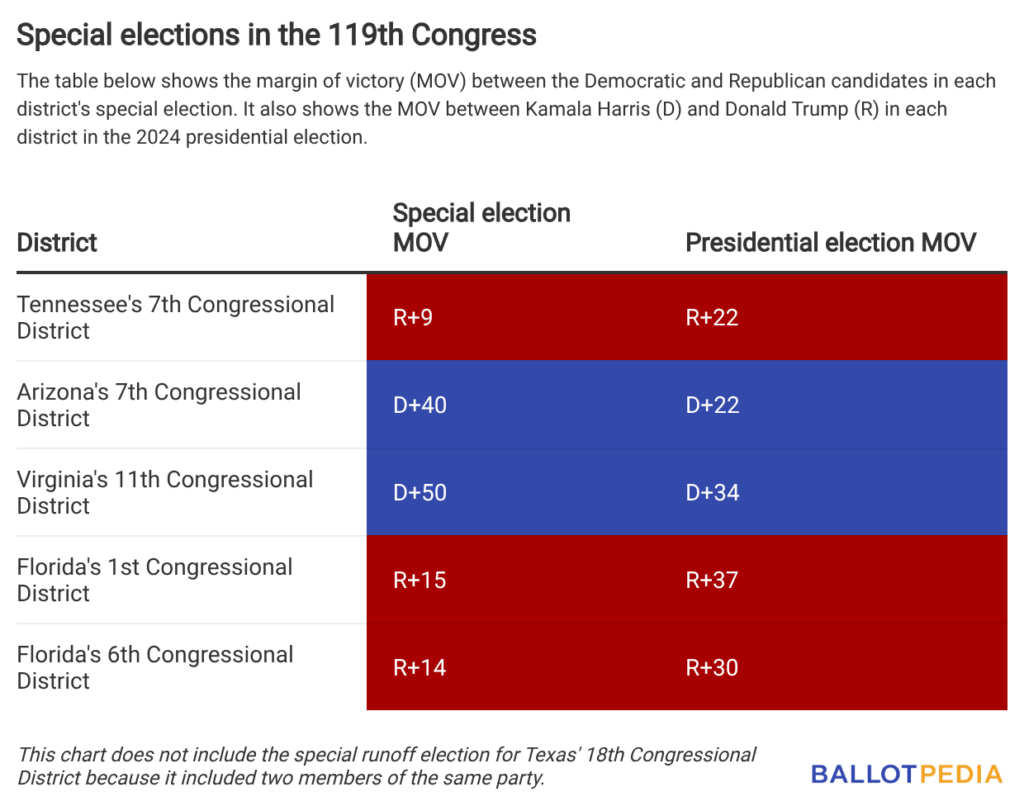
There were 80 special congressional elections between the 113th and 118th Congresses, for an average of about 13 special elections per Congress.
Click here to read more about the special runoff election for Georgia’s 14th Congressional District.