


Welcome to Ballot Bulletin: Ballotpedia's Weekly Election Policy Digest. Every Tuesday, we deliver the latest updates on election policy around the country, including nationwide trends and recent legislative activity.
In this week’s edition, we cover 520 bills state legislatures acted on in the last week and look at state laws prohibiting foreign nationals or governments from contributing to ballot measures or candidate campaigns.
The state of election legislation in the U.S.
Lawmakers in 36 states acted on 520 election-related bills over the past week. Thirty-five state legislatures are in regular or special sessions. In the last week, 20 bills were enacted, 22 bills passed both chambers of a state legislature, and no bills were vetoed.
Of the bills acted on this week, 207 (39.8%) are in states with Democratic trifectas, 160 (30.8%) are in states with Republican trifectas, and 153 (29.4%) are in states with divided government. The most active bill categories this week were campaign finance (161), election types and stages (125), and ballot measures (99).
Ballotpedia is currently tracking 4,285 election-related bills across the country. We are actively processing bills filed since March 21.
The chart below breaks down the status of those 4,285 bills by where they stand in the legislative process:
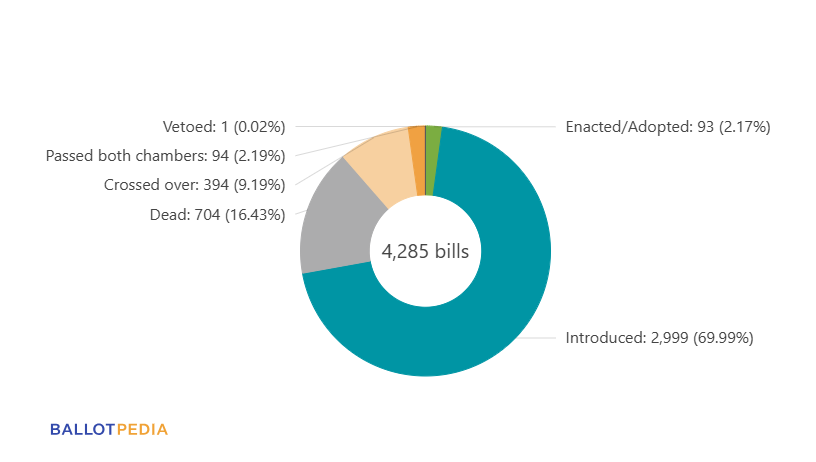
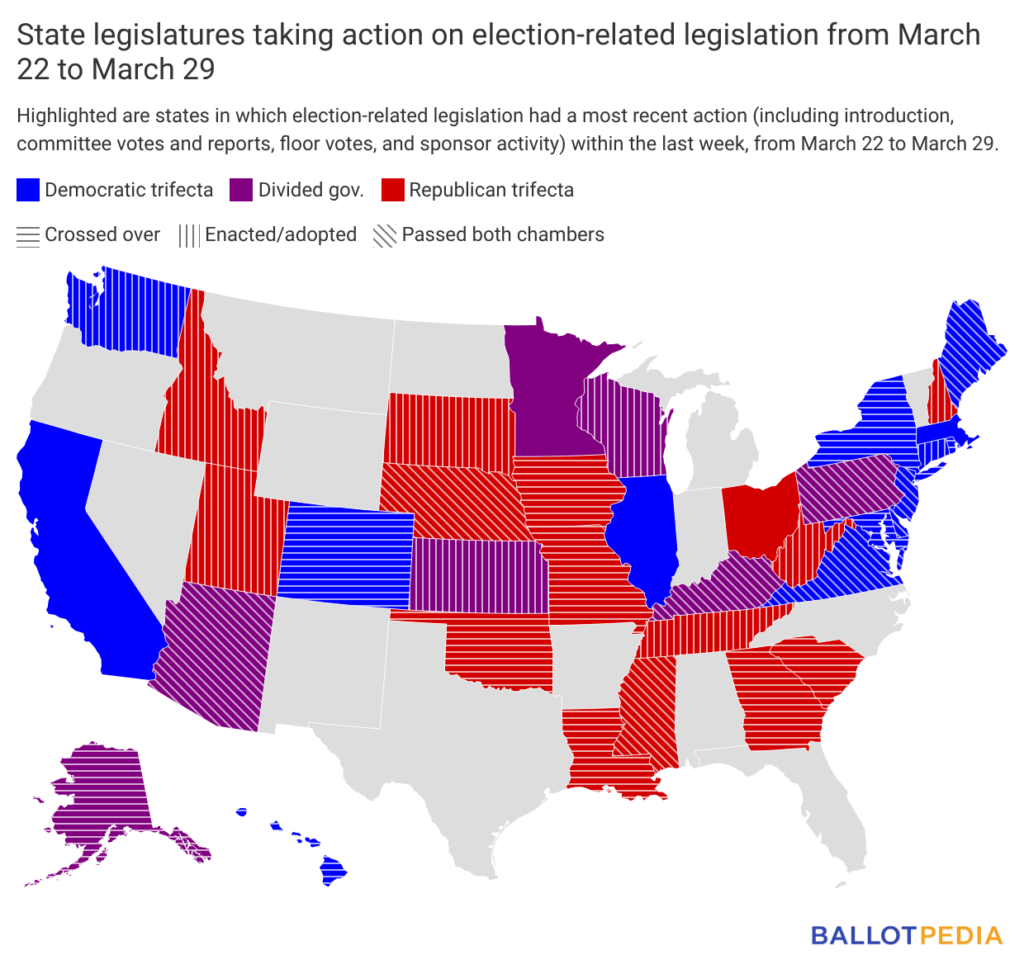
Note: In some states, legislators can file hundreds of bills per day. We are actively reviewing those bills to determine their relevance to election administration. As a result, during this period of heightened legislative activity, the newsletter may not yet account for all relevant bills introduced in 2026.
Enacted bills
On March 26, South Dakota Gov. Larry Rhoden (R) signed SB 175, which requires an individual to provide proof of citizenship to register to vote and requires a county auditor to designate an individual as a federal voter if the person does not provide documentation demonstrating that the person is a U.S. citizen.
On March 25, Utah Gov. Spencer Cox (R) signed HB 209, which requires individuals to provide proof of citizenship to vote a standard ballot, which includes state and local races. Individuals who have not provided proof of citizenship may only vote in federal elections. The legislation also requires election officials to review voter registration records by July 1, 2026, to flag possible noncitizens, as well as individuals whose proof of citizenship cannot be established.
Utah and South Dakota are the 10th and 11th states to enact laws requiring proof of citizenship to register to vote in at least some cases. For more information on documentary proof of citizenship laws, click here.
Eighteen other bills were enacted this week. They are:
- Connecticut (Democratic trifecta)
- Idaho (Republican trifecta)
- Kansas (Divided government)
- New Hampshire (Republican trifecta)
- Tennessee (Republican trifecta)
- Utah (Republican trifecta)
- Washington (Democratic trifecta)
- West Virginia (Republican trifecta)
- Wisconsin (Divided government)
Bills passing both chambers
On March 23, the Mississippi Senate approved SB 2588 31-16, sending the bill to Gov. Tate Reeves (R). The legislation requires the secretary of state to conduct annual checks of the statewide voter registration system against the Systematic Alien Verification for Entitlements (SAVE) database. Any individuals identified as possible non-citizens must be flagged to the appropriate local election official. If enacted, Mississippi would become the 24th state to require or authorize election officials to obtain citizenship data from a state or federal agency as part of the voter list maintenance process.
On March 26, the New Hampshire General Court officially sent HB 323 to Gov. Kelly Ayotte (R). The legislation removes student identification cards from the list of acceptable IDs for voting.
Twenty other bills passed both chambers this week. They are:
- Arizona (Divided government)
- Delaware (Democratic trifecta)
- Idaho (Republican trifecta)
- Kentucky (Divided government)
- Maine (Democratic trifecta)
- Nebraska (Republican trifecta)
- New Jersey (Democratic trifecta)
- Pennsylvania (Divided government)
- Tennessee (Republican trifecta)
- Virginia (Democratic trifecta)
- West Virginia (Republican trifecta)
- Wisconsin (Divided government)
To see a full list of bills awaiting gubernatorial action, click here.
Vetoed bills
No election-related bills we are following were vetoed in the past week. For a list of all vetoed bills, click here.
All bills
The chart below shows all bills Ballotpedia is currently tracking, broken down by partisan sponsorship:
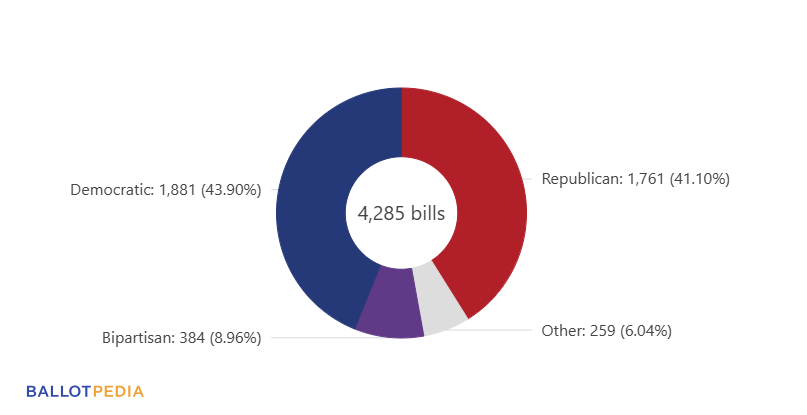
We are currently following 4,285 election-related bills, including bills carried over from the previous year.
- Trifecta status
- Democratic: 1,857 (43.3%)
- Republican: 1,576 (36.8%)
- Divided: 852 (19.9%)
- Partisan sponsorship
- Democratic: 1,881 (43.9%)
- Republican: 1,761 (41.1%)
- Bipartisan: 384 (9%)
- Other: 259 (6%)
In the news
On March 24, the Missouri Supreme Court issued a 4-3 ruling upholding the Missouri General Assembly’s ability to conduct mid-decade redistricting. In the majority opinion in Luther v. Hoskins, Judge Zel Fischer affirmed a lower court ruling, writing that “the obligation to legislate congressional districts once a decade does not limit the General Assembly’s power to redistrict more frequently than once a decade.”
On Sep. 28, 2025, Missouri Gov. Mike Kehoe (R) signed HB 1 into law, codifying newly-drawn congressional districts passed in the special redistricting session convened Aug. 29 of that year. Petitioners in Luther v. Hoskins challenged the constitutionality of mid-decade redistricting based on Art. 3, Sec. 45 of the Missouri Constitution, which states that redistricting must occur “when the number of representatives to which the state is entitled in the House of the Congress of the United States…is certified to the governor” following the decennial census. In its majority opinion, the state supreme court held that this language does not expressly prohibit mid-decade redistricting.
As we covered in last week’s Ballot Bulletin, opponents of mid-decade redistricting in Missouri announced they had collected enough signatures to advance a veto referendum of HB 1 to the November general election ballot.
Here are other news stories from across the country:
- On March 26, a ballot initiative in Utah to abolish the state’s independent redistricting commission failed to receive the required number of signatures to make the Nov. 3 general election ballot. Supporters of the measure said the redistricting commission makes districts less representative for Utahns because it removes the ability of elected state legislators to draw districts. Opponents of the measure said Utah voters have already expressed their will at the polls in favor of an independent redistricting commission.
- On March 26, the U.S. District Court for the Middle District of North Carolina upheld North Carolina’s 2018 law requiring individuals to present a photo ID to vote. The North Carolina NAACP challenged the law’s constitutionality, saying it discriminated against Black and Latino voters due to a disparity in access to acceptable forms of photo ID. In the court’s majority opinion, Judge Loretta Copeland Biggs wrote that although the photo ID law presents a burden to individuals without qualifying ID, the court cannot “conclude that the size of the burden imposed by S.B. 824 is greater than the usual burdens of voting.”
- On March 23, the U.S. Supreme Court declined to take up a challenge to a New York state law aligning local elections with state and federal contests in even-numbered years. On Oct. 16, 2025, the New York Court of Appeals upheld the law as constitutional. Supporters of aligning election dates in the state said the law streamlines elections and reduces costs for local election authorities, while opponents said the law diminishes local control and goes against county charters.
Policy spotlight: Alabama becomes the 24th state to prohibit foreign nationals or governments from contributing to ballot measure committees
The story below is adapted from a recent Ballotpedia News story by Victoria Antram.
Alabama enacted House Bill 214 (HB 214) on March 17, becoming the 24th state to pass a ban on foreign spending in ballot measure elections. HB 214 prohibits foreign nationals from making contributions related to ballot measures, prohibits recipients from accepting those contributions, and makes violations a Class C felony. Gov. Kay Ivey (R) signed the bill on March 17 after it passed unanimously in the state House and state Senate. It takes effect Oct. 1, 2026.
State Sen. Dan Roberts (R-15), who was one of the bill’s sponsors, said, “Under current federal law, foreign nationals are banned from donating to political candidates and committees. Loopholes in the law have led to millions of foreign dollars being funneled to influence ballot issue campaigns like constitutional amendment referendums across the United States.
Currently, Alabama does not have a matching state law. Therefore, state and local prosecutors do not have the ability to pursue instances of criminal foreign influence on our elections.”
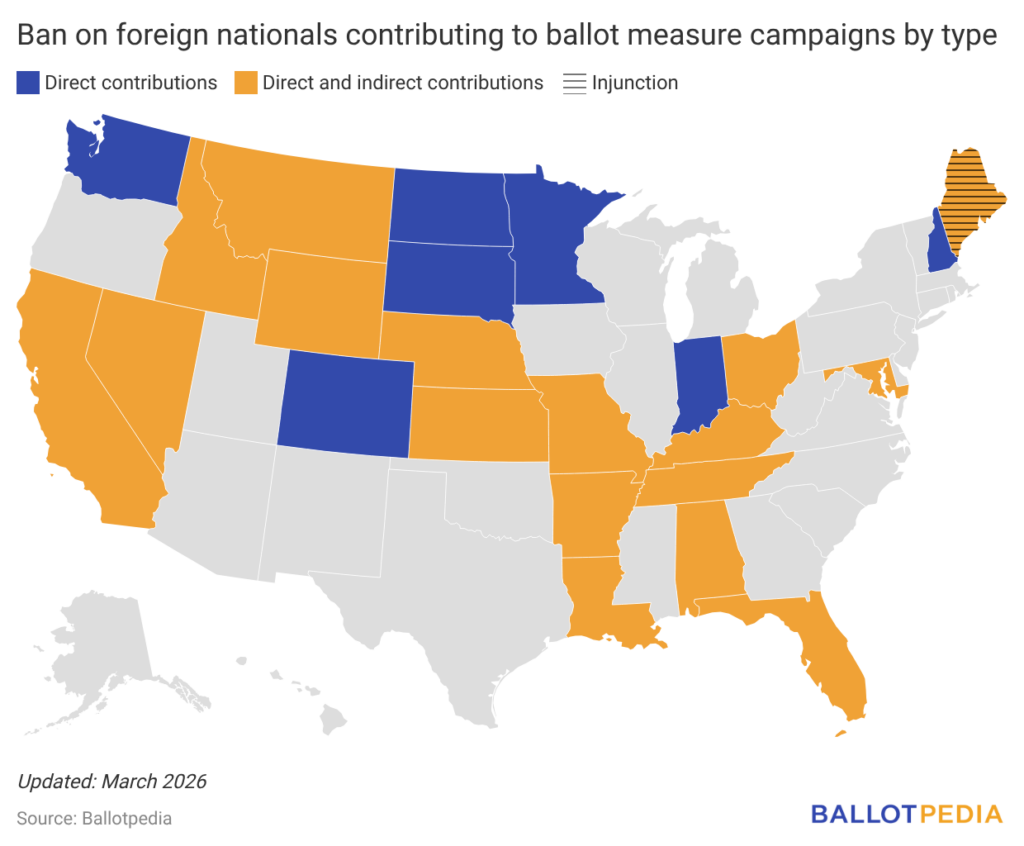
Of the 24 states with bans, seven states prohibit direct contributions, while 17 states ban direct and indirect contributions from foreign individuals or entities. Bans on direct and indirect contributions include those received directly from the foreign individual or entity, as well as contributions from intermediaries such as independent expenditure committees.
Alabama is the first state to pass such a ban this year. In 2025, nine states — Arkansas, Indiana, Kansas, Kentucky, Louisiana, Missouri, Montana, Tennessee, and Wyoming — enacted bills prohibiting foreign nationals from making contributions or expenditures to support or oppose ballot measures. California changed its existing ban to include foreign nationals in the list of banned foreign entities.
Voters approved four of the 24 bans through ballot measures. In 2023, Maine voters approved Question 2, an indirect initiated state statute, prohibiting foreign governments or entities with at least 5% foreign government ownership or control from spending money to influence ballot measures or candidate elections. The three other bans were citizen-initiated constitutional amendments in Colorado (2002), Missouri (2016), and North Dakota (2018).
Campaign finance rules for ballot measures differ from those for candidate elections. In 1978, the U.S. Supreme Court ruled in First National Bank of Boston v. Bellotti that spending on ballot measure campaigns is similar to issue advocacy in the lawmaking process.
In 2011, the United States Supreme Court upheld the U.S. District Court for the District of Columbia's ruling in Bluman v. FEC that said the Federal Election Campaign Act (FECA) prohibits foreign contributions to political candidates and that this prohibition is constitutional. The district court found that, "It is fundamental to the definition of our national political community that foreign citizens do not have a constitutional right to participate in, and thus may be excluded from, activities of democratic self-government." However, it also ruled that FECA "does not bar foreign nationals from issue advocacy,” which includes ballot measure campaigns.
The Federal Election Commission, following the court's orders, ruled in 2018 that ballot measure campaigns are not regulated under FECA. According to the FEC, since ballot measure campaigns are similar to issue advocacy, foreign individuals, corporations, and governments can contribute to them.
In addition to the federal ban on foreign nationals contributing to candidate elections, 30 states have laws governing campaign contributions to candidates from foreign individuals or entities. Read more about these laws here.