


On March 31, President Donald Trump (R) issued an executive order that requires the United States Postal Service (USPS) to mail absentee/mail-in ballots only to voters on an approved list.
The order, entitled Ensuring Citizenship Verification and Integrity in Federal Elections, also requires the U.S. Department of Homeland Security to use federal data to create a separate list of U.S. citizens who are eligible to vote. Those voters would still need to register to vote to cast a ballot.
The order requires states to notify the USPS 90 days before a federal election whether they intend to allow absentee/mail-in voting. State officials would then submit a list to the USPS 60 days before the election of all eligible voters to whom they intend to send a ballot. The USPS would be prohibited from mailing an absentee/mail-in ballot to individuals who are not on the list. States would be able to modify the list ahead of the election.
The ballots would also have to be marked as official election mail and bear a unique tracking barcode.
The order requires the U.S. attorney general to prioritize the investigation and prosecution of state and local officials "who issue Federal ballots to individuals not eligible to vote in a Federal election" and directs executive departments and agencies to withhold federal funds from non-compliant state or local governments.
“The Federal Government has an unavoidable duty under Article II of the Constitution of the United States to enforce Federal law, which includes preventing violations of Federal criminal law and maintaining public confidence in election outcomes,” the executive order states. “To enhance election integrity via the United States Mail, additional measures are necessary.”
The order requires the USPS to begin drafting rules to implement the order within 60 days. USPS spokesperson Cathy Purcell said that the agency was reviewing the order.
On April 1, four Democratic Party groups, as well as Senate Minority Leader Chuck Schumer (D) and House Minority Leader Hakeem Jeffries (D) filed a federal lawsuit challenging the constitutionality of the executive order.
Speaking to reporters, Trump said, “We want to have honest voting in our country, because if you don’t have honest voting, you can’t have, really, a nation.”
In a statement, Colorado Secretary of State Jena Griswold (D) said, “Trump once again is trying to unlawfully exert influence on states’ elections in an effort to hold onto power in the upcoming midterm elections, this time by creating a Trump voter list … The Constitution is clear: states oversee elections, not Trump. We look forward to this unconstitutional overreach being stopped in court.”
In January 2025, Trump issued an executive order requiring documentary proof of citizenship for individuals registering with a federal voter registration form, and requiring absentee/mail-in ballots to be received by Election Day. Both of those provisions have been blocked by federal court rulings, though the U.S. Department of Justice has appealed the decisions.
Every state has a method allowing voters to cast ballots without visiting a physical polling place.
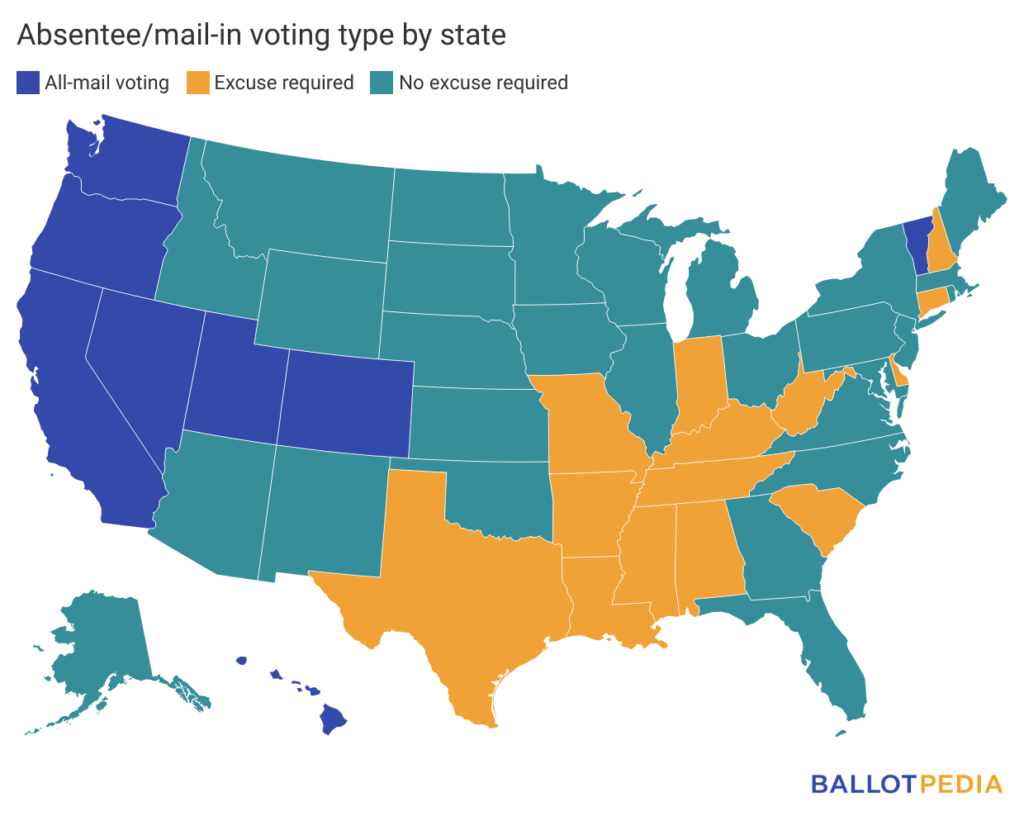
Fourteen states require voters to provide a valid excuse to vote by mail. Twenty-eight states allow any eligible voter to cast an absentee/mail-in ballot. Eight states have all-mail voting systems in which every eligible voter is automatically sent a mail ballot.
The executive order comes as Trump has also called on the U.S. Senate to enact the SAVE America Act, which would require individuals to provide proof of citizenship to register and voter ID to cast a ballot in federal elections. The voter ID requirement would also apply to absentee/mail-in voting.
A case heard by the U.S. Supreme Court last month challenging a Mississippi law allowing absentee ballots postmarked by Election Day to be received up to five days after the election could also affect absentee/mail-in voting nationally. Mississippi is one of 14 states to allow absentee/mail-in ballots postmarked by Election Day to be counted if they arrive within a set period of time after the election.
For more information on absentee/mail-in voting in the United States, click here.