


Welcome to the Tuesday, April 7, Brew.
By: Briana Ryan
Here’s what’s in store for you as you start your day:
- December redistricting vote shapes Republican primaries for the Indiana Senate
- It’s Election Day in six states
- Two justices were sworn into state supreme courts in March
December redistricting vote shapes Republican primaries for the Indiana Senate
Republican primaries for the Indiana Senate will happen on May 5. These primaries are taking place against the backdrop of the state Senate’s rejection of a mid-decade redistricting bill in December 2025.
The bill sought to redraw the state's congressional map to net two additional seats for Republicans in the U.S. House of Representatives. Currently, Indiana's U.S. House delegation includes two Democrats and seven Republicans.
The effort passed in the Indiana House of Representatives 57-41, but the state Senate rejected it 31-19. Twenty-one Republicans in the state Senate joined all 10 Democrats in voting against redistricting.
Ahead of the vote in the state Senate, President Donald Trump (R) wrote in a Truth Social post on Dec. 10, "Anybody that votes against Redistricting, and the SUCCESS of the Republican Party in D.C., will be, I am sure, met with a MAGA Primary in the Spring."
Ten of the 21 Republicans who voted against the effort are up for re-election this year. Two of those 10 Republicans — Eric Bassler and Kyle Walker — are not running for re-election.
Trump has endorsed primary challengers against five of the eight Republicans who voted against the effort and are running for re-election.
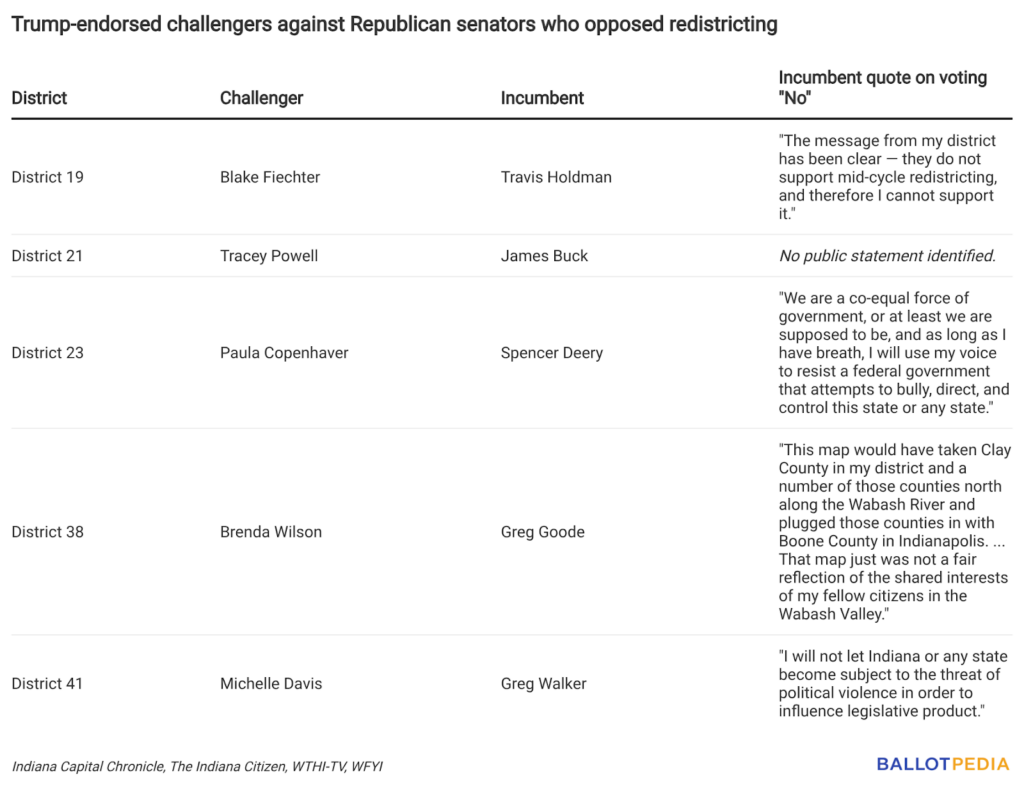
The Indiana Capital Chronicle's Tom Davies wrote on March 17, a group affiliated with U.S. Sen. Jim Banks (R-Ind.) released radio and digital advertisements against the Republican senators who opposed redistricting: "The ads that started appearing last week follow the theme that the senators opposed 'President Trump's plan to remove liberal Democrats from Congress' along with knocking them for votes on gasoline or property taxes and foreign land ownership."
Politico’s Samuel Benson and Adam Wren wrote that a spokesperson for Turning Point Action said that the organization would oppose the incumbents who voted against redistricting and that “the group would partner with other aligned PACs to dedicate an ‘eight-figure spend’ to ‘primary people that are standing in the way of the president’s agenda.’” Wren also reported that Banks’ Hoosier Leadership For America planned to spend $3 million on state Senate races. The Indianapolis Star’s Jake Allen reported that Gov. Mike Braun (R) “plans to endorse challengers to sitting state senators who opposed redistricting, and his HOPE Super PAC is expected to spend $500,000 in next month’s primaries.”
WFYI's Caroline Beck wrote, "Former Indiana Republican Gov. Mitch Daniels is lending his political will and name power to help campaign for current Republican state lawmakers being primaried by Trump-supported candidates." Daniels said, "I think it's important that people who are fine public servants and have shown it in other contexts, who stood up for a principle here and showed bravery in so doing, that ought to be rewarded, not punished, and it's certainly not going to be punished by people from several hundred miles away who couldn't find Indiana with a road map."
There are 16 contested Republican incumbents in the state Senate this year. The average number of contested Republican incumbents in the Indiana Senate each year since 2010 was three. There are a total of 29 Republican incumbents in primaries this year, a record high since 2010.
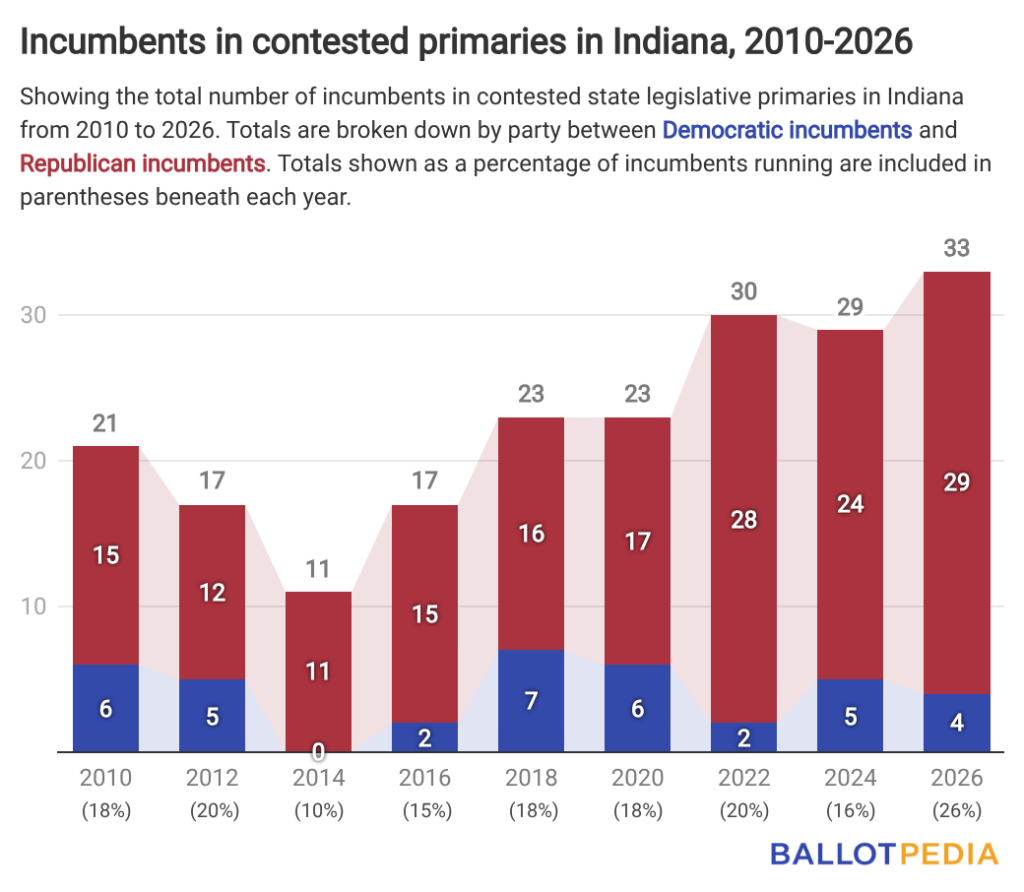
Heading into the elections, Republicans have a 40-10 majority in the state Senate. The state has had a Republican trifecta, in which Republicans control both legislative chambers and the governorship, since 2011.
The state Senate is one of 88 state legislative chambers with elections this year. Twenty-five of the state Senate's 50 seats are up for election this year.
Click here to read more about the Republican primaries for the Indiana Senate. Also, if you're an Indiana voter, check out our Sample Ballot Lookup here to prepare for Election Day.
It’s Election Day in six states
Voters in Wisconsin and parts of Alaska, Colorado, Georgia, Missouri, and Oklahoma are headed to the polls today, April 7. Here's an overview of what voters in each of these states will see on their ballots today — starting with the only state with a statewide election on the ballot.
Wisconsin
Maria S. Lazar and Chris Taylor are running in the general election for the Wisconsin Supreme Court. Incumbent Rebecca Bradley is not running for re-election. Bradley is a member of the Court's conservative minority. If Lazar wins, the Court would maintain its 4-3 liberal majority. If Taylor wins, the liberal majority would increase from 4-3 to 5-2.
Judicial elections are also being held for three seats on the Wisconsin Court of Appeals. The candidates running for each seat are running unopposed.
Voters in six school districts will decide general elections for seats on their respective school boards. Madison voters will decide general elections for seats on the common council. Voters in Dane and Milwaukee counties will decide general elections for county supervisors and county circuit court judges.
Port Washington voters will decide on a local ballot measure that would require voter approval before the city could create or approve a Tax Incremental District (TID) with either a projected base property value of $10 million or more or projected project costs of $10 million or more. Port Washington is one of at least five jurisdictions that will decide ballot measures related to data center development this year.
Alaska
Anchorage voters will decide general elections for seats on the school board, the assembly, and service area boards of supervisors. Additionally, Anchorage voters will decide on 12 local ballot measures.
Colorado
Collbran voters will decide whether to recall Jessica Price from the Collbran Board of Trustees. Additionally, voters will decide whether they want Lew Evans or Keith Todd to succeed Price. If Price is not recalled, she will remain in office, and any votes cast for a replacement candidate will not count. So far this year, there have been 103 recall efforts launched against 186 elected officials nationwide.
Georgia
Shawn Harris (D) and Clayton Fuller (R) are running in the special runoff election for Georgia's 14th Congressional District after neither received more than 50% of the vote in the March 10 special general election. The district's previous representative, Marjorie Taylor Greene (R), resigned on Jan. 5.
There are also special runoff elections for three state legislative districts — Georgia Senate District 53, Georgia House District 94, and Georgia House District 130.
Missouri
Voters in nine school districts will decide general elections on their respective school boards. Jefferson City voters will decide general elections for seats on the Jefferson City Council, and St. Louis voters will decide general elections for seats on the St. Louis Community College Board of Trustees. Voters in Clay, Jackson, and Platte counties will decide on a general election for a seat on the metropolitan community college district board.
Elections for local ballot measures will be decided in Cass, Cole, Jackson, and Platte counties, as well as in St. Louis.
Oklahoma
Voters in six school districts will decide general elections for seats on their respective school boards. Tulsa County voters will decide a general election for the Tulsa Technology Center Board of Education. Additionally, Tulsa County voters will decide on four local ballot measures.
Click here to check out more about the elections we're following today, April 7. If you're a voter in one of these states, make sure to check out our Sample Ballot Lookup Tool before you get to the polls.
Two justices were sworn into state supreme courts in March
Two state supreme court justices — Daniel Will and Mark Friese — were sworn into office in March. Daniel Will was sworn into the New Hampshire Supreme Court on March 4, and Mark Friese was sworn into the North Dakota Supreme Court on March 9.
Here’s a look at other state supreme court vacancy news from March.
One justice was nominated to a state supreme court
- On March 13, Maine Gov. Janet Mills (D) nominated Christopher Taub to the Maine Supreme Judicial Court. Taub will succeed Justice Andrew Horton, who retired in August 2025. Taub is Mills' seventh nomination to the Court.
Two justices were confirmed, and two were appointed to state supreme courts
- On March 5, the Tennessee General Assembly confirmed Kyle Hixson to the Tennessee Supreme Court. Hixson will succeed Justice Holly Kirby, who will retire on June 30. Hixson is Gov. Bill Lee's (R) fourth nomination to the Court.
- On March 9, Gov. Kelly Armstrong (R) appointed Mark Friese to the North Dakota Supreme Court. Friese succeeds Justice Daniel Crothers, who retired on Feb. 28. Friese is Armstrong's first appointment to the Court.
- On March 9, Gov. Bob Ferguson (D) appointed Theo Angelis to the Washington State Supreme Court. Angelis will succeed Justice Barbara Madsen, who will retire on April 3. Angelis is Ferguson's second appointment to the Court.
- On March 31, the Maine Senate confirmed Christopher Taub to the Maine Supreme Judicial Court. Taub will succeed Justice Andrew Horton, who retired in August 2025.
One justice announced his retirement, and two retired from their state supreme courts
- South Carolina Justice John C. Few announced he would no longer seek re-election. He released a statement on March 3, hours before the South Carolina Legislature was scheduled to vote on whether to allow the justice to remain on the Court for another ten-year term. In South Carolina, the Legislature holds a legislative election to determine whether a justice can sit on the Court. Few's withdrawal means the Legislature must restart the selection process. As of March 31, the Judicial Merit Selection Commission has not released a list of candidates who applied to succeed Few.
- On March 27, Justice Maureen McKenna Goldberg retired from the Rhode Island Supreme Court. Goldberg's retirement gives Gov. Daniel McKee (D) his first opportunity to nominate a justice to the Court.
- On March 28, Justice Marla Luckert retired from the Kansas Supreme Court. Luckert's retirement gives Gov. Laura Kelly (D) her fifth opportunity to appoint a justice to the Court.
Click here to learn more about state supreme court vacancies in March.