


In this week’s edition of Economy and Society:
- Department of Labor looks to enable private equity investments in 401(k)s
- Europe seeks to reform carbon trading system
- ESG legislation update
- TotalEnergies Won’t Commit to EU Net-Zero Targets
- Nestle partners with UN agency on labor rights in coffee production
In Washington
Department of Labor looks to enable private equity investments in 401(k)s
What's the story?
On March 30, 2026, the U.S. Department of Labor issued a notice of a proposed rule to establish guidelines for 401(k) plan managers considering investments in alternative assets. The proposed rule would establish guidelines for plan fiduciaries that create safe harbors under the Employee Retirement Income Security Act of 1974 (ERISA) when evaluating and investing in nontraditional assets, such as private equity or credit markets. Safe harbors shield plan fiduciaries from legal liability for investment decisions.
The comment period for the proposed rule ends on June 1.
Why does it matter?
According to the CFA Institute, assets under management in private markets more than doubled to USD $11.7 trillion between 2017-2022. Recent reports put the figure at more than $15 trillion. The growth reflects a number of trends, including the search for yield, longer-term investment horizons, and stricter post-2008 risk capital rules for banks. Private markets can offer more flexibility and protect investors from the short-term volatility of public markets, but they lack the on-demand liquidity, disclosure requirements, and oversight mechanisms that public markets provide.
Environmental, social, and governance (ESG) investing also works differently in private markets than it does in public ones. When choosing which companies to invest in, private equity firms can employ an ESG approach without public shareholder scrutiny. And, because they own their portfolio companies, they also have more ability to implement operational changes aligned or opposed to ESG than public shareholders do. Private firms are also not subject to ESG-related disclosure requirements in the U.S., meaning that such disclosures are largely voluntary and vary widely.
Background
The proposed rule comes after President Trump’s (R) August 2025 Executive Order, “Democratizing Access to Alternative Assets for 401(k) Investors.” The order established a policy “that every American preparing for retirement should have access to funds that include investments in alternative assets.” It defined these assets as including “private market investments…; direct and indirect interests in real estate…; holdings in actively managed investment vehicles that are investing in digital assets;… direct and indirect investments in commodities;… direct and indirect interests in projects financing infrastructure development; and lifetime income investment strategies including longevity risk-sharing pools.”
Critics of opening up private markets to investment by employer sponsored retirement plans argue that these investments are typically complex financial products unsuitable for millions of Americans’ retirement plans. They say that private funds bring greater concentration and illiquidity risk, higher fees, and higher uncertainty about asset valuations. In response to the proposed rule, Sen. Elizabeth Warren (D) said, “Americans facing an uncertain future in Trump's economy will now have more reasons to question the security of their retirement savings — all so that Trump's Wall Street buddies have another pile of cash to play with.”
Supporters of the move say that millions of Americans and institutional investors already have access to private markets, including through government-sponsored pension plans. They say that private markets provide higher returns in the long-term, and that clearer guidance for fiduciaries expands access to these returns to more people. Secretary of the Treasury Scott Bessent said the rule is a step towards “broaden[ing] access to additional retirement plan options for millions of Americans while being mindful of the importance of protecting retirement assets.”
Around the world
Europe seeks to reform carbon trading system
What's the story?
The European Commission has introduced a proposal to make a technical but significant change to its most prominent carbon market, the European Union (EU) Emissions Trading System (ETS). The proposal, which follows a promise EU President Ursula von der Leyen made last month to promote greater stability and predictability in emissions trading markets, would adjust the Market Stability Reserve (MSR) to allow the reserve to maintain carbon allowances above its current cap of 400 million. Under the current mechanism, any allowance returned to the reserve above that cap was invalidated, meaning it could not reenter the carbon trading market.
Why does it matter?
The EU’s ETS provides a mechanism for companies to purchase permits to emit certain greenhouse gases. The MSR acts as a moderating reserve on the availability of these permits. Through the ETS’s regulatory structure, the reserve acquires and holds these permits when there are more than 1.1 billion permits in circulation, and releases them to the market when there are fewer than 400 million permits in circulation.
Currently, when the number of permits in the MSR exceeds 400 million, the MSR automatically voids excess permits, meaning that these permits no longer exist and cannot be released to the market. The idea behind the reserve cap was to prevent a buildup of credits that could flood the market and drastically lower the price of emitting carbon dioxide. In addition to the reserve cap, the ETS caps the overall number of credits available each year and reduces this cap on a fixed schedule as a mechanism to drive decarbonization. Because availability of credits decreases over time, the importance of the MSR as a market stabilization tool grows in time.
Wopke Hoekstra, an EU Commissioner for Climate, Net Zero and Clean Growth, said of the proposal:
This marks an important first step in modernising our carbon market. By strengthening the Market Stability Reserve, we enhance EU ETS' resilience to volatility and ensure that it continues to drive decarbonisation, support competitiveness and foster clean investment.
Background
The EU launched the ETS in 2005 and it is the largest cap-and-trade carbon trading system in the world by both volume and value. According to Clean Energy Wire, the world’s 36 carbon trading systems cover approximately 18% of global emissions, as of 2024. Since its inception, emissions that ETS covers had fallen to 47.6% of 2005 levels.
In 2021, the EU Parliament announced a series of changes to the bloc’s emission reduction strategies, called the “Fit for 55” package, referencing a goal to reduce EU emissions at least 55% by 2030. Included in the package were various changes to the ETS, including accelerating the annual reduction of credits to 4.3% from 2024-2027 and 4.4% from 2028-2030.
The package also established the Carbon Border Adjustment Mechanism (CBAM), which requires importers of certain carbon-intensive goods to purchase credits tied to the carbon cost of those imports. According to EU policymakers, CBAM is intended to reduce the probability of “carbon leakage,” the offshoring of carbon-intensive industries to avoid the scope of EU carbon regulation or the foreign undercutting of EU producers because they are not subject to similar carbon costs. The program became operational in January 2026.
ESG legislation update
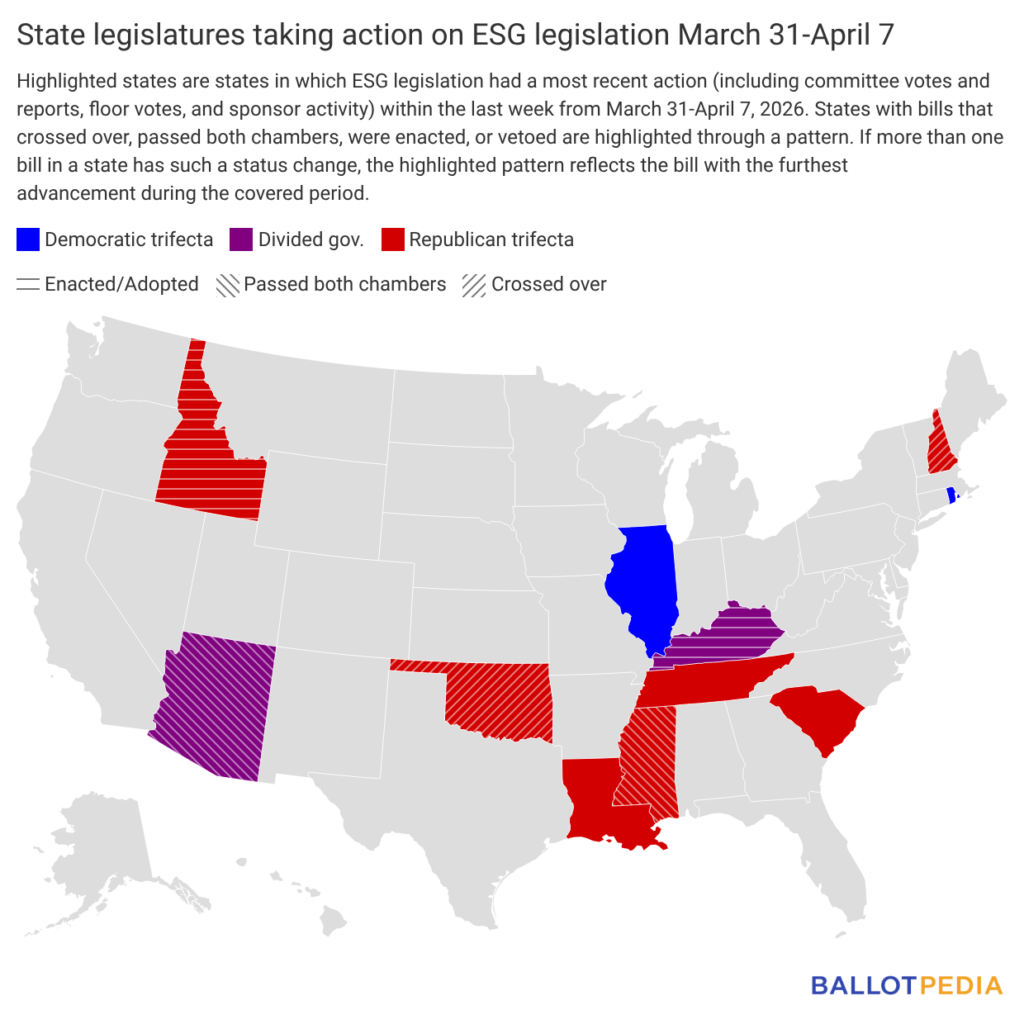
Eleven states took action on 18 ESG-related bills last week (since March 31).
States with legislative activity on ESG last week are highlighted in the map below. Click here to see the details of each bill in the legislation tracker.
On Wall Street and the private sector
TotalEnergies won’t commit to EU net-zero targets
What's the story?
TotalEnergies, the French-based energy company, released its 2026 Sustainability & Climate report and, in it, declined to reaffirm its commitment to align corporate transition plans with European Union climate standards. The company said that it “cannot formulate [aligned] ‘Net Zero’ targets” because the pace of the global energy transition makes meeting EU targets — themselves informed by the UN’s Paris Agreement first agreed to at the Climate Change Conference (COP21) in 2015 — unachievable. The announcement comes less than a month after the Trump administration reached an agreement with the company that released it from commitments to offshore wind development in the U.S. and redirected investment towards oil and gas projects.
Why does it matter?
The EU’s Corporate Sustainability Reporting Directive (CSRD) requires certain companies to develop transition plans that align with a target of warming of 1.5°C above pre-industrial levels by 2050. The TotalEnergies report says that the company cannot formulate such a plan in good faith because scientific consensus now sees achieving that goal as unlikely or unrealistic.
The company’s CEO said that while the company believes in the goal of becoming carbon neutral, it must also “confront our ambition with reality and acknowledge that our societies have embarked on a transition, but at a pace that does not yet allow for the collective achievement of carbon neutrality as pursued under the Paris Agreement.”
TotalEnergies said it remains committed to achieving certain emission reduction and decarbonization targets, including reducing Scope 1 and Scope 2 emissions by 40% by 2030 compared to a 2015 baseline, and reaching carbon neutrality for its own operations by 2050.
Background
TotalEnergies decision comes amidst a broader pullback on decarbonization targets and renewable energy investments amongst energy majors. In 2025 announcements, BP cut its 2027 low-carbon investment target from $4 billion to $800 million, and Shell reduced the renewable share of its planned investment from 19% to 9% and increased oil and gas investment by 1% per year from 2025-2030.
The retreat from climate-related pledges and commitments extends beyond energy players. In January 2025, the Net Zero Asset Managers Initiative, an international group of asset management companies (AMC) committed to supporting investing aligned with the global goal of net zero greenhouse gas emissions, announced that it was suspending operation in light of “[r]ecent developments in the U.S. and different regulatory and client expectations in investors’ respective jurisdictions.” The initiative relaunched in February 2026 with a revised commitment statement that removed a requirement that members align portfolios with a net-zero deadline. Between the initiative’s suspension and relaunch, 105 AMCs exited NZAM that were previously listed as signatories, while 28 joined.
Nestle partners with UN agency on labor rights in coffee production
What's the story?
On March 31, 2026, Nestle and the International Labour Organization announced that they were expanding an existing partnership and launching a new two-year project to promote human rights and fair work standards in three of Nestle’s largest Latin American coffee providers: Brazil, Mexico, and Colombia.
As part of the project, the ILO, a United Nations agency, said it will facilitate dialogue between governments, employers, and worker representatives with a goal of identifying and remedying “decent work deficits and labour-related risks in coffee supply chains,” with a focus on seasonal and migrant workers. The agreement contains no binding commitments.
Why does it matter?
According to ESG News, “the initiative highlights a growing convergence between ESG commitments and operational risk management.” However, a 2026 benchmark report from the Business and Human Rights Centre, an independent nonprofit, found that few of the world's major food and beverage companies have prioritized addressing labor risks in recent years. The report reduced Nestle’s score on the issue by more than 10% between 2023 and 2026.
At the announcement of the expanded Nestle partnership, Dan Rees, Director of the ILO’s Priority Action Programme on Decent Work Outcomes in Supply Chains, said “Coffee production sustains the livelihoods of approximately 20–25 million families worldwide, generating vital income and employment. However, decent work deficits in coffee supply chains persist, particularly among seasonal and migrant workers.”
Background
Nestle reported revenue of approximately $100 billion in 2024 and employees more than 290,000 people worldwide. Sales of coffee products account for roughly a quarter of the company’s overall revenue, and they are the largest coffee retailer in the world by market share.
The company has a documented history with supply chain labor abuses, notably tied to cocoa production in West Africa. According to an investigative report from the Washington Post, the company failed to meet commitments to eliminate child labor from these supply chains in 2005, 2008, and 2010. Scrutiny of labor practices in the coffee industry has grown in recent years, following events such as the EU’s December 2024 Forced Labour Regulation, as well as a series of legal actions in the U.S. attempting to block the import of coffee produced with forced labor, or seeking compensation for such labor.