



The Democratic governors of Kansas and Wisconsin both vetoed bills opting their states into the federal school choice tax credit scholarship program. They became the fourth and fifth Democratic governors to veto bills opting in to the program. At least 27 states have officially opted into the program, 23 of which have a Republican trifecta.
Democratic vetoes
On April 6, 2026 Kansas Gov. Laura Kelly (D) vetoed House Bill (HB) 2468 which permanently opts the state into the program. Kansas also has a divided government, but Republicans in the legislature have a veto-proof majority.
On March 30, Wisconsin, Gov. Tony Evers (D) vetoed Assembly Bill (AB) 602 which requires the state to opt into the program annually. Wisconsin has a divided government, with a Republican-controlled legislature and a Democratic governor. Republicans in the legislature do not have a veto-proof majority, meaning they cannot override Evers' veto without Democratic help.
Three other Democratic governors have vetoed similar bills; in Kentucky Gov. Andy Beshear (D) vetoed HB 1 on March 16, but the Kentucky General Assembly voted to override the veto the next day. The new law requires the secretary of state to opt into the program each year. Read more about that legislation here.
Arizona Gov. Katie Hobbs (D) vetoed SB 1106 on January 16. Gov. Josh Stein (D) of North Carolina was the first governor to veto a similar bill, doing so in August 2025. In his veto message he said that he planned to opt the state into the program once the federal government issued what he called sound guidance for the program.
Vote breakdowns
State legislators in Kansas and Wisconsin states voted mainly along party lines, with Republicans generally supporting and Democrats generally opposing legislative efforts to opt into the program. No Democrats in either state crossed party lines to support the bill, but Republicans in both Kansas legislative chambers voted against opting into the federal education tax credit.
Kansas
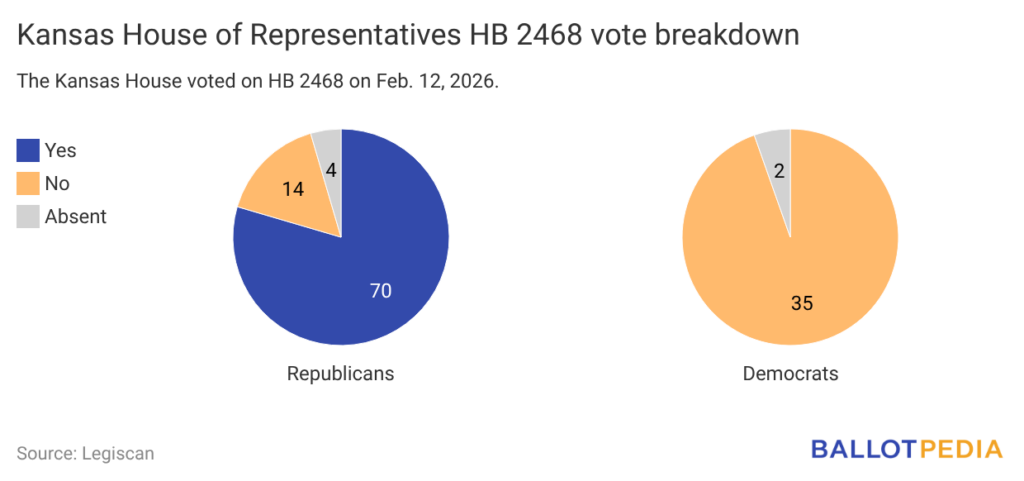
The Kansas House of Representatives voted 70-49 on Feb. 12, 2026, to pass HB 2468. No democrats supported the measure, but 14 Republicans crossed party lines to oppose the bill. Six representatives were absent from the vote.
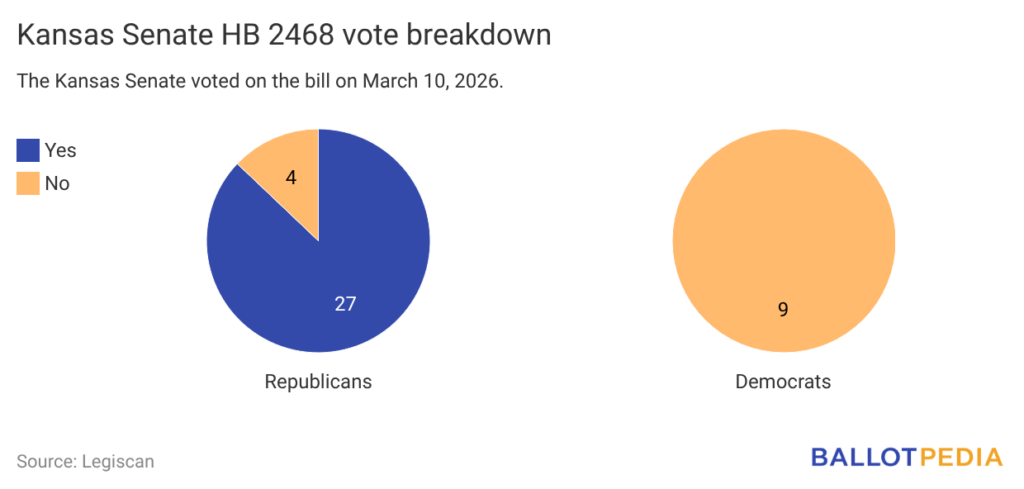
The Kansas Senate voted on March 10, 2026, to pass the measure 27-13. No democrats supported the measure, but 4 Republicans crossed party lines to oppose the bill. All senators were present and voted.
About the program
The U.S. school choice tax credit scholarship is a nonrefundable tax credit, allowing individuals to receive federal tax credits for donations up to $1,700 to authorized scholarship-granting organizations (SGOs). It is a dollar-for-dollar nonrefundable tax credit, meaning individuals can lower their federal tax liability by $1 for every $1 donated to accredited SGOs; if a taxpayer donates more than $1,700, they will not receive a tax refund for the amount over $1,700. The total amount of credits the program can offer is not capped.
SGOs distribute the donated scholarship funds to eligible families, which can be used on a variety of private or public educational expenses, including private school tuition, tutoring services, textbooks, and more. In order to qualify for scholarships, students had to live in households earning no more than 300% of the area's median gross income and be eligible to enroll in K-12 schools. The program will take effect January 1, 2027.
States that elect to participate must submit a list of SGOs that taxpayers can donate to in order to receive the federal tax credit. Students in states that do not opt in cannot receive scholarships funded under the program, but donors in those states can still receive a federal tax credit by donating to SGOs in participating states. As enacted, the program will not affect state budgets.
Other state actions to participate in the program
35 states have taken action regarding the program or indicated they would participate.
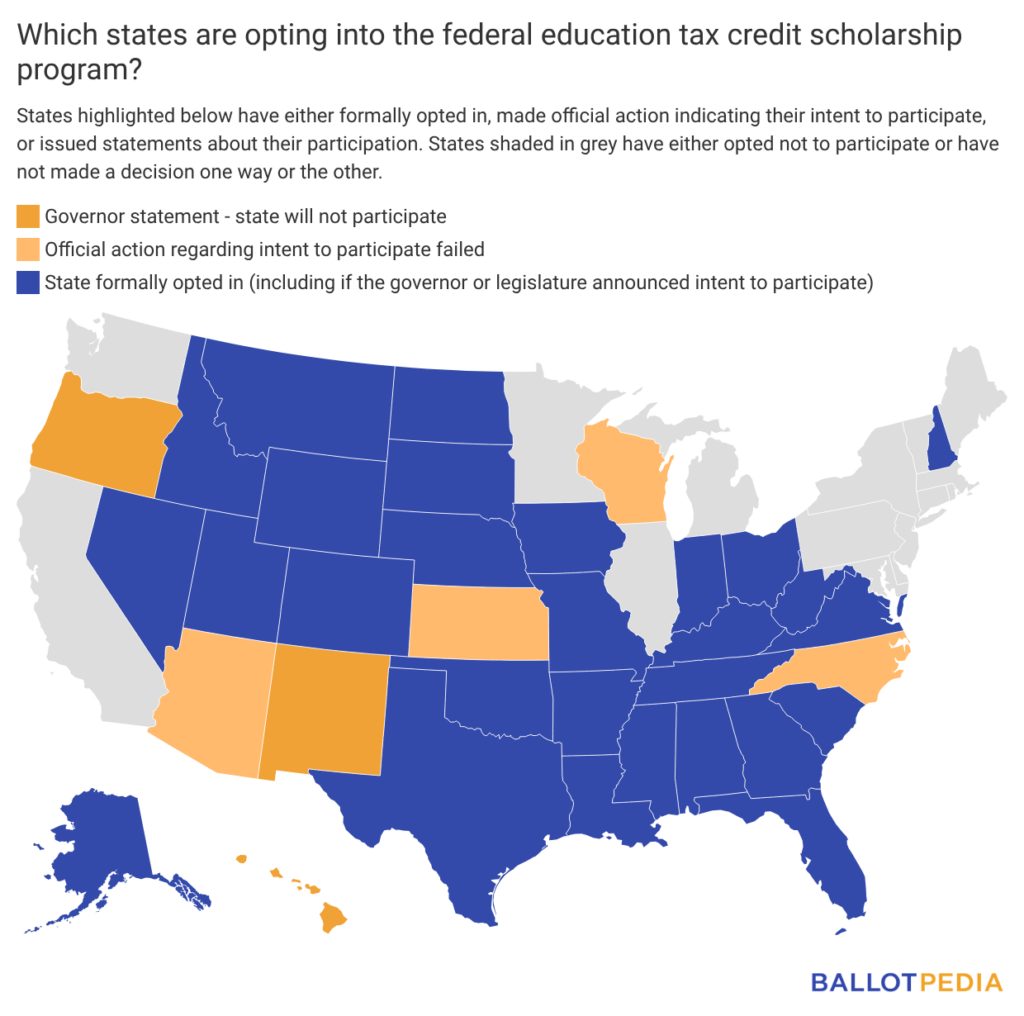
- Five have Democratic trifectas. Two states—Virginia and Colorado— have indicated participation in the program, while three states—Hawaii, New Mexico, and Oregon— have said they would not participate, though all three governors of those states are reconsidering participation, according to EdWeek.
- Twenty-three have Republican trifectas. All twenty-three states—Alabama, Arkansas, Florida, Georgia, Idaho, Indiana, Iowa, Louisiana, Mississippi, Missouri, Montana, Nebraska, New Hampshire, Ohio, Oklahoma, South Carolina, South Dakota, Tennessee, Texas, Utah, West Virginia, and Wyoming— said they would participate in the program.
- Seven have divided governments. The Kentucky Legislature overrode Gov. Andy Beshear's (D) veto of a bill requiring the state to opt into the program. In Kansas, North Carolina, Arizona, and Wisconsin, legislation to indicate participation failed. Alaska and Nevada formally opted into the program.
To learn more about how the program works, visit this page.
Editor’s note: This story has been updated to correct the Democratic vote breakdown. It now shows that all nine Democratic senators voted “no” on HB 2468.