


Welcome to the Monday, April 13, Brew.
By: Briana Ryan
Here’s what’s in store for you as you start your day:
- Four states have consolidated municipal or school board elections statewide since 2022
- Abraham Enriquez and Tom Sell are running in the May 26 Republican primary runoff for Texas' 19th Congressional District
- Looking back at the last time Virginia voters decided on a constitutional amendment in a special election
Four states have consolidated municipal or school board elections statewide since 2022
Each state has different rules for when general elections for municipal offices and school boards are held. Some states set a particular date for these elections, while others allow municipalities to choose their election days.
Nine states mandate consolidated municipal elections, meaning municipal elections must take place alongside a statewide primary or general election. Twenty-four states require municipal elections to be held at times other than statewide elections. Seventeen states allow municipalities to choose their election dates.
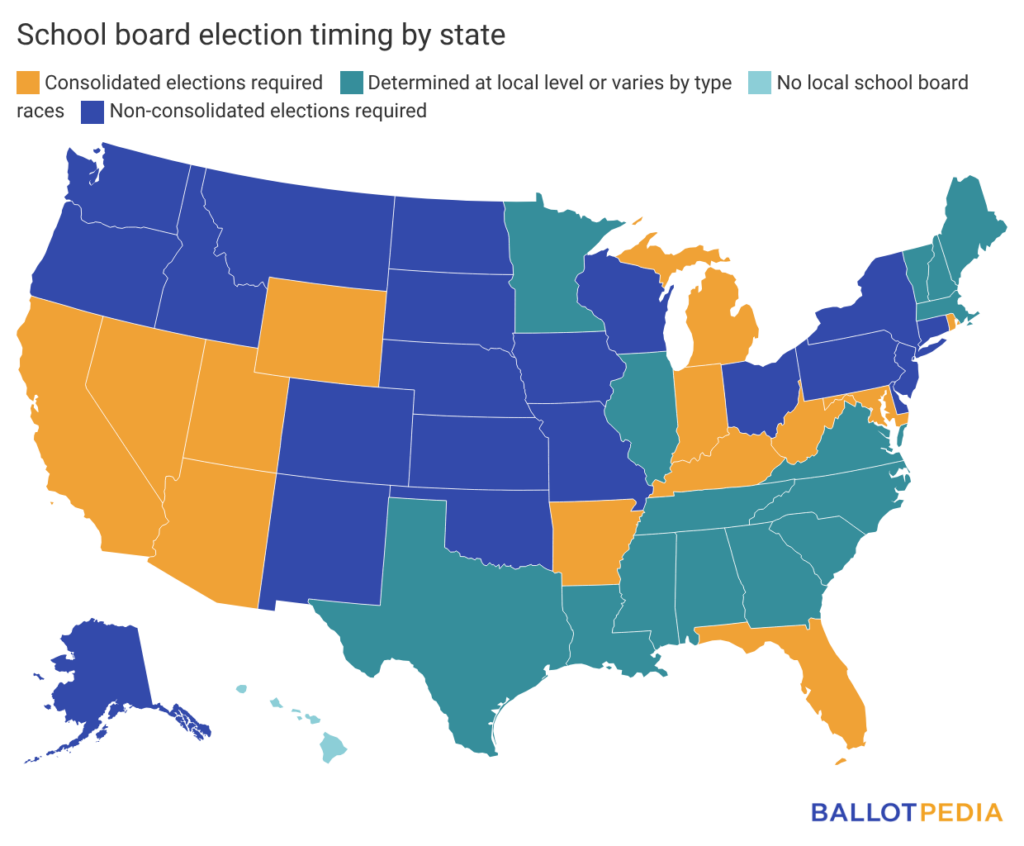
Thirteen states require consolidated elections for school board races, while 21 states require school board elections to be held on a different election date. In 15 states, school board election timing is determined at the local level or varies by type of school district, while Hawaii does not hold local school board elections.
Some states have moved to require local elections to be held at the same time as statewide elections.
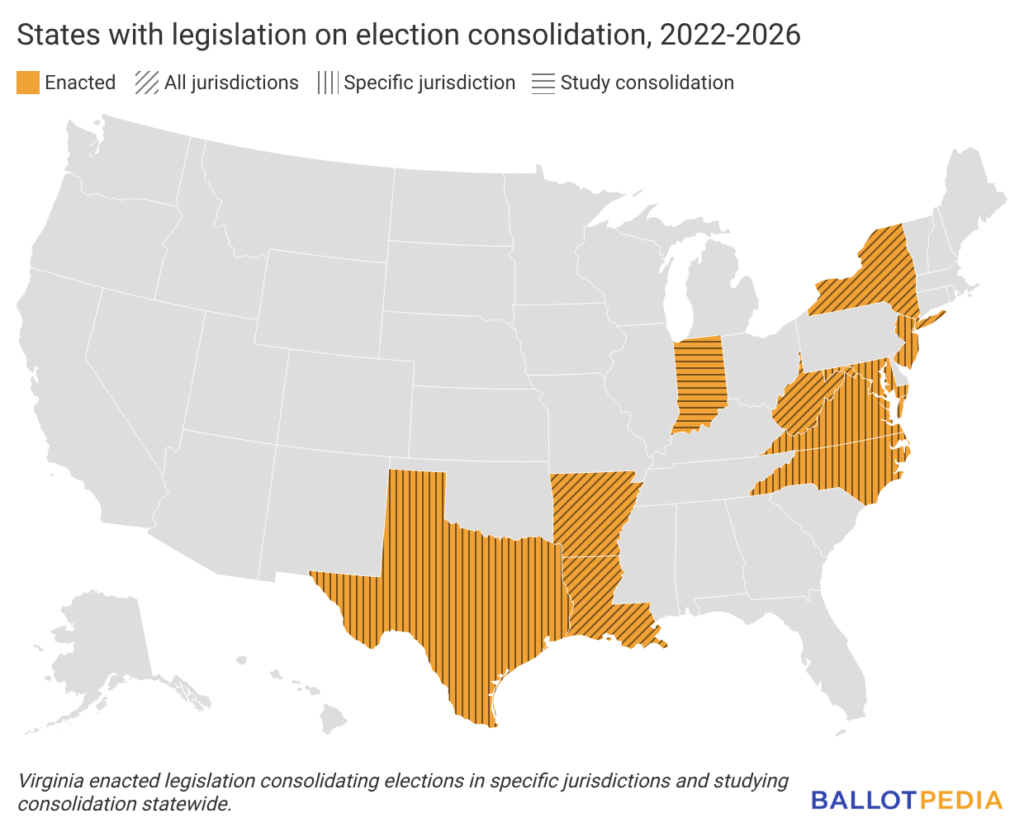
Since 2022, Arkansas, Louisiana, New York, and West Virginia have enacted laws mandating the consolidation of elections statewide. Arkansas (school board elections) and West Virginia (municipal elections) are the most recent states to enact consolidation laws, doing so in 2025.
Maryland, New Jersey, North Carolina, Texas, and Virginia have passed laws mandating election consolidation in some jurisdictions. Indiana and Virginia have passed laws requiring that statewide consolidation be studied.
Proponents say that consolidating elections saves taxpayers money, improves voter turnout, and ensures that voters in local elections represent the broader electorate.
Opponents say that consolidating elections makes it harder for local races to get attention, makes ballots longer, and makes it harder for candidates affiliated with minor parties to win.
This year, 31 states have introduced 74 bills related to election alignment. Arizona legislators have advanced a constitutional amendment that would require election consolidation. Currently, state law mandates that municipal and school board elections must be held alongside statewide elections. However, the Arizona Supreme Court has ruled that municipalities with other dates in their charters are exempt.
Four states have adopted legislation dealing with election alignment this year. On Feb. 23, South Dakota Gov. Larry Rhoden (R) signed a bill that gives municipalities the option to hold municipal elections only in even years, rather than annually. New Mexico legislators put a constitutional amendment on the November ballot that would repeal the requirement that school district elections be held on different days than those for partisan elections.
In 2025, seven states enacted 10 bills dealing with election alignment. In 2024, four states enacted four such bills, and in 2023, 15 states enacted 30 bills.
Click here for more information on the timing of municipal and school board elections.
Abraham Enriquez and Tom Sell are running in the May 26 Republican primary runoff for Texas' 19th Congressional District
Abraham Enriquez (R) and Tom Sell (R) are running in the May 26 Republican primary runoff for Texas' 19th Congressional District after neither candidate received more than 50% of the vote in the March 3 Republican primary.
In the primary, Sell received 40% of the vote, and Enriquez received 19% in a field of seven candidates. Incumbent Rep. Jodey Arrington (R) is not seeking re-election.
Enriquez is the founder and chair of Bienvenido, an organization focused on getting Hispanic young adults involved in politics.
Sell is the founder of a law firm. He previously worked in the office of former Rep. Larry Combest (R) and served as the deputy staff director for the U.S. House Committee on Agriculture.
The Texas Tribune's Olivia Borgula wrote, "While Sell, who has won the endorsements of many agricultural groups that represent the farmers who work in the region, has leaned into his local ties and past experience working on agricultural policy, another leading candidate, Abraham Enriquez, is emphasizing his connections to President Donald Trump."
Texas Governor Greg Abbott (R), Turning Point Action, and Conservative Political Action Conference endorsed Enriquez. Various agricultural organizations, House Majority Leader Steve Scalise (R-La.), and every Republican who ran in the primary except Matthew Smith (R) endorsed Sell.
The Cook Political Report with Amy Walter, Inside Elections with Nathan Gonzales, and Larry J. Sabato's Crystal Ball each rated the general election Safe/Solid Republican.
Click here to read more about the Republican primary runoff for Texas' 19th Congressional District.
Looking back at the last time Virginia voters decided on a constitutional amendment in a special election
On April 21, Virginia voters will decide on a constitutional amendment at a special election that would allow the General Assembly to conduct congressional redistricting through Oct. 31, 2030.
Since 1927, when the state's historic referendum data begins, Virginia has held two special elections for statewide ballot measures, in 1928 and 1956.
With the upcoming special election, here is a look at the last time Virginia held a special election for a statewide measure, more than 70 years ago.
On Jan. 9, 1956, voters approved a ballot measure authorizing a limited constitutional convention to revise Section 141 of the Virginia Constitution to allow the General Assembly and local governments to use public funds to provide tuition grants for students attending nonsectarian private schools. Voters approved it 67.5% to 32.5%.
In 1955, following Brown v. Board of Education (1954), Gov. Thomas B. Stanley (D) appointed a commission of state legislators to recommend a response to school desegregation. The commission proposed several changes, including allowing state-funded tuition grants for students to attend private schools and revising constitutional provisions that restricted public funding for private education.
On Nov. 30, 1955, Stanley convened a special legislative session, which referred the constitutional convention question to the ballot. Stanley addressed the General Assembly, saying the commission's proposals attained two objectives: "(1) avoidance of enforced integration of the races in any of our public schools and (2) maintenance of educational opportunities for the boys and girls in all sections of Virginia, despite the wide variation in problems and density of white and negro population." He added, "The first, and the vital, step toward accomplishing these objectives involves amendment of Section 141 of the State Constitution."
At the time, the Virginia Constitution could be amended in two ways. One such method, which was eliminated under the 1971 Constitution, was to ask voters to hold a constitutional convention and elect delegates, who could amend the Constitution without submitting the changes to voters for ratification. The General Assembly could also limit the scope of the convention to specific provisions.
The constitutional convention met from March 5 to March 7, 1956, approving the amendment allowing public funds for nonsectarian private school tuition grants.
Unlike the 1956 process, the 2026 special election is for a constitutional amendment that voters will directly decide.
Click here to read more about the Virginia Limited Constitutional Convention for Nonsectarian Private School Tuition Grants Measure.