


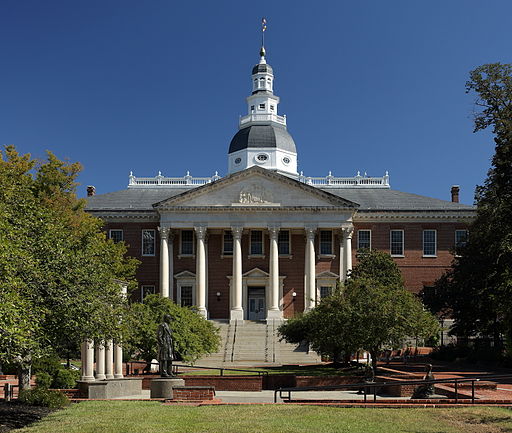
The Maryland State Legislature voted to refer two constitutional amendments to voters in November.
The first amendment (Senate Bill 933) would repeal the amendment (House Bill 788) referred to the ballot during the 2025 legislative session. Both amendments were designed to allow the chair of the Commission on Judicial Disabilities to appoint former members to temporarily fill vacancies or allow the governor to appoint a substitute member or extend the term of an existing member when a vacancy occurs due to a commission member’s recusal, disqualification, or expiration of term. The amendment would also require any temporary substitute member to be subject to the same qualifications that applied to the former member. If the member is a judge or attorney, they must be in good standing with the Maryland Bar.
The 2026 amendment would not allow a temporary substitute member who had previously been rejected by the Senate for appointment to the commission to serve. This is the difference between the 2026 amendment on the ballot and the 2025 one it replaced. Both amendments passed unanimously in both chambers.
Currently, vacancies on the state Commission on Judicial Disabilities are filled by appointment by the governor with the advice and consent of the state Senate. The quorum requirement for the commission to perform its duties is a majority of members, with at least one judge, one attorney, and one public member present. If the quorum does not have one of the three, the state Supreme Court, with the consent of the judge who is the subject of the complaint, may designate a judge, attorney, or public member to serve as a substitute member for quorum purposes.
The commission was established with the approval of Amendment 5 in 1966. The amendment tasked the commission with investigating complaints against any judge or justice of the Supreme Court of Maryland, Appellate Court of Maryland, Circuit Courts, District Courts, or Orphans’ Courts; issuing reprimands; and recommending to the state Supreme Court the removal, censure, or other disciplinary measure of a judge.
At the time of the passage of the 2025 amendment, Shaoli Sarkar, advocacy director of the Maryland State Bar Association, said, "[The amendment] would allow the Commission on Judicial Disabilities, a judicial agency responsible for monitoring the conduct of Maryland judges and justices, to continue its work without delay due to member recusals or vacancies."
The second amendment relates to arbitration for state employees. Senate Bill 28 and House Bill 604 were cross-filed in each respective chamber. Both bills were adopted, referring the amendment to the ballot. The bills contain nearly identical texts. They were designed to make statutory changes if the accompanying constitutional amendment is adopted in November.
The constitutional amendment would require the governor's budget to include expenditures for wages, hours, benefits, and other terms and conditions of employment, as provided in a memorandum of understanding (MOU) covering certain state employees.
The statutory changes include requiring the selection of a neutral arbitrator during collective bargaining for certain state employees and establishing a binding arbitration process. Currently, it is up to the governor’s discretion whether or not the budget provides for expenditures for state employees under an MOU. The arbitration process is also not currently binding and includes a fact finder who provides advisory recommendations on labor disputes to the governor and legislative leaders.
Both bills received final passage largely along party lines on April 10.
In support of the amendment, Donna S. Edwards, president of Maryland State and DC AFL-CIO, wrote, “Binding arbitration is mutually beneficial to our state government, our state employees, and taxpayers. ... Binding arbitration is a common dispute resolution process in both private and public sector labor relations all around the country. SB 28 provides balance in the negotiations process, giving both parties every motivation to bargain in good faith and work toward a timely agreement.”
The University System of Maryland (USM) opposed the amendment during the legislative process. Sherri Roxas, senior director of labor relations at USM, said, “Putting the ultimate decision-making authority into the hands of a single third party is inconsistent with the process of collective bargaining and could have serious fiscal consequences for the USM, particularly its smaller institutions. While Senate Bill 28 purports to bind the Governor to include appropriations in his budget necessary to fund implementation of all wage and other terms and conditions of employment in each MOU, it is unclear whether the General Assembly would be obligated to ultimately fund those terms. If those terms go unfunded, Senate Bill 28 would essentially create an unfunded mandate, binding the institutions to ‘take all actions necessary to carry out and effectuate the final written award and place into effect the memorandum of understand[ing].’”
Between 1985 and 2024, a total of 60 ballot measures appeared on statewide ballots in Maryland. Voters approved 55 measures and rejected five.
Additional reading: