


In this week’s edition of Economy and Society:
- U.S., Europe diverge on ESG investing
- World Bank shareholders push to preserve climate strategy
- ESG legislation update
- ESG shareholder proposals drop 47% in 2026 proxy season
- Glass Lewis expands beyond proxy voting with climate research
- Delta revises net-zero and sustainable fuel commitments
Around the world
U.S., Europe diverge on ESG investing
What’s the story?
According to a Financial Times analysis published on April 19, 2026, diverging attitudes underscore a widening divide between the U.S. and Europe over investment approaches on environmental, social, and governance (ESG) investing, with asset managers facing conflicting expectations across regions.
The report points to BlackRock as an example. In Europe, two major pension funds — PME and PFZW — ended or reduced mandates with the firm, citing concerns about its approach to climate investing and sustainability integration. In the United States, however, BlackRock has faced legal scrutiny and political pressure for incorporating ESG considerations, including a lawsuit from 11 Republican states challenging its investment practices in November 2024.
The contrasting responses reflect broader regional differences. European investors and regulators continue to emphasize sustainability disclosures and climate-related investment strategies, while some U.S. investors and policymakers have moved in the opposite direction, prioritizing financial returns and questioning ESG frameworks.
Why does it matter?
The divergence creates operational and legal challenges for global asset managers, who must navigate different regulatory systems and client expectations across regions. Firms may need to adjust how they apply or communicate ESG strategies depending on where they operate.
The split also suggests ESG investing is becoming more regionally fragmented rather than converging into a single global approach. This fragmentation will influence capital flows, investment strategies, and relationships between asset managers and institutional clients.
What’s the background?
In November 2024, 11 Republican-led states sued BlackRock, Vanguard, and State Street, alleging the firms coordinated climate-related investment strategies affecting coal production in violation of antitrust laws. The firms said they operate independently and compete with one another.
In Europe, investors have taken a different approach. Dutch pension fund PME Pensioenfonds ended a €5 billion investment contract with BlackRock in late 2025 following an ESG review, and PFZW withdrew roughly €14 billion earlier in the year after shifting its investment strategy toward sustainability.
The differing actions reflect broader political and regulatory differences. European rules require more extensive sustainability disclosures, while ESG investing in the United States has faced increased political and legal from Republican officials.
World Bank shareholders push to preserve climate strategy
What’s the story?
At the International Monetary Fund and World Bank spring meetings in Washington, D.C., on April 17, 2026, shareholders considered whether to extend the World Bank’s Climate Change Action Plan, which directs 45% of its annual lending toward climate-related projects and is set to expire at the end of June.
French officials said they are working with other shareholders to preserve elements of the plan. Eleonore Caroit, France’s development minister, said, “we don’t find it acceptable that there is the expiry of this current action plan, and we want to find a solution so that we can find a way to continue acting in this field." Other shareholders have also explored ways to maintain climate-related lending, even if the current framework is not formally renewed.
The Trump administration has opposed continuing the strategy. Treasury Secretary Scott Bessent said the policy moves the World Bank away from its core mission. In a statement, Bessent said the 45% climate finance target “breeds inefficiency, distorts economic decision making, and moves the Bank away from its core mission.”
Why does it matter?
The debate centers on how the World Bank allocates a large share of global development funding. The bank describes itself as “the largest multilateral provider of climate finance for developing countries” and has committed tens of billions of dollars to climate-related investments, including $83 billion over a recent five-year period.
Its current strategy aims to integrate climate and development by directing a significant portion of financing toward mitigation and adaptation. Whether the plan is extended or allowed to expire could shift how those funds are deployed — potentially redirecting large-scale financing away from climate-focused projects even as private-sector climate commitments continue to expand globally.
In the states
ESG legislation update
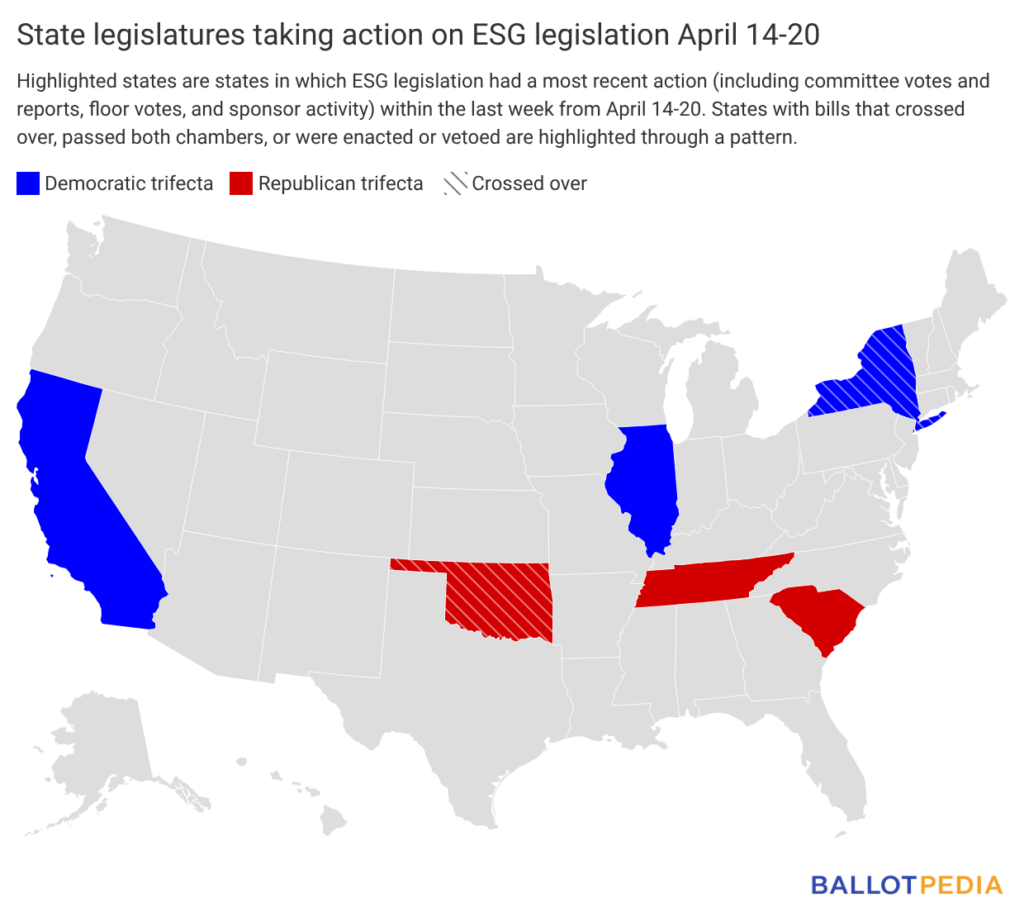
Six states took action on 13 ESG-related bills last week (since April 14).
States with legislative activity on ESG last week are highlighted in the map below. Click here to see the details of each bill in the legislation tracker.
On Wall Street and in the private sector
ESG shareholder proposals drop 47% in 2026 proxy season
What’s the story?
According to As You Sow, a shareholder advocacy nonprofit, in its 2026 Proxy Preview report, shareholders filed 184 ESG proposals at U.S. shareholder meetings as of March 17, 2026. That is down 47% from 355 proposals filed at the same point in 2025.
Shareholders use proxy proposals to ask companies to adopt specific policies or disclosures, which stockholders vote on at annual meetings. The report attributes the decline partly to increased private negotiations between companies and shareholders, which led to more withdrawn proposals before formal filing.
During the same time period, shareholders had withdrawn 42 proposals in the 2026 proxy season — 22% of the total filed. That withdrawal rate matches the 2025 level but is significantly higher than the 7.7% withdrawal rate in 2024, reflecting increased private negotiations between companies and shareholders.
CEO of Proxy Impact and co-author of the report, Michael Passoff said the decline reflects a new dynamic where "shareholders thought they weren't going to get a fair shake in filing resolutions, so they thought, does it make sense to file resolutions or to focus on company dialogues."
Most shareholder proposals are nonbinding but can lead to corporate policy changes. Common topics in the 2026 season include carbon emissions reporting, workforce diversity, data center governance for artificial intelligence infrastructure, and lobbying disclosure requirements.
Why does it matter?
The filing decline reflects a shift in how shareholders and companies handle ESG disputes, with more negotiations occurring outside the public proxy process. Passoff told Reuters that company executives now show greater willingness to negotiate behind closed doors to avoid public controversies. The trend suggests that ESG-related shareholder activism may move from public proxy battles to private engagement.
The Securities and Exchange Commission (SEC) made rule changes in November 2025 that affected shareholder proposals. The SEC altered how it issues no-action determinations and removed the ability of most shareholders to use exempt solicitations to communicate material information. These changes appear to have encouraged more private negotiations and fewer public filings.
What’s the background?
The SEC announced Nov. 17, 2025, that it would not respond to most no-action requests during the 2025–26 proxy season. Companies traditionally file these requests when they want SEC staff to confirm the agency will not recommend enforcement if a shareholder proposal is excluded from the proxy. The Division of Corporation Finance said it would offer views only on exclusion requests related to a company's jurisdiction under state law.
The SEC also removed the ability of most shareholders to use exempt solicitations to communicate material information. These changes shifted responsibility for exclusion decisions onto companies rather than the SEC, leaving investors and fund managers without the staff guidance they have typically relied on.
Glass Lewis expands beyond proxy voting with climate research
What’s the story?
Glass Lewis announced April 16, 2026, that it launched Climate Intelligence, a research product designed to help investors evaluate climate transition strategies across 4,000 companies. The proxy advisory firm said the tool takes a forward-looking approach, focusing on how companies integrate climate risk into their business models and capital allocations rather than relying on backward-looking measures such as emissions data.
President of Climate Intelligence at Glass Lewis, Diederik Timmer said, "Investors don't just need more climate data — they need insight into what it means for long-term value creation and retention." The research evaluates whether transition plans are credible, feasible, and investable, analyzing transition risks and opportunities at the level of a company's underlying business activities.
The launch marks Glass Lewis's expansion beyond its core proxy research and voting business into broader investment research tools. Glass Lewis said Climate Intelligence will serve investors in Europe, Canada, and Australia.
Why does it matter?
Glass Lewis and Institutional Shareholder Services (ISS) control more than 90% of the proxy advisory market, meaning changes in their services can affect how large institutional investors evaluate companies. The launch of Climate Intelligence expands Glass Lewis’s role beyond proxy voting recommendations into broader investment research, as firms respond to client demand for tools that connect climate strategy to financial performance.
Some large investors, including JPMorgan and Wells Fargo, have also taken steps to reduce reliance on proxy advisors, suggesting firms like Glass Lewis are adjusting their services to remain relevant.
What’s the background?
On Dec. 11, 2025, President Donald Trump signed an executive order directing federal agencies to review proxy advisory firms, including Glass Lewis and ISS, focusing on their role in shareholder proposals and competition in the market.
Delta revises net-zero and sustainable fuel commitments
What’s the story?
Delta Air Lines revised its climate commitments in April 2026, removing and rewording environmental targets on its sustainability webpage. The company deleted its pledge to use 10% sustainable aviation fuel (SAF) by 2030 and changed its 2050 net-zero emissions target from a goal to an aspiration.SAF refers to lower-emissions alternatives to conventional jet fuel, often made from materials like used cooking oil or animal fats.
After the changes, a Delta spokesperson said the airline still supports SAF development and remains committed to the 2030 target, but added that the technology has not advanced quickly enough to meet industry expectations. The spokesperson said, “While we have successfully increased use of SAF every year, we recognize that the technology has not advanced as rapidly as the industry or our ambitions require.”
Why does it matter?
Delta is the latest example of a major airline adjusting how it presents climate commitments as the industry faces limits in scaling SAF. Delta reported using about 23 million gallons of SAF in 2025, but that still accounted for only about 0.5% of its total jet fuel use.
SAF production is increasing globally, but demand has lagged in some regions due to high costs and limited mandates, creating an imbalance between supply and use. These conditions have slowed adoption and complicated airlines’ ability to meet previously announced targets.