


Welcome to Hall Pass, a newsletter written to keep you plugged into the conversations driving school board governance, the politics surrounding it, and education policy.
In today’s edition, you’ll find:
- On the issues: The debate over no-zero policies
- School board filing deadlines, election results, and recall certifications
- North Carolina Supreme Court issues final ruling on Leandro case after 32 years of litigation
- Extracurricular: education news from around the web
- Candidate Connection survey
Reply to this email to share reactions or story ideas!
On the issues: The debate over no-zero policies
In this section, we curate reporting, analysis, and commentary on the issues school board members deliberate when they set out to offer the best education possible in their district. Missed an issue? Click here to see the previous education debates we’ve covered.
No-zero grading policies mandate that the lowest grade a student receives is above a zero, typically around a 40% or 50%. Teachers, schools, and school districts have increasingly adopted no-zero grading policies since Joe Feldman, a former educator and educational consultant, encouraged no-zero policies, among other grading practices, in a 2018 book titled "Grading for Equity."
Debates about no-zero grading policies center on whether grades should reflect student achievement or behavior, whether they are fair to students, and their effect on student learning.
Dr. Joshua Kunnath, high school teacher and department chair, says grades are intended to measure student learning. He says, giving zeroes for missed assignments makes it hard to accurately estimate student learning through a grade. He said this reflects student behaviors rather than content mastery, and it can be hard for students to bring their grades back up once a zero is averaged in. Kunnath says that when students get zeroes, they lose motivation to learn the material.
Mike Petrilli, president of the Thomas B. Fordham Institute, an education policy think tank, says that grading practices influence how much effort students put into learning. He says no-zero policies inflate grades, lower expectations for students, and can give caregivers an inaccurate understanding of how their students are performing in school. Petrilli says it's not unreasonable or cruel to give students grades that accurately reflect their effort toward or mastery of course material.
The Low-hanging Fruit of Grading Reform: Eliminating the Zero | Joshua Kunnath, The Core Collaborative
"[T]here are several problems with these uses of the zero.
"1. Zeros are usually inaccurate. If grades are intended to represent student learning (which grading literature overwhelming[ly] supports), then assigning a student a zero for anything other than zero learning makes grades inaccurate.
"2. Zeros are usually about behavior. A zero for not completing an assignment or assessment is punishing the student’s decision to not do the work or to cut class when she knows there is an assessment. A zero for plagiarism is punishment for copying someone else’s work. But none of these purposes for the zero are directly about student learning.
"3. Zeros are harsh punishment. Even if a teacher feels that a student has no knowledge or skill on a standard, assigning a zero harshly punishes a student IF the teacher uses a percentage scale for calculating grades. To recover from a zero, a student would have to move up at least 60 levels on most scales just to reach the D range. This is why I advocate for the use of a four-point scale instead (more on this in a future post).
"4. Zeros give kids an out. Assigning a zero for missing work or a missing assessment sends a signal to the student that the teacher has finished grading and it’s time to move on. To the student with the zero, this means no more pressure to continue learning previous standards or to show evidence of their learning."
“Equitable” Grading Through the Eyes of Teachers (forward) | Mike Petrilli, The Fordham Institute
"Grades are central to the work of schools. For students, they are an important source of motivation and feedback. For teachers, they are an essential form of communication and leverage. For parents and other caregivers, they are a vital starting point for understanding how their kids are doing in school.
"Although lowering the bar for receiving a good grade may seem like a victimless crime, research shows that grading standards influence student behavior, as well as learning. For example, a seminal study of college students by economist Philip Babcock showed that when students expected a C grade in their classes, they studied about 50 percent more than students who expected an A. Such behavioral changes help explain why subsequent studies of elementary students in Florida and high school math students in North Carolina have found that students tend to learn less when assigned to teachers with lower grading standards. Simply put, they do not work as hard.
"Still, some ideas that are associated with the push for 'equitable' grading are less obviously connected to eliminating bias. For example, some advocates argue that districts should change their grading scales (e.g., by moving from 0–100 to 0–4), ban grades for homework, or abolish late penalties. Moreover, many also advocate "minimum grading", which stipulates that teachers must award students partial credit (e.g., a grade of 50 on a 100-point scale) even when they make no attempt to complete an assignment, on the grounds that zeros damage students’ academic prospects so grievously that they may stop trying."
School board update: filing deadlines, election results, and recall certifications
In 2026, Ballotpedia will cover elections for more than 30,000 school board seats. We’re expanding our coverage each year with our eye on covering the country’s more than 80,000 school board seats.
Election results from the past week
April 21
Ballotpedia covered elections for the Newark Public Schools Board of Education. School board elections in New Jersey are nonpartisan. Click this link to view the results.
Upcoming school board elections
Ballotpedia’s staff is covering school board elections for 674 seats in 420 districts in the next 30 days.
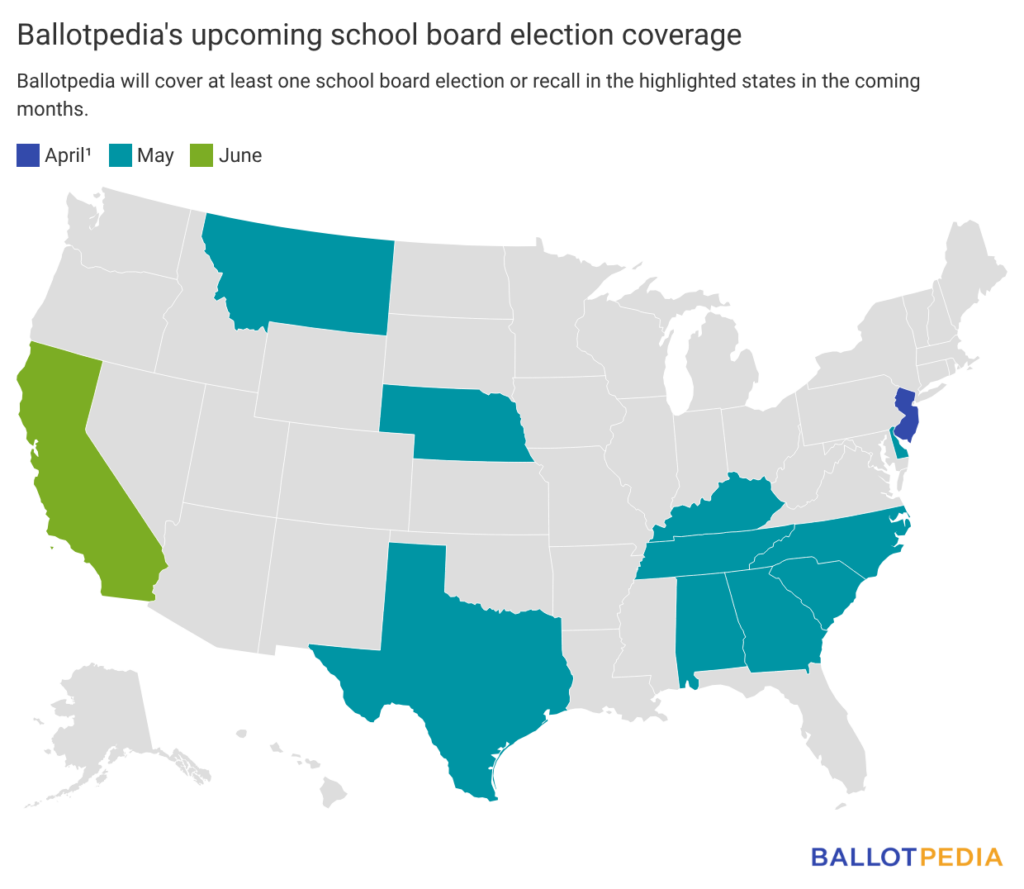
Watch future editions of Hall Pass for the May primary and general election results in Alabama, Delaware, Georgia, Kentucky, Montana, Nebraska, North Carolina, South Carolina, Tennessee, and Texas.
North Carolina Supreme Court issues final ruling on Leandro case after 32 years of litigation
On April 2, the North Carolina Supreme Court issued its fifth and final ruling in what is known as the Leandro case, named for one of the original plaintiffs when five low-income North Carolina school districts and families first filed the case in 1994. The court, comprising seven partisan, elected judges, decided the case 4-3. Four Republican justices supported the majority opinion (with one concurring), and one Republican joined two Democratic justices in dissenting.
In the original case, five low-income North Carolina school districts and families in Cumberland, Hoke, Halifax, Robeson, and Vance counties filed a lawsuit, Leandro v. State of North Carolina, alleging that the state had violated its constitutional obligation to provide a general, uniform, and equal system of education across the state. They said the state had not adequately funded public education in the five districts, and they sought a declaration that the state had not provided an equal education for all students in the state and a court-imposed remedy for the failure to do so.
Before the 2026 ruling, parties to the Leandro case negotiated a 2021 court-ordered plan to fund public education in the state. Titled the "Leandro Plan", it focused on enhancing teacher training and retention, expanding pre-kindergarten education, and funding for low-income school districts. The state was to fully implement the goals by 2030.
The 2026 ruling overturned a 2022 state supreme court mandate that the Legislature fund the Leandro Plan, ended the possibility for further litigation, and held that the trial court could not tell the state how to spend money. It did not change the state constitution or its education requirements, but it upheld the Legislature's primary role in determining education spending.
Timeline of Leandro litigation
Though much of the litigation regarding the Leandro case occurred in North Carolina's trial courts, the N.C. Supreme Court issued five rulings on the case in 1997, 2004, 2013, 2022, and 2026.
1997 - The N.C. Supreme Court rejected the plaintiffs' original claim. It sent the case back to the Third Division of the Superior Court of North Carolina (trial court), which subsequently concluded in May 2001 that the state had failed to provide at-risk students with the opportunity to obtain a sound basic education. The trial court ordered the state to provide pre-kindergarten to at-risk students to remedy the failure. The state appealed that decision to the state supreme court.
2004 - The state supreme court affirmed the trial court's finding that the state had failed to provide sound education to all students, but reversed its remedy. It ruled that the state should've had the opportunity to propose a remedy before the court imposed one.
2013 - The court upheld the state's efforts to expand the availability of pre-kindergarten. In 2011, the trial court ruled that the state could not limit access to the pre-kindergarten program after the Legislature modified it. The state appealed that ruling to the state supreme court. Before the court reviewed it, the state Legislature amended the pre-kindergarten program in 2012 to increase access. The 2013 N.C. Supreme Court decision held that the 2012 legislative changes resolved the complaint.
2022 - The court upheld a 2021 trial court decision to require the state to fund the Leandro Plan — which the trial court approved in 2021 — after a court-appointed independent consultant in 2019 found that, despite state efforts, students in some NC districts still didn't have access to a basic education. The trial court ordered the state on Nov. 10, 2021, to pay $1.75 billion to fund the Leandro Plan that the plaintiffs and the state submitted. Defendants who joined the case to represent the North Carolina General Assembly (NCGA) appealed the order to the state supreme court. The court's 2022 finding required the trial court to adjust the funding amount needed based on the latest state budget and require the Legislature to appropriate that amount for the program.
2026 - The court's April 2, 2026, ruling reversed the 2022 decision that mandated the state to fund the Leandro plan and held that the court could not tell the Legislature how to spend money. In 2023, a newly elected N.C. Supreme Court prohibited the trial court from directing the state to fund the Leandro plan. The trial court complied with the 2022 order to adjust the amount of funds needed to pay for the plan in an April 17, 2023, decision, but did not force the state to transfer the amount. Defendants representing the NCGA appealed the 2023 trial court decision, and the state supreme court agreed to hear it only on the question of whether the trial court had the subject-matter jurisdiction to issue its order. It ruled in 2026 that the court did not have the jurisdiction, throwing out the 2022 ruling.
Evolution of the case
Over the 32-year course of litigation surrounding the Leandro case, parties intervened on both the plaintiff and defendant sides, the scope of the remediation originally ordered in 1997 grew into the Leandro plan, and the judges presiding over the case changed through retirements and N.C. Supreme Court elections.
By 1996, boards of education in bigger, more affluent cities and counties had joined the plaintiffs. They included the Cities of Asheville and Buncombe, Wake, Winston-Salem/Forsyth, Charlotte-Mecklenburg, and Durham counties. In 2006, all of the districts except Charlotte-Mecklenburg Schools dropped their participation in the suit.
In 2021, the Senate President Phil Berger (R) and Former House Speaker Timothy Moore (R) joined the defendants to represent the General Assembly and appeal the Nov. 10 trial court order.
The 1997 remedy for the Leandro case was to provide pre-kindergarten for at-risk students. By 2021, the remedy grew into the court-approved Leandro plan, which required the state to enhance teacher training and retention, expand pre-kindergarten education, and increase low-income school districts' funds.
Advocates of the Leandro Plan believed the increased scope of the plan was necessary. Former president of the Public School Forum of North Carolina, Mary Ann Wolf, said in 2022 that she was hopeful about the way the Leandro Plan could ensure "that every child in North Carolina has access to a sound basic education."
Writing for the majority in the 2026 ruling, Chief Justice Paul Newby (R) said, "What began as modest, as-applied challenges to the allocation of educational resources in the named school districts became a full-scale, facial assault on the entire educational system enacted by the General Assembly. When this case ceased to be about the as-applied claims raised in the complaints and refined by this Court’s decisions, the trial court’s authority to hear the case likewise ceased."
Reactions to the 2026 ruling
A representative for North Carolina House Speaker Destin Hall (R) said, "Today’s decision rightly recognizes the constitutional role of the North Carolina General Assembly, since the state Constitution entrusts sole appropriations authority to the Legislature. House Republicans remain committed to investing in public education, including through our budget proposal to raise starting teacher pay to $50,000 and provide 8.7% average raises to our public school teachers."
Governor Josh Stein (D) said, "Education opens doors of opportunity for children, but today the Court slammed them in the face of students who deserve the right to a sound basic public education. The Supreme Court simply ignored its own established precedent, enabling the General Assembly to continue to deprive another generation of North Carolina students of the education promised by our Constitution. … Their decision is contrary to the plain language of our Constitution and the court’s past rulings."
Zooming out
According to a 2025 Education Law Center study, North Carolina spends the smallest percentage of its gross domestic product (GDP) on public education from pre-kindergarten to 12th grade of any state. The study found that North Carolina's state per-pupil funding ($12,193) was the second lowest in the nation, behind Idaho. It was $5,660 below the national per-pupil funding average.
North Carolina districts are facing trends similar to those across the nation, including declining student enrollment and funding challenges as birth rates decrease and access to public funding for private schooling increases. Student enrollment in public schools in all five of the original plaintiff school districts — Cumberland, Hoke, Halifax, Robeson, and Vance — decreased from the 2021-2021 school year to the 2024-2025 school year.
In 2023, the North Carolina General Assembly expanded the use of state funds for private school education through the Opportunity Scholarship program. As of April 6, more than 100,000 North Carolina students were using the state's Opportunity Scholarship. There were 1,575,161 students enrolled in the state's public schools, including charter schools, in the 2024-2025 school year.
Students in the five original plaintiff school districts — Cumberland, Hoke, Halifax, Robeson, and Vance — were using less state funds for private education than students in Guilford, Mecklenburg, and Wake counties, which are the state's three biggest school districts. Cumberland County had the 4th highest number of students using state funds, and Alamance County had the 7th. The other three districts had fewer than 1,000 students using the scholarship.
Extracurricular: education news from around the web
This section contains links to recent education-related articles from around the internet. If you know of a story we should be reading, reply to this email to share it with us!
- Schools get another year to comply with web accessibility deadlines | K-12 Dive
- The heat is on: As climate change threatens student athlete safety, states try to adapt | The Hechinger Report
- Lower Merion parents are in a standoff with the school district over opting out of Chromebooks | Philadelphia Inquirer
- Why Blue State Governors Should Sign Up for New Federal Scholarship Tax Credit | The74
- Districts, states grapple with 4-day school week | K-12 Dive
- Education was the signature issue of the ’26 legislative session. What happened? | Mississippi Today
Take our Candidate Connection survey to reach voters in your district
Today, we’re looking at responses from the two candidates running in the May 2 general election for Place 5 on the Coppell Independent School District board in Texas.
The Coppell Independent School District is located in Dallas County, Texas, and operates 18 schools. The district served 13,414 students during the 2023-2024 school year.
Kevin Chaka earned a high school diploma from Coppell High School, a bachelor's degree from Texas A&M University in 2006, and a graduate degree from Harvard Business School in 2012. Chaka's career experience includes working as a CFO. Here’s how he answered the question, “What are the main points you want voters to remember about your goals for your time in office?”

- "My first priority is making sure Coppell ISD remains a district where students are challenged academically, supported personally, and given meaningful opportunities to thrive. Academic excellence should always be central, but a great district also recognizes that students have different strengths, interests, and goals. That means protecting strong classrooms, supporting great teachers, and preserving the programs and opportunities that make CISD special. I want Coppell ISD to remain a place where families know their children will be well prepared, well supported, and able to grow into who they are meant to become.
- "Coppell ISD is at a point where the board has to think carefully about the future. Enrollment trends, budget pressure, facilities planning, and other long-term issues require more than short-term reactions. They require discipline, perspective, and decisions grounded in good data and clear priorities. One of my core priorities would be helping the district navigate those issues responsibly. I believe in being honest about the challenges, thoughtful about the tradeoffs, and focused on solutions that protect what matters most while positioning CISD well for the next generation of students and families.
- "My third priority is strengthening trust between the district and the community. Families want to know that decisions are being made thoughtfully, that their voices matter, and that they understand the reasoning behind major actions. I believe the board should communicate early, explain decisions clearly, and make sure community input is meaningful rather than just procedural. To me, transparency is not just about sharing information. It is about helping people understand what is happening and why. That kind of trust is essential to keeping Coppell ISD strong over the long term."
Khanh Windham earned a high school diploma from The King's Academy in Dallas. Windham earned a bachelor's degree from Baylor University in 2002 and a graduate degree from the University of Texas at Tyler in 2019. Windham's career experience includes working as a consultant. Here's how she answered the question, “What are the main points you want voters to remember about your goals for your time in office?”
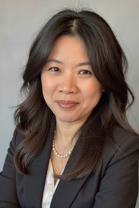
- "Coppell ISD’s strength is the breadth of programs that allow every student to find where they belong. As a parent of three children across five campuses, I’ve seen how academic supports, advanced coursework, fine arts, athletics, leadership opportunities, and career pathways build confidence, connection, and purpose. Not every child thrives in the same setting, and that is why preserving a wide range of high-quality opportunities matters. I want every student in Coppell ISD to feel safe, challenged, connected, and able to find the place where they can thrive. Strong programs ensure we can address the whole student and prepare them for life beyond graduation while strengthening the overall student experience across the district.
- "Teachers made me who I am today. I value teachers and believe supporting and retaining them must remain a top priority. Great teaching is one of Coppell ISD’s core values, and I have seen the difference great teachers make in the lives of students, including my own children. As PTO president, I have worked closely with teachers and supported them in practical ways through appreciation events, snack carts, classroom support, and efforts to lift some of the daily burden they carry. But this goes beyond small gestures. Teachers need strong campus leadership, protected planning time, manageable demands, professional growth, and a culture of respect. When teachers feel supported, students benefit, and the entire district grows stronger.
- "I believe in supporting the whole student. Every child is more than a score, a label, or a statistic. Students need to feel safe, supported, known, and challenged in order to succeed. As a parent, I have seen how timely intervention, strong relationships with teachers, academic scaffolding, extracurricular involvement, and counseling support can make a lasting difference in a child’s confidence and growth. My own family has experienced the value of a school system that can respond to different student needs while still offering broad opportunities for success. I will support an approach that keeps students at the center and values their academic, social, and emotional development together. Calm, discerning decision making is key to this."